Praise of the Land of Cherry Blossoms — Travel Notes of Kansai, Japan
Nara — Kasuga Taisha
Nagoya — Nagoya Castle
Kyoto — Fushimi Inari Taisha
Kyoto — Kiyomizu-dera
Kyoto — Hanami-koji
Wakayama — Kumano Kodo
Kyoto — Yasaka Shrine
Japan's midsummer is rich, colorful, and enchanting.
Here, there are beautiful mountains and rivers, dazzling summer fireworks displays, familiar Japanese cuisine, and of course, the exquisite World Heritage architecture in the Kansai region.
I am KIKI, a global traveler. During my gap year from 2014 to 2016, I traveled across Asia, Europe, and Africa, crossing the Sahara Desert, the ancient Middle East, the mysterious South Caucasus region, and the epic Trans-Siberian Railway. In the Tibetan year of the Horse, I completed the Kora around Mount Kailash.
I love natural geography, World Heritage sites, religious architecture, deserts, and oceans. I am happy to share the wonderful stories of my journey with you.
Travel map of the Kansai region
【About Visas】
For well-known reasons, Japan's visa procedures have recently become simpler. As of October 1, 2024, Japanese tourist visas are mainly divided into single-entry, 3-year multiple-entry, and 5-year multiple-entry. Among them, the 3-year multiple-entry visa is the most popular. For specific details, click here for visa application...
【About Climate】
The island nation has a typical temperate oceanic monsoon climate. In simple terms, cherry blossoms bloom in spring, summer is hot and lively, autumn leaves dance, and winter is covered in snow. Of course, there is also the unique rainy season in June!!! Just like the Jiangsu-Zhejiang-Shanghai region, the drizzly rain during the rainy season has the advantage of fewer tourists.
【About Food in the Kansai Region】
Osaka: Okonomiyaki, Takoyaki
Kyoto: Unagi don, Tofu soup
Nara: Kakinoha sushi (persimmon leaf sushi)
Uji: The hometown of matcha, all kinds of matcha
Shiga: Duck hotpot, Mackerel noodles
Kobe: Kobe beef, Akashi-yaki (Akashi-style octopus dumplings)
Wakayama: Sea prawns, Bluefin tuna sashimi
【About Transportation in Japan】
If it's your first time on the island nation, don't expect to fully understand the transportation system.
Japan has the world's most punctual and well-developed public transportation system. Of course, in terms of complexity, it's slightly better than India, which I have visited.
Japan has multiple public transport systems operating simultaneously, roughly divided into:
【JR】, short for Japan Railways, operated by six companies nationwide. Trains are categorized by speed: Shinkansen, Limited Express, Express, Rapid, and Local.
Shinkansen = China's high-speed rail, the fastest and most expensive.
【Subway】Similar to domestic metros.
【Private Railways】Privately operated railways with frequent regional services and wider local coverage.
For example, private railways in Kansai: Hankyu Railway, Keihan Electric Railway, Hanshin Electric Railway, Kintetsu Railway, Nankai Electric Railway, Hankai Tramway, Randen (Arashiyama Tram).
When traveling in Japan, public transport is the top choice. In addition to various regional passes available online, getting a transportation IC card is essential for smooth travel.
【Types of IC Cards】
Similar to China's transportation all-in-one cards. In Kanto, you can get Suica; in Kansai, you can get ICOCA (cannot be used on Shinkansen) or the Panda Card (cannot be used on Shinkansen). These three mainstream IC cards can be used on almost all public transport, just top up with money.
Key point!!! When traveling in Japan, don't worry about getting lost or mixing up trains and subways. Just install Google Maps, and all routes will be instantly clear.
West Honganji (World Heritage), Kyoto's oldest temple
As a World Heritage cultural city, Kyoto is an important stop when visiting Kansai. For me, after arriving in Nagoya, I constantly longed to visit Kyoto.
Regarding the itinerary in Kyoto, I studied the layout of the buildings before departure and roughly divided them into 7 areas:
1. Explore ancient capital charm: connect Kiyomizu-dera, Hanami-koji, Ninen-zaka and Sannen-zaka, then walk to the Kamo River.
2. Explore temple Zen: connect Sanjusangen-do, Tofuku-ji, Fushimi Inari Taisha.
3. Witness historical fusion: connect Nijo Castle, Kitano Tenman-gu, Kinkaku-ji, Ryoan-ji.
4. Autumn light and shadow: connect Shoren-in, Sanzen-in, Kifune Shrine.
5. Tour the art world: connect Murin-an, Ginkaku-ji.
6. Imperial garden style: connect Katsura Imperial Villa (imperial garden), Suzumushi-dera (where you can listen to monks preach), Saiho-ji, Jizo-in (where the monk Ikkyu was born).
The moat around Hongan-ji
Tang-style corridor
The sound of "dong dong dong" draws you into the originally spacious temple courtyard. Arriving in Kyoto, I avoided the crowds and the long-awaited famous historical sites. My first visit was the relatively secluded West Hongan-ji. It is one of the oldest temples in Kyoto, and among its structures, the Karamon Gate, White Study, Black Study, and Noh Stage are national treasures of Japan.
The South Gate of Hongan-ji has richly colored pillars and numerous sculptures, like an elaborately designed luxurious building. Its presence makes the adjacent gate seem lackluster.
The Amida Hall from 1636. Since Pure Land Buddhism focuses on chanting "Namu Amida Butsu," their main hall is called "Amida Hall," enshrining Amitabha Buddha.
Do you like train culture?
Kyoto Railway Museum, the largest railway museum in Japan
As a train enthusiast, I naturally wouldn't miss this railway museum hidden in Kyoto. Japan, known as the "Kingdom of Railways," displays 54 various types of trains covering the development of Japanese railways, from steam locomotives to Shinkansen.
The experience at this museum is excellent. Besides the full-size train exhibits, there are interactive models for children, a real locomotive shed, an outdoor children's slide area, a steam train ride experience, a model train layout, and a rooftop observation deck overlooking the Shinkansen.
Development of Kintetsu trains in Kansai cities
The "Thunderbird" limited express train: origin of the name "Thunderbird."
On the second floor of the museum, exhibits show the operating principles of trains, tracks, mechanical components, and daily life of trains. Every exhibit allows you to operate mechanical parts for a more intuitive experience of train culture.
Learn about the function and structure of switches and signals for changing train routes
Outside the exhibition hall is the steam locomotive shed
The newly established SL No. 2 maintenance shed in the Umekoji operation area, showing the maintenance scene of steam locomotives.
The Stage of Kiyomizu, 13 meters high and 11 meters wide, built without a single nail, is one of the most important structures of Kiyomizu-dera and a representative building of Kyoto.
Kiyomizu-dera is the head temple of the Hossō (Northern) school of Japanese Buddhism, covering an area of 130,000 square meters. It was founded in 778. This is one of the most popular places in Kyoto. In 1994, Kiyomizu-dera was inscribed as a UNESCO World Heritage site as part of the "Historic Monuments of Ancient Kyoto."
From late May to July, during the rainy season, hydrangeas bloom. In the large forested mountains of Kiyomizu-dera, beautiful hydrangeas bloom.
The Kiyomizu Stage observation deck is the location used in the Detective Conan movie "Crossroad in the Ancient Capital." The suspended Kiyomizu Stage in front of the main hall is a Japanese national treasure. Surrounded by lush greenery, it is a famous cherry blossom viewing spot in spring and a famous autumn foliage spot in autumn.
Kiyomizu-dera's mountain name is Otowa-san, and it mainly enshrines the Thousand-Armed Kannon.
Koyasu-to (Small Three-Storied Pagoda), facing the distant large three-storied pagoda, was built by an emperor and empress specifically to pray for safe childbirth.
Main gate of the temple — Niomon Gate.
Coming out of Kiyomizu-dera, you'll find Sannen-zaka and Ninen-zaka. These two ancient paths connect to Kiyomizu-dera, are very characteristic Kyoto slopes, and are designated as an "Important Preservation District for Groups of Traditional Buildings."
On both sides of the slope, many old wooden houses are preserved, housing mochi shops, souvenir stores, Kyoto specialty antique porcelain shops, as well as tea houses and cafes.
On this street, there is a very photogenic five-storied pagoda of Hōkan-ji Temple. It can be seen from both Yasaka-dori and Sannen-zaka. Although not as famous as many other historical sites in Kyoto, it is very photogenic and is known as the "Symbol of Higashiyama."
As night slowly descends and the golden sunlight sheds its last rays, Kyoto's moonlit night begins.
Yasaka Shrine — the head shrine of about 3,000 Yasaka shrines across Japan. The shrine's regular festival is called Gion Matsuri, which, together with Kanda Matsuri in Tokyo and Tenjin Matsuri in Osaka, is known as one of Japan's three major festivals.
The main enshrined deities are Susanoo-no-Mikoto (Take-minakata-no-kami), Kushinadahime-no-Mikoto, and Yahashira-no-mikogami. Within the shrine, there are many branch shrines, the most famous being the Ume-no-miyasha, which enshrines three goddesses who can grant wishes for beauty, performing arts, and wealth.
The dance stage is hung with white lanterns that light up at night. That said, some shrines in Japan are fine for sightseeing, but it's better not to worship at them because you may not know exactly who is enshrined inside...
World Heritage — Kasuga Taisha
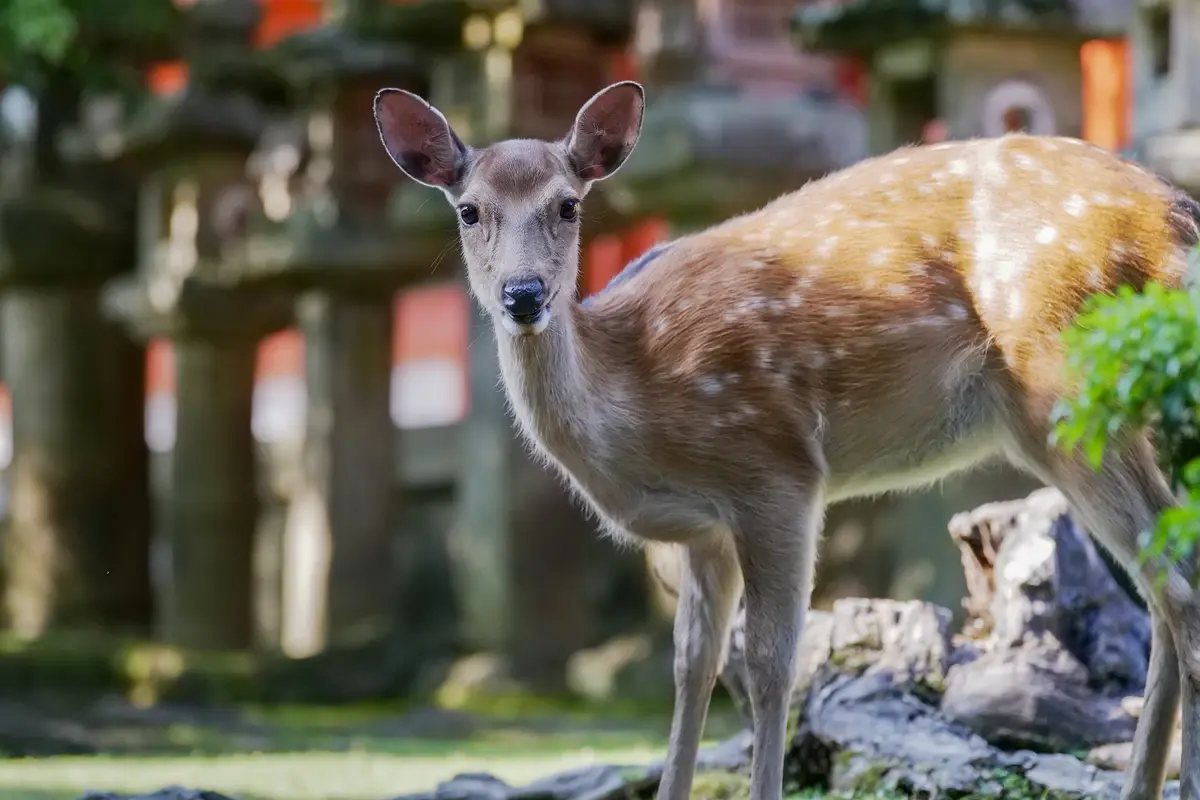
Nara became my favorite city after traveling in Kansai. It is quiet and solemn. Most of the city consists of World Heritage cultural buildings, some pleasing to the eye, some awe-inspiring. Of course, the most important thing here is the group of lovely, spirited deer.
During the day, Nara is a city surrounded by deer. Deer appear everywhere on sidewalks, in parks, at shrines, etc., in groups, asking tourists for deer crackers and even bowing, which has become a symbol of Nara.
World Heritage Tōdai-ji, with a history of over 1,200 years, is the world's largest wooden building. The Great South Gate is about 50 meters wide and 25 meters high. It was built in 760 but was destroyed by fire and rebuilt during the Kamakura period.
Passing through the Great South Gate, there are two imposing wooden Kongōrikishi statues on the left and right. The one on the right is called Agyō, and the one on the left is Ungyō. Each weighs 6.6 tons and stands guard at the temple entrance.
World Heritage Kasuga Taisha
Mount Kasuga, as the sacred mountain of Kasuga Taisha, has been forbidden from logging for over a thousand years, so it is covered with a primordial forest of evergreen broadleaf trees, mainly oak and mitsuba.
The vermilion-colored corridor surrounding the main shrine contrasts beautifully with the green forest at the foot of Mount Kasuga, creating a picturesque scene together with the hanging lanterns and shrine buildings.
Little deer at Kasuga Taisha hide in various places. At a turn, one might appear from the forest.
The vermilion main hall has long been famous for its wisteria trees. The shrine's 3,000 stone lanterns and hanging lanterns are also very famous. In the "Kasuga Taisha Shinen" (divine garden), about 300 species of plants are grown.
The vermilion buildings, set against the forest tones, are endlessly fascinating.
Leaving Kasuga Taisha, follow the signs to the popular spot — Mount Wakakusa. This is also an ideal place to overlook the city at sunset, but you need to watch the time. Enter early to see the sunset, as it closes at 5 PM, exit only.
Outside the mountain, there are still deer. Even if you can't see the sunset from Mount Wakakusa, it's fine to play with the deer in the evening light.
Nara is a city I lingered in. Before leaving, I savored the city's beauty with a meal of grilled meat.
In Kansai, there are many "unusual" trams, subways, and Kintetsu trains. Among them, the Cat and Dog tram is one.
From Kyoto, take the Kintetsu or JR train to Nara. There is a small city called Ikoma. The purpose of coming here is to find the Cat and Dog tram. After boarding the tram, you can go up to Mount Ikoma to overlook Nara at night.
Get off at Kintetsu Torii-mae Station. The starting point of the Cat and Dog tram is diagonally opposite, on the second floor. There are signs at the roadside entrance, very convenient.
The tram starts from here. The first stop is Hōzan-ji Station, then it goes up the mountain to the summit.
Osaka Umeda Sky Building Observatory
Osaka City Walk Highlights:
1. Kuromon Market: A market for seafood & beef. You can taste good beef, shrimp, king crab, sashimi, etc.
2. Namba Yasaka Shrine: A shrine hidden in a neighborhood, popular, with a huge and exaggerated lion head.
3. Tsutenkaku: Osaka's TV tower, a landmark in the Namba area.
4. Shitennō-ji: The oldest official Buddhist temple in Japan. The five-storied pagoda in the temple is distinctive.
5. Osaka Prefectural Police Headquarters: A scene from Detective Conan.
6. Osaka Castle (Tenshukaku): A classic spot in Osaka, appears in Detective Conan movies.
7. Shinsaibashi: Central shopping street. The iconic Glico running man sign is there.
8. Dotonbori: A huge, lively night market with everything.
Upon arriving in Osaka, my first stop was the inevitable visit to Osaka Castle (Tenshukaku).
Osaka Castle walls, built by Toyotomi Hideyoshi in 1586, constructed of stone blocks.
The former Kansai Army Headquarters building, now a restaurant and hotel.
In the center of the citadel is a high castle, originally a residence, called Tenshukaku, which is now one of Osaka's classic landmarks.
A nearly 600-meter-long market with a total of 170 shops. The market also specializes in seasonings and cooking condiments from around the world that are hard to find elsewhere. It mainly sells fresh, high-quality meat, poultry, eggs, vegetables, fruits, and seafood.
Here, there are many places that hold countless memories for locals. You can not only see the lives of local people but also taste various foods!
If Kuromon Market satisfies your taste buds, then the Umeda Sky Building Observatory is a visual feast.
Osaka has several observation decks. Limited by time, I went up to the Kuchu Teien Observatory of the Umeda Sky Building in the evening. Take the subway to Umeda Station, exit 5, and walk about 10 minutes to reach it.
Completed in 1993, the Umeda Sky Building was named one of the world's top 20 buildings in 2008 by the British publisher Dorling Kindersley. From the observatory, you can see the entire Osaka city centered around Umeda.
The classic Glico running man sign
Barbecue by the Shinsaibashi canal
The billboards along Shinsaibashi are all high and exaggerated in shape, giant signs. Each restaurant showcases its specialty dishes, a feast for the eyes.
As for Osaka, I can only say I particularly love this city, especially at night. The lights come on, hazy and splendid like flowing water, full of passion and vitality. People here are relaxed, without the tension of Kanto. The environment is laid-back, and walking around feels just right. Although the Kansai region doesn't have particularly magnificent natural scenery, its charm seeps in like water, making you unconsciously fall in love with it.


