Kansai Osaka Kyoto and Central Nagoya Journey
In the week after the 2025 Chinese New Year holiday and before primary and secondary schools reopened, we embarked on a long-awaited 8-night, 9-day trip to Japan. This family trip was decided at the end of last year. Four months in advance, we grabbed a round-trip economy class card for China Eastern Airlines outbound flights on X Zhu, booked round-trip tickets from Shanghai to Osaka (non-refundable and non-changeable), applied for a single-entry Japanese tourist visa on Ctrip, and booked hotels. My wife spent a lot of time comparing and secured hotels in Osaka and Nagoya.
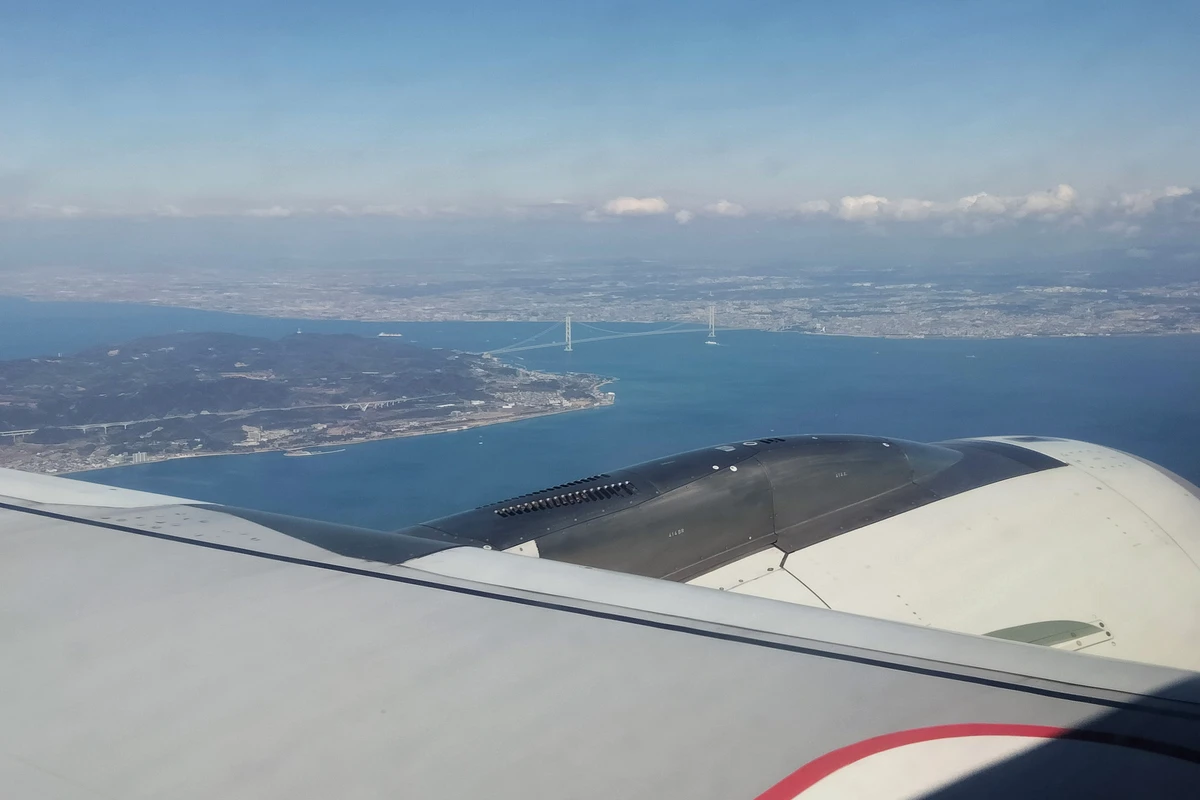
Two days before departure, we booked a Didi ride-hailing service. On February 10th, before dawn, we were full of energy to catch the early flight. Osaka is not far from Shanghai. After a two-hour flight, we arrived at Kansai International Airport. Before landing, we could see the Akashi Bridge, which looked like a rainbow spanning the blue sea. I knew from early on that Kansai International Airport was built on reclaimed land. Coming out of the airport, we passed a long, spectacular cross-sea bridge. Currently, there are many direct flights from Shanghai to Osaka. Besides our China Eastern flight, Spring Airlines and Juneyao Airlines also have many flights on this route. Additionally, Peach Aviation, a Japanese airline, is headquartered here. After docking at the gate and disembarking, we found a long line at immigration, mostly from China, I guessed. Since we had children, we could use the family fast track and needed to fill out the entry card on site for a smooth entry. Note that you cannot bring milk, meat, fruit, etc., into Japan; otherwise, they will be confiscated. If you have little luggage, you can use the no-declaration channel to exit the airport.
Before coming, I checked guides. We bought tickets for the Nankai Line from Kansai Airport to Namba. Japan's public transportation has no security checks, and the train station is right opposite the terminal, very convenient. However, subways, Kintetsu, intercity, Shinkansen, express, and local trains share the same platforms. Various trains stop, which can be confusing, and you need to be careful not to board the wrong train. Also, fares for regular and limited express (express with fewer stops) trains differ. Children under 6 can buy half-price tickets, and disabled people can also get welfare tickets (half price) in some places. Each exit has only one station master on duty. I observed that the social atmosphere is based on trust, and ticket evasion is rare. I really admire this in our neighboring country.
After about 50 minutes, we arrived in Osaka city. Exiting Namba station, we followed the navigation and dragged our luggage toward our booked accommodation. Passing Kuromon Market and Nippombashi Station, we walked about 20 minutes and arrived at the Huazhu Hotel in Higashi-Shinsaibashi around 3 PM. This hotel is a Chinese chain guesthouse with Chinese-language service, which we valued for easy communication in case of any issues. Japanese hotels only allow check-in after 3 PM, and some even refuse early check-in, reflecting the rigid and inflexible Japanese culture. Our room was on the 10th floor with a small balcony and a great view. My first impression of Osaka was narrow roads, narrow cars, and narrow, tall buildings... I thought this might be related to Japan being an island nation with a large population and scarce resources, haha.
After checking in, we dropped our luggage, freshened up briefly, and eagerly headed down to the Shinsaibashi shopping area. Crossing several streets, we reached a river. Standing on a bridge, we could see a Ferris wheel in the distance. Walking along the riverbank, we arrived at the famous Dotonbori food street. Later, I learned that the building with the Ferris wheel was actually the Don Quijote免税店 (Shinsaibashi store). We thought it was special and explored from the 1st to the 6th floor, haha.
As dusk fell and lights came on, we continued walking along the river and soon reached the famous Glico running man sign, a collective memory for our generation born in the 70s and 80s. Since childhood, we knew about Japan's development and prosperity, especially its excellent electronics. Our family's first refrigerator was a Sharp (light green, good quality, very quiet, used for nearly 20 years). Later, in college, I used Sony Walkman, Panasonic CD players, Toshiba batteries, etc., all high-end Japanese electronics. There were many tourists taking photos in front of the Glico sign, from the opposite riverbank to the bridge. Probably many Conan fans came to replicate scenes from the manga and anime, fulfilling a dream.
Shinsaibashi is Osaka's central business district, integrating food and shopping. Daimaru Department Store, founded in 1717, is here. As night fell, the area was bustling with people. I marveled at Japan's extreme commercial development. Without further ado, just enjoy the beautiful photos.
Our first meal in Osaka was at Yoshinoya in Dotonbori. We ordered eel rice and curry beef rice. The taste was authentic, definitely better than the chain stores in Shanghai, though the price was slightly higher than in China.
D2: Osaka Castle Park
Waking up naturally in the morning, we had breakfast in our room, then took the subway to Osaka Castle Park. Exiting the turnstiles at Temmabashi Station, we found a large supermarket. We quickly bought some food, including two servings of yakisoba, sausages, cheese, bread, and local Sakura beer. Sitting at a table by the riverbank near Temmabashi Station, we ate and attracted flocks of pigeons, seagulls, and sparrows.
Then we walked to Osaka Castle Park. From a pedestrian overpass, we first saw the Tenshukaku (main keep). After visiting, I felt that Japan was deeply influenced by Tang Dynasty culture. The city planning and palace architecture were similar to Tang style, with city walls, gates, and moats. However, the base of the Tenshukaku was made of huge stones with angled placements, perfectly balanced. I admired the craftsmanship.
Exiting Osaka Castle Park, we crossed a street in the warm winter sun and arrived at the Osaka Museum of History. I highly recommend this museum. It has three floors covering Osaka's urban development history. After visiting, I learned that Japan's first capital was set in Asuka, Nara. From the 6th-floor escalator, through windows, we could clearly see the Naniwa Palace ruins (destroyed twice historically, divided into early and late Naniwa Palaces from the Asuka period in the 6th century) and Osaka Castle Park's Tenshukaku, which was truly impressive.
From the museum, we took the subway to Tennoji. On the way back from Tennoji to the hotel, we passed Tsutenkaku Tower illuminated by sunset. It was late, so we didn't go up, just took some photos from a distance.
D3: Kyoto Day Trip
The weather forecast predicted rain, and indeed it did. In the morning, we took the Keihan Electric Railway to the world heritage city of Kyoto, a place deeply connected to Chang'an of the Tang Dynasty, a name that inspires endless imagination. After getting off the train, we walked straight, then climbed a small hill. About 20 minutes later, we arrived at Kiyomizu-dera Temple.
Passing through Hanami-koji Street, it was already noon. Given the poor weather, we decided not to go to Arashiyama for the fun little train, which was a pity. Between Fushimi Inari Taisha and Nijo Castle, we chose to visit Nijo Castle. Nijo Castle was built in 1603 by order of Tokugawa Ieyasu, founder and first shogun of the Edo Shogunate (1603-1867). After the long Warring States period, Tokugawa Ieyasu unified Japan and led the country into 260 years of peace and prosperity. The shogunate he established lasted 15 generations, and the Edo period was one of the most stable and prosperous in Japanese history. After the Battle of Sekigahara in 1600, the Tokugawa clan unified Japan. In 1603, Ieyasu became Seii Taishogun (usually referred to as shogun). After being appointed, he announced this to the daimyo gathered at Nijo Castle. In other words, Nijo Castle became the stage for the most important era in Japanese history. Behind Nijo Castle's palace, there is a back garden. From a small high corner, you can see the view of Kyoto, a city surrounded by mountains with few tall buildings. I was very satisfied with the visit and recommend it.
Leaving Nijo Castle, it started to drizzle and was a bit cold. We took a bus to Sanjo Meidori Street. For dinner, at a street-side Gyudon shop, we ordered a bowl of okra beef rice and curry beef rice. I noticed that Japanese food portions are small, and adding extra usually costs more. The diet is light and healthy, which might be why Japanese people live long. After dinner, it was dark and drizzling. We walked directly to Keihan Electric Railway Station and returned to Osaka.
D4: Universal Studios Japan
After a good night's sleep, the sky cleared, revealing blue skies and white clouds again. We got up early and took the subway to Universal Studios on Sakurajima before the park opened, only to find a long line of tourists waiting to enter. The appeal of two major international IPs, Universal Studios and Disney Resorts, is extraordinary. Even with very expensive tickets, it cannot stop the enthusiasm of global players.
D5: Nagoya Castle
Waking up naturally, we had breakfast, checked out, walked to Nippombashi Station, took the subway to Tsuruhashi, then transferred to the Shinkansen to Nagoya. We bought tickets at Nippombashi Station and rushed to Tsuruhashi at 11:03, barely catching the train. Japan's Shinkansen is like our high-speed rail. It takes only 2 hours from Osaka to Nagoya, but tickets are expensive and there are fewer passengers. Shortly after boarding, the conductor came to check tickets. The train was very clean, with a coffee machine and free hot water, giving a great experience. On the return from Nagoya to Osaka, we chose the local train, costing about half the Shinkansen fare but taking over 3 hours. For those not in a hurry, it's a good cost-saving option. I personally liked Nagoya very much. It has fewer people and less commercialization than Osaka, is clean, tidy, organized, and has lots of fun and delicious things. I recommend everyone to visit Nagoya if possible.
D6: Legoland, Railway Museum, Shinmaiko Beach
I really liked the hotel we booked—Nagoya Sakae Smart Hotel. The room rate included breakfast. Though simple, it was exquisite and delicious, a pleasant surprise. In the early morning, we went downstairs for breakfast, then walked to Nagoya's landmark, the Central Power Tower. Later, I jogged to Nagoya Station to exchange yen. This trip, I discovered that you can withdraw cash using VISA credit cards at any FamilyMart, Lawson, or 7-Eleven ATM (with a fee), which is very convenient.
Legoland Japan has different ticket prices for weekdays and weekends/holidays. Weekend tickets are about twice the weekday price. I look forward to the opening of the world's 11th Legoland in Jinshan, Shanghai, this summer! We took the subway to the terminal station, Kinjo Futo. Exiting the station, we crossed a pedestrian bridge past a furniture store, then descended to Legoland Japan.
After the Railway Museum, to fulfill our child's wish to pick up seashells at the beach, we discussed and decided to take the subway back to Nagoya Station, then transfer to the Meitetsu Tokoname Line to Shinmaiko Beach. This subway line goes to Chubu Airport. Shinmaiko Station is roughly in the middle. After getting off the subway, we crossed a large bridge and arrived at the beach around 3:30 PM. The weather was great that day. Under the blue sky and white clouds, golden sunlight sprinkled on the sea, beautiful. We collected many stones and shells on the beach, then built a train station and railway with sand, dug a tunnel, and played until sunset and nightfall before reluctantly but contentedly leaving. I truly wished the wonderful time could last longer...
Returning to the hotel, we were confused again at Shinmaiko Station. We waited an hour as several trains passed, all different, and we didn't dare to board. Now I recall it was embarrassing, haha. At Nagoya Station, we got a takeaway of the most famous Nagoya pork cutlet rice (expensive, about 125 RMB per serving; the queue of waiting customers even extended to the emergency stairwell!). Before returning to the hotel, we went to that small shop (Nishiki) and ordered their signature curry udon. The freshly made curry was rich and delicious!
D7: Nagoya Castle Park, Return to Osaka
Waking up, we found it had rained overnight, and the air was fresh. After breakfast, I jogged alone to Nagoya Castle. On the way, I passed the Chunichi Shimbun headquarters. Later, I walked around the park. The castle's tenshukaku looked exactly like Osaka Castle's, but smaller. Back at the hotel, we checked out, stored luggage, and the whole family went to the Nagoya Science Museum. We watched a dome movie about the universe, a great experience (except the narration was all in Japanese). Photography and video were prohibited during the show. The visuals took us to the North Pole to see brilliant auroras and then into space to see the beautiful blue planet Earth from an astronaut's perspective.
We took a local slow train from Nagoya Station back to Osaka. The route was different from a few days ago; this time we passed Kyoto and changed trains at some station (I forgot the name). Along the way, we passed a spectacular snowy mountain.
D8: Osaka City Walk, Nakanoshima Park, Daimaru Department Store
This day, I chose not to go to Nara Park to see the deer. I spent a leisurely day alone in Osaka. I visited Osaka City Hall, Central Public Hall, Nakanoshima Park, and Osaka Exchange. Near the subway station, I had lunch. In the afternoon, I took the subway to Osaka Port, visited Tempozan Park (a small park), next to the Osaka Aquarium Kaiyukan. There is a prominent Ferris wheel that I had seen from Universal Studios a few days earlier. The 2025 Osaka Expo is on Yumeshima Island (also an artificial island) not far from Osaka Port. I could imagine that after the Expo opens in less than a month, it will be very lively here.
From Osaka Port, I returned to Shinsaibashi to finally explore the historic Daimaru Department Store. Daimaru was founded in 1717—wow, over 300 years! I went floor by floor from 1 to 10. The merchandise was dazzling. The 10th floor was the anime floor, full of memories. Daimaru and PARCO are connected on every floor, with heavy foot traffic, so sales should be high, haha. Walking from PARCO back to the Sakura Minshuku hotel, I incidentally found that Kao Corporation is right nearby. When my child was little, they used Kao diapers, haha.
D9: Happy end of trip, returning home
In the morning, we packed up, had breakfast, took bus No. 75 to Namba Station, then the Nankai Line to Kansai International Airport, Osaka. Our happy 8-night, 9-day Japan trip came to a successful end. Looking forward to the next family trip.


