#Lake West Sky#: A 14-Day Independent Trip in Kansai – D1: Wakayama
This is my third trip to Japan. The first time dates back to the 1990s, when I stayed in Tokyo for three weeks; the second was in October 2019, also a free trip to Tokyo and its surroundings. That time, I encountered the strongest typhoon of the year, which forced me to change my itinerary, missing Hakone and Mount Fuji.
This time, I chose to travel in late May to early June, hoping to avoid the crowds and enjoy a relaxed trip before the peak season. The itinerary mainly covers most of the Kansai region, including: Wakayama, Shirahama, Kii-Katsuura, Shingu, Tottori, Amanohashidate, Kyoto, Kobe, Nara, and Osaka. The first half focuses on world heritage sites, while the second half is about modern cities. The total duration is 14 days.
On the morning of May 23, 2025, I took a direct flight from China Southern to Kansai International Airport in Osaka. At the first floor of Terminal 1, I found a shop selling JR passes after asking around and purchased the "Kansai Wide Area Rail Pass," which is valid for five consecutive days at 12,000 yen per pass.
The pass I bought could not be used immediately; I had to set the first use date at a ticket machine or service counter. To take limited express trains, I needed to obtain reserved seat tickets, while non-reserved seat cars were free to board. To make the most of the pass, I planned to visit as many remote areas within its coverage as possible. I decided to start using the pass on May 26, covering the route: Wakayama to Shirahama, Shirahama to Kii-Katsuura, Kii-Katsuura to Shingu, Shingu to Tottori, Tottori to Amanohashidate, and Amanohashidate to Kyoto.
After purchasing the pass, the next step was to recharge my Suica card (bought during my 2019 Tokyo trip, no deposit required, valid for 10 years). I did this at a self-service ticket machine with a simplified Chinese interface, easily adding 10,000 yen.
Next, I headed to my hotel. After consulting at the JR service counter, a staff member printed a detailed travel plan, including departure time from JR Airport Station, transfer at Hineno to Wakayama, and alighting at Wakayama Station (my hotel was near the station). I must say, the service was very thorough.
Until the 26th, I used the Suica card for travel, which was very convenient. I arrived smoothly at Wakayama Station and found my hotel (Comfort Hotel Wakayama), where I settled in and stayed for three consecutive nights.
My room was on the ninth floor with a great view.
Wakayama Prefecture (Wakayama-Ken) is located on the southwestern side of Japan's largest peninsula, the Kii Peninsula, facing the Pacific Ocean. It borders Mie, Nara, and Osaka prefectures to the east and northeast. Its land area accounts for 1.25% of Japan's total, ranking 30th. With a coastline of about 650 kilometers and vast lush forests, it is rich in timber resources, earning the nicknames "Land of Mountains and Seas," "Kingdom of Wood," and "Kingdom of Fruit." Forestry and furniture manufacturing are well-developed industries, and it has many fishing ports, making fishing a major industry. Steel is the leading industrial sector. The climate is warm and humid year-round, with hot and humid summers and mild winters, with almost no snowfall except in mountainous areas.
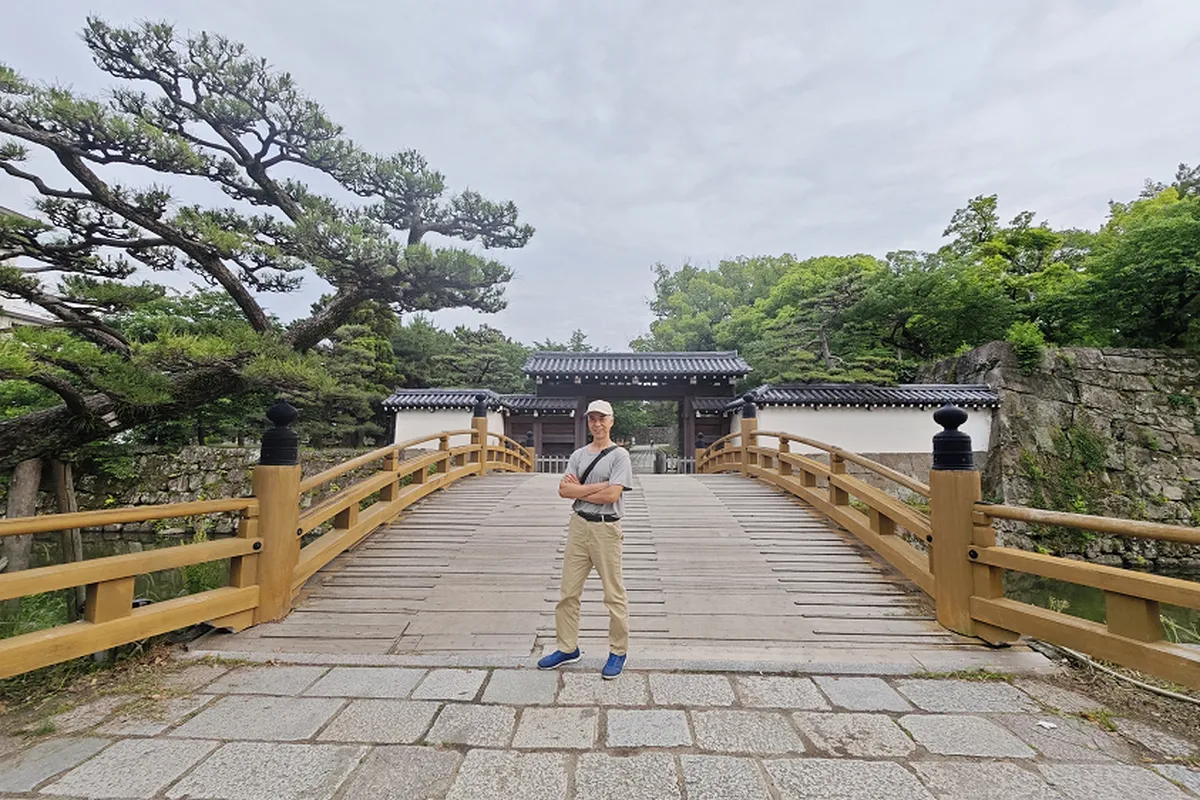
At 5 p.m., the weather was still nice, so I went for a walk to Wakayama Castle Park, enjoying the street views along the way.
Wakayama Castle is located in the center of Wakayama City. It is a flatland-mountain castle (teikaku-shiki hirayamajiro) and is also known as Torafusu Castle because it sits on Mount Torafusu. The Kii River flows north of the castle, serving as a natural moat. It was once the residence of the Kii Tokugawa family, one of the Gosanke (Three Tokugawa Houses) that governed the Kii Domain (also known as Kishu Domain or Wakayama Domain). The fifth lord of the Kii Domain, Yoshimune, and the thirteenth lord, Yoshitomi, later became the eighth shogun, Tokugawa Yoshimune, and the fourteenth shogun, Tokugawa Iemochi, respectively. Wakayama Castle was once designated a National Treasure of Japan, but it was burned down during World War II due to bombing by the U.S. military. The current castle was rebuilt in 1958. At its peak, the castle grounds of the Gosanke were vast, but now Wakayama Castle covers only one-quarter of its original size. The former castle grounds once included areas now occupied by the Wakayama City Government, Wakayama City Fire Department, Wakayama District Court, Wakayama Family Court, Wakayama District Public Prosecutors Office, as well as schools, commercial facilities, office buildings, and Wakayama Central Post Office. It was a very large castle, but the originally planned scale was even larger.
Although the keep was already closed, the park was still open, and the environment was beautiful and tranquil.
I continued strolling and taking photos of the beautiful views of Wakayama City.
At 7 p.m., I returned to Wakayama Station. A large store had already closed, so I went to the basement food street to find something to eat.
After dinner, I returned to the hotel to rest.


