#The Sky of Koxi#: A 14-Day Free Travel in Kansai - D3: World Heritage Mount Koya
May 25, 2025. The weather was okay—no sun, but no rain either. After breakfast at the hotel, we set off to explore the World Heritage site of Mount Koya.
Mount Koya is a collective name for a group of mountains about 1,000 meters above sea level in Wakayama Prefecture, Japan. Located in the northeastern part of Wakayama, it belongs to the Koya-Ryujin Quasi-National Park. In 2004, Mount Koya was registered as a UNESCO World Heritage site, with a history of 1,200 years. As the head temple of Japanese esoteric Buddhism, the Shingon sect (also known as Tōmitsu), Mount Koya has become a sacred place for those seeking to study Shingon Buddhism from around the world.
At the summit, surrounded by a ring of peaks, stands Kongobuji, the head temple of the Shingon sect founded by Kōbō Daishi 1,200 years ago. With Kongobuji at its center, more than 120 temples are scattered around, forming a large religious city.
Within the mountain area stands a gate over 25 meters high, which has served as the main gate since the founding of Kongobuji and is now designated as an Important Cultural Property of Japan. There are also many buildings designated as National Treasures, including temple structures and the Danjō Garan complex. The Mount Koya Reihōkan Museum continuously exhibits the vast cultural heritage of Mount Koya. Kongobuji provides lodgings for believers and also accommodates general pilgrims and visitors. In these temple lodgings, one can enjoy shōjin ryōri (vegetarian cuisine) made from vegetables, grains, and seaweed, without using meat, fish, or shellfish. Among the over 120 temples, some offer experiences such as Zen meditation and other Buddhist practices. The building on Mount Koya associated with Toyotomi Hideyoshi is called "Kongōbuji," but originally this name refers to the entire mountain. Including the main gate, various halls, and inner precincts, the whole Mount Koya is within the domain of "Kongōbuji." In 1643, Tokugawa Iemitsu built a mausoleum dedicated to Tokugawa Ieyasu and Tokugawa Hidetada here, collectively known as the "Tokugawa Family Mausoleum," designated as an Important Cultural Property of Japan.
It was Kōbō Daishi—Kūkai—who founded Mount Koya. Kūkai was born in 774 in Tado District, Sanuki Province, Japan. He entered Kyoto at fifteen to study Confucianism and later embraced Buddhism. In 804, he accompanied the Japanese envoy to Tang China to seek the Dharma. Once in China, he visited renowned monks across the land and eventually became a disciple of Master Huiguo (Keika) at Qinglong Temple in Chang'an, receiving the esoteric transmission and the secret title "Henjō Kongō" (Vajra of Universal Radiance), becoming the eighth patriarch of orthodox esoteric Buddhism. During this time, he also diligently studied Chinese poetry, painting, and more. Three years later, he returned to Japan and became the founder of the Shingon sect, spreading the Dharma. He authored works such as Bunkyō Hifuron (The Mirror of Literature), and made achievements in literature, civil engineering, medicine, and the arts. His calligraphy was also highly accomplished, earning him recognition as one of the "Three Great Brushes" of Japan. In 852, he passed away on Mount Koya. Emperor Daigo posthumously bestowed upon him the title "Kōbō Daishi." Kūkai's mission to China, following in the footsteps of the monk Jianzhen who traveled east, brought the culture of Tang China to Japan, promoting the development of Japanese culture, and thus he is held in high esteem in Japan. Because Kūkai once passed by Hanshan Temple in Suzhou, a bronze statue of Master Kūkai is enshrined there in commemoration. This is also why many Japanese devotees visit Hanshan Temple.
From Wakayama Station, take the Wakayama Line (toward Kokawa or Hashimoto) to Hashimoto Station. After swiping your card to exit, swipe again to enter another platform to board the Nankai Electric Railway to Mount Koya.
This is the platform of Hashimoto Station on the Wakayama Line.
This is the platform of Hashimoto Station on the Nankai Electric Railway.
From the picture inside the train, you can see that over the approximately 20 km section from Hashimoto Station to Koyasan Station, the altitude rises from 92 meters to 867 meters. In particular, the 800-meter stretch from Gokurakubashi Station to Koyasan Station climbs from 535 meters to 867 meters, so a cable car is needed.
Most of the railway tracks along the way are single-track, so trains must meet at stations along the line. Sometimes the train waits at a station for an oncoming train to pass before continuing.
After arriving at Gokurakubashi Station, follow the crowd forward to board the mountain cable car.
Take a look back at Gokurakubashi Station.
Check the return cable car schedule to keep track of time.
It takes only 5 minutes on the cable car to reach Koyasan Station.
After swiping out, you see the misty atmosphere at Koyasan Station. Quickly head to the bus stop to take the bus to the various scenic spots on Mount Koya.
Soon, the bus arrives at the first stop, "Daimon" (Great Gate). My initial plan was to go to the farthest "Okunoin" first, then slowly explore my way back, and finally take the bus from Daimon back to Koyasan Station. So I didn't get off at Daimon and went directly to Okunoin.
Parking lot at Okunoin Station.
Across the street is the entrance to Okunoin.
This is the great cedar forest of Okunoin, with many tall cedar trees standing straight and reaching toward the sky.
Scenery near Nakanohashi Bridge.
After walking for over an hour, I reached Ichinohashi Bridge.
This is another entrance to Okunoin from Ichinohashi. We were going in the reverse direction, coming out from the inner area.
The path from Ichinohashi to Okunoin is relatively quiet, while the section from Ichinohashi to Daimon is much more lively, with many temples, shops, and eateries along the way.
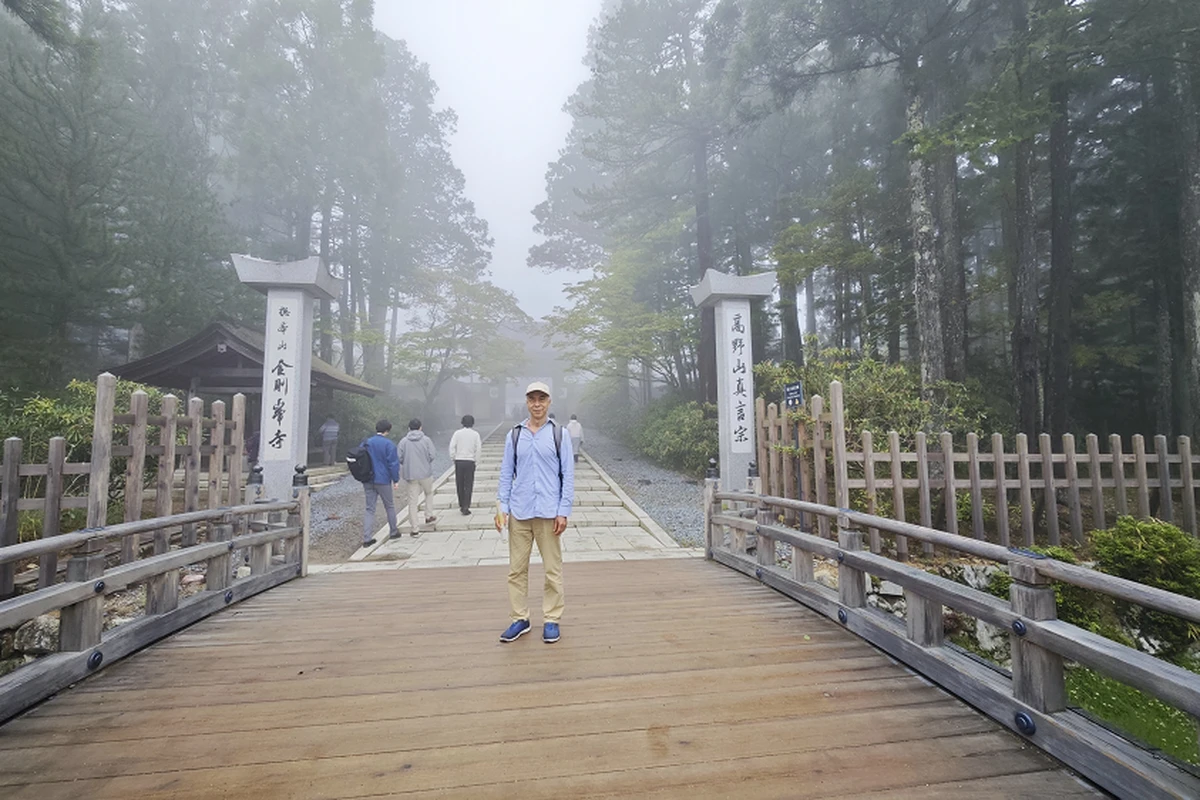
— Gokurakumon (Gate of Paradise)
Kongobuji was built in 1593 and rebuilt in 1863. It is designated as a National Treasure of Japan. The more important role of this temple is as the head temple of the Shingon sect, founded by Kōbō Daishi.
Although the exterior of Kongobuji is already quite charming, after taking off your shoes and stepping inside the temple gate, you can feel the elegant beauty of its interior even more.
Unfortunately, the weather was not cooperative—a heavy fog set in, creating a hazy landscape.
Danjō Garan is one of the core sacred sites of Mount Koya. It was the first place established by Kōbō Daishi (Kūkai) when he founded the mountain, dating back to 816 AD, and is the sacred ground of the Shingon sect.
Danjō Garan contains 19 pagodas and halls, the most famous of which is the nearly 50-meter-tall Great Stupa (Konpon Daitō), an iconic structure of Mount Koya.
Mount Koya is not only a Buddhist sacred site but also known as a "Buddhist city," with over 100 temples densely concentrated on the mountain, preserving many ancient buildings. The scenic beauty and profound cultural depth of Mount Koya attract many worshippers and tourists. As a landmark of Mount Koya, Danjō Garan draws many visitors for sightseeing and spiritual practice.
The visibility in the sky grew worse, and the temperature dropped. When I returned to Daimon Station to wait for the bus down the mountain, I saw the real-time temperature was 12.8°C.
I returned smoothly to Koyasan Station and waited for the cable car down. With some time to spare, I walked around the station. The first floor has a small shop and a restaurant, and the second floor is a rest area with promotional panels and information stands, as well as an observation deck where you can enjoy the view on clear days.
There is a commendation plaque from Nankai Electric Railway.
Also a certificate of recognition as a Modern Industrial Heritage site.
Information board and waiting shelter for the Mount Koya bus.
A photo at Koyasan Station.
Take the cable car back the same way. At Gokurakubashi Station, board the Nankai Electric Railway to Hashimoto Station. The train to Wakayama Station still had half an hour, so I got off at Hashimoto and walked around. Persimmons are the mascot of Hashimoto City, a very cute cartoon character.
I came to the riverside, where the scenery on both banks was very beautiful.
Timing it well, I transferred at Hashimoto Station to the train heading back toward Wakayama, ending my World Heritage Mount Koya tour.
It was almost 7 PM when I returned to Wakayama Station. It was time for dinner. Tonight, I tried SUKIYA.


