#Lake West Sky#: A 14-Day Free Travel in Kansai – D8: Amanohashidate, an Amazing Place
May 30, 2025, a clear sunny day. Today I will visit all the main attractions of Amanohashidate.
Amanohashidate is a scenic spot located in the northern part of Kyoto Prefecture. On a sandbar about 3.6 km long that separates Aso Sea (part of the Sea of Japan) from Miyazu Bay, a continuous avenue of about 8,000 pine trees stretches. It is ranked as one of the Three Great Views of Japan, along with Matsushima (Miyagi Prefecture) and Itsukushima (Hiroshima Prefecture). It is said that its shape resembles a white bridge ascending to the sky, hence the name 'Amanohashidate' (Bridge of Heaven).
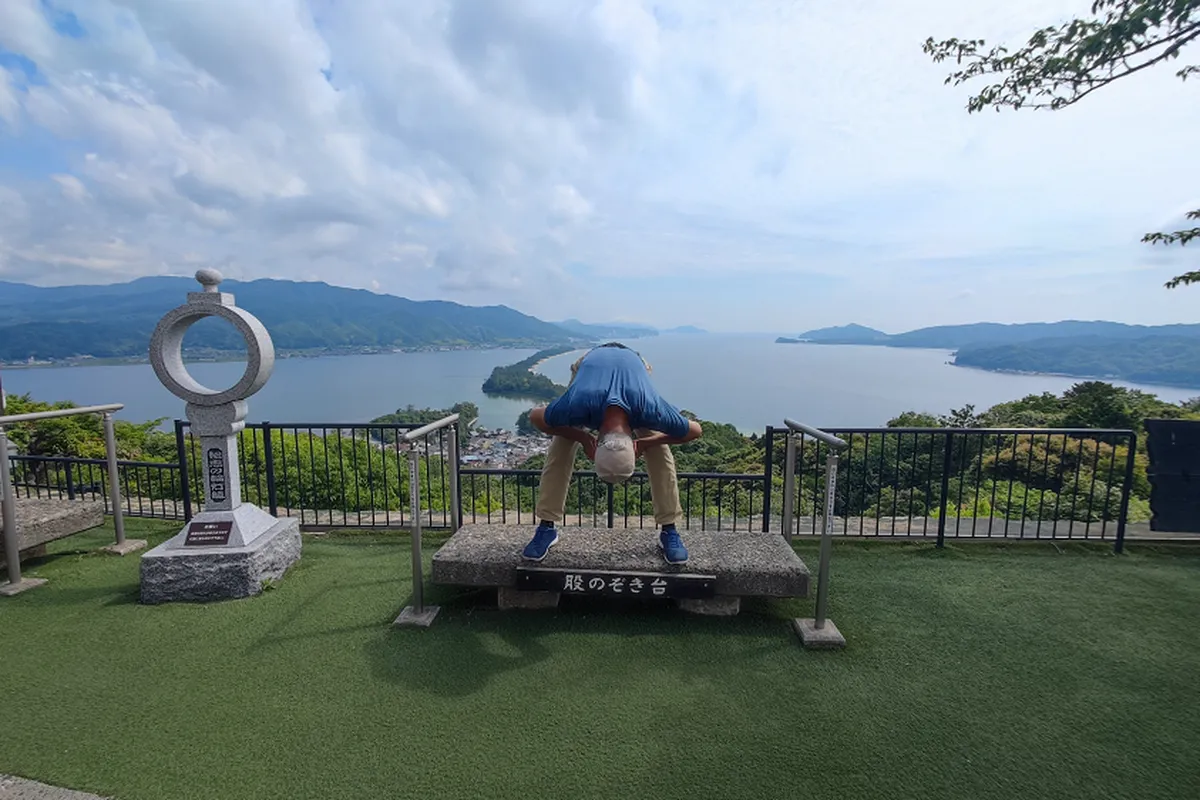
There are two legends about the name 'Amanohashidate'. One says that if you stand on the hills of Hiryukan at the southern end of the sandbar or at Kasa Matsu Park at the northern end, bend over and look upside down between your legs, the long sandbar looks like a bridge stretching diagonally up to the sky. Under this special perspective, it got its name. Another legend says that the male god Izanagi built a great floating bridge in the sky to make it easier to reach the residence of the female god Izanami. One day, Izanami stayed overnight in the human world, and unexpectedly the floating bridge collapsed and fell to the earth. That became the present-day Amanohashidate.
In the morning, I pulled open the curtain and saw the beautiful view of Miyazu Bay outside the window. I felt refreshed.
First, I went to the hot spring bath for a soak. The atmosphere during the day is different from at night. Last night when I came, the windows beside the hot spring pool were dark and I couldn’t see anything. During the day, I could bathe while clearly viewing the sky, mountain scenery, and sea water outside—how beautiful! (Filming and photography are prohibited in the hot spring area.)
Back in my room, I brewed a pot of tea and tasted a small cake made from a special pine needle material unique to Amanohashidate. I relaxed for a while.
The hotel’s Japanese-style breakfast was exquisite and full of ceremony.
After breakfast, I looked around the hotel lobby. In Japan, if a guest has a visitor, the visitor cannot enter the guest’s room; meetings can only be held in the lobby.
At a little past 8 a.m., I set off!
As I walked out of the hotel, I saw a train of the Tango Railway Company passing by. Yesterday we also came to Amanohashidate on this type of train.
First, I strolled through Amanohashidate Park next to the hotel.
The building ahead on the walking path is the hotel we stayed at.
First stop: going to the Hiryukan observation deck. On the way, I had to cross the railway line. A hundred meters ahead was the platform of Amanohashidate Station.
Soon I reached the cable car station.
It opens at 9 a.m. Round-trip fare is 1000 yen per person.
There are two types of cable cars: one is a cabin type and the other is a chairlift type. The cabin cable car runs every 20 minutes; the chairlift runs continuously. We chose the chairlift for a better experience.
We quickly reached the top. Let’s take a photo!
This is the Hiryukan observation deck.
These platforms are for visitors to stand on, bend over with their rear end pointing up, and look backwards at the scenery upside down.
A poster shows how to see a different perspective.
The picture below clearly shows the geography of Amanohashidate: a north-south sandbar separates the Aso Sea from Miyazu Bay.
Such a beautiful photo spot—I had to take a picture!
Looking far into the distance, the beauty of Miyazu City.
At the top, besides sightseeing, there are also small Ferris wheels, pedal rail cars, shooting games, and other entertainment facilities.
The Hiryukan Promenade is absolutely unmissable—it is very impressive.
Before descending, I took a panoramic view.
On the way, I saw the cabin cable car.
Second stop: boarding a sightseeing boat.
On the way to the pier, I passed by Chion-ji Temple.
I bought a round-trip ticket at the sightseeing boat pier, 1300 yen per person.
I went up to the top deck of the boat, struck a pose, showing off a bit.
The sightseeing boat sailed on the Aso Sea toward Shoryukan. Along the way, many seagulls and eagles flew around—some circled overhead, some followed the wake behind the boat.
Brave ones would fly over and snatch shrimp crackers from the hands of tourists (shrimp crackers are sold at the pier for 100 yen per pack).
I captured several close-up shots of the seagulls—so cute and silly.
I also got a shot of several eagles in the same frame.
After landing, I headed toward Kasa Matsu Park.
At Fuchu Station, I took the cable car up the mountain. Round-trip ticket: 800 yen per person.
Again I took the chairlift. The cabin cable car here was under maintenance. First-time chairlift riders could check this picture first and pay attention to the instructions.
The Shoryukan observation deck is a little lower than Hiryukan.
Another upside-down pose!
I saw the effect of the dragon ascending to the sky.
At the summit park, there was a piano. Those who can play can show off their skill. But my wife pretended to be cool.
There was also a terrace suitable for holding small weddings (or proposals)—very romantic, isn’t it?
On the way back, it was already noon. I saw almost no seagulls or eagles; maybe they had eaten their fill. The shrimp crackers in my hand couldn’t be sold, so I treated myself.
This is a photo taken from the boat of the Shoryukan cable car line at Kasa Matsu Park.
Lunch was at a restaurant in the commercial street near the pier.
With some time left, I rented two bicycles (500 yen per bike) to ride through the Amanohashidate sandbar.
2.6 kilometers, with beautiful scenery all the way.
Perfect! Round trip plus photography took less than an hour and a half. I actually cycled across the Amanohashidate sandbar—easy and pleasant.
Of course, there is another way: take the boat to the opposite side and walk back. Bicycles must be returned where rented; one-way cycling is not possible.
Due to time constraints, I couldn’t visit more distant attractions this time, such as Ine Bay to see Ine no Funaya (boat houses) or experience the marine railway.
At 3 p.m., I returned to the hotel to pick up stored luggage. On the way, by the sea, I saw something like jellyfish swimming.
Leaving the hotel, I boarded the limited express train to Kyoto departing at 15:51.
This reserved seat ticket was obtained last night by asking the staff at Amanohashidate Station (there are no self-service machines at Amanohashidate Station).
There was a little episode on this Kyoto trip. After boarding, I found seat 16B according to the number. Strangely, the seat was not turned in the normal direction (normally, for the last row I booked, the back of the seat can store luggage). Now it was reversed; seat 16 was the first row. I was puzzled when the train started. I had to push my luggage to seat 1 (which happened to be unoccupied). After about ten minutes, the train turned at a junction, and our seat 16 indeed became the first row (no wonder the seat wasn’t turned). Then I tried to coordinate with the train attendant to switch to seat 1, but he said no, as one seat had already been sold and the passenger would board at an intermediate station. He told me to put my luggage in the space by the door. I felt it was inconvenient—passengers coming and going, easy to lose things.
More than ten minutes later, the attendant asked me to move my luggage to the second row of another car (maybe he checked that row was unsold). Seeing my worried expression, he said, 'No problem.' In our understanding, placing luggage in another car is really unsettling. Every time the train stops, you have to check whether your luggage is still there. Although it is a limited express, there are six or seven stops. Having to keep an eye on the luggage each time is inconvenient. But in the Japanese attendant’s understanding, he thought it was fine, because in Japan no one would take someone else’s belongings.
So I moved my luggage to another car. At first I was still a little uneasy, but later I let it go. Different countries, different perspectives—this really deserves praise.
At 18:07, I arrived smoothly at Kyoto Station, retrieved my luggage, and exited. The rail pass completed its mission. In five days, I covered many places—the pass was worth the price. Rough estimate: five limited express trains (Shirahama to Kii-Katsuura, Shingu to Osaka, Osaka to Tottori, Tottori to Toyooka, Amanohashidate to Kyoto) and three local trains (Wakayama to Shirahama, Kii-Katsuura to Shingu, Toyooka to Amanohashidate). Total fare would have been over 24,000 yen; using the rail pass was roughly a 50% discount.
The hotel we booked is at Kyoto Shijo, just two subway stops away.
We found the hotel smoothly and checked in. We are staying here for four consecutive nights.
The room has two windows.


