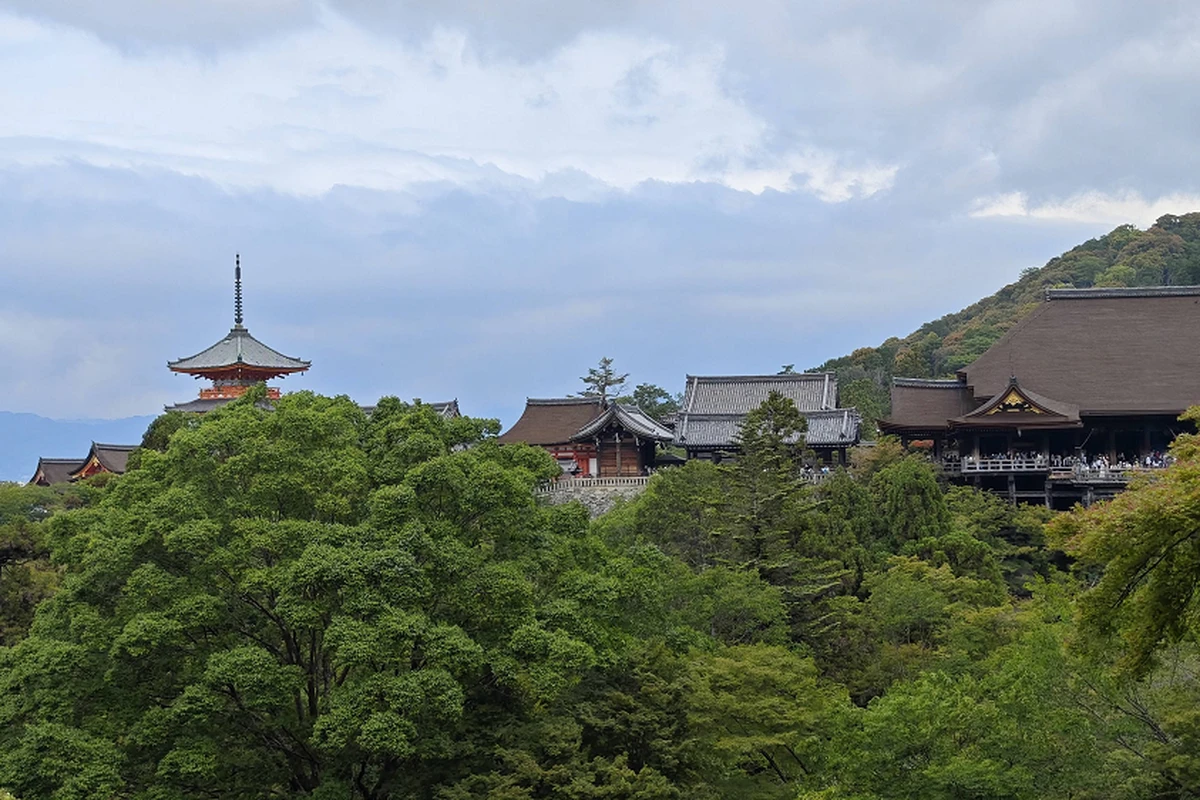
#Huxi's Sky#: 14-Day Kansai Free Travel - D10: Kiyomizu-dera, Fushimi Inari Taisha, etc.
June 1, 2025. The sky was clear. Today I planned to wander around Kyoto.
When booking the hotel, the room rate did not include breakfast. Yesterday I left early and didn't get to try the hotel's breakfast. Today I wanted to taste it. First, I went to the front desk to buy breakfast tickets: 990 yen per person. Breakfast had both Western-style and Japanese-style options, so I ordered one of each.
Bread, coffee, drinks, rice, soup, tea, etc. were all unlimited, so you could eat your fill.
After breakfast, I took a look at the hotel's surroundings. I had been leaving early and coming back late these past two days and hadn't had a chance to see it in detail.
First stop: Kiyomizu-dera.
Leaving the hotel, I walked five or six minutes to the bus stop and took bus 207 for five stops. I got off at Kiyomizu-michi Station (or you could ride one more stop to Kiyomizu-dera Station).
Following the navigation instructions, I passed through a commercial street.
I arrived at Kiyomizu-dera. Today is Sunday, so there were especially many people, including many local student groups coming to pray.
Kiyomizu-dera is the oldest temple in Kyoto and is designated as a National Treasure of Japan. Located halfway up Mount Otowa in eastern Kyoto, it was founded in 778 and is the oldest temple in Kyoto. It has been burned down and rebuilt several times, and was later inscribed as a UNESCO World Heritage Site in 1994.
The Kiyomizu Stage, a wooden terrace extending from the main hall, is a Japanese national treasure. Surrounded by lush greenery, it is famous for cherry blossoms in spring and autumn leaves in autumn, making it one of Kyoto's premier cherry blossom and fall foliage viewing spots.
The tea ceremony at Kiyomizu-dera is ranked first in Kyoto.
Today, Kiyomizu-dera's precincts include the West Gate, East Gate, Three-Story Pagoda, Sutra Hall, Founder's Hall, Hongo Gate, Asakura Hall, Main Hall, and Amida Hall. Surrounding buildings include Nio Gate, Horse Station, Bell Tower, and North General Gate.
Like a poem of the ancient capital, every scene around Kiyomizu-dera fully reveals the charm of Kyoto. Whether it's cherry blossoms in spring, waterfalls in summer, autumn leaves, or light snow in winter, Kiyomizu-dera seems to exist to embody Kyoto, constantly attracting visitors who linger and cannot bear to leave. The simple main hall balcony protrudes over a cliff, and because of its beautiful environment, it has become the first choice for suicides by jumping.
The main hall enshrines a standing statue of the Eleven-Faced Thousand-Armed Kannon. It opens to the public only during the Japanese Qingming Festival (spring equinox week) for visitors and local worshippers.
Kiyomizu-dera is located on a mountainside with great elevation changes. This entirely wooden temple covers a total area of 130,000 square meters. The most famous "Kiyomizu Stage" stands 50 meters above the ground and is supported by only 139 wooden pillars, demonstrating the immense scale and difficulty of the original construction!
There were so many people that even taking a photo required lining up.
Second stop: Sanjusangen-do.
Leaving Kiyomizu-dera, I headed to Sanjusangen-do. On the way, I passed Ki Museum ("Kikutani" or "Mokutani"? Actually, the text says "木谷本庙" – likely a temple or shrine; but from context, probably "Kiya" or "Kitanomine"? Let's check: it says "木谷本庙" – this appears to be a place called "Kitani Temple" or "Kidanomiya"? Possibly a small shrine. I'll transliterate as "Mokutani Temple" but better to check. Actually, in Japanese, 木谷 is "Kitani" or "Kiya". Since it's a proper noun, I'll keep as "Kitani Temple" or "Kiya Temple"? The text says "木谷本庙", which might be a specific temple. I'll keep as "Mokutani Temple" (音译) or search memory: There is a temple called "木谷本堂"? Not sure. I'll transliterate as "Mokutani Temple" and note it. Alternatively, I can use Pinyin: "Mùgǔ Temple"? No, better to use Japanese reading: "Kitani Temple" (assuming 木谷 is Kitani). I'll go with "Kitani Temple" (木谷本庙).)
A beautiful and exquisite temple.
Continuing on, I saw a poster for the Kyoto Culture Museum.
These are shared electric bikes and electric scooters.
I arrived; diagonally opposite is the entrance to Sanjusangen-do.
Sanjusangen-do is an ancient Japanese building located at Shichijo in Higashiyama Ward, Kyoto City. It is a temple of the Tendai sect of Buddhism. Famous for enshrining one thousand statues of Kannon (Goddess of Mercy), it is well known in Japan. It is the main hall of Rengeoin, a national treasure of Japan, and one of the most splendid temple buildings in Kyoto. The main structure is rectangular, 120 meters in length, and gets its name from the 33 spaces created by the pillars.
Sanjusangen-do was built in 1164, located in the middle of the sightseeing highlights of central and eastern Kyoto. It consists of 33 bays and enshrines 1001 statues of Kannon. The seated Thousand-Armed Kannon is a national treasure of Japan. Every year on January 15, an archery ceremony called "Toshiya" (or "tsuya"? Actually, it's "Tōshiya" or "Toshiya" – distant arrow) is held, where archers shoot at a target from 60 meters away.
Sanjusangen-do is a Tendai sect temple, officially named Rengeoin. Because the main hall is divided into 33 bays ("ken", a unit of length measuring the distance between two pillars, about 1.818 meters), it is commonly called Sanjusangen-do (Thirty-Three Bays Hall). The principal image is a seated statue of Thousand-Armed Kannon (made by Tankei, about 3 meters high). It is said that in 988, Fujiwara no Koremasa built one hall of Hoju-ji; in fact, Taira no Kiyomori built this temple in 1164 by order of Cloistered Emperor Goshirakawa, west of the Hoju-ji palace. It burned down in 1249, and the current hall was rebuilt in 1266.
The hall is 17 meters deep and 120 meters long north-south, making it the longest temple hall in Japan. In the center is a huge wooden seated Eleven-Faced Thousand-Eyed Thousand-Armed Kannon, about 3.3 meters tall, flanked by 500 golden standing Kannon statues each about 1.7 meters tall on each side. The 1001st standing Kannon is behind the giant Buddha in the center. In front of the Kannon statues are 28 statues of protective deities. Photography and video recording are prohibited inside the main hall, so I could only look with my eyes and listen with my ears.
Before entering the main hall, I had to go to the shoe storage area, take off my shoes, and place them in a storage locker.
Then I entered barefoot or in socks, so it's necessary to pay attention to personal foot hygiene to avoid embarrassing situations caused by foot odor or holes in socks.
After visiting the main hall, I could stroll around the garden, following the map to circle the grounds and enjoy the beautiful courtyard scenery.
Third stop: Fushimi Inari Taisha.
Leaving Sanjusangen-do, I went to Shichijo Station and took the Keihan Main Line - Inari Line (or Keihan Main Line - Kamodai? Actually, the text says "京阪本线-鸭东线(淀屋桥方向)" – Keihan Main Line - Kamo East Line (toward Yodoyabashi)) for 3 stops, got off at Fushimi Inari Station and exited.
I had a bite to eat before going in.
Fushimi Inari Taisha was built in the 8th century and primarily enshrines the Inari deity Ukanomitama no Mikoto and other Inari gods. Inari is the god of agriculture and commerce, and worshippers come to pray for good harvests, business prosperity, and traffic safety. It is one of the most popular shrines in Kyoto.
At the entrance to Fushimi Inari Taisha stands a large torii gate donated by Toyotomi Hideyoshi in 1589. Behind it are the main hall and other buildings. Inside the shrine, you can see various fox statues, because foxes are considered messengers of Inari. Fox-faced ema (votive tablets) are a distinctive feature here.
The most famous feature here is the dense array of vermilion "Senbon Torii" (thousands of torii gates) behind the main hall, one of the most iconic sights in Kyoto, which also appeared in the movie "Memoirs of a Geisha." Hundreds of vermilion torii gates form a pathway up to the top of Mount Inari, with dozens of fox statues in between.
The most eye-catching structures within Fushimi Inari Taisha are the countless torii gates of various sizes covering the entire mountainside, known as "Senbon Torii" ("senbon" means a thousand, metaphorically indicating the large number of torii gates). The vermilion Senbon Torii are full of Japanese charm and have become a popular photo spot for tourists.
Fourth stop: Ninen-zaka and Sannen-zaka.
When leaving Fushimi Inari Taisha, I asked at the information counter how to get to Ninen-zaka and Sannen-zaka, and the staff gave me this map.
It went smoothly; it took about 40 minutes to arrive, and by then it was just after 5 PM.
I entered from Sannen-zaka and walked down toward Ninen-zaka. Sannen-zaka is steeper, with 46 stone steps.
Sannen-zaka is a street in Kyoto, built in 808 (Daido 3), connecting Kiyomizu-zaka and Ninen-zaka. Because this slope is the approach to the Koyasu Pagoda (Taisan-ji) dedicated to prayers for safe childbirth, and the Japanese reading of "safe childbirth" ("san'an") is similar to "three years" ("sannen"), Sannen-zaka is also called San'nei-zaka (meaning safe delivery).
It is a stone-paved slope on the hillside, which is the approach to Kiyomizu-dera. Souvenir shops, pottery shops, and restaurants line the street. Nearby are Yasaka Shrine, Maruyama Park, Kodaiji Temple, and Hokanji Temple.
Turning into Ninen-zaka, I continued downhill.
Ninen-zaka is about 200 meters long, with 17 stone steps.
Looking back at the historic old street from the exit of Ninen-zaka.
Kodaiji Temple is located at the northern exit of Ninen-zaka and is a famous temple in Japan. When I arrived, the visiting hours had passed, so I could only see the exterior.
From the Kodaiji Temple plaza, I looked out over the Ninen-zaka street.
And also the Yasaka Pagoda of Hokanji Temple in Kyoto.
With that, today's itinerary ended. I took bus 207 back to the hotel.


