A Journey to the West: The British Isles (Part 3)
A fall into a pit, a gain in your wit. Since we had walked too much on the first day in London and felt quite tired, we decided to take it easy on the second day, visiting only the Greenwich Observatory and the British Museum. That's the beauty of independent travel—you can be as spontaneous as you like.
An Eastern stomach doesn't always pair well with Western cuisine. When we got up the next morning, I first made a hearty breakfast. It was just simple bread, milk, and fried eggs, but it felt so comforting. Thanks to our experience from the first day, we were much more adept at getting around. We reached the Tower Bridge on foot at 8:30, half an hour before the ferry staff started work. We took the first ferry to Greenwich Observatory, and it took about half an hour to get there. The most significant feature of the Greenwich Observatory is undoubtedly the Prime Meridian. Its main purpose is to serve as the standard reference meridian for global time and longitude measurement, known as the 0° longitude or Prime Meridian. Not only do maps published by various countries use this line as the starting point for geographical longitude, but they also use the Greenwich Observatory as the starting point for the 'World Time Zone,' calibrating time with Greenwich timekeeping instruments.
The Greenwich Observatory is also part of the National Maritime Museum. In fact, the observatory was established due to the booming development of navigation. After disembarking at Greenwich Pier, visitors first see a large, exquisitely crafted sailing ship, which once served as a merchant vessel for the tea trade with China. Standing at the site of the Greenwich Observatory, visitors can enjoy a panoramic view of London. Below the hill is a vast expanse of green grass, still lush even in winter when the leaves have fallen.
Some say the purpose of travel is nothing but beautiful scenery and good food. But for me, seeking out delicacies has never been a must. Western cuisine seems to neglect vegetables, and as an Eastern stomach, we prefer to eat more vegetables. So after visiting the Greenwich Observatory, we decided to have lunch at a restaurant near the pier, mainly eating grass (vegetable salad). After lunch, we continued by ferry back to Westminster and then took the subway to visit the British Museum.
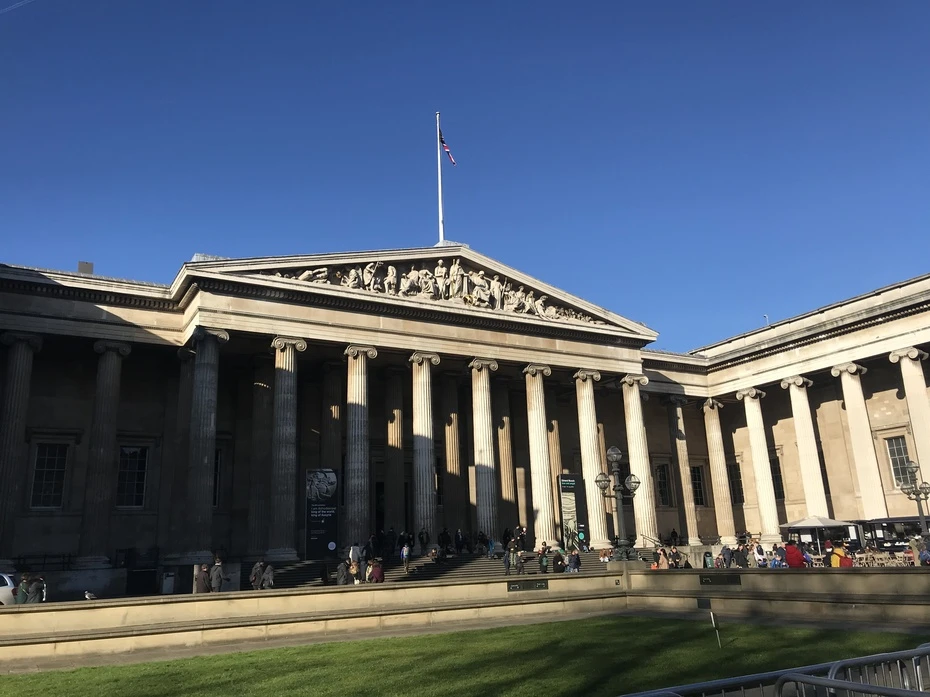
My favorite galleries in the British Museum are mainly two: the Chinese Gallery and the Egyptian Gallery. The exhibits in these two galleries bear witness to the two ancient civilizations with the longest histories in the world. I had actually been to Egypt in 2018 and had visited the Egyptian Museum in Cairo. This time, at the British Museum's Egyptian Gallery, my main goal was to see the Rosetta Stone, the museum's star exhibit. The Rosetta Stone is regarded as the key to deciphering Egyptian writing and culture. It is inscribed with the same decree in three scripts: the top part contains 14 lines of ancient Egyptian hieroglyphs, the middle part has 32 lines of Egyptian demotic script (a form of papyrus writing), and the bottom part has 54 lines of ancient Greek. The Rosetta Stone was originally discovered by the French, but during the Anglo-French wars it came to Britain, and has since been displayed in the British Museum, becoming its most treasured artifact.
I love the Chinese Gallery naturally because I am Chinese, and I want to see which national treasures were plundered by the British around the time of the Eight-Nation Alliance's occupation of Beijing. The Chinese Gallery has a rich variety of exhibits, including jade, ceramics, calligraphy, paintings, and sculptures. Among them are the Chicken Cup, a Ming Dynasty reproduction of 'Along the River During the Qingming Festival,' a calligraphy piece by Liu Yong of Jiang Kui's poem, a large bronze tripod from the Qianlong period of the Great Qing Dynasty, and exquisite jade artifacts from various dynasties after the Spring and Autumn and Warring States periods.
Compared to the Egyptian and Chinese galleries, the exhibits in the Japanese, Korean, South Asian, American, and Hawaiian galleries are very sparse, and I wasn't very interested in them—just a quick glance.
The British Museum houses numerous treasures, many of which were looted from other countries during the imperial era. Many sculptures and stone carvings were forcibly cut and transported by the invaders. Fortunately, these national treasures, plundered by aggressors, are now well-preserved and open to the public free of charge worldwide. As a citizen of a country that was once plundered, this brings me a bit of consolation.
After visiting the British Museum, we ended our second day in London and returned to our accommodation to rest and recharge, ready for the third day >>>>>>


