Don't Miss the Most Popular London Natural History Museum | A Guide to the Dinosaur Gallery
The Natural History Museum in London is known as the cathedral of nature. Some say that reading ten books is not as enlightening as visiting this museum once. If you plan to bring your kids to London in the future, the first recommendation is the London Natural History Museum. It's also very easy to find—get off at South Kensington station on the Underground and you'll see the grand Victorian-era building.
Once inside, from dinosaur fossils to Mars meteorite fragments, from the dodo to ancient marine life, from the Earth Hall to the Minerals Gallery, you never know what you'll encounter in the London Natural History Museum. You're bound to get lost in the museum. So you need a guide who is most familiar with the museum and knowledgeable about natural science to navigate for you. https://huodong.ctrip.com/ottd-activity/dest/t19879145.html
This time, let's follow the editors from Yi Yu to explore the most popular and well-known gallery—the Dinosaur Gallery!
Please save this map first, and follow our guide to explore the Dinosaur Gallery at the Natural History Museum!
Before entering the gallery, we can see the English name of the dinosaur gallery: Dinosaurs. In early times, this word meant "terrible lizard," a name coined by Richard Owen. In 1841, while studying several fossils that looked like lizard bones, Owen believed they were left by some prehistoric creature—much larger than lizards—so he used the word Dinosaur, meaning "terrible lizard," to name them.
This is the superstar of the dinosaur world, the Tyrannosaurus rex. They lived during the late Cretaceous period, about 67 million years ago, and were large carnivorous dinosaurs at the top of the food chain at that time. T. rex could reach about 12 meters in length, a tail up to 5 meters, height up to 6 meters, average weight about 9 tons, with the heaviest reaching 15 tons—an exceptionally massive build.
Is that little baby being lifted up by his dad really not scared at all? This truly reflects the body proportion between humans and T. rex; humans appear especially tiny in front of a T. rex.
Pachycephalosaurus is a herbivorous dinosaur with a swollen head, like a huge tumor. Its head circumference and snout tip are covered with small bony bumps. Some Pachycephalosaurus have large, sharp spikes at the back of the head. This massive skull functioned to withstand the huge impact force when they slammed into each other, protecting the brain and other head organs from damage.
The Kentrosaurus specimen in the museum. Kentrosaurus is also a herbivorous dinosaur. They are relatively small, about 4 meters in length—slightly smaller than Pachycephalosaurus—similar in height to an adult human, weighing only 450 kg.
Triceratops lived in the late Cretaceous period, at the same time as T. rex and Pachycephalosaurus, and was also one of the last dinosaurs to appear. They had a very large frill and three sharp horns on their head. Triceratops' height is similar to a human's. They used their horns, mouth, and body to knock down tall plants to eat. Their three horns and frill structure were effective weapons against predators and also used for courtship to display status within the group.
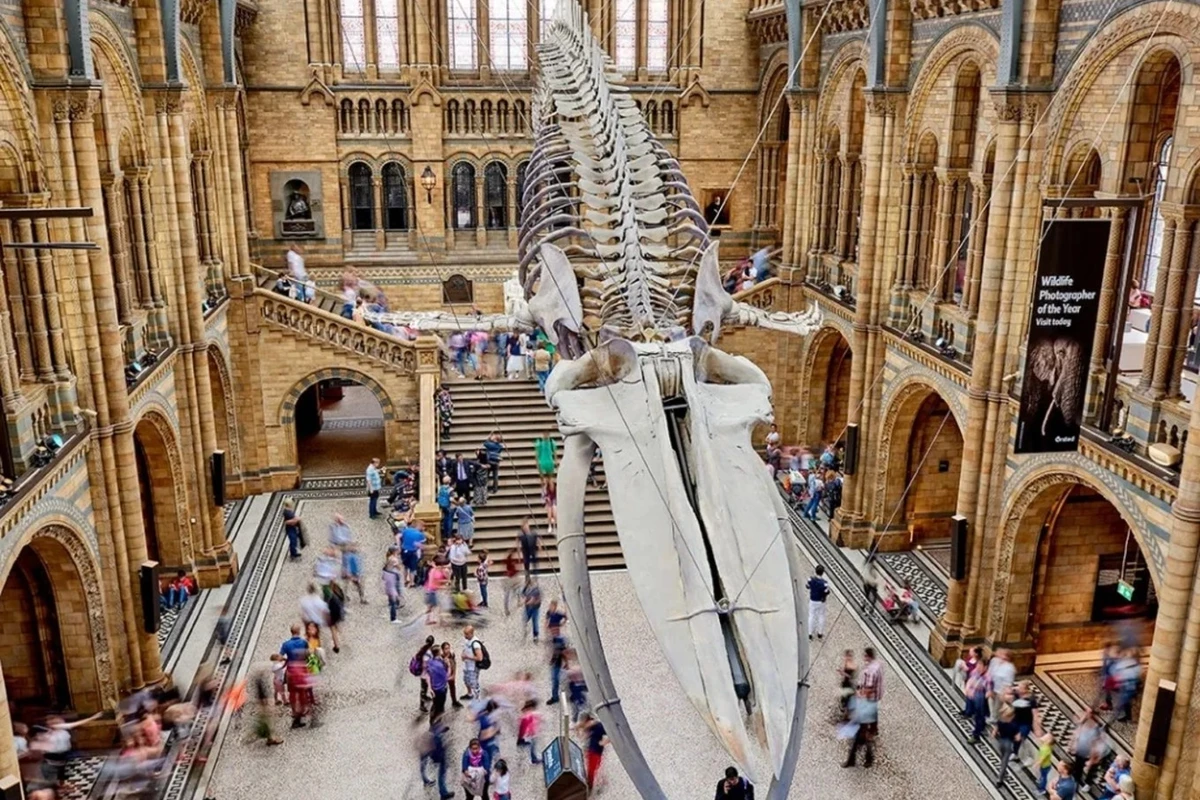
What everyone sees should be a replica of a huge Diplodocus. This Diplodocus (specimen model) is regarded as an "animal superstar" by the British, affectionately called Dippy. In 2015, the Natural History Museum in London decided to replace the Diplodocus Dippy with a blue whale skeleton. The replacement was completed only in 2017. The dinosaur skeleton originally displayed on the ground took up a lot of space, while the suspended blue whale skeleton freed up ground space, making the entire hall more open and awe-inspiring. (Insert a picture of the current superstar HOPE in the central hall of the museum. The meeting point for our Yi Yu live tour is also right below this blue whale skeleton. No matter where you are, this is the easiest meeting spot to find!)
Let's continue to look at the most precious fossil in the collection—this is a Stegosaurus fossil named "Sophie." It is placed outside the Earth Hall. This Stegosaurus fossil was discovered in 2012 by a museum scholar and his colleague while attending the Tucson Gem and Mineral Show. "Sophie" is the most complete dinosaur fossil preserved in the entire museum. Finding a complete Stegosaurus fossil is indeed very rare and holds great significance for human research on dinosaur evolution.
There are many more dinosaur specimens waiting for you to discover.
Are these two dancing dinosaurs?
The teeth of T. rex are the most terrifying among dinosaurs. Inside its huge mouth, there are many huge, dagger-like sharp teeth, jagged and uneven. The teeth are all the same shape, only slightly different in size, so scientists call them "homodont teeth."
At the exit of the Dinosaur Gallery, we can see a specimen like this: the sleeping Psittacosaurus, one of the most common dinosaurs from the early Cretaceous period. It used a parrot-like beak and grinding teeth to eat plants. Recent discoveries suggest that young Psittacosaurus lived in small groups. So, do dinosaurs still exist? We find the answer to this question.
The London Natural History Museum is not just a museum; it is also considered by locals as the best parent-child classroom. Children and parents often participate in various parent-child activities held in the museum. There is also a cool dinosaur-themed restaurant. If kids have the opportunity to come to the London Natural History Museum in the future, they must experience this dinosaur-themed restaurant with their parents. This is the most unmissable parent-child travel check-in spot.
After all this introduction, I believe everyone must want to see these dinosaur specimens in person! If you come to the London Natural History Museum in the future and want to learn more about natural history, please listen to the professional live commentary from Yi Yu in the UK. Don't miss it if you like it! https://huodong.ctrip.com/ottd-activity/dest/t19879145.htm


