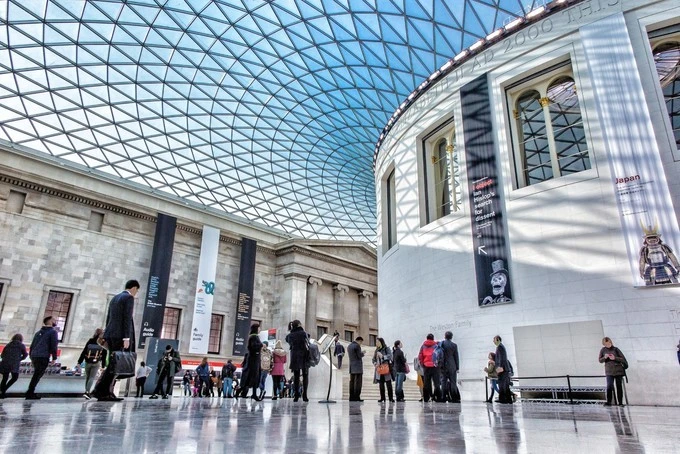
Top 10 Must-See Treasures at the British Museum When You Visit the UK
The most exciting thing in London is that the museums and some art galleries in London have reopened to the public. The first time I went to the British Museum, I was truly amazed. Whether it was the Andy Warhol special exhibition at Tate Modern or the Titian special exhibition 'Love, Desire, Death' at the National Gallery, they attracted many art enthusiasts. The most thrilling news is that the British Museum will also open to the public on August 27, but you must book in advance to enter the museum.
Booking website: ;/p>
Friday: 10:00–15:00
Wednesday–Sunday: 10:00–17:00
Monday: Closed
Address: The British Museum, Great Russell Street, London WC1B 3DG
In the UK, if you want to find a location, you just need to enter its postcode. If you don't have internet, you can also download maps.me in advance; the app works completely offline. In the picture, I have marked the nearby tube stations.
If it's your first time at the British Museum, I recommend entering through the main entrance. The first time I entered through the back door, I got lost~~~~ (How embarrassing)
On my first visit to the British Museum, I booked the on-site Chinese guided tour service from Yiyu. The tour guide, a young lady named Yilan, was beautiful, had a sweet voice, and was knowledgeable. I truly looked up to her throughout the tour. Currently, Yiyu's guided tour service is also open. https://huodong.ctrip.com/ottd-activity/dest/t19857394.html#ctm_ref=www_hp_bs_lst
I hope you can take this opportunity to discover or rediscover this museum, exploring some of the most popular collections in a rare quiet environment. In this issue, I will take you through the TOP 10 classic collections of the British Museum.
Location: Room 4, Ground Floor
This is a granodiorite stele made in 196 BC. Originally just a stele inscribed with a decree of Pharaoh Ptolemy V of ancient Egypt, this stele is carved with the same content in three different language versions. This allowed modern archaeologists to compare the language versions and decipher the meaning and structure of Egyptian hieroglyphics, which had been lost for over a thousand years, making it an important milestone in the study of ancient Egyptian history.
Location: Room 18, Ground Floor
The classical Greek sculptures exhibited in the British Museum were originally part of the Parthenon. The Parthenon is a 2,500-year-old temple on the Acropolis of Athens dedicated to the Greek goddess Athena. They were brought to the UK by Lord Elgin in 1801 and are some of the most important archaeological discoveries that help us understand ancient Greek life. The temple was adorned with many exquisite marble statues, designed and supervised by Phidias. The metopes and pediment sculptures are based on ancient Greek mythology, including the famous horse head of the moon goddess Selene, the Ilissos river god, and the high relief of the Centauromachy. The frieze decorations mainly depict the religious beliefs of the Athenian people.
Location: Room 41 (The Sir Paul and Lady Ruddock Gallery)
The most astonishing discovery regarding Viking ship burials occurred in 1939 when a lady found a ship burial beneath a mound at Sutton Hoo, near the coast of Suffolk, England. She reported the discovery to the government, and the whole country shared the joy of finding great treasure. After the outbreak of World War II, the burial site was significantly damaged. However, the most significant find from the Sutton Hoo ship burial was a helmet that later became a representative artifact of Sutton Hoo. The helmet's cap was forged from a single piece of iron, with cheek guards and neck guards attached by leather loops. The face mask on the front of the helmet is exquisite, with a lifelike appearance, and two small holes under the nose for the wearer to breathe.
Location: Rooms 62-63, Upper Floor
Some of the most popular galleries at the British Museum are about ancient Egypt. The museum has a collection of over 140 mummies and coffins, of which only a small portion is on display due to space and conservation constraints. My favorite coffin is that of Pharaoh Nubkheperre Intef, who ruled Egypt's 17th Dynasty around 1600 BC, and is 3,500 years old.
Location: Room 1, Ground Floor
This beautiful gallery is dedicated to the Enlightenment era of the 18th century and was once called the King's Library. It was built between 1823 and 1827 and housed over 60,000 books collected by King George III. Today, many of these books can still be seen at the British Library. Here you can see some striking objects and treasures, including the fossil of an ichthyosaur, one of the earliest dinosaurs to be discovered, collected by the museum's founder, Sir Hans Sloane.
Location: Rooms 55 & 56, Upper Floor
Mesopotamia is a Greek word meaning 'the land between two rivers', these two rivers being the Euphrates and the Tigris, which we all know. Mesopotamia, the land between the rivers, once nurtured many great civilizations, such as Sumer, Babylon, and Assyria. The Sumerians created the earliest writing system in human history. Babylon is one of the four great ancient civilizations we know well. Assyria was the first true empire in human history, emerging around the 7th century BC, and was the most powerful period in Mesopotamian history. The greatest monarch of this period was Ashurbanipal. He built the international metropolis of Nineveh, and on the walls of the Nineveh palace, he left a set of reliefs of extremely high artistic value—the 'Royal Lion Hunt', which vividly depicts his lion-hunting scenes.
Location: Room 2A, Ground Floor
The Waddesdon Bequest is one of the more recent galleries, featuring over 300 Renaissance and medieval ornate objects bequeathed to the museum by Baron Ferdinand Rothschild. Many of these jewel-encrusted items once belonged to European royalty.
Location: Room 21, Ground Floor
This tomb was built in 350 BC for King Mausolus of Caria, one of the Seven Wonders of the Ancient World. Caria is now the Bodrum region of modern-day Turkey; nothing remains at the original site today. Before being destroyed by a series of earthquakes, the structure stood 40 meters tall, decorated with sculptures and standing statues. You can see some of them in the museum. Room 21 of the British Museum houses some sculptures from the tomb. The surviving stone lion statues, columns, and fragments of figures share a similar charm with the tomb-guarding wooden figurines in the Chinese galleries of the British Museum. Standing on a high platform, the building reached 40 meters (131 feet) in height, adorned with numerous sculptures, both in the round and in relief. Sculpture in the round is a form where the figure is presented in full three-dimensional form, not attached to a flat background.
Location: Rooms 69 and 70, Upper Floors
Once you have marveled at the grandeur and size of the Parthenon marbles, go upstairs to see smaller and more intricate items from the Greek, Roman, and Etruscan periods. I could spend hours looking at some of the mosaics there. Now we come to the ancient Greek and Roman sculpture hall. In the center of the hall, we can see a statue of a goddess. This goddess is very familiar to us—the Roman goddess of love, Venus.
Gallery: Stairwell outside the Oriental Gallery (staircase from Room 27 to Room 33b)
This Buddha statue is tall and beautiful, with a handsome face, slightly open eyes, and a smiling expression. The lines of his robe are simple and flowing, like sheer silk. The entire statue is about 5.8 meters high, almost the height of two stories. Because it is so tall, it can only be displayed in this stairwell gap. You will be even more amazed to know its era: it was carved in the 5th year of the Kaihuang reign of the Sui Dynasty, AD 585, and was originally erected at Chongguang Temple in what is now Hebei Province. It has a history of nearly 1,500 years.
Well, I'll stop here. If you want to see more exhibits and learn more stories behind the artifacts, you still need to visit in person. In the UK, many museums and art galleries are free to visit. Most tourists who come to London make the British Museum their first stop to see a condensed world history. How to visit the museum efficiently and choose the must-see exhibits from the 8 million items? There is no better way than to hire a professional museum guide, who can quickly get you in and help you understand the history of human civilization within the limited time. If you come to the museum in the future, open the door of the museum together with Yiyu!


