Greenwich: A Different London
Greenwich, located in southeast London on the south bank of the River Thames, is a borough of London. My daughter calls it 'Ge Village'. Because the original Royal Greenwich Observatory is located here, and it is also the marker of the prime meridian, the starting point for calculating time and longitude worldwide, Greenwich is famous for this. There are also the Maritime Museum, Greenwich Royal Park, etc., which together form a famous tourist area listed as a World Heritage Site.
But because London has so many tourist attractions, most visitors probably don't have much time to visit, or just pass through quickly. But this is the place in London I know best. From 2013 to 2020, I stayed there briefly five times, experiencing all four seasons. I don't know if it's because I have feelings for it or it's truly beautiful, but I really love this place. It's different from other parts of London – it's quiet, peaceful, elegant, and grand, a typical European small-town landscape. I've always wanted to write this travelogue, but never had the time. Now that I'm stuck at home, I'm organizing photos and recording it.
Greenwich is actually not far from central London and very convenient to reach. From London Bridge, it's two stops by train, about ten minutes. From Bank, take the DLR for about half an hour (get off at Cutty Sark station). You can also arrive by boat.
On the dock, you can see the 64.7-meter-long sailing ship Cutty Sark, famous in its time. This was once the fastest and most beautifully decorated sailing ship in the world, called 'Cutty Sark whisky', representing the peak of sailing ship construction technology, built in Scotland in 1869. It is the last remaining old commercial sailing ship in the world. From 1870, it continuously transported tea from China for the East India Company for seven years, and from 1885 to 1895 it carried wool between Australia and Britain, later replaced by steam engines. In 1895, it was sold to a Portuguese for £1,250, bought again in 1922 for £3,750, and after the buyer's death in 1938, it was purchased by the Royal Naval College. From 1951, it was placed in this specially built dry dock and became a museum. You can buy tickets to visit inside. It displays many historical materials of heroic voyages, giving a basic understanding of 19th-century maritime trade history. Another interesting collection inside is various ship figureheads, some heroic and imposing, some poetic and romantic, but all guarding the ships at sea.
In 2007, it suffered a fire and nearly was destroyed. Later, £50 million was raised for restoration and it reopened in 2012, so it looks very new.
Walking inward from here is the center of Ge Village, completely different in style from the West End of London. The West End is high-end and grand, while here there is a more delicate charm.
Next to the Cutty Sark is the Royal Naval College, with very impressive architecture. The college was originally a royal palace, converted into a hospital for wounded soldiers during the Anglo-French war, and rebuilt as a naval college in 1871. Most of the early Chinese government-sent naval students studied here. The Royal Naval College moved out at the end of the last century, and the site was converted into the University of Greenwich. Some parts of the buildings can be visited.
In 1805, the body of the famous British general Lord Nelson was placed here before being buried at St. Paul's Cathedral. To this day, the Royal Navy holds an annual event here in memory of Nelson.
Opposite the Naval College is the Maritime Museum, a museum entirely dedicated to maritime collections. Here you can find ship models, navigation instruments, maritime art, and the world's largest maritime museum. The exhibition hall displays various maritime-related items, such as paintings by maritime artists, naval uniforms, and ship equipment. It has one of the world's largest libraries of maritime history, with 100,000 books: manuscripts related to maritime history research from the 14th to 20th centuries, ship design drawings, public records of the Royal Navy and merchant navy, semi-governmental and non-governmental records, and personal accounts of naval voyages. Among them is Lord Nelson's uniform worn at the Battle of Trafalgar. Free admission.
Once the powerful British Empire spanned the world with its maritime power, relying on excellent naval fleets and advanced navigation technology. When visiting Greenwich, you cannot miss the comprehensive National Maritime Museum. The National Maritime Museum claims to be the largest maritime museum in the world, with 16 exhibition halls. The modern and novel three-story hall design provides a comfortable environment for visitors. The exhibits thoroughly document British maritime history and technology. This educational and entertaining museum communicates with visitors through various interesting interactive methods. You can try your hand at steering a ship at sea, follow a video to relive the Titanic scene, or admire numerous art treasures related to the ocean and navigation.
Front door of the museum
Below is the back door of the museum
QUEEN'S HOUSE
Greenwich Queen's House, commonly known as the Queen's House, is a white building next to the Maritime Museum. It was commissioned by Queen Anne (daughter of Frederick II of Denmark), wife of James I (reigned 1603–1625). Completed in 1635, it later became the residence of Charles I and Queen Maria, and because Queen Maria loved this house very much, it gradually became known as the Queen's House. Designed by the famous court architect Inigo Jones, it is the first fully classical building in England. It reflects Renaissance mathematical concepts, classical balance and harmony. The palace is now part of the museum, displaying some fine art collections. Free admission.
(Enter through the small door in the front middle)
Royal Observatory: If you have been to Greenwich, you have likely been here. Located on a hill in Greenwich Park, you can see the onion-shaped building from afar. Designed by the renowned architect Christopher Wren, it houses the largest astronomical telescope in Britain. At the other end, also designed by Wren, is Flamsteed House, where the first Astronomer Royal, John Flamsteed, conducted research. The red ball on the roof drops from the pole at 1:00 PM every day, allowing ships on the Thames to calibrate their time.
In 1884, international astronomers held the International Meridian Conference in Washington, D.C., USA, deciding to take the meridian passing through Greenwich Observatory as the prime meridian for calculating geographical longitude; to take Greenwich as the starting point for 'world time zones'; and to calibrate time using the observatory's timekeeper. Since then, Greenwich has been famous worldwide. Greenwich is the starting point of the Earth's meridians. This prime meridian not only serves as the basis for Greenwich Mean Time but also divides the Earth into Eastern and Western hemispheres.
In the pictures above and below, you can see a copper line on the ground, symbolizing the meridian.
The reason Greenwich is widely known is the familiar 'Greenwich Mean Time'. That is, the 0° longitude passes through the Royal Observatory, and the measurement of global time zones is also based on Greenwich.
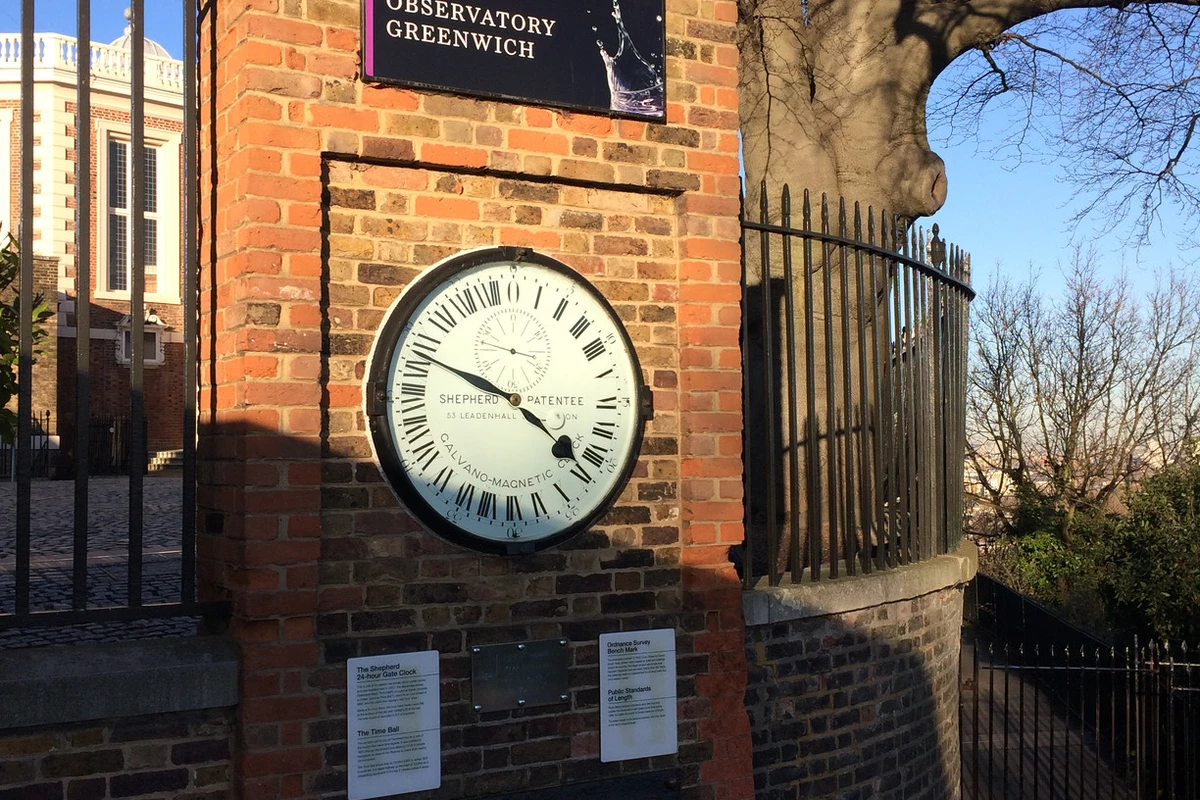
Beside the gate of the old Greenwich Observatory, a large 24-hour standard clock installed in 1851 is mounted on the wall, displaying Greenwich Time and providing the universal standard time used by all countries.
Greenwich Royal Park
Greenwich and its adjacent gardens are typical buildings constructed in the 17th and 18th centuries in the styles of science and art, respectively. Inigo Jones built the first Palladian-style building on the British mainland. The Royal Naval College was designed by Christopher Wren. The gardens are based on the design of André, and the Greenwich Royal Observatory is a masterpiece of both Wren and scientist Robert Hooke.
This is the place I want to highlight. If I went to London, as long as it wasn't raining, I would go for a walk there almost every day. The beautiful park is unforgettable. It has mountains, water, forests, vast lawns, lakes, gardens, a deer park, and many small animals and birds. The park is scenic, quiet, and serene, appearing very grand and truly royal. From the hill, you can overlook much of London. Although it is not as famous as Hyde Park and Regent's Park, it is quieter and more comfortable than those two parks. There are fewer tourists and more lawns. When the weather is nice, nearby residents come here to sunbathe.
Some small animals in the park,
Cherry blossom path in the park
A cherry blossom tree blooming in two colors
Winter in the park (caught the 2018 London heavy snow)
The domed building below is the entrance to the foot tunnel. There is an elevator directly to the tunnel. You can cycle or walk across to the island opposite, then walk to the financial district (Canary Wharf)
View of the Royal Naval College from the opposite bank
The annual marathon also starts from Greenwich
Greenwich has different scenery in spring, summer, autumn, and winter. I have posted many pictures here to enjoy slowly later.


