Third Journey to England - Shakespeare Chapter (3): A Tour of Shakespeare's Globe Theatre, Bankside, and South Bank (Part 1)
Shakespeare's Globe Theatre is located in the Bankside area of London. "Bankside" lies on the River Thames, extending east to Tower Bridge and west to the South Bank area. Thanks to the shipping on the Thames, this area became the economic center of London in the Middle Ages, standing alongside Westminster as the political center. It was also a melting pot of people from all walks of life, much like the ancient Beijing Tianqiao. Shakespeare, as a playwright and actor, established the Globe Theatre here. After the 18th century, prosperity faded, the Globe Theatre was lost, and the area turned into factories and crowded, dirty residential districts. In the mid-20th century, the Festival of Britain was held to commemorate the centenary of the Great Exhibition, resulting in the South Bank Centre. Around the turn of the millennium, under the leadership of the then Mayor of London, numerous cultural facilities and millennium memorial buildings were constructed. Coupled with the golden opportunity of the London Olympics, the area regained its former glory and became a new entertainment and tourist destination in London. Shakespeare's Globe Theatre was also rebuilt in its original style in the 1990s.
In 2017, when we first visited London, we toured Shakespeare's Globe Theatre, HMS Belfast, the Tower of London and Tower Bridge, and took a day cruise on the Thames, strolling along the picturesque riverside several times. We revisited the area during our second trip to England in 2018. Taking the opportunity of writing the 2019 "Third Journey to England - Shakespeare Chapter", I have compiled these impressions for your reference.
Figure: A bird's-eye view of the Bankside area of London. The large ship in the river is the popular tourist attraction HMS Belfast. Next to it is the green building of the new City Hall, and below it, the southern support beam of Tower Bridge is faintly visible. The most prominent structures in the picture are the spire-like The Shard and London Bridge Station.
Figure: A closer look at The Shard. The three bridges from right to left are: 1. London Bridge, 2. Cannon Street Railway Bridge with its elegant bridgehead, and 3. Southwark Bridge.
Figure: A bird's-eye view of the Bankside area. The Shard is visible at the lower right, and St Paul's Cathedral (with its green dome) is in the center. It connects via the Millennium Bridge directly to Tate Modern (with its black chimney and green glass roof). From right to left, the bridges visible are: 1. London Bridge, 2. Cannon Street Railway Bridge, 3. Southwark Bridge, 4. Millennium Bridge, and 5. Blackfriars Bridge.
Figure: The boundary between the Bankside area and the South Bank area at a river bend. From right to left, the bridges visible are: 1. Millennium Bridge, 2. Blackfriars Bridge, 3. Waterloo Bridge, and 4. Hungerford Bridge. The corner of the London Eye ferris wheel is visible on the left side of the picture.
Figure: A bird's-eye view of the South Bank area. From top to bottom, the bridges visible are: 1. Waterloo Bridge, 2. Hungerford Bridge, 3. Westminster Bridge, and 4. Lambeth Bridge. The Houses of Parliament, Big Ben, and the London Eye on either side of Westminster Bridge are famous landmarks. Next to the London Eye, with a green spire, is the old County Hall. Above it (between the two bridges), the green roof of the South Bank Centre can be seen.
Figure: While visiting the Tower of London, a distant view of the Thames beyond the city walls: the circular building on the right is the City Hall, and on the left is Tower Bridge.
Figure: A distant view of the Thames from the Tower of London: the spire is the new landmark The Shard, and HMS Belfast is moored in the river.
Figure: A distant view of the Thames from the Tower of London, with the circular City Hall in the middle.
Figure: A magical combination of tradition and modernity.
Figure: Inside and outside the walls of the Tower of London, green fields and clear skies, classical and modern elements blend perfectly, like a fairyland.
Figure: A time tunnel spanning a thousand years: the Tower of London, completed in 1078, stands 30 meters tall—the tallest building in London at the time; The Shard, completed in 2013, stands 310 meters tall—the tallest in the UK and Europe today.
Figure: After leaving the Tower of London, climbing Tower Bridge offers a panoramic view of the river. In the distance, HMS Belfast and the dome of St Paul's Cathedral are visible.
Figure: From Tower Bridge, looking far into the distance, modern buildings of different shapes echo each other across the river: on the south bank, the sharp The Shard and the circular City Hall; on the north bank, the solid "Sky Garden" tower.
Figure: Descending from Tower Bridge to the south bank of the Thames, the quaint Tower Bridge and the ultra-modern HMS Belfast form a picture that looks like an oil painting against the backdrop of blue sky, white clouds, river, and pier.
Figure: Riverside scenery: the circular City Hall is right next to the southern end of Tower Bridge, flanked by three square buildings that seem to be its supporting office towers, probably also including hotels and restaurants. By the river is the ticket office and pier for HMS Belfast. After visiting this exhibit of the Imperial War Museum, it must be very pleasant to take a rest at the viewing bar upstairs.
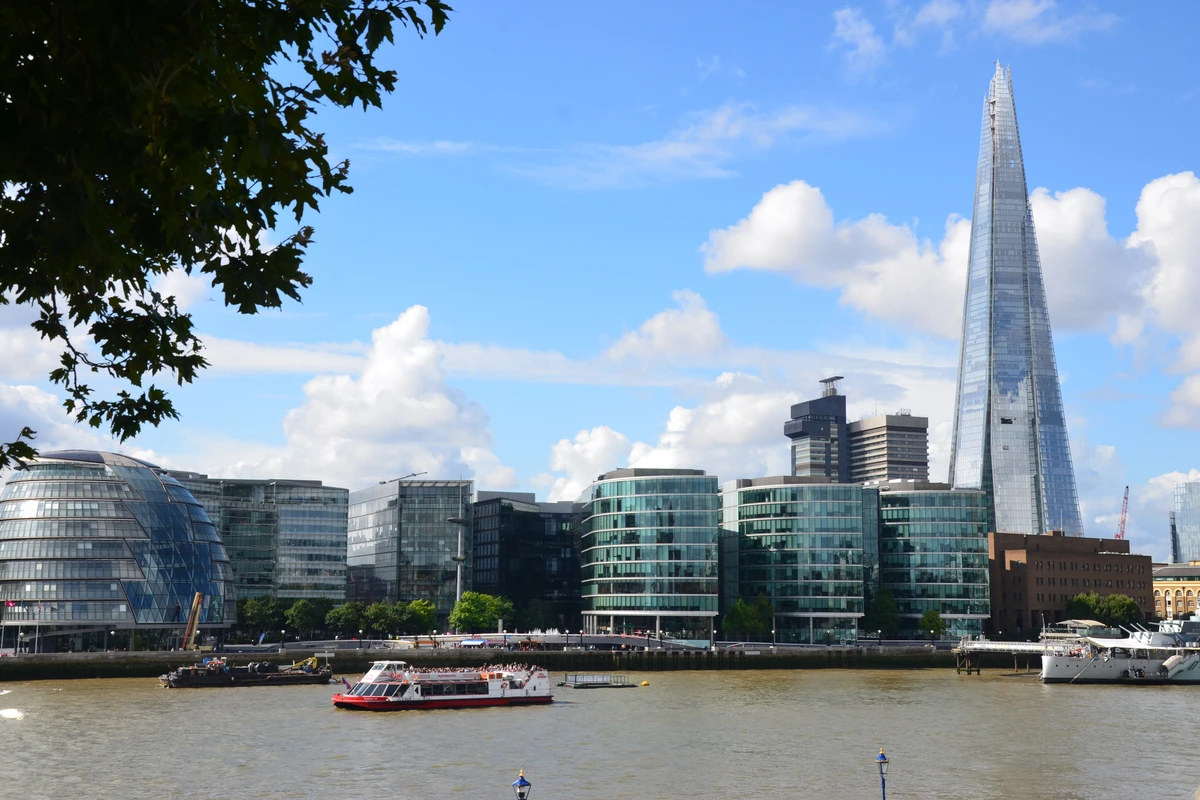
Figure: Riverside scenery: The Shard stands like a jade pillar reaching the sky; on the left, the elliptical London City Hall is visible; below right, HMS Belfast is moored; and red City Cruises boats travel on the river.
Figure: Riverside scenery: The elliptical London City Hall, completed in 2002, contrasts nicely with the spire of The Shard, completed in 2013. A viewing ticket for The Shard costs about £30, while the lobby and top floor of City Hall are open to the public, nicknamed "London's Living Room".
Figure: A riverside bar.
Figure: Not far ahead is the Hay's Galleria shopping mall.
Figure: Originally a dock built in the 1850s, it has been converted into a covered shopping and entertainment venue.
Figure: An honesty library at the entrance. Borrow freely, return after reading, welcome to donate.
Figure: A fountain sculpture called "The Navigator" in the passageway, reportedly movable, attracts many tourists.
Figure: Children's playground.
Figure: Another riverside bar.
Figure: Continuing upstream, the first bridge encountered is London Bridge. Until 1750, it was the only crossing over the Thames. The current bridge was built in 1972; its predecessor, built in 1831, was dismantled and moved to Arizona, USA, costing $7 million.
Figure: Looking back at The Shard from upstream. In the foreground is Cannon Street Railway Bridge; in the distance, London Bridge with buses crossing can be faintly seen; further still, Tower Bridge is visible.
Figure: Southwark Bridge, completed in 1912, lies upstream of Cannon Street Railway Bridge, looking classic and timeless. On the north bank of the Thames, the sharp "Cheesegrater" building is vividly shaped, and the solid "Sky Garden" building shows off its charm against the classical bridgehead.
Figure: View of St Paul's Cathedral from Southwark Bridge.
Figure: St Paul's Cathedral photographed from the south bank of the Thames; this is said to be the best vantage point. It is said that England's greatest architect, Christopher Wren, lived here and often admired his masterpiece—the second-largest domed church in Europe.
Figure: Looking upstream from Southwark Bridge, the Millennium Bridge and Blackfriars Bridge overlap in outline. The Millennium Bridge reaches Tate Modern (the brown chimney of the former power plant is its landmark) on the south bank; at the Blackfriars Bridge head, a new landmark, the Blackfriars Building, nicknamed "Boomerang", rises.
Figure: The Millennium Bridge, completed in 2000, connects directly to St Paul's Cathedral on the north bank, facilitating access for tourists on both sides. To avoid obstructing the view, the contemporary architect Norman Foster abandoned the conventional solution of suspension towers and cables, designing this suspension bridge in its current clean and simple style. However, good things are not easy: it closed only three days after opening due to swaying, and after repairs, it reopened in 2002. In the distance is Blackfriars Bridge.
Figure: View of the National Theatre on the south bank from Waterloo Bridge. This 1976 building has been criticized for its "Brutalist" exterior, but its interior facilities are high-end, with three theatres (large, medium, and small) suitable for different types of performances. Its services are also very user-friendly: visitors can enjoy coffee and scenery on various levels, and there are free outdoor performances.
Figure: The IMAX cinema, located south of the National Theatre. This area was originally a homeless gathering place; in 1998, £20 million was spent to build a stereoscopic cinema with the largest screen in the UK. Ticket prices are only £5-7.
Figure: Enjoying the Thames scenery from Waterloo Bridge. In the distance, Blackfriars Bridge and, on the north bank, St Paul's Cathedral and a cluster of skyscrapers are visible; on the right side of the picture, two landmarks on the south bank: the "OXO" Tower Restaurant and the "Boomerang" building.
Figure: Upstream from Waterloo Bridge is the Hungerford Bridge, built in 1864. The northern end extends into Charing Cross station, completed in 1991. The station looks like an imposing ocean liner, integrating a hotel, large shopping malls, and theatres. In 1901, Monet painted this bridge with the Houses of Parliament and Big Ben as a backdrop, colorful and magnificent.
Figure: Close-up of Hungerford Bridge.
Figure: Flanking Hungerford Bridge on both sides are two pedestrian bridges, opened in 2002, named Golden Jubilee Bridge to celebrate the 50th anniversary of Queen Elizabeth II's reign.
Figure: From this bridge, you can also enjoy river views including the London Eye.
Figure: Walking upstream along the bank, you can see famous landmarks such as the London Eye on the south side of Westminster Bridge and the Houses of Parliament and Big Ben at the north end of the bridge.
Figure: The Houses of Parliament and Big Ben photographed from Westminster Bridge.
Figure: The new landmark London Eye, completed in 2000 for the millennium, costs about £20, is the world's fourth tallest ferris wheel (135 meters), and takes about 30 minutes per rotation. Behind it is the old County Hall.
Figure: The old County Hall has been converted into an aquarium and other entertainment facilities, becoming a popular attraction. There is also a Marriott hotel.
Figure: Scenery of the Thames and the north bank. HMS Belfast is moored in the river. In the distance, London Bridge and the dome of St Paul's Cathedral are visible; on the right, a corner of the Tower of London can be seen. Between them is a cluster of 21st-century skyscrapers.
Figure: Skyscrapers on the north bank of the Thames competing in splendor. On the far left, standing alone among peaks, is 20 Fenchurch Street ("Sky Garden"); the tallest in the middle is 122 Leadenhall Street, nicknamed "Cheesegrater"; the conical building on the right is the famous "Gherkin", officially 30 St Mary Axe, also known as the Swiss Re building. The Tower Hill Memorial on the far right seems to be left out.
Figure: A closer view of the above building cluster. In the foreground is the Tower Hill Memorial, located in Trinity Square Gardens north of the Tower of London.
Figure: Tower Hill Memorial: the main monument was built in 1928, the secondary monument in 1955, to commemorate British naval personnel and seamen who died in World Wars I and II.
Figure: The main monument of Tower Hill Memorial.
Figure: A combination of green, white, gray, and blue colors, like an Impressionist painting.
Figure: This photo has some symbolic meaning—the church (All Hallows-by-the-Tower, built in 675) and heaven (the "Sky Garden" building). In fact, the "Sky Garden" does feel like heaven to ordinary people—the viewing platform is free (previously, tickets had to be picked up one day in advance; now due to the pandemic, online reservation is required three weeks in advance).
Recalling old memories from two or three years ago feels like a lifetime away. I can only silently pray for the end of the pandemic and the restoration of the Thames to its former glory.


