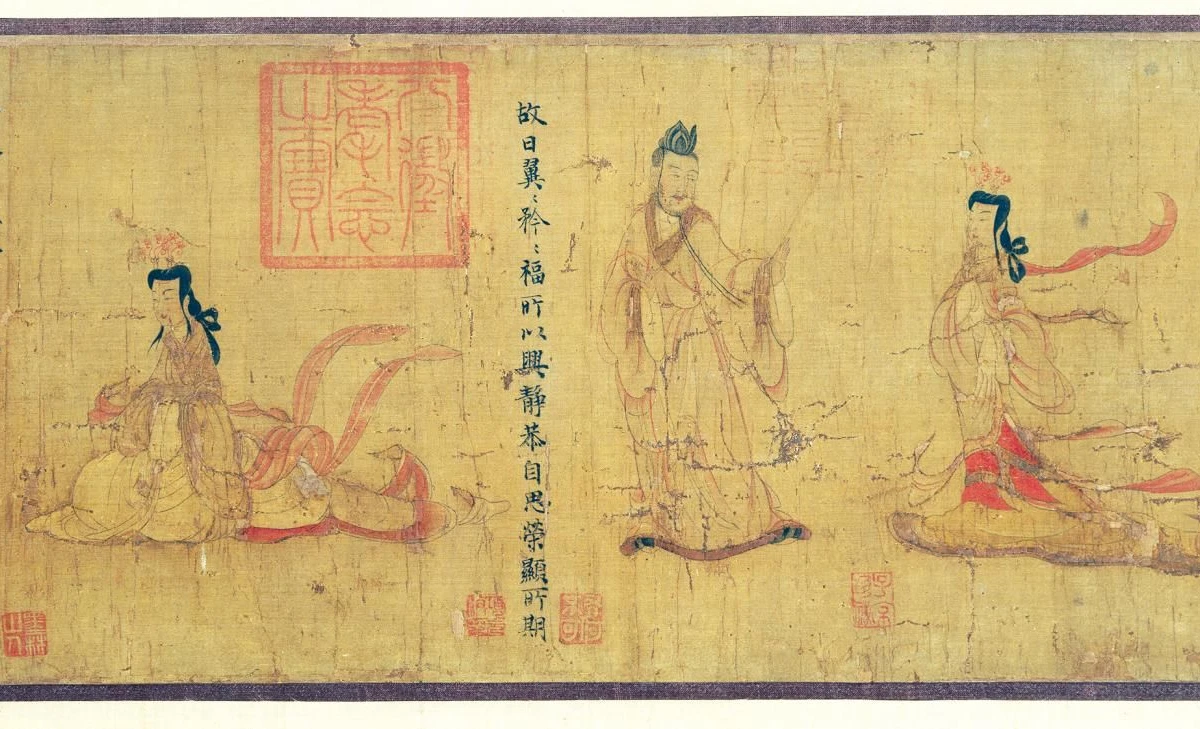
British Museum October Exhibition News | 'Admonitions of the Instructress to the Court Ladies' Only on Display for 6 Weeks
After three years, the British Museum is again exhibiting China's 'Admonitions of the Instructress to the Court Ladies'.
The 'Admonitions of the Instructress to the Court Ladies' is traditionally attributed to Gu Kaizhi (c. 345–406 AD), known as the 'painting ancestor' of the Eastern Jin dynasty, though scholars now generally consider it a 5th–6th century copy. This narrative scroll was painted according to 'Admonitions of the Instructress', a work by the Western Jin literatus Zhang Hua (c. 232–300 AD) written in 292 AD, and aims to teach court women proper virtue through stories of exemplary empresses and concubines. The painting marks a milestone in Chinese art history, signalling the transition from didactic to aesthetic focus, and is one of the finest works in Chinese figure painting.
Seals and inscriptions on the scroll reveal that it was once in the collections of many scholars and connoisseurs, including the Tang dynasty Hongwen Hall (with the 'Hongwen' seal), Emperor Huizong of Song (with the 'Ruisi Dongge' seal), and the Qing imperial collection. The mounting bears a colophon by the Qianlong Emperor and a painting titled 'Pines, Bamboo, Rocks and Spring' by the Qing official and painter Zou Yigui, demonstrating its extraordinary value.
Because the painting is sensitive to light, it can only be displayed for about six weeks each year for conservation. This exhibition is open only from 3 October to 13 November 2022. Visitors are welcome to view it for free in Room 91a of the British Museum.
Also on display alongside the 'Admonitions of the Instructress' are two oil paintings by modern Chinese artist Fu Baoshi (1904–1965): 'The Literati in Distress' and 'Jingangpo', both created during the Second Sino-Japanese War (1937–1945). Fu Baoshi conducted in-depth research on Gu Kaizhi and was influenced by his style in figure painting.
Special Exhibition for the Bicentenary of Deciphering Ancient Egyptian Hieroglyphs
Ancient Egyptian civilisation, one of the oldest in the world, remained shrouded in mystery for centuries until the discovery of the Rosetta Stone. The stone provided the key to deciphering hieroglyphs, advancing human history by three millennia. The Rosetta Stone, one of the British Museum's top treasures, was discovered in 1799. It bears the same decree inscribed in three scripts – hieroglyphs (Egyptian pictographic writing), Demotic (Egyptian cursive), and known ancient Greek – and thus became the unique key to decoding hieroglyphs.
Marking the bicentenary of the decipherment, the British Museum is launching a special exhibition, 'Hieroglyphs: unlocking ancient Egypt', in the Sainsbury Exhibitions Gallery (Room 30) from 13 October 2022 to 19 February 2023. This immersive exhibition reveals the process of deciphering hieroglyphs and the impact of this breakthrough on the study of ancient Egyptian civilisation, taking visitors through key historical moments that unveiled the mysteries of ancient Egypt.
Free Special Exhibition on the Beirut Explosion
On the evening of 4 August 2020, a massive explosion of ammonium nitrate stored at the Port of Beirut, the capital of Lebanon, killed at least 218 people, injured 7,000, displaced 300,000, and caused US$15 billion in damages.
At the Archaeological Museum at the American University of Beirut, over 3 km from the disaster site, a display case containing 74 glass vessels was shattered – ancient glass fragments mixed with those from the case and surrounding windows. In collaboration with the museum, thousands of fragments from eight of the delicate vessels were transported to the British Museum's world-class conservation centre, where they were painstakingly reassembled piece by piece. The restoration of these eight glass objects symbolises the grief, mutual support, and recovery of the Lebanese people after the disaster.
You can view these unique artefacts up close in the free Asahi Shimbun special exhibition 'Shattered glass of Beirut', which showcases the rich cultural heritage of Lebanon and the wider region from the 1st to 9th centuries AD – while the cracks tell new stories. The exhibition runs until 23 October 2022.
Art on Paper Since 1960
From one of Britain's greatest contemporary expressionist painters, Lucian Freud, to legendary contemporary female artist Kiki Smith; from life drawing to minimalism, from etching to collage – the free exhibition 'Art on paper since 1960' in Room 90 of the British Museum covers a fascinating range of styles and techniques in paper art from 1960 to 2017.
The exhibition features around 150 prints and drawings donated by Hamish Parker, a long-term supporter of the British Museum. Focusing on American works, it showcases masterpieces by leading artists from around the world, some of whom have never before been represented in the Museum's collection. The exhibition continues until 5 March 2023. Come and embark on a wonderful journey through the past 60 years of art on paper!


