Experiencing the Euro-Asian Life in Istanbul
Straddling two continents, Europe and Asia, Istanbul, as the capital of the thousand-year empire Constantinople, known as the capital of the world, has always attracted me to explore. The Turkish visa, which can be obtained instantly as an e-visa, makes it even more convenient for everyone to travel to Turkey. Turkey has many unique tourism resources, but I am particularly fond of Istanbul, so this time I only visited one city to experience it. The mosques scattered throughout the city make you feel it is an Asian city, while the transportation and lifestyle are very Westernized, making you feel it is also a European city. Istanbul is the largest city in Turkey, with a population of over 14 million. It is the economic, cultural, and transportation center of Turkey and is considered a first-tier global city. I flew from London with Wizz Air for about 4 hours and arrived in Istanbul early in the morning. The booked Sheraton City Center Hotel is near the famous Taksim Square. In the morning, I walked about 1 km to the square to scout the area. Taksim Square has a metro station and bus stops, making it very convenient to visit various attractions. Since traffic jams are quite severe in Istanbul, I mainly used public transportation this time.
It is very important to get an Istanbul red public transport recharge card at the metro station. It can be used for metro, tram, bus, funicular, and cable car, and even to pay for entry to toilets. Since taking the public ferry between Europe and Asia is very convenient, we basically took the boat every day to enjoy the scenery on both sides and the busy Bosphorus Strait, a golden waterway.
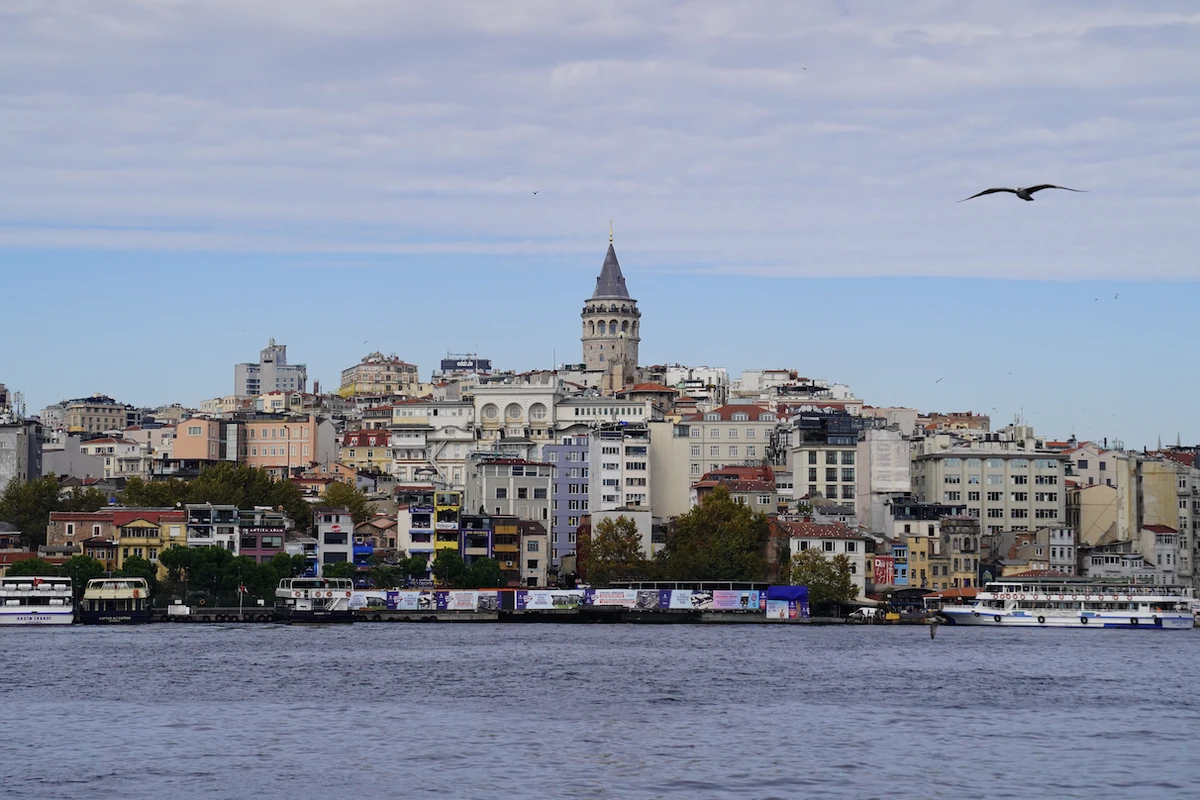
The map above clearly describes the layout of Istanbul's districts and attractions, even the piers. The main attractions in the city are located in the European district. In the afternoon, I took the T1 tram to EMINONU Pier in the old European district, then took a ferry to KADIKOY Pier on the Asian side. A single ticket costs 24 lira, about 5 RMB, which is very cheap. Since the ferry goes back and forth between the two piers, if it doesn't stop running, you can basically make multiple round trips without getting off. From the pier, I could see the Galata Tower in the new European district. EMINONU Pier is the busiest, with crowds every day. There are many benches and shops along the shore, where many locals and tourists sit leisurely, enjoying the views on both sides and the passing cruise ships.
In the morning, I set off from Taksim Square to visit Hagia Sophia and the Blue Mosque. Yesterday, I relied entirely on walking up and down the slopes. After studying the F1 line at night, I finally understood that F1 is an underground funicular train. Google can't find this line even if you're a god, and Apple Maps doesn't provide navigation services in Istanbul. After searching through many travel guides, I discovered this line, which became essential for the following days. I smoothly went from Taksim to the T1 tram line and got off at Sultanahmet station. Soon, I saw the Blue Mosque and Hagia Sophia. This is the hottest tourist spot in Istanbul, packed with people. Around 2 PM, I arrived near Hagia Sophia and saw a long queue, estimated to take 3 hours to enter. So I gave up and decided to come another time. Then I visited the Blue Mosque and the Hippodrome of Constantinople.
Hagia Sophia was originally the main cathedral of the Byzantine Empire, later converted into a mosque after the Ottoman conquest, and now serves as a museum. It is a historic building in Turkey and one of its symbols. The second floor is open to visitors for a fee.
The Blue Mosque is right across from Hagia Sophia. It was built without a single iron nail, with strict architectural structure, and has survived several major earthquakes undamaged. Its real name is the Sultan Ahmed Mosque. Entrance is free; visitors can take off their shoes and enter the ground floor.
This morning, I exercised and swam at the hotel. I planned to climb the Galata Tower in the afternoon and visit Hagia Sophia.
The Galata Tower is a landmark of Istanbul's new city, standing on the Golden Horn. From the top, you can overlook the Bosphorus Strait and the Golden Horn. It was originally a lighthouse built by Byzantine Emperor Anastasius in 507 AD, initially made of wood, later burned down, and rebuilt in stone by the Genoese in 1348, becoming the highest point of the then fortress. The stone tower is a landmark in the new European city and a must-visit spot for tourists in Istanbul. Since the ticket I booked is valid for 10 days, I had plenty of time.
After visiting the Galata Tower, I went to the new palace. The new palace, also known as Dolmabahçe Palace, was built in the mid-19th century during the Ottoman Empire. It is located on the European coast of the Bosphorus Strait, with the building complex stretching 600 meters along the strait, covering 15,000 square meters, with 285 rooms and 43 halls. It is magnificent, showing the former glory and wealth of the Ottoman Empire. Several sea gates near the palace are particularly suitable for tourists to take photos.
A panoramic view of the new palace on the coast.
The most impressive central hall inside the new palace houses the world's largest crystal chandelier, weighing 4,500 kg.
Around 5 PM, I arrived at Hagia Sophia for a visit. By then, most tour groups had finished, so I quickly entered without queuing, which was quite exciting. As the most famous attraction in Istanbul, I could finally appreciate its true appearance up close. Inside the magnificent central hall, the floor is paved with multicolored marble, and the walls are inlaid with colorful marble patterns, creating a vibrant display. The various small and large windows and low-hanging chandeliers maintain the light in the hall. The dome retains Byzantine frescoes, and large circular Arabic calligraphy plaques hang on the second-floor columns. Under warm lighting, the interior of the church looks solemn and dignified.
After visiting Hagia Sophia, I returned to Taksim Square. After getting off at the T1 tram stop, I went to the seaside to enjoy the strait scenery under the sunset. Standing by the shore, quietly watching the boats come and go, the seagulls flying freely, listening to the waves, and enjoying a relaxed and carefree life, I completely forgot the pressure of work.
This morning, I went to Lovers' Hill on the Asian side to admire the new European district and overlook the Bosphorus Strait from a high vantage point. Lovers' Hill, also known as Çamlıca Hill, is 267 meters high and offers a perfect panoramic view of the Bosphorus Strait, the Martyr's Bridge, and the new European district. I took bus 129T from Taksim Square to Lovers' Hill, experiencing the unreliability of the bus again—it was hard to wait for and had poor value. The nearest metro station to the hill is Kısıklı. Even transferring multiple times by tram and metro is more reliable than the bus. This spot seems frequented more by locals than tourists, but the view from the top is spectacular, and the feeling of looking down from a height is great. I also enjoyed local coffee and black tea on the hill, which was a unique experience: drinking coffee in Asia while looking at Europe—something unique in the world. The coffee and tea on the hill are very cheap. Turkish black tea costs less than 2 RMB, and coffee costs 12 lira, less than 3 RMB per cup.
In the afternoon, I took a bus from the top to the trendy spot, BALAT colorful neighborhood. BALAT is located on the coast of the old European district, with charming colorful buildings, winding slopes, and vintage cars, attracting many visitors to take photos.
During my days in Istanbul, I became addicted to taking ferries. Sitting on the open upper deck, watching seagulls chasing the ferry, the gradually approaching and receding scenery on both sides, and other passengers constantly taking photos, I realized that the ferry is the most popular public transport in Istanbul and also the one with the best views.
The Maiden’s Tower is a Baroque-style lighthouse standing on a small islet in the Bosphorus Strait near the Asian shore. Though not grand in appearance, it is one of Istanbul's romantic symbols. Although I passed by the Maiden’s Tower several times, I didn't have a good angle, so I didn't take out my camera. Now, the Maiden’s Tower represents a holy place of love, attracting many couples to express their faithful love.
After getting off the ferry, I wandered along the shore, feeling the bustling city full of people and traffic, and especially tasting the local cuisine. In the afternoon, I tried Turkish kebab, one of the world's three major cuisines, and also tried traditional Turkish black tea and pickled peppers, all worth experiencing. Turkish desserts are especially delightful to the taste buds. The desserts in the picture are cheap and delicious, no wonder there is a long queue outside the shop.
Due to work in London, I use London as my starting point for many European countries, so I returned to London after Istanbul. After a night's rest, the next day I went to visit the famous White Cliffs. The White Cliffs are located in the town of Eastbourne, with beautiful alpine meadows and the most spectacular white cliff coastline. I followed the cliff path to Birling Gap beach, which is the best for sunbathing. Birling Gap is the core of the scenic area and also a stop for sightseeing buses. Getting off here allows you to walk the least and see the most beautiful scenery.
In the afternoon, I took a train back to London and encountered great weather. Carrying my camera, I set off on foot along the Thames, tirelessly citywalking.
This trip of a few days in Istanbul deeply attracted me to the city. As an ancient capital of a thousand years, it has moved beyond its past glory. Now, Istanbul is a world-renowned tourist city, with world cultural heritage sites, modern CBDs, and Europe's largest airport, one of the busiest in the world. The city's comprehensive public transport system makes it easy for visitors to reach all attractions. The daily leisurely ferry rides are what I miss most. On the ferry, you experience a cityscape that is both busy and leisurely, modern and retro, Asian and European.
Travel Directory
1. Arrival in Istanbul, a taste of city scenery
2. Visit the Blue Mosque, cruise the Bosphorus Strait
3. Hotel exercise and swimming, climb the Galata Tower, visit Hagia Sophia
4. Drink coffee in Asia while looking at Europe, visit the Balat colorful neighborhood
5. Enjoy the White Cliffs in an English town, citywalk along London's Thames River
Travel Information
Hotel Index
Guide Index
Ticket Index
Website Navigation
Travel Index
Cruise Index
Corporate Travel Index
Franchise Cooperation
Distribution Alliance
Friendship Links
Corporate Gift Card Purchase
Insurance Agency
Agent Cooperation
Hotel Franchise
Destination and Attractions Cooperation
More Franchise Cooperation
About Ctrip
About Ctrip
Ctrip Hot Topics
Contact Us
Careers
User Agreement
Privacy Policy
Business License
Security Center
Ctrip Content Center
Intellectual Property
Trip.com Group Algorithm Publication


