【Keith's European Study Series】Part 2: The Acropolis of Athens: A Tale of Romance and Timeless Beauty
【Keith's European Study Series】Part 2: The Acropolis of Athens: A Tale of Romance and Timeless Beauty
In the history of human civilization, no place is more suited for such contemplation and exploration than Greece.
Greece is a ethereal and soul-stirring celestial masterpiece. It once nurtured the very heart of Western wisdom. Western philosophy, democracy, the Olympic Games, Aesop's Fables, the Iliad, and Homer's Epics—every name touches the depths of the human soul. The Acropolis of Athens, the eye of Greece, is the spiritual home and ideal pursuit of every traveler on earth.
After Keith arrived in Athens on November 7 last year, the first attraction he wanted to visit on the weekend was the Acropolis of Athens. Unfortunately, the COVID-19 pandemic was raging at the time, and Athens was under lockdown. Except for emergencies such as going to the supermarket, seeking medical treatment, or picking up children from school, people were not allowed to go out freely, so the trip to the Acropolis was postponed.
With the arrival of spring 2021, Athens became vibrant and colorful, with softer and brighter weather, filled with the fragrant and diverse scent of spring. Taking advantage of the weekend, we brought the children to the Acropolis in the city center for a walk. After all, they had been attending online classes for four or five months, so it was time to relax. This was also Keith's first visit to a historical site after more than five months in Athens.
Greece is an ancient civilization and the cradle of Western civilization. Ancient Greek history is as long as that of China, with a splendid civilization spanning over 3,000 years. More than 2,500 years ago, ancient Greek civilization was at the forefront of the world, exerting a profound and extensive influence on the West and even the entire world in philosophy, mathematics, language, sculpture, art, political systems, religion and mythology, culture, and technology.
The Acropolis of Athens, located on a rocky hill in the center of Athens, is surrounded by steep cliffs on its east, south, and north sides, making its terrain extremely rugged. The Acropolis is about 280 meters long from east to west and about 130 meters wide from north to south. In Greek, it is called "Acropolis," meaning "high city" or "city on a high hill." It was the religious center of ancient Greece and the most outstanding group of ancient buildings in Greece.
The Acropolis of Athens was first built in 580 BC. It is a hilltop city fortified by solid stone walls, covering an area of about 3 hectares (30,000 square meters). It includes the four greatest masterpieces of classical Greek art: the Parthenon, the Propylaea, the Erechtheion, and the Temple of Athena Nike. It represents a thousand years of Greek prosperity, flourishing civilization, mythology, and religious history. In the history of Western architecture, it is regarded as an extremely successful example of architectural group composition, particularly in its ingenious use of terrain.
The earliest building on the Acropolis was the Temple of Athena. The Parthenon, with a total area of 1,200 square meters, is a temple of ancient Greek religion. It is the most famous building in Greece and even the world, one of the renowned Seven Wonders of the Ancient World, built 430 years before the advent of Christianity. Its area is one-third that of Notre Dame de Paris, and it is 1,500 years older than the cathedral.
The Erechtheion, built in 406 BC, stands opposite the Parthenon. It is an elegant Ionic temple that uniquely combines two sanctuaries—one for Athena and one for Poseidon. In 1987, the Acropolis of Athens was approved as a cultural heritage site by the UNESCO World Heritage Committee and inscribed on the World Heritage List.
For over 2,500 years, the Acropolis of Athens has remained the most beautiful scenery in Athens. Foreign invasions, war damage, religious desecration, cultural plunder, and the erosion of time have all failed to erase its brilliant and eternal charm.
In the ruins of the Acropolis shine the ideals of the Greek Golden Age: the philosophy of Socrates, the geometry of Pythagoras, the physics of Archimedes, the wise tales of Aesop's Fables, and the myths and legends of the Greek gods. The Acropolis of Athens represents the highest level of ancient Greek architecture, temples, columns, sculpture, and aesthetic art.
On the morning of April 17, 2021 (Saturday), after breakfast, we took Keith on the Metro Line 2, transferring to Line 3 to Akropoli Station. In the spring of Athens, the sun is abundant, the atmosphere is elegant and fresh, and hundreds of flowers are in full bloom, adorning the city with vibrant colors.
At the exit corridor of Metro Line 3 to the Acropolis, an exhibition of unearthed artifacts piqued Keith's curiosity. Placing cultural relics in the metro station—such an innovative exhibition is lively and interesting.
Exiting the metro, we walked along a path paved with highly polished bluestone slabs toward the Acropolis. Today, Athens had a gentle breeze and bright sunshine, with crowds of tourists bustling along the pedestrian walkway at the foot of the Acropolis hill.
What came into view was a magnificent complex of ancient Greek European-style buildings, proudly standing on the top of the Acropolis hill. The temples were grand in structure, exquisite and spectacular in design, beautifully ornate, with delicate and vivid carvings, and robust in architecture. Standing among them felt like being transported to another era.
At the entrance to the site, we bought tickets (€20 for adults, half price for minors) and slowly walked up the slope toward the hill. First, we visited the rows of fragmented stone columns arranged in groups. The mottled marble columns were carved into various mythological figures, with exquisite craftsmanship and elegant design. Broken walls and scattered ruins lay everywhere, silently telling the glorious history of the Acropolis's past and present, forming a magnificent and unique landscape.
It is hard to describe the complex feelings upon first seeing the Acropolis. The former grandeur and beauty now remain only in ruins, reminding me of the Old Summer Palace in Beijing. Once adorned with carved jade railings, lavish beauty, and enchanting splendor, it has now undergone great changes, with its glory faded and prosperity withered, evoking deep emotions.
The architectural form of the Acropolis of Athens was not only considered a model during the Greco-Roman period but also continues to exert an extraordinary influence today. Neoclassical monuments around the world are inspired by the artistic inspiration of the Acropolis monuments.
According to ancient Greek mythology, Athena was born from the forehead of her father Zeus. She taught humans weaving, tailoring, sculpture, pottery, and painting. She is the goddess of war, wisdom, civilization, and crafts, and later became the patron goddess of the ancient city of Athens.
The main deity enshrined in the Parthenon is the goddess Athena, who has multiple incarnations: Athena Polias (goddess of the city), Athena Promachos (goddess of war), Athena Nike (goddess of victory), and Athena Ergane (goddess of crafts). In ancient times, Athena was also an important spiritual pillar and source of strength for the Greek army, inspiring them to advance courageously and achieve victory. She was also a symbol of the prosperity, strength, and abundance of the city-state.
The Acropolis of Athens has endured many tribulations throughout history.
During the Morean War in 1687, the Venetians besieged Athens, causing severe damage to the Parthenon and other buildings. At the time, the Turks had stored gunpowder in the Parthenon, which was hit by a cannonball and exploded, causing immense devastation to the Acropolis. In 1806, the British ambassador to the Ottoman Empire, Lord Elgin, looted a large number of marble reliefs from the Parthenon. These stone carvings later became known as the "Elgin Marbles" and are now housed in the British Museum. In recent years, the British Museum has faced increasing international pressure to return the looted Parthenon sculptures to their rightful place.
In early December 2019, I visited the National Archaeological Museum of Athens (also known as the Athens Archaeological Museum) with my wife and friends. The museum displayed thousands of exquisite stone statue artifacts, with finely engraved lines and curves, highlighting the highly developed artistic aesthetic level of the ancient Greek people. These relics, which were almost as advanced as those from China's Spring and Autumn and Warring States periods, added a sense of respect and reverence for Athens and Greece, deepened our understanding of ancient Greek civilization, and allowed us to feel the brilliance and splendor of Greek civilization.
In addition to its highly developed material civilization, Greece's significant contribution to the world and humanity is also reflected in its early exemplary model of social democracy. In the 5th century BC, Greek democracy, economy, and culture reached their glorious peak. The variety of cities expanded, and many public buildings were constructed, including senates, assembly halls, theaters, clubs, galleries, hotels, markets, workshops, docks, and stadiums. At that time, many of the rights of citizens in Greece had gained widespread recognition across society.
We climbed the steep cliffs on the south side of the Acropolis. Under the clear sky, the clouds were vast and blue, the ground was filled with the fragrance of flowers. Along the way, we saw tall ruined columns scattered among the rugged rocks, bearing the marks of time and shining with the memory of a splendid culture. These exquisite and precious carved fragments revealed the former elegance, grandeur, and glorious history of the Acropolis.
Then, we entered a large open-air theater with a unique and exquisite design—the Theater of Dionysus. This grand theater boasted a magnificent design, with a beautifully arranged circular layout that expanded outward in layers. The theater had 18,000 seats, accommodating nearly 20,000 people. Its remarkable feature was its acoustics: even at the edge of the vast semicircular theater, the audience could clearly hear the actors' soft sighs and the sound of tearing paper, just like those in the front rows. The skill of ancient Greek architects in applying acoustic principles to building design still impresses today's engineers.
Further drawing our attention was the Acropolis Museum, built in 1878 and located to the southeast. It houses a rich collection of genuine historical artifacts that are extremely precious. The museum has nine rooms, displaying precious stone carvings and reliefs from the temples of the Acropolis, including the "Man Carrying a Calf," the "Wingless Victory (Nike Adjusting Her Sandal)," and four Caryatids from the Erechtheion, preserved in nitrogen-filled cases.
Continuing uphill, we soon arrived at the Odeon of Herodes Atticus, located on the southwest slope. This three-story structure could seat over 6,000 people and served as an even more magnificent concert hall. It featured a high arched colonnade on each side, adding to its splendid beauty. Built during the Roman era, it is still in use today and is likely the longest continuously used theater in the world, unique for its continuity over millennia. The semicircular auditorium of the concert hall had a diameter of 38 meters, allowing the audience at any point to clearly hear the actors' lines and musical performances.
The Temple of Athena Nike is located to the right of the Propylaea. It was constructed entirely of Pentelic marble, quarried near Athens. The temple, measuring 18 feet long and 12 feet wide, consisted of an Ionic portico and a roughly square inner chamber. A frieze, 18 inches wide and adorned with high-relief carvings, surrounded the exterior of the building. The temple had a front hall, main hall, and back hall, with a relief sculpture of Athena holding a shield on the east side.
The city of Athens is named after the goddess of wisdom, Athena. According to ancient Greek mythology, when people built a new city on the shores of the Aegean Sea, Athena wanted to be its patron goddess, while Poseidon, the god of the sea, also sought to claim the city. They could not agree and began to compete. Then, Zeus, the king of the gods, decreed that whoever could give humans the most useful gift would win the city.
Poseidon struck a rock with his trident, and a warhorse, symbolizing war, emerged from it. Athena, however, struck a rock with her spear, and immediately an olive tree with lush branches and abundant fruit grew from it. The olive tree symbolized peace and harvest, and the people cheered. Thus, Athena became the patron goddess of the new city. They named the city Athens after her and planted olive trees all over Athens.
This moving myth reflects the Greek people's desire for peace and aversion to war, resulting in the city being granted to the goddess Athena. She thus became the protector of Athens, giving the city its name. Later, Athens came to be regarded as the "city that loves peace."
To this day, the olive branch and the dove of peace have become universal symbols of human civilization, representing humanity's pursuit and belief in "loving peace and upholding justice."
The architecture of the Acropolis of Athens is closely integrated with the terrain, demonstrating the masterful architectural vision of its designers. If we view the Acropolis as a whole, the hill itself serves as its natural base, while the structure of the building complex and even the arrangement of many parts harmonize naturally with the undulating contours of the base, forming a complete unity. It is considered a perfect embodiment of the Greek national spirit and aesthetic ideals.
The only entrance to the Acropolis is on the western cliff. Viewed from above, the plan of the Acropolis resembles a leaf, with the stem at the entrance. Upon entering, the first building complex is the Propylaea, built between 437 and 431 BC, designed by Mnesicles. It is a marble structure with a wide central gateway and colonnades on either side, from which the sacred way to the Acropolis begins. The two wings of the gateway are asymmetrical: the north wing was once a picture gallery, and the south wing was an open loggia. During the Turkish occupation, the Propylaea was used as a powder magazine, and the Turkish governor once lived there. In 1640, the Propylaea was severely damaged by a lightning strike.
We paused at the entrance for a moment to take photos. A helpful Greek young man offered to take a family picture for us, and we were deeply touched by the warmth and sincerity of the Greek people. Keith said that from the first day he set foot on Greek soil, he had felt the kindness and friendliness of the Greek people toward the Chinese. People on the street would greet us, smile, nod, and say "Ni hao"—it was truly heartwarming.
Passing through the Propylaea, we entered the core area of the Acropolis, where several magnificent ancient buildings have stood for millennia, exuding grandeur and dignity. This area housed the Temple of Athena, the Parthenon, the Erechtheion, and other temples, filled with a strong religious atmosphere and classical charm. The temples featured ingenious carving techniques, with various decorations interspersed, as if narrating the vicissitudes of history and timeless legends, proudly displaying their ancient charm and majestic spirit.
A gentle breeze swept across the hilltop, bringing great comfort. We walked along the long stone path, admiring the Parthenon and the Erechtheion. The Parthenon was designed by the renowned architects Ictinus and Callicrates under the supervision of the magistrate Pericles. It took nine years to build and was completed in 438 BC. Located at the highest point of the Acropolis, it is the largest and most imposing structure, serving as the center of the Acropolis. For over 2,500 years, this temple built of white limestone has stood against the blue sky and bright sun, displaying a solemn and magnificent beauty.
The Parthenon is a rectangular peripteral temple built on a three-step base. It is about 70 meters long from east to west and less than 31 meters wide from north to south, with an original height of over 13 meters. The temple is surrounded by 48 Doric marble columns with semi-circular flutes and conical capitals, each 1.9 meters in diameter and over 10 meters high. Above the three-tiered colonnade, the marble architrave and cornice are composed of alternating triglyphs and metopes. The triangular pediments at the east and west ends are adorned with high-relief sculptures. The overall appearance of the temple is harmonious and majestic, conveying a sense of stability, solidity, elegance, and solemnity.
Through two rows of columns, people entered the "Hundred-Foot Hall" within the temple, where a 12.8-meter-high statue of Athena once stood. She was fully armed, wearing a helmet adorned with chariots and eagles, holding a shield in her left hand and a statue of Nike (Victory) in her right. The statue was covered in gold sheets, with her face, arms, and toes decorated with ivory, and her eyes inlaid with precious gems. To facilitate transport in emergencies, the core of the statue was made of fragrant wood. It was the masterpiece of Phidias and a representative work of the "Golden Age" of ancient Greek sculpture.
The Parthenon also has unique features in architectural aesthetics. The foundations and cornices at the east and west ends curve slightly upward to create a visually more grand and elevated effect. Additionally, the four corner columns are slightly thicker than the others to correct the optical illusion observed from a distance. A large number of marble carvings with mythological and religious themes are an integral part of the temple's artistic whole.
The Erechtheion, built between 421 and 405 BC, was dedicated to Erechtheus, the son of Athena and the legendary king of Athens. It is another gem in the Acropolis complex. Its ingenious and complex architectural design, along with its exquisite and perfect details, is rare in ancient Greek architecture. Particularly distinctive are its Caryatid porch and windows, which are unusual in classical architecture.
The Erechtheion was built on uneven terrain, resting on three different levels of foundations, with an irregular combination of multiple rectangular plans, reminiscent of the famous Minoan Labyrinth on Crete. Inside stood a statue of Athena in full armor, which served as the model for all later statues of Athena. The Caryatid porch is located on the south side of the temple, featuring six female figures (now replicas; five original Caryatids are housed in the Acropolis Museum, and the sixth—the second from the west—was taken by Lord Elgin to London and is now in the British Museum), each 2.3 meters tall, with full figures, dignified bearing, facing south, supporting a flat marble entablature and ceiling on their heads. The carvings are lifelike, with realistic clothing and attire. Below the maidens lies the tomb of Cecrops, the mythical first king of Attica and the father of Athens. This king was also a witness to the contest between Athena and Poseidon for the patronage of Athens.
The Acropolis of Athens gave birth to the great civilization of Greece. Here, Plato, Aristotle, and a host of other wise ancient Greek philosophers wrote their works and taught their students; Aeschylus, Aristophanes, and other witty and humorous playwrights staged their immortal tragedies and comedies; Pericles and other visionary politicians delivered their grand speeches; and talented artists and architects such as Phidias, Ictinus, and Callicrates fully displayed their extraordinary skills, leaving behind masterpieces for future generations. The Acropolis of Athens is the oldest and best-preserved remnant of classical civilization in Europe and is considered one of the birthplaces of European civilization.
The Temple of Athena Nike, also known as the Temple of Wingless Victory, stands beside the south wing of the Propylaea. It is a graceful temple with Ionic columns. According to legend, the citizens of Athens cut off the wings of the statue of Nike (Victory) so that victory would never leave them, hence the name "Temple of Wingless Victory." This temple has experienced a history of rise and fall and the ravages of war. In the 17th century, the British removed many of its reliefs, and by the 21st century, only a few 11-meter-high columns remained.
Walking toward the eastern viewing platform, we saw the Greek flag flying high and fluttering in the wind. Leaning against the railing, we looked into the distance at the Aegean Sea, shimmering with light, vast and misty, infinite and deep blue. Taking a deep breath, the Acropolis was right in front of us, within reach. Looking down, the entire cityscape of Athens spread out before our eyes, with a unique charm.
The Sanctuary of Artemis Brauronia was dedicated to Artemis, the goddess of the moon and hunting in Greek mythology. To the left are the remains of a square platform.
The roofs of these temples were gone, their interiors empty, the ground uneven and scattered with collapsed wall stones and broken columns. Only the marble columns of the temples still stood tall and intact, faintly recalling their former glory and splendor.
Sitting beneath the tall and upright rows of columns that have stood for millennia, our hearts soared.
Sunlight filtered through the clouds, illuminating the ground beneath our feet. A gentle breeze brushed the columns, like cheerful fingers strumming the strings of a harp, stirring the slumbering memories of visitors. Keith closed his eyes and let his thoughts wander.
Descending from the Acropolis hilltop, we headed to a high ground formed by large rock formations to the northwest, which is the best spot to watch the sunset over the Acropolis. Many tourists were sitting in groups on the rocks, enjoying the view of Athens' streets and alleys. Finally, we walked 850 meters to Syntagma Square to watch the changing of the guard ceremony in front of the Hellenic Parliament building.
Today's visit to the Acropolis was deeply moving. Whether it was the esteemed nobles or the high-ranking princes and dukes, all the splendor and beauty of this world, in the blink of an eye, were transformed into those cold stone columns, fragmented statues, broken foundations, and faded stone carvings. It left one with a feeling of "things are fleeting" and "success and failure turn to nothing."
Like all modern cities, Athens also faces the collision between tradition and development. These are the descendants of Socrates and Plato—wise and broad-minded, eloquent, passionate, and fiery. What is most remarkable is their serene and unhurried attitude, undismayed by honor or disgrace. This is a tranquility and composure that has survived thousands of years of calamities. Possessing the richest cultural heritage in the world, the people of Athens do not show the slightest arrogance or complacency. Instead, they live leisurely and calmly, with ease and nonchalance. From time to time, the melodious sound of music and soft singing drifts through the streets and alleys, echoing in this ancient, peaceful, and tranquil town. It gives one a warm and romantic feeling of "quietly seeing the southern mountains."
No matter how turbulent the outside world is, they have a broad-minded and detached perspective in their hearts. They walk by the sea, sing, herd sheep, walk dogs, enjoy the Mediterranean breeze, and amidst the sea and sky of the Aegean, they leisurely cultivate their free spirits, releasing a spirit of tranquility and a brilliant, enduring culture.
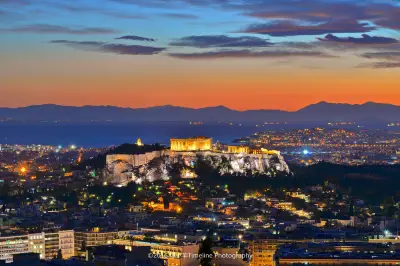
Late at night, the bustling city quieted down, and Athens fell asleep. Looking back at the Acropolis, the rows of white marble columns, illuminated by lights, emitted a bright radiance. Against the starry sky, they appeared especially holy, as if the goddess Athena, holding a torch, silently watched over her people.
【Travel Information】
Acropolis entrance fee: €20. Students can enjoy a half-price discount, ticket price €10.
Opening hours: 08:00–19:30; winter: 08:30–17:00.
Transportation: Take Metro Line 2 and transfer to Line 3 to reach the station.
Thomas Luo
Written in Athens, May 11, 2021