A Troublesome Journey to the West: Southern Spain
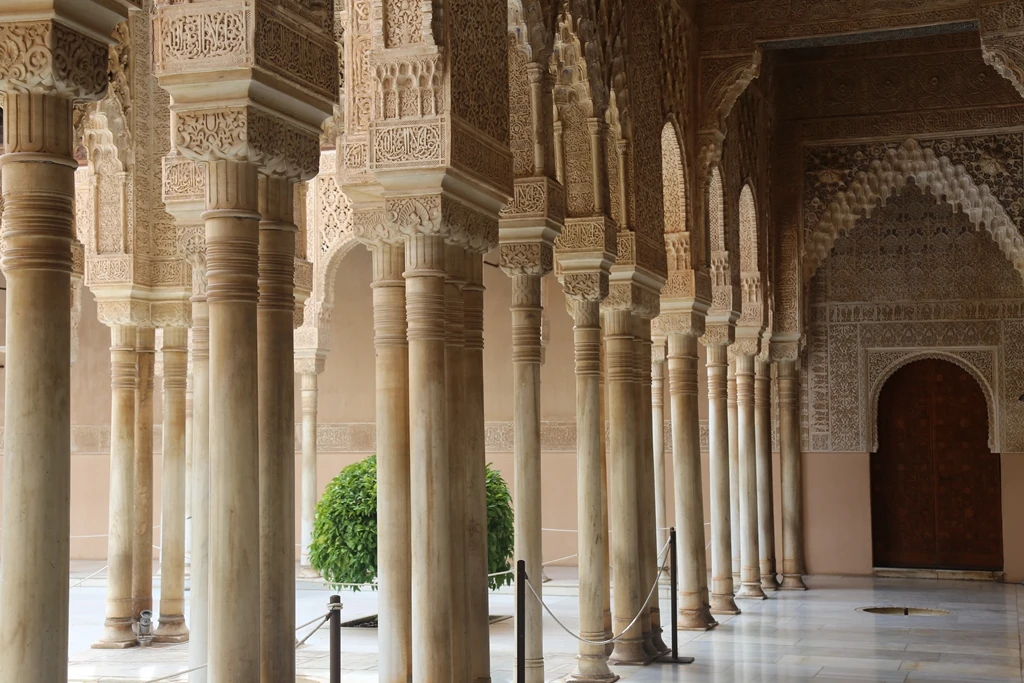
For this trip to Spain, we chose the southern region of Andalusia. Here, there are both sunny coasts and North African vibes. The unique architecture and cuisine made us want to explore. According to the planned itinerary, we were to take a train to Jerez... The reason for this choice was partly to experience Spain's public transportation system. The distance from Madrid to Jerez is about 600 kilometers, and driving would take 5 to 6 hours, with no particularly scenic views along the way. Taking the train would be a bit faster. After exiting Terminal 2 at Madrid Airport, we took the airport shuttle to Terminal 4, where the airport express to Madrid's Atocha central train station is located. We had already booked train tickets from Madrid to Jerez online. By printing the order, we could ride the airport express from the airport to the train station for free. We arrived at the central station around noon local time, with plenty of time before departure, so we had coffee near the station and looked at the surrounding streetscape. Wanting to keep the train tickets as souvenirs, we specifically used the self-service ticket machine at the station to print them. Renfe, Spain's national railway company, is an excellent old-established company operating most train lines in Spain. Compared to other travel modes, Spanish train travel is relatively expensive. For instance, the Madrid to Jerez route is 620 kilometers, takes 3 hours and 20 minutes, and costs 70 euros. Of course, if you manage to get discounted tickets, it's quite a deal. Later, we bought train tickets from Seville back to Madrid at 40% off—a story for later. Boarding began. Spanish trains are similar to China's high-speed trains, with assigned seats. The carriage was not full and was very quiet, with a maximum speed of 250 km/h. We looked out the window at the scenery. It was late September, and the weather wasn't very cold, but it felt like winter—somewhat desolate. In the outskirts, many hills were withered and yellow, with no green grasslands, only a few scattered trees. Much of the land lay fallow, with no crops, and rivers were rarely seen. We enjoyed the scenery... Arriving in Jerez de la Frontera local time past 7 PM, it was still light. Exiting the station, we looked back and saw that the train station was actually a beautiful building. A row of taxis waited outside. According to GPS, the hotel was only 800 meters away, so we decided to walk. Dragging our suitcases and taking a few wrong turns, I was about to get annoyed when we arrived at the hotel entrance. A long day! A bad day! A tiring day! And an uncertain tomorrow! Now I just wanted to go to sleep, and figure out what to do after waking up. The next morning... After many setbacks, the southern Spain trip was about to begin. We hoped this bad start would end here. We picked up our luggage and met two anxious companions waiting at the hotel, and the four of us set off happily. The white town of Arcos de la Frontera is perched on a high ridge. The house walls are whitewashed with lime, and the streets are intricate like a maze, preserving the layout from the Arab rule. We passed many such white villages along the way. Tarifa, at the southernmost point of mainland Spain, is a paradise for surfing, kite surfing, and windsurfing enthusiasts. Cape Tarifa is the southernmost point of mainland Spain and also of continental Europe, offering a distant view of the Moroccan coast across the Strait of Gibraltar. The Atlantic Ocean and the Mediterranean Sea are also divided at Tarifa—you can have one foot in the Atlantic and the other in the Mediterranean. Bolonia Beach is one of the five most beautiful beaches in Spain. Ronda, a city in Malaga Province, means "surrounded by mountains." It is divided in two by the El Tajo Gorge, and the "New Bridge" spanning the impressive gorge is Ronda's landmark. Ronda's bullring, over 200 years old and seating 5,000, is now a venue for concerts and opera. Admission is 6.50 euros per person, with audio guides available for rent but no Chinese language service. Nerja, the "Balcony of Europe," is a white town built on rocks, with a lookout in the center overlooking the Mediterranean. When King Alfonso visited Nerja in 1885 and looked out over the Mediterranean, he was so moved that he named it the "Balcony of Europe." Since then, its stunning views have become world-famous. Malaga is most famous for Picasso. Granada was ruled by Islam from the 8th century until the 15th, thriving especially under the last dynasty, which built the lavish Alhambra Palace. Admission to the Alhambra is 15.40 euros per person. It's best to purchase tickets online in advance and reserve entry time for the Nasrid Palaces; it's nearly impossible to buy tickets on-site. Allow plenty of time to visit. Unfortunately, the audio guide has no Chinese. The Albayzin district in Granada, a Muslim quarter, preserves the ancient urban layout, with labyrinthine streets that make you lose all sense of direction. From a viewpoint, you can see the Alhambra, and the Arab street lets you experience the Islamic world. The Mosque of Cordoba has a Christian cathedral at its center. During Muslim rule, it was a mosque; under Christian rule, it became a cathedral. The Stone Forest of Antequera was a spur-of-the-moment change to our itinerary. Recommended by a kind Chinese restaurant owner and rarely mentioned in travel books, it is a national geopark without walls or entrance fees. There we met foreigners who had finished hiking through the stone forest and strongly recommended it using words like "Incredible" and "Amazing." Well, foreigners get easily excited; I thought it was just so-so. Besides, the mountain had fog and the weather wasn't great. The trail was a real hiking route, with no proper path—just paths worn by previous hikers. Seville, the fourth-largest city in Spain, is the capital of Andalusia. During the 500 years of Moorish rule, Seville became a stage for Islamic culture's prosperity, before the Catholic reconquest. The cathedral and the Giralda are Seville's symbols. Throughout our days in Andalusia, we saw mostly the fusion of Islamic and Christian architecture. Examples include the Baroque cathedral built inside the Mosque of Cordoba and the Italian Renaissance-style Palace of Charles V in the Alhambra. Although we couldn't see a wonderful combination of the two cultures, we could strongly feel the rulers' will to demonstrate Christianity's superiority—quite interesting. Rulers repeatedly destroyed and rebuilt to show their religion's dominance. In contrast, Chinese rulers throughout history, to demonstrate their supremacy, would rather destroy the previous dynasty's culture, often by setting fires. In Seville, you must see flamenco. I had brushed up on flamenco knowledge beforehand. Truly pure flamenco is very sad and soul-stirring. Later, to cater to tourists and popular taste, elements like jazz were added. In Seville, there are bars and training schools where you can watch flamenco, but you need to book in advance. We chose a pure performance ticket without drinks, costing 18 euros per person. Tickets had to be bought the night before. Our trip ended in Seville... Next, we took a train to Madrid. The ticket from Seville to Madrid was also booked online before departure. An early 8:45 AM train had a discount for a small group of four, and we got tickets at 30 euros each—a real bargain. Spanish daily routine: breakfast at 9 AM, lunch at 2 PM, dinner at 8 PM, so few people take trains early in the morning, making them cheaper. We were still on Shanghai's schedule and found it hard to adjust. Seville to Madrid took 2.5 hours, with a top speed of 269 km/h—a comfortable, quiet train. Finally, we arrived in vibrant, passionate Madrid. In Madrid, you can see many exquisite artworks. The three major museums—Prado National Museum, Reina Sofía Art Center, and Thyssen-Bornemisza Museum—offer vast collections. It takes a day to stroll through the squares: from Puerta del Sol to Plaza Mayor, the Royal Palace, and Plaza de España. Forgive our ignorance; we are outsiders looking at these art pieces. Better to enjoy ordinary life: have a Spanish meal, watch an exciting football match at the Bernabéu Stadium, and admire the sunset in the tree-lined Retiro Park. During our stay in Madrid, it was the Spanish league season, so watching a Real Madrid match was a must. Tickets can be booked a week in advance on the Real Madrid website, but you have to act fast; cheap tickets sell out quickly. We bought tickets for 120 euros each. Let me complain about the Spanish bus system. There was a bus from our hotel to the Bernabéu; you buy tickets from the driver, who also acts as conductor. The trip there was fine, but after the match, a sea of fans poured out of the stadium. We expected quick crowd dispersal measures, but there were none. Many people waited at the bus stop; buses still ran at their slow intervals. It was the last bus, and many couldn't get on because those in front didn't move inside, blocking the door. The bus ahead was packed, but the one behind was empty. The locals were gentlemanly and didn't push, so those outside just watched helplessly. Fortunately, another bus also passed our hotel. On the last bus, we finally squeezed in, and the driver slowly took tickets and drove—this efficiency would be drowned in spit in Shanghai. Now about Spanish cuisine. In Andalusia, the famous tapas are various fried foods. When taking a break during sightseeing, ordering a beer with various tapas is a good choice. Paella, especially seafood paella and squid ink paella, wasn't as hard as we imagined; the rice suited our taste greatly, and we loved it. Meat lovers can taste what is considered the most delicious ham in the world: Spanish cured ham. It can also be paired with various cheeses as a tapas platter. I don't eat much meat, so I only tried a small piece. It wasn't my thing—sorry, no comment. Fine food pairs with fine wine. Jerez is the birthplace of sherry. This fortified, secondary-fermented wine has a unique taste, generally divided into four types: dry and crisp, light, and sweet. Unfortunately, we didn't stay long in Jerez and missed visiting a winery—a pity. Spain is the world's third-largest wine producer, and its quality is no worse than France's. But perhaps we know too little about it. The prices are low. For wine lovers traveling through Spain, pairing local specialties with wine must be very pleasant. In Seville and Madrid, we fully felt the passionate and exuberant nature of the Spanish people. Ernest Hemingway once said: "Nobody goes to bed in Madrid until they have killed the night." Bars everywhere cater to all kinds of people. We passed by a bar near the Casa de Pilatos in Seville twice: once at 11 PM and once at noon. The bar was packed with people, each holding a beer or drink, standing in the square with no seats, chatting animatedly. Our pleasant trip to southern Spain was ending. The return flight was with Qatar Airways via Doha. Originally smooth, with only a short layover of under 2 hours, the flight to Shanghai was delayed by 2.5 hours. So we had to wait endlessly in the airport in the middle of the night. The only upside was that Doha Airport offers free Wi-Fi without time limits, which is rare at other airports. There were also rows of brand-new Apple Mac computers in the lounge for passengers, letting us truly experience what wealth means. Qatar Airways' service was also impressive, offering various alcoholic drinks from whiskey to vodka, red and white wine—the alcoholics would be blessed. The plane landed smoothly in Shanghai, and we got our luggage quickly. The unexpected happened: due to my carelessness, I took someone else's suitcase. I only realized it when I got home and started unpacking. I rushed back to Pudong Airport, and fortunately, our luggage was still there. The exchange procedure went smoothly, so it was a false alarm. The title "A Troublesome Journey to the West" stems from the whole trip: from the very start, there were flight ticket mistakes, a change of airports, forgetting the driver's license, and finally taking the wrong suitcase. The trip felt full of errors and chaos. Luckily, the journey itself went smoothly. The four of us, from the Eastern Tang Empire (China), traveled to the Western continent of Europe. All our experiences and feelings are recorded here as a journey to the West. For more photos, please click http://photo.163.com/donnyzhou01