Give Me a Cosmic Stomach and I Could Eat All of Madrid
February 1, 2021
Madrid is really delicious.
In the bitter cold of the late night, staying up late working on a manuscript, debating whether to open a food delivery app to order some barbecue, I inexplicably clicked on "Once Upon a Bite" (Flavorful World). A bigger impact came from the screen—a dedicated ham cutter slicing wafer-thin pieces of ham with a rich layer of fat. The person on TV picked up a slice and put it in their mouth, the intense savory meaty aroma, the enchanting nutty flavor of hazelnuts, the aged oiliness with a full cheese sensation, the smooth and fatty ham melting tenderly in the mouth...
My head was full of question marks??????
I had no idea why I was torturing myself by watching a food documentary in my sparsely furnished study late at night. My thoughts uncontrollably drifted: Iberian ham is truly addictive—pair it with a good sherry or a Spanish Rioja wine, or if nothing else, a Bordeaux left bank. Cleanse your palate with water from Cuenca or the Pyrenees, and it becomes an indescribably divine experience.
I got up and scrounged some leftovers from the fridge. I suspected if I didn't pick up a fork, I'd gnaw off my own big toe.
Thinking this way, on the verge of tears, the memory of Iberian 5J ham with its acorn flavor mixed with the sweetness of sherry surged back, mercilessly kicking off my Madrid food journey. It interrogated my expanding body: I had eaten bone-side meat cut by a master ham cutter in the tasting room of Cinco Jotas in Madrid. Biting into it, it was an explosion of popping aroma and chewy texture...
Southern Europeans are widely recognized as hedonists, daily yearning for eating, drinking, having fun, flirting, and art. They love beauties and fine food more than kingdoms. Follow them and eat right!
Among Spain's various culinary achievements, ham is undoubtedly the most captivating. It may not be as common as paella or tapas (because it's too expensive...), but anyone who tastes it immediately falls into its complex and magical deliciousness, unable to extricate themselves.
Once you taste it, your palate expands. Beyond the five basic tastes of sweet, sour, bitter, spicy, and salty, you develop a sixth sense. From then on, you have an imperial tongue, starting to feel the rich layers of food flavors.
As for why it's so expensive? Just as wines have designated appellations and oysters have specific farming waters, Iberian ham is also protected by a designated appellation system. Anything restricted rises in value, after all, pigs raised elsewhere aren't of the right origin.
As seasoned wine lovers say, good wine allows you to taste the power of the terroir when you drink it—feel the local climate, soil, winemaking techniques, the winemaker's mood and effort, and even find emotion in it. This emotion comes from nature, from people, perhaps what we Chinese call "unity of heaven and humanity."
An Iberian black pig must be raised free-range for several months in vast oak forests, happily sleeping, sunbathing, and eating acorns every day, repeating endlessly, to qualify for making top-grade acorn-fed ham (Bellota).
A good black-haired pig is called "walking olive oil"; 100g of ham has fewer calories than 100g of boiled peas!
It can be said that being selected as the raw material for acorn ham is the second highest honor a pig can achieve, aside from becoming Marshal Tianpeng (a mythical pig deity).
The purebred Iberian pig is an endemic species unique to the southwestern Iberian Peninsula.
According to official data from Cinco Jotas (Spain's top Iberian ham brand), each free-range Iberian pig: eats 12 kg of acorns daily (acorns are nutritionally very similar to olive oil), has 2 hectares of activity space (that's just 20,000 m²), and walks up to 14 km per day (about 3–5 times your daily step count on WeChat)!
The keywords for an excellent top-grade ham are: 5J—the five letters 'J' represent five requirements and important values: 100% purebred Iberian pig, originating from the town of Jabugo, acorn-fed and free-range in pasture, processed and aged with advanced techniques, all monitored by a ham master, naturally fermented over 5 years. Only then can it be considered authentic 100% Iberian ham.
At this point, you should have a pyramid structure in mind. The shining point at the top belongs to the rare and precious 5J. Such ham is the most suitable for tasting and trying.
The unique richness of Spanish ham is due to its dry-curing process. Chinese ham is processed with smoking and roasting, while Spanish ham uses only salt. After being salted with sea salt at low temperature, the raw leg is sent to a cellar for dehydration, air-drying, and maturation.
The "rawness" of Iberian ham is actually a fully matured "rawness."
Even an ordinary ham needs to age for 24 months, sometimes 36, 42, or even longer. It truly embodies the saying, "good things come to those who wait."
The longer the aging, the richer the flavor.
Once cut, it immediately fills the air with aroma: the meat is crimson, with light pink fat around the muscles like clouds, the fine intramuscular fibers densely forming a marble-like pattern. The appearance of top-grade products is like a work of art.
When the paper-thin slices of ham rely on room temperature or the warmth of the fingertips to release the aroma of the fat, the signature aromatic substances and savory flavors alternately take over the senses upon entering the mouth...
The red and white, paper-thin slice of ham is the ultimate expression of meat flavor. Its stimulation of the taste buds is truly wonderful—salty, sweet, fragrant; chewing slowly brings endless aftertaste.
Like a child eating candy with joy.
— Madrid Delicious Bites Awards —
PS: The following foods were all obtained during my Madrid wanderings in 2018–2019. Under the pandemic, I hope they are all still there.
01 Cinco Jotas Jorge Juan 5J Ham Restaurant
During every meal in Spain, I wanted to eat Jamon—breakfast, lunch, dinner; alone, with wine, with melon...
Even on trains leaving Spain for other European countries, I would have a meal of ham + croissant + fruit/vegetable salad. Ham and cheese sandwiched between hard bread brushed with olive oil is simply a divine delicacy.
Ah, my infatuation with Jamon is as clear as day...
Cinco Jotas, founded in 1879, belongs to the Osborne Group. It is Spain's national treasure ham, representing the highest quality Iberian ham. It has always been a symbol of top quality. They opened a restaurant of the same name in Madrid's trendy Salamanca district, requiring reservations to sit.
The restaurant has a dedicated 5J ham cutter who slices fresh ham right there for you—this is the authentic way to eat top-grade Iberian ham.
The cutter arranges the thin slices in a circle on the plate with the fatty end facing inward to avoid fingers damaging the fat, allowing each slice to fully contact the air, letting the oil slowly seep out and the marbled fat gradually melt at room temperature into the deep red lean meat. The more premium the ingredient, the simpler the consumption: pick up a slice with your fingers, put it directly in your mouth, let it melt slightly, then chew slowly—you can taste the natural flavors of forests, groves, and acorns.
Before the main meal, start with a glass of sherry. Sherry originates from Spain, derived from the Spanish word "Jerez." Shakespeare once described it as "Spanish sunshine in a bottle," and it serves as a great aperitif. When ham is served as an appetizer, quality wine at the ideal temperature is its best companion. It also pairs well with Cava (Spanish sparkling wine). For red wine, choose a young, fruity one. There are countless options—you can even pair it with strong gin, brandy, and whiskey.
Then two large plates of sliced ham were served, with a waxy, oily sheen glistening seductively under the light. My Spanish friend next to me skillfully picked up a slice with thumb and index finger, put it in their mouth, took a sip of red wine, and a satisfied expression immediately appeared on their face. We followed suit. The deliciousness of the ham bloomed in our mouths—soft yet sticky, savory with fragrance, rich but not greasy. This is a gift created by time. As we chewed, identical satisfied expressions appeared on our faces, which I could feel myself.
Artichokes, known as an aristocratic food, were served braised with pork stuffing. It was clear that the complex ingredients were handled well, and the texture was quite good.
At the whole table, no one spoke. At that moment, we only wanted to talk to the ham, to the acorns, to the sherry, and to share with friends who could be comfortable without speaking.
Front legs, hind legs, bone-side meat... Different parts, whether in color, luster, fat distribution, or texture, could easily create illusions. If not for slight differences in flavor, I would have doubted my own tongue.
Amazingly delicious.
Address: Calle Puigcerda S/N, 28001 Madrid, Spain
02 La Bola Taberna Madrid Stew
Madrid, located on the Castilian plateau, although winters are not harsh—lowest temperatures around freezing—still has the austere character of an inland city. Wrapped in cool breezes, the gallant, tenacious spirit of Spanish knights infuses the city's elegant classical temperament.
At such times, a pot of Madrid stew is perfect.
Chickpeas, vegetables, half-fat half-lean braised pork... cook them all together—that's "Madrid stew."
Originally a dish for the poor, it gradually became a representative dish of Madrid.
The century-old La Bola, established in 1870, is famous for its Cocido Madrileño (Madrid stew). Now run by the fourth generation of the family, this inherited skill means La Bola still uses traditional methods from the late 19th century. The ingredients are simmered in individual clay pots over holm oak charcoal for nearly 4 hours, resulting in a lingering fragrance.
The restaurant deeply understands the essence of Chinese soup-making, leaving diners fully satisfied: old hen, beef, fatty pork, sausage, ham, and other ingredients mixed with chickpeas, simmered with water for several hours until flavorful, then the ingredients are separated from the broth. Fine pasta is added to the broth and cooked for about ten minutes until done, served in a bowl as the first course. The previously fished-out ingredients become the second course, boiled so tender they melt in the mouth, with all the essence left in the broth and beans. The portions are particularly large; it's nearly impossible for one person to finish, even if our group included a tall guy of 1.9 meters.
Fangfang, a girl from Ningbo who studied in Spain, said that one year her elderly landlady cooked this for her, and as she drank the soup, homesick tears couldn't help but fall.
Without a doubt, La Bola is one of the best restaurants to enjoy traditional Castilian cuisine.
Address: La Bola Taberna, 5, Calle de la Bola, Madrid
03 Patio de Leones Restaurant
We habitually call it the Lion Courtyard restaurant, just a few steps from the Puerta de Alcalá. The restaurant combines the decoration style of the Alhambra's core attraction—the Patio de los Leones—with creative touches on Arabic tile paintings, embedding some words of wisdom. The staircase at the corner is a popular photo spot for visitors. The restroom on the ground floor uses large glass to extend the visual space, and the faucets even replicate the style of the Lion Courtyard, making you stop and admire.
The restaurant serves cutting-edge Spanish cuisine. Besides traditional Spanish dishes, highlights include ham, Indian-style salad, rosemary oxtail, glazed chicory, and wood-grilled pigeon with passion fruit water.
Worth mentioning, the waiter there has a very handsome face.
As you sit, you can't help but want to flirt: "Excuse me, another glass of wine, please."
Some online comments say that doing the opposite of what X app (like Dianping) recommends is the way to find good places.
Arzabal, located next to the Museo Nacional Centro de Arte Reina Sofía, is another restaurant worth visiting. Both the ambiance and the dishes left a deep impression on me. It's hard to find information about it online; we stumbled upon it after visiting the Reina Sofía art center. The restaurant is by the street corner, surrounded by walls and greenery. As we passed by, our group was attracted by the wafting aromas—it has a dining area and a drinking area. The decoration style is somewhat similar to London's Petersham Nurseries greenhouse restaurant. Dining in the bright and elegant glasshouse is a wonderful experience. I estimate the garden terrace is about 200 square meters, making you feel close to nature. The dining experience is excellent, making Madrid afternoons very lovely.
We ordered several dishes blindly, all successful. A large bucket of butter was served, astonishing us with its boldness! The paella was very large, perfect with the garlic and fresh rosemary cheese sauce. The prawns were so well prepared that we ordered another round. The grilled selection of meats and fish was abundant. The smoked dishes or croquettes on the menu, Iberian ham with tomato sauce on toasted bread, creamy soup with mussels, and grilled monkfish all satisfied me greatly. Even the complimentary bread and butter were exceptionally delicious.
Address: Avenida Menendez Pelayo 13, 28009 Madrid, Spain
05 Platea Theater Restaurant
If you visit here on an empty stomach, you'll either faint from hunger or burst from fullness!
The building looks like a 1970s apartment block, easy to miss, but worth a visit—it's a Michelin food court transformed from a large theater. The entire building design is very cool. The three-story restaurant is essentially a food market: the first floor serves Mediterranean and various world cuisines, the second floor offers tapas and Spanish flavors, and the third floor is an upscale à la carte restaurant. The front courtyard has a place for live band performances and shows.
Interestingly, many shopping centers have established "food courts." The difference here is that the food is more upscale, yet reasonably priced. Nachos, guacamole, a slice of pizza, pasta toast, Iberian pork cheeks, mixed Peruvian plate (anticuchos), swordfish, steak skewers, hamburger sliders! Two glasses of wine, a Diet Coke... All that for only 60 euros.
If you go in to eat around 8 PM, you can confidently say the audience changes as night falls.
This is an alternative to Mercado de San Miguel—fewer people, larger, with a great atmosphere. Bands also play songs during the day.
As a dining experience, it will make you love Madrid a little more.
Address: Calle de Goya, 5-7, 28001 Madrid, Spain
06 Viva Madrid Restaurant & Bar Madrid's Late-Night Tavern
Apart from its artistic atmosphere, Madrid is also famous throughout Europe for its bar culture and nightlife.
We stumbled into a bar called VIVA Madrid, whose Chinese name translates to "Long Live Madrid." It is said to have once been a secret party garden for celebrities and a meeting place for revolutionaries. The shop is small, but its signage, space, and soft furnishings are impressive. For example, a large antique palace chandelier would generally not be suitable for a small space, but the designer did just that, adding arches and archways meticulously, executed cleverly.
Similarly, with intricate carvings and patterns, the space feels very stable. Large amounts of exquisite Arabic-style colored tiles decorate and enhance the atmosphere. The use of three large mirrors on different floors is truly bold and stunning—making a 100-square-meter space visually feel five times larger with a great sense of extension.
Also, their cocktails have won many international awards. Watching the bartender mix drinks is an immense pleasure. The side dishes are great, especially their Russian salad, which was superbly delicious. I immediately added it to my "Tapas" list.
Just a side note: Russian salad is popular in many European countries. Its original Russian name is "Olivier salad," named after the Belgian chef Lucien Olivier who invented it. The typical ingredients are boiled potato cubes, carrot cubes, pickled cucumber cubes, peas, onions, eggs, chicken or ham cubes, and apple cubes, mixed with mayonnaise, salt, pepper, and yellow mustard, garnished with mayonnaise on top.
Eating Russian salad in Madrid—interesting, isn't it?
Address: Calle de Manuel Fernandez y Gonzalez
07 Mercado de San Miguel Ham Cutting
If tapas are the essence of Spanish cuisine, then Madrid's Mercado de San Miguel, still retaining its retro 1915 appearance, is the carnival of tapas.
This old market, up until the pandemic, was always crowded with tourists from all over the world, coming in hungry and leaving satisfied.
As soon as you enter, dazzling displays of Iberian ham beckon you. 33 stalls showcase everything from ham to meat, bread, fresh fruits and vegetables, and seafood stew, as well as a variety of tapas and alcoholic beverages. Peeking through the market's food reveals the culture of Spanish snacks—no matter what kind of food you like, you can find a corner you love here.
Crispy bases with soft toppings find a perfect balance between sweet and salty textures, winning over tourists from all over the world. There are also European-style skewers—Europeans consider them toothpick tapas: olives, cheese, tomatoes, ham, potatoes, etc., perfect for instant consumption. Ham and passion fruit? Are you surprised enough to bite your hand? Two favorite foods together—salty and sour, that's me!
The market is surrounded by steel structures; the interior, from pillars to ceiling, is entirely made of iron, full of industrial style. Architect Dube y Díez began construction in 1916, and the design remains timeless.
Besides buying ingredients, many people come here to taste authentic Spanish snacks—Spanish people are used to standing while eating. The market has many high round tables for people to stand and enjoy. Opening a bottle of wine with authentic tapas for a drink, enjoying the lively atmosphere of Madrid's streets, is also a great experience.
Most commendably, people here have boundless feelings and enthusiasm. Compared to the price of goods here, the communication and exchange between people are the true meaning of travel.
Thus, some say Mercado de San Miguel is a place full of vitality and vigor. Whether locals, restaurant staff and owners, or travelers here, everyone is very happy. You can feel the hustle and bustle of people coming and going, and endless laughter in conversations.
Your mood unconsciously becomes pleasant, joyful, and relaxed.
Address: Next to Plaza de San Miguel, west of Plaza Mayor
08 The Tapas Route
Hemingway said, "In Madrid, no one goes to bed before dawn."
In the morning, Madrid's streets are sparsely populated; people start appearing in the afternoon. By 9 PM, the streets are packed with people, unwilling to leave until late at night. I can't help but mutter every time: it's not "Sleepless in Seattle," it's clearly "Sleepless in Madrid."
"Tapas" in English means "cover," the lid on a glass. Spaniards eat tapas for a short time, often to cope with travel or similar situations. Of course, such light food is also enjoyable as a snack. Small dishes before a main meal, with a special sauce that tastes like a mix of Thousand Island and salad dressing over fried potatoes, are far better than ketchup with fries. Several people sharing a few dishes creates a much better atmosphere than each person having their own main course.
Every tavern has its signature dish. The century-old La Casa del Abuelo, even after opening three branches in Madrid, is still packed at meal times. Garlic shrimp is a must-order dish at every table. When served, the hot oil still sizzles, releasing an intense garlic aroma. The super fresh shrimp are springy and sweet. You can't help but grab bread to wipe the plate clean as a finishing ritual.
Some taverns are even more straightforward, naming themselves after their specialty, such as Mesón del Champiñón (Mushroom Tavern) and Casa de las Torrijas, known for making the Holy Week dessert Torrija (bread soaked in milk, then fried, and dusted with powdered sugar). Just by looking at the name, you know if it suits your taste and what to order.
At "Grandfather's House" on Victoria Street, drink their homemade sweet wine with garlic-fried shrimp. At Alhambra restaurant, have a portion of roasted oxtail. La Bola Tavern is the cradle of the Spanish Socialist Workers' Party; their cod croquettes are perfect.
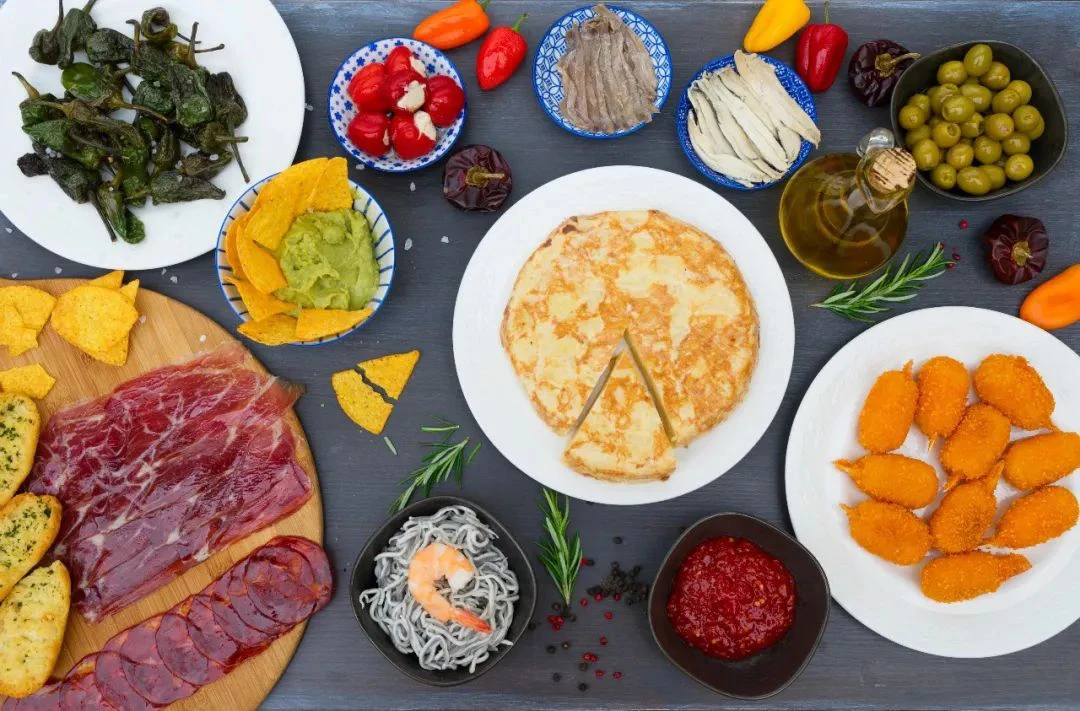
Ham cups, cured sausages, sliced ham, fried cured meat, fried green peppers, fried ham croquettes...
Come on, let's have fun together.
1. Spaniards hardly show sadness or anxiety on their faces. Almost everyone I met was full of vitality and love for life.
2. The lighting in restaurants is dim and intimate, not particularly bright. Evening dining is completely unsuitable for taking photos (this is not an excuse for the pictures in this article). There's no habit of "phone eats first." Perhaps they naturally enjoy life, not living in a world hijacked by AI and virtual socializing.
3. People prefer face-to-face communication, not sitting around playing on phones.