A Memoir of Traveling Through the Capitals of Czech Republic, Germany, the Netherlands, and Belgium
Every trip I follow the call of my heart. In March 2019, I planned the itinerary (all arranged by my husband) and purchased tickets from the China Southern Airlines official website (I must praise China Southern Airlines for their meticulous and thoughtful service; objectively speaking, it is much better than Air China. If I travel abroad again in the future, I will choose China Southern Airlines again). We selected accommodation on Booking. The flight was at around 2:00 a.m. on July 12th. To be honest, this timing is a huge challenge for both adults and children. We left home at 8:00 p.m., taking a taxi, high-speed rail, and subway to reach Beijing T2. I have always believed that the journey begins the moment you leave home. We arrived at Beijing Airport around 10:00 p.m., then took the airport express to T2. It was already the child's bedtime, and I was a bit sleepy too. At T2, we found many people. After a long wait in line, our luggage was checked in. Then we found a quiet place to let the little one rest for a while. The first part of the trip was basically completed, and the next step was boarding.
Friendly reminder: For those traveling to Schengen countries with children, if the child has not started school, you only need to go to the local notary office to get a notarized birth certificate (in 2017 it was about 260 RMB, I requested 2 copies and the extra copy seemed to be 25 RMB; when traveling in 2019 it was still valid, saving 260 RMB). If the child is already in school, you need a school-issued bilingual enrollment certificate, which is a bit more troublesome. The certificate must state your itinerary; for multi-country trips, the destination should be the country with the longest stay. This was what the visa staff told us when applying. The rest is the same as the adult's employment certificate; you also need to write down the return date. The above notarization is prepared by yourself. For the visa, a higher-level notarization from Beijing's capital is also required. We always expedited it (around 200 RMB), and the visa agency could handle that.
We never bring too much luggage. At the child's request, we brought these two little pigs along.
After a ten-hour flight, we arrived at our destination—Prague, the capital of Czech Republic. As we got off the plane, a light drizzle was falling. Europe is still quite cool at this time of year; cold is the word. To think that day was the first day of the "fu" period in China! Remember to bring a down jacket when coming to Europe this season; you will regret it if you don't. We arrived on the first day of the "fu" period. During our stay, we had to wear down jackets in the morning and evening because it was constantly cloudy; the highest temperature was only about 13°C, and when we went out in the morning it was around 7°C.
Although Czech Republic is in Europe, prices are not high. You can use the local koruna or euros, but using koruna is more economical. As I recall, public restrooms in Czech Republic only accept euros. Public restrooms in Europe are usually paid (even McDonald's), typically costing between 0.5 and 1 euro, while scenic spots can be 1.5 to 2 euros. Indoor attractions like museums are generally free.
The picture above is Prague's train station.
The streets were very quiet after the rain.
Starting the sightseeing mode: The Astronomical Clock (in Czech: Pražský orloj) is mounted on the Gothic tower of the Old Town Hall. It is a masterpiece of Czech Gothic science and technology, as well as a magnificent artistic monument. It consists of two parts, an exquisite self-striking clock designed according to the geocentric theory of that time. The upper clock makes one revolution per year, the lower one per day. Every hour on the hour, skeletons pull the time, saints appear, a rooster crows, and other time-telling events occur. At noon every day, twelve apostles appear in sequence from beside the clock, six turning left and six turning right; with the crow of the rooster, the windows close and the bell sounds.
It is said that to ensure no similar clock was ever made, the craftsman who built it was blinded. During World War II, the astronomical clock was severely damaged by fire and was restored in 1948 and 1979 respectively. According to local legend, if the clock is not properly maintained, the city will face disaster. After viewing the astronomical clock, you can climb the tower of the Old Town Hall to overlook the bustling crowds and the entire Old Town Square.
The photo of the hall above is the Old Town Hall.
Charles Bridge was built in 1357 and is a stone bridge of great artistic value. It spans the Vltava River, 520 meters long and 10 meters wide, with 16 piers. The two ends are the Prague Castle district and the Old Town district. It was once the必经之路 for the coronation processions of kings. On the bridge, you can watch street performers and handicraft artists, and buy many artworks such as watercolor paintings of Charles Bridge, and wooden puppets dressed in traditional Czech costumes and court attire. This oldest and longest bridge in Europe has 30 saint statues, masterpieces of Czech Baroque art from the 17th-18th centuries, called "the open-air Baroque sculpture gallery of Europe" by Europeans. The original statues are now preserved in museums; most on the bridge are replicas. The eighth statue on the right side of the bridge is St. John of Nepomuk, the guardian of Charles Bridge. A golden cross on the railing marks the spot where St. John was thrown off the bridge.
We wanted to see the night view here, but we waited until nearly 22:00 with our sleeping child, and it still didn't get dark. Due to the geographical location, days are long and nights short here. We had to go back to the hotel. Curious about Prague's night scenery, I got up around midnight, opened the curtain, and took a look. There are always regrets in travel, to be continued in the future. The night view is beautiful. In Spider-Man (I think it's called "Spider-Man: Far From Home"), the beautiful night view of Charles Bridge appears.
Czech cuisine: the pork knuckle deserves a thumbs up. It's tastier than the German pork knuckle, preserving the collagen.
Snacks at scenic spots: watching foreigners eat with gusto, I tried it myself. Haha, the taste was hard to accept, but it filled my stomach.
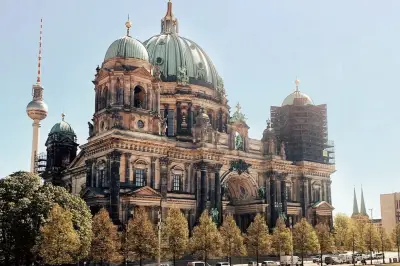
Berlin Cathedral was built from 1894 to 1905. It once served as the royal family's private church, with extremely luxurious interior decoration. Inside, it is resplendent and magnificent, adorned with intricately designed columns and exquisite murals, even the column capitals are gilded. It has four above-ground floors, with the highest point reaching 114 meters. I forgot the reason, but on the day we visited, it was not open for sightseeing, only for worshippers.
German pork knuckle with beer is a standard combination. I had this pork knuckle when I came to Germany in 2017, and I really couldn't get used to it. I thought changing cities might make it better, but it was the same. The skin is very hard, not as good as in Czech Republic. Of course, it's not as delicious as in our motherland.
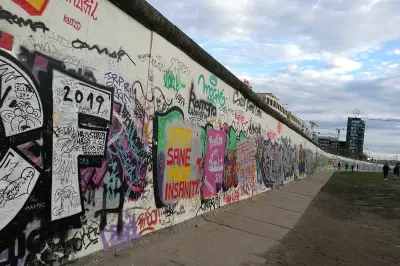
The Berlin Wall, which existed for more than 40 years, has now mostly been demolished. The remaining sections (such as the East Side Gallery) no longer show their original appearance. Only this 220-meter-long section preserved in the memorial park lets you see the authentic Berlin Wall. Coming here makes you feel heavy-hearted. Without saying more, we must cherish world peace!
The Brandenburg Gate is a symbol of Berlin and also a national symbol of Germany. Completed in 1791, this neoclassical sandstone building is modeled on the Acropolis gate in Athens. At the top is a bronze sculpture of the winged goddess of victory driving a four-horse chariot. In the goddess's scepter are an oak wreath, an Iron Cross, and an eagle with outstretched wings, all symbolizing victory in war. The Brandenburg Gate faces east, and the area to its east is the core of old Berlin. It is the only remaining Berlin city gate. Standing here for more than 200 years, it has witnessed the rise and fall of German history.
Germany does a good job with garbage classification, which is worth learning from.
Garbage bins on trains are also categorized, a very detailed effort.
Large supermarkets have plastic bottle recycling machines. Every time we travel to Europe, we keep our plastic bottles and sell them when we see such supermarkets. It also teaches children how to protect nature and turn waste into treasure.
Look, our plastic bottles sold for 0.5 euros.
In Berlin, we saw our country's Mobike; had to take a photo for memory, haha.
The scooter under the child's feet is a shared transport tool in Berlin.
Third stop: Amsterdam
Public restrooms on the street are a highlight of Amsterdam. We basically visited all the must-see places, including the red-light district. No photos of the red-light district; out of respect and rules, I didn't take any.
Windmill Village (I think that's the name). We saw the prototype of Shaun the Sheep; so this is what European sheep look like.
We had Italian pizza in Amsterdam. The three of us eat very little; a portion for two filled us up. Foreigners each eat one portion.
A trendy restaurant in Amsterdam: The Seafood Bar. We had seafood there. The taste? Not as good as in our motherland.
Fourth stop: Brussels
Belgium is the hometown of comic characters Tintin and Smurfs. It is a comic powerhouse, with the highest number of comic artists per capita in the world. The Comic Art Museum, designed by the architect Victor Horta, is a paradise for comic enthusiasts. This world-famous museum is located on an inconspicuous small street, in a house built by Victor Horta. Here we found the Smurfs. The museum is not large, but the ticket price is not low. Since we only knew the Smurfs, we basically skimmed over the other comics.
Manneken Pis is the symbol of Brussels, the capital of Belgium. This world-famous little boy bronze statue is a fountain and sculpture located in the pedestrian area of the city center. The statue of a five-year-old boy is small but has a history of nearly 400 years. There are several versions of the legend about the boy: roughly, a boy named Julien urinated and inadvertently saved the city. No one knows if the story is true. In 1619, sculptor Jérôme Duquesnoy the Elder made the bronze statue of Julien, which is preserved to this day. Over 400 years, people have not forgotten him; instead, he has become a major symbol of Brussels and often wears different styles of clothes, looking very fashionable. During the days we were there, we didn't catch him dressed up. But on the day we returned, it was Belgium's National Day; I believe little Manneken Pis would have worn beautiful clothes that day.
The Saint-Hubert Galleries are a paradise for shopping, leisure, and entertainment. Under the long arched glass roof, shops in the Italian Renaissance style line both sides of the galleries. The Saint-Hubert Galleries consist of three parts: the main ones are the King's Gallery and the Queen's Gallery, each over 100 meters long, and a smaller Prince's Gallery. The galleries were started on May 6, 1846, took 18 months to build, and the total length of 213 meters was completed on June 20, 1847. The galleries house fashion stores, antique shops, cafes, and a cinema built in 1847, renovated in 1951, which is one of Brussels' three royal theaters.
The Town Hall (City Hall) is the most important building around the Grand Place in Brussels, a medieval Gothic building with a 96-meter-high tower in the middle. The whole building looks very elegant, symmetrical, and exquisite. If you look closely at the figures on it, they are lifelike: saints, happy couples, sinners, etc.
The European Commission headquarters is located in Brussels, the capital of Belgium.
The Parc du Cinquantenaire (Fiftieth Anniversary Park) is a large city park located in the easternmost part of the European Quarter in Brussels. Most of the buildings around the park were ordered by King Leopold II of Belgium to celebrate the 50th anniversary of Belgium's independence. The triumphal arch in the middle was completed in 1905, made of iron, glass, and stone, symbolizing Belgium's economic and industrial situation at that time. The nearly 30-hectare park consists of small gardens, ponds, and waterfalls. In the early 20th century, many trade fairs, exhibitions, and large celebrations were held here. Since 1930, it has completely become a place for leisure and relaxation.
We visited this Chinese restaurant twice in Belgium; the food was great!
Belgian cuisine: the first picture is waffle, which everyone is familiar with. The seafood below is very famous; the mussels taste good, recommended. Also, this restaurant is good, but I forgot its name.
In summary, the round trip was 11 days, visiting four countries; the time was a bit tight. I look forward to a future in-depth tour of France. This travelogue is my first attempt; it is sketchy because it is a memoir, and some details I cannot recall. Please forgive me.