Conference Trip - Berlin, Germany
In May 2004, I went to Berlin to attend an international conference. It was my first visit to Europe.
On May 23, we transferred at Amsterdam Airport and then continued flying to Berlin. This was my first time setting foot on European soil.
Amsterdam Airport Schiphol, also known as Amsterdam International Airport, is located in the municipality of Haarlemmermeer, North Holland, Netherlands, 15 kilometers northeast of Amsterdam city center. It is the largest airport in the Netherlands and ranks among the top three major international hub airports in Europe. Many flights to Europe transit here.
At the time, our layover was tight, and I was on a tight budget, so I only hurried through the transfer procedures and didn't have a chance to do much sightseeing. But as someone who rarely had the opportunity to travel abroad back then, I was deeply impressed by the vastness of Amsterdam Airport—the long corridors stretching into the distance, the bustling shopping areas, and the rows of planes on the tarmac.
We continued flying to Berlin without any rest. The next day, May 24, the conference schedule began.
The opening ceremony was held at the Friedrichstadt-Palast. At the time, I only thought the venue was very grand and upscale. Nearly 20 years later, I searched online and realized just how luxurious the venue chosen for the opening ceremony was.
Friedrichstadt-Palast, located at Friedrichstraße 107 in central Berlin, was built in 1984. It exudes opulence inside and out, especially its Art Deco stained glass windows. Friedrichstadt-Palast is one of the most historic theaters in Europe. After nearly 40 years, it remains the largest and most modern show venue in Europe. Its most iconic feature is traditional kick-line dancing. It also has its own Friedrichstadt-Palast ballet troupe. It hosts Berlin's top cabaret shows, the vivid grand show, which are very audience-friendly, with almost no spoken dialogue—relying entirely on body language and emotion. Many large-scale performances and award ceremonies are held here, and it is also one of the main screening venues for the Berlin International Film Festival.
Reading these introductions, I can't help but regret my youthful ignorance. I was fortunate enough to attend the opening ceremony at such a famous place—why did it take me till now to realize it? Luckily, although I was unaware at the time, I did take some photos, which have left me with some fond memories.
Performances during the opening ceremony intervals...
A string quartet accompanied the entire opening ceremony, with beautiful melodies and humorous performances.
A dance titled "The Fall of the Berlin Wall" had a large cast and impressive stage effects. Looking back now, it must have been a vivid grand show at the Friedrichstadt-Palast.
After the opening ceremony, there were intense meetings in the afternoon. In the evening, there was the customary welcome reception for the conference.
The welcome reception was a cocktail party, with no formal dinner or fixed seating. There were some light snacks and refreshments, along with various alcoholic drinks and beverages. People ate, drank, and mingled, talking to acquaintances, clinking glasses, and catching up. When tired, they found an empty seat to rest until they felt like continuing to stroll and eat. The reception was mainly a place for socializing and networking, with snacks and drinks serving as props to create a lively atmosphere.
This welcome reception was also held at the Friedrichstadt-Palast, allowing us to experience its social function.
At the entrance to the reception, staff dressed in traditional European costumes welcomed guests.
Inside, staff in various costumes greeted guests, conveyed friendliness, and created a cheerful atmosphere.
If your shoes happened to be dirty, a charming shoe-shine boy was ready to serve you at any time.
In a corner, a band played throughout the entire welcome reception.
Of course, we can't forget the drinks and food at the reception...
Staff in various costumes took photos with the guests...
The lounge area of the reception...
People chatting...
There was also a small aviation exhibition upstairs...
The entire evening, the atmosphere of the reception was warm and peaceful, and time flew by.
After the welcome reception, the talks and exhibition continued. Back at the hotel, I had to organize materials and samples, working late into the night every day.
It wasn't until the evening of May 26, after dinner, that I managed to squeeze in some time to take a walk in Berlin. Strolling along the banks of the Spree River, Berlin's mother river, the air was still a bit chilly. The lights on both sides flickered, and the scenery was somewhat blurry. There were no tall buildings, and not many people.
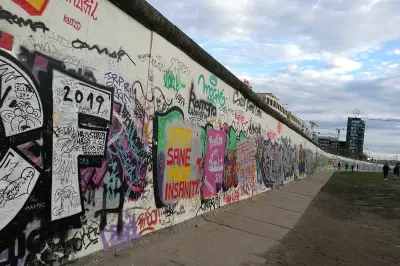
Although I didn't have time to visit other sights in Berlin, remembering the dance "The Fall of the Berlin Wall" at the opening ceremony, I wanted to try to find the Berlin Wall to see it. Back then, online maps weren't as convenient, so we had to ask for directions. Seeing a middle-aged gentleman walking by, I randomly asked him for directions. He first tried to explain the way on a map, but seeing our puzzled expressions, he didn't hesitate—he enthusiastically led us directly to the Berlin Wall and even warmly explained some related history.
The Berlin Wall was a fully enclosed border security system built by the German Democratic Republic (GDR) around West Berlin during the Cold War to separate it from the Federal Republic of Germany (FRG) administered West Berlin. The GDR government called it the "Anti-Fascist Protection Rampart," aiming to stop the free movement of people between the GDR (including East Berlin) and West Berlin (part of the FRG). Construction began on August 13, 1961, and it was 155 kilometers long. Initially, it was a barbed wire and brick wall, later reinforced with watchtowers, concrete walls, open areas, and anti-vehicle trenches. The final reinforced wall was 3.5 meters high. After World War II, Nazi Germany and its capital Berlin were divided into four occupation zones by the Soviet Union, the United States, the United Kingdom, and France. The former Nazi capital Berlin was split into East Berlin and West Berlin. In 1949, the Federal Republic of Germany (West Germany) and the German Democratic Republic (East Germany) were established. The two Germanys became the front line of the East-West confrontation, each loyal to its own side. The two Germanys were divided and confronted each other for 41 years. The Berlin Wall was a symbol of Germany's division and a key landmark of the beginning of the Cold War. In June 1990, the GDR government officially decided to dismantle the Berlin Wall. Its fall marked the reunification of Germany, was part of the Revolutions of 1989, and contributed to the dissolution of the Soviet Union and the end of the Cold War. During the wall's existence, the atmosphere inside and outside was starkly different: outside the wall, guard posts were everywhere, and East German citizens were forbidden to approach, with crossers shot on sight; inside the wall, there were no guards, only signposts advising West Germans that 50 meters ahead they would cross the border. All West Berliners, West Germans, and domestic and foreign tourists could approach the wall, providing an opportunity for later graffiti and artistic creation.
The section we saw was not the original Berlin Wall but a section rebuilt on the original site in June 2000, just to commemorate that history. The wall is covered with various graffiti, and there is a sign explaining everything.
Finally, we took a group photo by the Spree River, permanently capturing the warmth and kindness of the German people.
After this brief visit, I returned to the conference routine. On May 27, the conference finally ended, and there was a banquet in the evening to mark the conclusion. This banquet was also held at the Friedrichstadt-Palast.
The banquet was the final event of every large conference. After many days of hard work, this banquet served as a formal closure, emphasizing a sense of ceremony. During the conference, table reservations were opened, and participants had to book a seat in advance, choosing a location close to the main stage or selecting companions to sit with. Without a reservation, you would be randomly assigned to an unreserved seat, and if traveling in a group, you might be scattered. The banquet had a dress code requiring formal attire. It was said that in early conferences, men wore tailcoats and women wore dresses, which was very formal. Over time, the dress code relaxed, but men were still expected to wear dark suits, and women formal dresses or skirts. Dressing too casually, while not barring you from entry, would make you stand out among the formally dressed crowd—a different kind of prominence.
There was a time requirement for entering the banquet. Early arrivals could not enter the hall but could have pre-dinner drinks in the waiting area, chat with acquaintances, and pass the time.
When it was time to enter, everyone took their reserved seats. The tables were already set with cutlery and glassware, and menus were placed on the tables. People could sit down directly or continue greeting acquaintances.
A few minutes before the banquet officially began, everyone was required to be seated and not move, waiting for the start.
On the main stage, the conference organizers controlled the program: summaries of the conference, awards, handover to the next conference, etc., with intervals between each item. The formal procedures of the banquet were interwoven with the events on stage, proceeding in an orderly manner. Dishes were served one by one according to the menu. Western dining has a strong procedural nature: when the next dish arrives, the previous one is removed regardless of whether you have finished it. Therefore, unless you are sure you don't want it, it's best to finish the current dish quickly before doing anything else. It often happened that just as a dish was served, people from other tables came to toast and chat, and by the time they left, the dish had been removed untouched.
During pauses in the conference and banquet, a band performed on stage.
After all the courses of the banquet were finished, the waitstaff cleared the tables, and another band began to play on an open area in front of the main stage. If they were not in a hurry to leave, interested attendees could dance to the music, spending the final beautiful moments of the evening. Usually, more people watched than danced. Most of those who danced were Europeans and Americans, reflecting their attitude of working hard and playing hard. In contrast, most Asians either left directly or watched, with very few participating in the dancing.
The banquet ended, and the conference was completely over. Participants returned home, and we also set off on our journey back.
Thus ended my first trip to Europe. I gained a lot professionally but not much else. It was a worthwhile experience to see the procedures and spectacle of an international conference.
In later years, I attended several more international conferences of the same level, but this one was the best prepared, most perfectly organized, and with the highest quality environment and facilities—by far the best, without any equals. I'm quite content with that.
May 23, 2004: Departed from Shenyang, transferred at Amsterdam Airport, arrived in Berlin
May 24, 2004: Friedrichstadt-Palast, opening ceremony and welcome reception
May 26, 2004: Night visit to the Berlin Wall
May 27, 2004: Friedrichstadt-Palast, banquet
May 24–27, 2004: Conference meetings and exhibition visits
May 28, 2004: Return from Berlin