Three Months in Europe, Part 9: Crossing Germany from North to South: Graffiti Under the Berlin Wall and Dresden's Frauenkirche
Three Months in Europe, Part 8: The Imperial Tricolor of Prague: A Never-Ending Fairy Tale of a Hundred Spires
The golden ripples of the Vltava River flow slowly under the arches of Charles Bridge, carrying Kafka's parables and Smetana's melodies, northward, ever northward, quietly merging into the embrace of the Elbe. Our journey, too, follows the current, from the fairy tale of Bohemia to the Florence of Saxony and the steel heart of Prussia.
The waters of the Elbe, blending the romance of the Vltava, become elegant before the Zwinger Palace in Dresden. Yet when they continue onward to Berlin and merge with the coldness of the Spree, they must confront the heaviest chapters of 20th-century history.
In Germany, we bought a 2-month Deutschland-Ticket (German monthly pass) for €58 per month.
The Deutschland-Ticket covers all local public transport in every city, including: metro, trams, buses, regional express trains, and regional trains. These are slow trains covering states and interstates within Germany, but not high-speed or express long-distance trains (such as ICE, IC, EC, Flixtrain). You must register and subscribe to this ticket on the Deutsche Bahn official website. Once subscribed, it automatically renews monthly and deducts from your linked bank account or credit card. If you want to stop using it, you must cancel the next month's subscription before the 10th of the current month; otherwise, it will renew automatically. This is important to remember. The ticket is personal and cannot be transferred to others. It exists as a QR code in the mobile app (sometimes a physical chip card is also available). Show it to staff when boarding. With one ticket, you can explore public transport and regional rail networks in any German city, without needing to study complex zone tickets, day tickets, or state tickets – nationwide access (except high-speed trains).
Dresden means "people of the riverside forest." In Germany, Dresden is synonymous with "culture." It is the capital of Saxony and the second-largest city in the east after Berlin.
Before World War II, Dresden was the city with the highest cost of living in Europe. In the later stages of the war, it suffered massive bombing by the Allies. Decades after the war until German reunification, Dresden was reborn from the ashes, earning the nickname "Florence on the Elbe."
Waiting for the train to Dresden at Prague Central Station.
Arriving at Dresden after more than two hours, the station hall.
Dresden Central Station.
IntercityHotel Dresden is right across from the train station, 1.2 km from the Royal Palace and the Zwinger. We stayed for 3 days.
St. Petersburg Street is Dresden's "international window," lined with many important foreign institutions and research centers. It exudes modernity and a lively atmosphere. It's a popular gathering place for local residents, students, and especially foreign expats and professionals. From Italian, Greek, Vietnamese, Thai, to Middle Eastern restaurants, everything is available to satisfy all tastes.
After German reunification, this building was originally scheduled for demolition but was preserved as a historical mark.
Theater Square is an artistic sanctuary surrounded by world-class cultural heritage, the best place to experience Dresden's reputation as "Florence on the Elbe." Here you can admire masterpieces of multiple architectural styles at once: Renaissance (Royal Palace), Baroque (Zwinger Palace), Neo-Renaissance (Semperoper), and Late Baroque (Court Church).
The Lipsius Building (Kunsthalle im Lipsius-Bau) was built at the end of the 19th century and named after architect Constantin Lipsius. It was originally built for the Dresden Academy of Fine Arts and is a prime example of Neo-Renaissance style. It was severely damaged in 1945. During reconstruction in the 1990s, architect Peter Kulka added a huge glass dome, whose steel frame glows blue in the night sky, becoming a striking modern landmark on the Dresden skyline.
The bronze equestrian statue of King John was unveiled in 1889, created by sculptor Johannes Schilling. His full name, John Nepomuk Maria Joseph Anton Xaver, was a Saxon king of the House of Wettin, reigning from 1854 to 1873.
The Semperoper is a masterpiece of 19th-century opera architecture, designed by architect Gottfried Semper and built in 1841. After being destroyed by fire in 1869, it was rebuilt by Semper in 1878 and now houses the Saxon State Opera. Its architecture blends Italian High Renaissance style, achieving natural stereo acoustics through its circular vaulted structure, and is considered one of the most beautiful opera houses in the world.
Neumarkt Square is not just a tourist attraction but a vibrant public space. Various events take place in the square, including street performances, music festivals, and farmers' markets. Surrounded by cafes, restaurants, and shops, it is a popular spot for gathering, relaxing, and enjoying food.
This is a 101-meter-long porcelain mural, the largest in the world – the Procession of Princes. It is made of Meissen porcelain tiles, exquisitely handcrafted, using 27,000 tiles. The mural traces the lineage of the Wettin dynasty of Saxony, depicting equestrian statues of Saxon princes from 1123 to 1904, as well as contemporary artists, totaling 93 figures.
Returning to the hotel along St. Petersburg Street.
St. Petersburg Street.
The Royal Palace was the residence of the Saxon electors (1547–1806) and kings of Saxony (1806–1918). The entire complex displays a variety of architectural styles, from Romanesque to Baroque.
In the bombing of 1945, the palace was severely damaged, leaving only some outer walls. After reunification, it underwent decades of careful reconstruction, finally fully restored to its former glory in 2013. Today, it is not a single museum but a grand museum complex housing five world-class exhibitions and collections.
The Cathedral of the Holy Trinity (Court Church) is the largest church in Saxony. This nearly 300-year-old building is adorned with countless lifelike statues. Inside, the pulpit, altar, and organ are designs by different masters. Augustus the Strong, Elector of Saxony and King of Poland, was buried in Poland, but his heart is kept in the church's crypt, showing his enduring attachment to Dresden.
The massive tower is one of Dresden's city landmarks, its facade decorated with statues of Saxon rulers from various periods, illustrating the history of the Wettin dynasty from bottom to top.
The Green Vault (Grünes Gewölbe) is part of the Dresden Royal Palace, founded by Augustus II in 1723. Its highlight is the rich collection of Baroque to Classical period treasures. During World War II, three of the nine exhibition rooms were destroyed in Allied bombing, but the treasures were safely hidden elsewhere. In 1945, Soviet troops seized them, returning them to the German Democratic Republic in 1958. On September 1, 2006, the Green Vault reopened after reconstruction. It consists of two separate permanent exhibitions.
The Historic Green Vault includes themed rooms such as the Amber Room, Ivory Room, Silver Room, Bronze Room, and Heraldic Room, all resplendent with gold. It feels like stepping back into an 18th-century court, experiencing the era's fascination with "rarities and curiosities" and aesthetic tastes. An immersive experience of "luxury." (Photography is not allowed in the Historic Green Vault.)
The Historic Green Vault was once the treasury of the Wettin-Saxon rulers, attracting thousands of visitors each year. However, only 100 visitors per hour can enjoy this intense time-travel journey; tickets must be purchased in advance.
The New Green Vault is dim and quiet, focusing all attention on the artistry and craft details of the treasures themselves, allowing visitors to hold their breath and admire the unparalleled details of each masterpiece up close. The star pieces include court jeweler Dinglinger's works: "The Birthday of the Mughal Emperor Aurangzeb," "The Moor," "The Golden Coffee Service," and "The Dresden Green Diamond."
"The Birthday of the Mughal Emperor Aurangzeb": Commissioned by Augustus the Strong, made of gold, silver, enamel, and nearly 5,000 diamonds, pearls, and rubies, depicting a celebration scene of the Mughal emperor in India, with breathtakingly intricate craftsmanship.
The Dresden Green Diamond is the largest natural green diamond in the world, weighing about 41 carats, with a unique color, an absolute star.
"Sgraffito" – a distinctive wall decoration technique from the Renaissance.
The Old Masters Picture Gallery (Gemäldegalerie Alte Meister) is internationally renowned for its extensive collection of masterpieces by classical painters. Its highlight is Raphael's "Sistine Madonna" (1512–1513), which has been cherished by visitors for over 250 years. The gallery also houses paintings from the Italian Renaissance, especially representative works by Giorgione, Titian, Correggio, Mantegna, Botticelli, and Parmigianino.
This art gallery within the Zwinger Palace opened to the public in 1855, giving it the name "Old Masters Picture Gallery."
The highlight of the collection is Raphael's "Sistine Madonna" (1512–1513).
Raphael's "Sistine Madonna" is hailed as "Dresden's Mona Lisa." In the painting, the Virgin Mary holds the infant Jesus, stepping on clouds, emerging from behind a green curtain. On the left is Saint Sixtus in a brocade robe, and on the right is the devout Saint Barbara. The two little angels (cherubs) at the bottom have become worldwide pop icons. Raphael endowed the sacred figures with human warmth and deep melancholy, transcending mere religious painting and reaching the pinnacle of classical harmony.
Giorgione's "Sleeping Venus" is the first large-scale reclining nude goddess painting in Western art history, pioneering a theme that influenced countless later artists (such as Titian, Goya, etc.). The curves of Venus's body harmoniously blend with the natural landscape (hills, clouds), full of tranquility, elegance, and divine beauty. The painting was started by Giorgione, but the landscape background is generally believed to have been completed by his colleague Titian.
Passing through the city park on the way to Louisenstraße.
Louisenstraße is often called Dresden's "shopping street" and "living avenue." It lacks a heavy historical feel, replaced instead by a relaxed, fashionable, international atmosphere. It is a popular spot for locals, students, and tourists to relax, shop, dine, and socialize.
The building walls along the street feature interesting graffiti and street art.
From German traditional restaurants to Italian, Greek, Vietnamese, Turkish, Indian, and other world cuisines, everything is available.
A strong artistic and creative atmosphere, vibrant with youthful energy.
Art knows no bounds – a young boy bravely steps up to interact with the singer on stage.
Weekend market, closed to vehicles.
Back at Neumarkt Square in the evening.
Having dinner, planning to watch the sunset over the Elbe.
Brühl's Terrace was originally part of the Dresden fortifications. In the 18th century, Elector of Saxony and King of Poland Augustus the Strong granted this area to his chief minister, Count Heinrich von Brühl. The count built a palace and beautiful Baroque gardens here, giving the terrace its name. In the early 19th century, the fortifications were removed, and the gardens were renovated and opened to the public, becoming a public leisure space for Dresden citizens.
Standing on the terrace, viewing the opposite bank: a beautiful late Baroque administrative building (Saxon State Ministry for Regional Development and Infrastructure).
Augustus Bridge was built between 1907 and 1910, replacing a previous wooden bridge. The bridge was named after King Frederick Augustus I of Saxony (also known as "the Just"), grandson of Augustus the Strong. At the end of World War II, the retreating German army blew it up. After the war, it was rebuilt and reopened.
Crossing the bridge to the opposite bank.
The Elbe Valley stretches for 20 kilometers through the city, and the Elbe meadows are an important landscape feature.
The Elbe at dusk becomes a sea of joy. Young people, children, lovers, and tourists all flock to the Elbe to enjoy nature's gift.
The Zwinger Palace was commissioned by Elector Augustus the Strong in 1709 as a venue for court festivities, tournaments, and gatherings, reaching its peak of construction between 1710 and 1719. It was severely damaged in the bombing of 1945. After the war, the East German government meticulously rebuilt it, making it a symbol of national rebirth.
View of the Zwinger Palace from Theater Square.
Going up the stairs here.
Arriving at Neumarkt Square to visit the Frauenkirche (Church of Our Lady).
The Frauenkirche was built from 1726 to 1743, using a circular dome and sandstone construction. It was designed and built by master carpenter Georg Bähr, taking 17 years to complete, making it the largest sandstone building in the world. Its dome, the so-called "stone bell," is one of Dresden's landmarks. In the bombing of February 13, 1945, the church was reduced to ruins. After German reunification, it was reconstructed from 1994 to 2005. The reconstruction used as much original rubble as possible; about 43% of the new building stone came from the original ruins, giving the church exterior a patchwork of dark (old stones) and light (new stones), a unique visual effect called "archaeological reconstruction."
The interior of the Frauenkirche is bright, spacious, filled with warm light, reflecting the characteristics of a Protestant church.
The mural inside the dome, "Luther's Vision," depicts scenes of the Reformation.
Exiting the Frauenkirche, heading to the Bundeswehr Military History Museum. Walking along, I truly felt the German concept of environmental protection ingrained in their bones – everywhere you look, it's lush green.
The main building of the Bundeswehr Military History Museum is an arsenal built in 1877, heavy and symmetrical. A huge wedge-shaped structure made of glass and steel was added to the original building, piercing through the historic structure in a powerful way. This "wedge" symbolizes breaking the old, linear narrative of military history.
The St. Martin Garrison Church (official name: Church of Our Lady) was originally (from the 18th century to WWI) the church of the Saxon army, serving soldiers and their families stationed in Dresden, symbolizing the union of military power and religious faith. A magnificent Baroque church famous for its tall dome and beautiful bells.
Passing by a fountain in the city park.
The Hunting Lodge (Jagdschloss) is over 400 years old and now houses the Saxon Museum of Folk Art.
The Japanese Palace now houses the Museum of Ethnology.
Dresden is a poem written with scars and treasures. Beneath the Baroque dome lies the resilient spine reborn from the ruins of World War II; in the ripples of the Elbe reflect the golden memories of the Old Masters Picture Gallery. Most striking is its courage to face history – the wedge-shaped crack of the Military History Museum and the peace bell of the Frauenkirche engage in a cross-century dialogue amid the broken walls. Its beauty is profound because of destruction, noble because of reflection.
Berlin's origins date back to the late 12th century. It consisted of two settlements: Berlin on the north bank of the Spree and the settlement on the site of today's Museum Island, which existed by the 13th century. October 28, 1237, is the first recorded mention of Cölln. In 1307, the two parts were merged, giving birth to Berlin. That day is considered Berlin's birthday.
Berlin is a European cultural capital, home to numerous museums, galleries, theaters, and concert halls. Museum Island is a UNESCO World Heritage site, gathering the Pergamon Museum, the Neues Museum, and other important institutions.
Taking the U2 metro from the station to the hotel.
Hilton Hotel has a great location, directly opposite Gendarmenmarkt, with the U2 metro line about 200 meters away. After checking in, we went out for a walk.
Leaving the hotel, taking the U2.
At 8 PM we will visit the Reichstag Building, first checking it out.
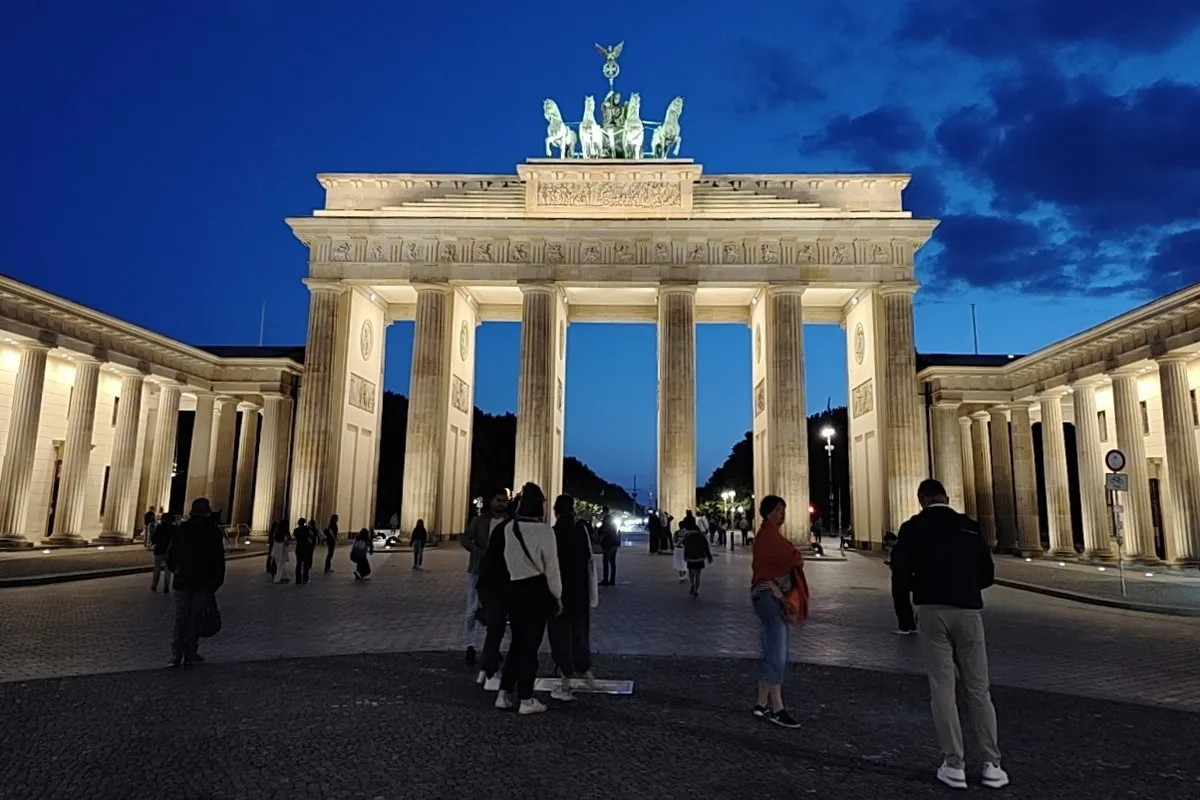
The Brandenburg Gate was built between 1788 and 1791 and is the symbol of Berlin and Germany, as well as a symbol of the end of division. It is modeled on the Propylaea of the Acropolis in Athens, topped with a quadriga sculpture of the goddess Victoria. Before German reunification on October 3, 1990, it was the border between East and West Berlin.
The Memorial to the Murdered Jews of Europe on Wilhelmstraße silently tells of the unspeakable crimes. On nearly 19,000 square meters, 2,711 stelae designed by New York architect Peter Eisenman stand. Beneath the undulating stelae field, there is an "Information Center" that presents the persecution and murder of European Jews through exhibitions. It is a place of sorrow, solace, perhaps forgiveness, but above all, a place of never forgetting.
The Reichstag Building was completed in 1894 and housed the parliament of the German Empire and the Weimar Republic. In the infamous Reichstag fire of 1933, the top of the building was burned. During World War II, it was again severely damaged. During the division of East and West Germany, the Reichstag stood on the West Berlin side and was used as an exhibition hall. In September 1999, after comprehensive renovation and the addition of a new dome, it became the seat of the German Bundestag.
Visits are free, but you need to book 2-3 months in advance on the official website. After successful booking, a confirmation email is sent. Visitors are divided into lines A, B, and C; first check your line on the booking confirmation (many people visit, ask on-site staff if unsure), then queue at the appropriate entrance.
The entire tour is guided, only in English. The walls bear marks left by Soviet soldiers when they occupied the Reichstag.
Along the Spree River, next to the Reichstag, stand some simple white crosses commemorating those who died trying to escape East Germany. Though small in scale, it is impressive – the silent river, the contrast with the modern environment, provoke reflection. (White crosses in the lower left of the photo.)
The Reichstag at night.
Paris Square under the night sky.
The Brandenburg Gate under the night sky.
Checkpoint Charlie was a border crossing on Friedrichstraße from 1961 to 1990. It was the only designated passage for foreign diplomats, journalists, and non-German civilians between East and West Berlin. Next to the Allied guardhouse stands a famous sign, with the words "You are leaving the American sector" in English, French, German, and Russian.
Around the checkpoint, there is a free open-air exhibition with rich photos and text explaining the history of Checkpoint Charlie, the tank standoff incident, and the structure of the border facilities.
Potsdamer Platz can be considered the geographical center of Berlin; the Berlin Wall once passed through the square. Today it is a large public space for leisure, entertainment, shopping, and dining. Major facilities on Potsdamer Platz include: the Potsdamer Platz Arkaden shopping center, the Sony Center with the Berlin Film Museum and LEGOLAND Discovery Centre, and the Berlin Mall at Leipziger Platz across the street. Additionally, in the underground level of the S-Bahn station, there is an indispensable Asian supermarket open 365 days a year for Chinese people.
Underground bicycle parking.
The Berlin Philharmonic concert hall is hailed as "one of the best concert halls in the world," renowned for its unparalleled acoustics and iconic "tent" shape. Architect Hans Scharoun's design concept was romantic: treating the audience as a "valley" and the stage as a "vineyard at the foot of the mountain." The building's exterior looks like a huge golden circus tent or a hill, with fluid and dynamic lines, contrasting sharply with the surrounding square modern buildings.
Straße des 17. Juni stretches from the Victory Column in the west, through the Tiergarten park, to the Brandenburg Gate in the east. Originally called "Charlottenburger Chaussee" because it connected Berlin with Charlottenburg Palace, it was renamed to commemorate the popular uprising in East Germany on June 17, 1953.
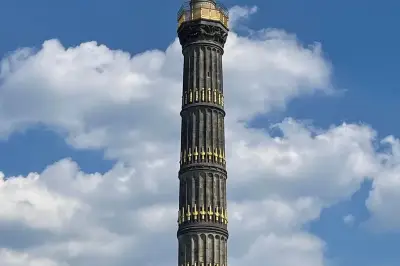
The Victory Column is a 67-meter-high golden column monument built to commemorate Prussian victories in the Danish-Prussian, Austro-Prussian, and Franco-Prussian wars.
The avenue runs through Berlin's largest city park, Tiergarten, flanked by vast lawns, woodlands, waterways, and sculptures, ideal for jogging, cycling, and picnics.
The Soviet War Memorial, built in 1945 to commemorate Soviet soldiers who fell in the Battle of Berlin. Two T-34 tanks flank it, a footnote to Cold War history.
The Neues Museum is a museum on Museum Island. Built between 1843 and 1855 by order of King Frederick William IV of Prussia, the building employs Neo-Classical and Renaissance Revival designs.
After suffering war damage and decay during the GDR era, the Neues Museum was restored between 1999 and 2009 by David Chipperfield. Currently, it houses the Egyptian Museum, the Papyrus Collection, the Museum of Prehistory and Early History, and parts of the Antikensammlung. As part of the Museum Island complex, it was inscribed as a UNESCO World Heritage Site in 1999.
The Nefertiti Bust is a painted limestone and stucco sculpture 3,300 years old. The statue depicts the Great Royal Wife of the Egyptian Pharaoh Akhenaten, Nefertiti. It is believed to have been carved in 1345 BC by the sculptor Thutmose.
It was discovered in 1912 in Amarna, Egypt, by a German archaeological team led by Ludwig Borchardt.
Close-up photography of the Nefertiti Bust is not allowed; you must be at least 10 meters away (resulting in less optimal shots). Over 3,300 years, it remains intact with vivid, bright colors – a miracle!
Berlin's "Golden Hat": a conical ceremonial hat made of thin gold sheet, densely decorated with astronomical symbols, testifying to the extraordinary craftsmanship and astronomical knowledge of Bronze Age Europe.
The square is the central public space connecting several museums on Museum Island (such as the Pergamon Museum, Neues Museum, Bode Museum) with Berlin Cathedral and the Lustgarten.
Friedrichsbrücke has undergone several complete renovations since it was built in 1703. The current bridge was built from 1907 to 1909 and expanded in 1920. It is an Art Nouveau style bridge, quite unique in Berlin. Each end of the bridge has two obelisk-shaped towers, making it look like a grand gate from a distance. It connects the Museum Island on the north bank with the Humboldt Forum site, while the south bank leads to Berlin's government district, including the Federal Chancellery and the Reichstag.
The Pergamon Museum is the most prominent of the five museums on Museum Island, primarily featuring ancient Greek and Roman architecture. The magnificent Pergamon Altar, the Roman market gate of Miletus, the Ishtar Gate from Babylon, and the Mshatta Facade all make the Pergamon Museum shine.
The Pergamon Museum is undergoing full renovation and has been completely closed to visitors since October 23, 2023.
The James-Simon Gallery is a new building on Museum Island. It functions as a new entrance building, providing central services for the entire Museum Island, offering orientation information and a welcoming space. Besides the information center and ticket office, it has cloakrooms, a shop, a café, and a restaurant. It also has an auditorium and a special exhibition space. From here, you can directly access the most popular Pergamon Museum to the Ishtar Gate of Babylon.
Coming out of Museum Island and heading to Alexanderplatz, the Friedrichsbrücke photographed.
The Rotes Rathaus (Red City Hall) was built between 1861 and 1869, named for its red brick facade. The building is entirely made of red brick, an outstanding example of Neo-Renaissance brick architecture. The city hall has a 74-meter square clock tower, imposing, part of Berlin's skyline. The tower flies the Berlin state flag (white with a red bear).
After completion, it replaced the old city hall as the seat of the unified Berlin government. In World War II, the Rotes Rathaus was severely damaged. After the war, the East German government reconstructed and restored it. During Berlin's division, West Berlin had its own city hall in Schöneberg (Rathaus Schöneberg). The Rotes Rathaus served as East Berlin's city hall. In 1991, after German reunification, the Berlin government moved back into the Rotes Rathaus, marking the return and unification of the administrative center of Berlin.
The Berlin TV Tower (Fernsehturm) was built in 1969, 368 meters high, the tallest building in Berlin, dominating the city's skyline.
The Neptune Fountain was built in 1891, with Neptune in the center surrounded by female statues representing the four main rivers of Germany. It is one of the few old landmarks that survived WWII.
The St. Mary's Church (Marienkirche) originated in the Middle Ages, initially a Catholic church, later Protestant after the Reformation. It has witnessed Berlin's development from a medieval town to a modern metropolis. In 1944, the church was reduced to only partial outer walls and tower ruins in an air raid. After the war, the East Berlin government initially planned to demolish the ruins. However, following appeals from the public and the East German Christian community, it was decided to preserve it and combine it with a new bell tower as a monument against fascism and for peace.
The Nikolaikirche was founded around 1230, originally a Roman Catholic church. After the Reformation, it became a Protestant church. The settlement around this church was the embryo of the later city of Berlin; the name Berlin was first mentioned in documents related to this church.
The church's most iconic feature is its two completely symmetrical towers with Baroque spires, unique among Berlin churches. Like most of Berlin, the Nikolaikirche was severely damaged in WWII, reduced to a ruin. For the 750th anniversary of Berlin's founding (1987), the church was meticulously restored by East Germany. After restoration, it no longer serves as a regular place of worship but is part of the "Berlin City Museum."
The Berlin Bear in a cage (in the iron frame) was created in 1750, carved from sandstone, showcasing typical late Baroque style.
The St. George and the Dragon fountain was unveiled in 1853. The legend says a town was plagued by a dragon; to appease it, the residents had to sacrifice a sheep daily, and later even their own children by lot. One day, the princess was chosen. Saint George, traveling through, stepped forward, fought the dragon, and killed it with his lance, saving the princess and the town. The fountain was originally located in the courtyard of the Berlin Palace. After WWII, the palace was demolished by the East German government, and the fountain was removed. It was reinstalled in the reconstructed Nikolaiviertel (Nicholas Quarter) in 1987 for Berlin's 750th anniversary.
This sculpture group was unveiled in 1986. Karl Marx sits in front, his expression resolute, as if expounding his theories. His posture is stable and authoritative. Friedrich Engels stands behind Marx, his posture more like a faithful partner and co-thinker.
Gendarmenmarkt is a neoclassical square, whose name dates back to the Napoleonic occupation, surrounded by two similar-looking cathedrals: the French Cathedral with an observation platform and the German Cathedral.
The French Cathedral is the church for Berlin's French Huguenot (Protestant Calvinist) congregation. In 1685, French King Louis XIV revoked the Edict of Nantes, which had allowed religious freedom for Protestants, and began persecuting Huguenots. In the same year, Elector Frederick William of Brandenburg issued the Edict of Potsdam, inviting these persecuted French Huguenot refugees to settle in Prussia, providing them with a place of worship. The church was built from 1701 to 1705. Initially a simple church, a magnificent dome tower was added from 1780 to 1786, making it symmetric with the German Cathedral opposite. It was severely damaged in WWII and carefully rebuilt from the postwar period until the 1980s.
The Konzerthaus (Concert Hall) was designed and built from 1817 to 1821. However, it was not originally for music; it served as the royal guard's cavalry stables and theatre. Under Schinkel's redesign, it quickly became a theatre and eventually, in the 20th century, a dedicated concert hall. The concert hall was completely burned out in WWII, leaving only the exterior walls. After the war, the East German government undertook careful reconstruction and restoration from the 1970s to 1984, restoring its former glory.
The Konzerthaus Berlin is one of the most important concert halls in Berlin and Germany. It is not only the permanent home of one of the world's top orchestras, the Konzerthausorchester Berlin, but also an unparalleled architectural masterpiece in itself.
The German Cathedral was built for the German Lutheran congregation, completed in 1702–1708. A completely symmetric dome tower was added from 1780–1785. It was completely destroyed by fire in WWII. After reunification, the German government undertook a large-scale reconstruction and modernization, reopening it as a museum in 1996. Today, the German Cathedral houses a permanent exhibition of the German federal government: "Milestones and Wounds of German History."
The Alte Nationalgalerie (Old National Gallery) opened in 1876, housing paintings and sculptures of the Romantic, Realist, and Impressionist movements of modern history, including Caspar David Friedrich's "The Lonely Tree," Karl Friedrich Schinkel's "Gothic Church by the Sea," Manet's "In the Conservatory," and Monet's "View of Vétheuil."
The Alte Nationalgalerie currently holds over 2,000 paintings and a similar number of sculptures, with about 400 paintings and 100 sculptures on public display.
"Portrait of Princesses Louise and Friederike" by Johann Gottfried Schadow.
Édouard Manet: "In the Conservatory."
Rodin's early work "The Age of Bronze."
Rodin's "The Thinker."
The Altes Museum (Old Museum) is the first museum on Museum Island, adjacent to Berlin Cathedral. It was designed by Karl Friedrich Schinkel, a pivotal architect in Berlin's urban development, and completed in 1830.
After a comprehensive reorganization in 2011, the Altes Museum once again focuses entirely on classical antiquities. Its main hall presents a magnificent panorama of Greek art from the 10th to the 1st century BC. The exhibition is chronologically arranged, showcasing stone sculptures, vases, artifacts, and jewelry, organized around core themes.
Highlights include the "Berlin Goddess" statue, the "Praying Boy" statue, the "Berlin Painter's Amphora," and the throne goddess from Taranto. Jewelry, gold, silver, and engraved gems form a veritable treasure house under Schinkel's blue dome.
"The Runner of Tarentum" (also known as the Tarentine Runner) – an exquisite bronze Greek statue from around 480 BC, vividly capturing the dynamic pose and muscle definition of a young athlete at the start of a sprint, a masterpiece of early Classical Greek sculpture.
"Berlin Goddess" (kore) – a famous marble statue from the 6th century BC, wearing an ornate robe, with the characteristic "Archaic smile," a representative work of the Archaic period.
"Girl Playing Knucklebones" (c. 150 BC).
Centaur mosaic from Hadrian's Villa.
Standing in the center of the rotunda, looking up at the dome, this solemn and dignified spatial experience transports you directly to the spiritual world of classical antiquity.
The Lustgarten was a kitchen garden for the Elector of Brandenburg in the 16th century, transformed into a magnificent Baroque garden by the "Great Elector" Frederick William in the 17th century, a venue for courtly society. In the 19th century, under the Kingdom of Prussia, it was turned into a gravel parade ground by Frederick William III for military drills, reflecting Prussian militarism. In the 20th century, it became a stage for political rallies, especially large Nazi events. After WWII, the Lustgarten in East Berlin was redesigned as a public green space with a large dove of peace pattern in the center. After reunification, the garden was restored, incorporating some historical elements, and now serves as an ideal resting and relaxing spot for visitors and locals after touring the surrounding top-tier museums and churches.
On the east side is the UNESCO World Heritage Museum Island (Altes Museum).
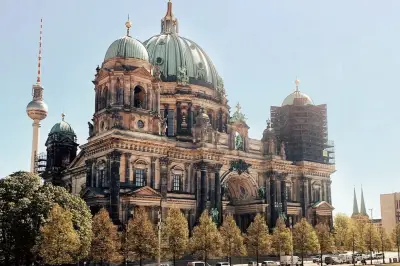
The cathedral is on the west side of the garden, originating as the court chapel of the Berlin Palace. The current church was built from 1894 to 1905, designed by Emperor Wilhelm II based on plans by Julius Carl Raschdorff in Renaissance and Baroque Revival styles. Upon completion, it became the largest Protestant church in Germany and one of the most important dynastic tombs in Europe. In addition to church services, the cathedral is used for German state ceremonies, concerts, and other events. It was damaged in Allied bombing during WWII, and the original interior design was restored in 2002.
On the north side is the reconstructed Berlin Palace (now the Humboldt Forum). This was the site of the original Berlin Palace, which was nearly destroyed in the late stages of WWII and demolished in 1950. During the GDR era, it was the site of the famous Palace of the Republic. After reunification, the Palace of the Republic was demolished due to harmful materials in its construction. Fifty years after the demolition of the Berlin Palace, the Berlin Humboldt Forum opened to the public, built on the foundation and in the style of the original palace.
The granite bowl (Granitschale) in the Lustgarten is a famous historical landmark, renowned for its monumental size and as a masterpiece of Biedermeier-era architecture. It was carved from a single block of granite over several years and placed in front of the Altes Museum in 1831. It has weathered countless storms, including damage and bombing during WWII, and a crack that appeared in 1981 when an attempt was made to move it.
This museum's collection encompasses over 20,000 objects from nearly all Asian cultures, spanning from the 4th millennium BC to the present, making it one of the most important and comprehensive collections of Asian art in the world.
Berlin's Asian Art Museum originated from the merger of the former "Museum of Indian Art" and "East Asian Art Museum." Today, it consists of two branches: the Asian Art Museum (Berlin-Dahlem), opened in 2017, and the Asian Art Museum (Humboldt Forum), located in the reconstructed Berlin Palace, part of the Humboldt Forum cultural complex, which opened in stages from 2021.
The Bode Museum is a Neo-Baroque building resembling a water castle, completed in 1904. The current building underwent a thorough renovation and reopened in 2006.
The Bode Museum comprises two sections: the Sculpture Collection and the Museum of Byzantine Art, and the Coin Cabinet. The Museum of Byzantine Art houses antiquities and Byzantine artworks from the 3rd to the 15th century. The Coin Cabinet contains millions of objects related to coins, seals, stamps, etc., one of the world's most important numismatic collections.
Ivory diptych – a small, luxurious ivory carving, royal or religious use (1857).
Mosaic icon (Byzantine period).
Sculpture "The Dancer" by Antonio Canova.
This is one of the world's largest coin collections, with over 500,000 objects. The time span ranges from the first coins from Asia Minor in the 7th century BC to the Euro of the 21st century.
Gold coin of Holy Roman Emperor Frederick II (1220–1250).
Hackescher Markt was once the center of Berlin's Jewish community. Magnificent courtyard buildings were built around the square, forming a bustling commercial and residential area full of life. In WWII, the area was devastatingly hit by air raids, almost completely destroyed. During the Cold War, it lay exactly on the border between East and West Berlin; parts became no-man's land and were long abandoned. After the Berlin Wall fell, the Hackescher Markt area experienced a great revival. Original ruins were carefully restored or rebuilt, and new modern buildings rose, creating today's unique urban landscape where old and new coexist. The core building complex consists of eight interconnected courtyards, each with a different theme and atmosphere.
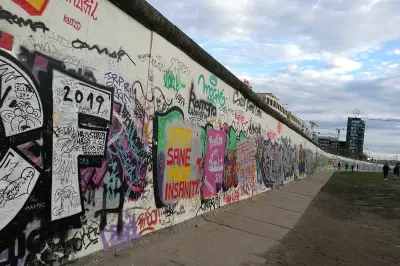
Graffiti is found in many places in Berlin.
Alexanderplatz takes its name from a visit by Tsar Alexander I of Russia in 1805. Originally a livestock and wool market, it became a major transport and commercial hub in the late 19th and early 20th centuries. In WWII, the square and its surrounding buildings were almost completely destroyed. During the GDR era, as the center of East Berlin, Alexanderplatz was massively rebuilt in a socialist modernist style. After reunification, the square underwent ongoing modernization, with new shopping centers, but still retains its distinct GDR-era character and layout.
Alexanderplatz fountain.
Schinkelplatz (building 10117).
The Friedrichswerder Church is a Neo-Gothic church built from 1824 to 1831. During WWII, the church was destroyed and remained in ruins until restoration began in 1982, completed in 1987. The church now serves as a branch of the National Gallery.
Unter den Linden began as a sandy riding path leading to the Tiergarten hunting grounds. It was named "Under the Lindens" when Elector Frederick William planted thousands of walnut and linden trees along the path in 1647. Under Frederick the Great, the street was planned as a grand ceremonial boulevard, lined with fine Baroque and Classical buildings, becoming the power and cultural center of the Kingdom of Prussia. Stretching from the Schlossbrücke at Museum Island in the east to the Brandenburg Gate in the west, about 1.5 km, it is the heart and spine of Berlin, known as the German "Champs-Élysées."
The Schlossbrücke (Palace Bridge) was originally a wooden drawbridge in the 16th century, called the "Royal Bridge." The current stone bridge's appearance comes from the design of the famous Prussian architect Karl Friedrich Schinkel. Completed in 1824, it is a three-arch stone bridge. Severely damaged in WWII, it was simplified rebuilt by the East German government, with most decorative sculptures removed. After reunification, in the 1990s, the bridge underwent a comprehensive historical restoration, with all sculptures recreated based on historical sources, restoring its original splendor from Schinkel's design.
The German Historical Museum is divided into an old building and a new building. The old building is a Baroque structure over 300 years old, housing a permanent exhibition on over 1,500 years of German history, titled "From the Middle Ages to the Fall of the Berlin Wall," with a very rich collection.
German Historical Museum (old building).
The Neue Wache (New Guardhouse) is the central memorial to the victims of war and tyranny in Germany. This Neoclassical building was built by Karl Friedrich Schinkel from 1816 to 1818, originally as a guardhouse and a memorial to those who fell in the Napoleonic Wars. Today, it serves as a central memorial, housing the open-air sculpture "Mother with Her Dead Son" by Käthe Kollwitz, along with the unknown remains of a resistance fighter and a concentration camp prisoner.
Käthe Kollwitz's open-air sculpture "Mother with Her Dead Son."
St. Hedwig's Cathedral was built by order of King Frederick the Great of Prussia between 1747 and 1773. Although Frederick was Protestant, he promised to build a church for the Catholic immigrants from Silesia and the Rhineland, naming it after the patron saint of Silesia, St. Hedwig, reflecting his policy of religious tolerance. Its design was heavily influenced by the Pantheon in Rome, a very bold architectural choice in predominantly Protestant Berlin at the time. It was also the first Catholic church in Berlin. It was severely burned out in 1943 during WWII, leaving only the outer walls. From 1952 to 1963, the church was rebuilt within the original shell. The interior was given an extremely minimalist modern design, contrasting sharply with the original Baroque dome exterior, thereby commemorating the wounds of war.
Humboldt University of Berlin originally occupied the Prince Heinrich Palace, a Baroque palace built from 1748 to 1766. Founded in 1809 by Wilhelm von Humboldt, the Prussian Minister of Education, together with philosopher Fichte and theologian Schleiermacher, it was initially named the University of Berlin. In 1828, it was renamed Friedrich Wilhelm University. In 1949, to shed the royal name and honor the brothers Alexander and Wilhelm von Humboldt, it was renamed Humboldt University of Berlin.
Humboldt University has nine faculties. It pioneered the influential "Humboldtian model" of higher education, earning the title "Mother of all modern universities," with a far-reaching impact on Europe and the entire world.
Humboldt University (administrative center and important academic venue).
Historically, the site of the 1933 book burning, where Nazi students burned tens of thousands of books deemed "un-German." Today, an underground memorial niche contains empty white shelves, enough to hold the approximately 20,000 books that were burned, serving as an eternal warning.
Inside the administrative center of Humboldt University.
Humboldt University (administrative center and important academic venue) and Bebelplatz.
Humboldt University (main campus).
Equestrian statue of Frederick the Great, King of Prussia, with a long history and rich details. It was removed during the GDR era and later restored to its original location.
The Berlin State Library (Unter den Linden branch), built 1903–1914, is the largest universal library in Germany, collecting all publications published in Germany. Special collections include historical manuscripts and musical scores: its most prized holdings include original manuscripts of Beethoven's Fifth and Ninth Symphonies, autograph scores of Mozart, Bach, and other music masters. Valuable manuscripts: collections of works by scientists, thinkers, and writers such as Leibniz, Kant, and Goethe. Maps and atlases: world-class map collections, historical newspapers and periodicals.
The Berlin State Opera was built by order of King Frederick the Great of Prussia between 1741 and 1743. Its original name was the "Royal Opera House." It was the first public theater in Germany independent of the court, a milestone. The building's fate mirrors Berlin's: it has experienced multiple destructions and rebirths. After reunification, a large-scale modern renovation was carried out, reopening in 2017. Its affiliated orchestra is the world-renowned Staatskapelle Berlin.
The Stabi Kulturwerk (part of the State Library) treasures many fine ancient books and artifacts. Some corners display surprising books/magazines, offering perspectives on different periods and performances.
Unter den Linden.
Russian Consulate.