European Travel: Entering Germany's Capital Berlin (Photos)
The reporter has visited two cities in Germany, and the German capital Berlin, introduced in this article, is the second German metropolis I visited after Munich, and also the first stop of my Balkan Peninsula tour in Europe.
Soaring in the Blue Sky (Photo: Feng Ganyong)
From June 24 to July 14, 2018, the reporter participated in a 21-day European tour of the Balkan Peninsula, covering 13 countries including Germany, Hungary, Serbia, Macedonia, Croatia, Austria, etc. From a travel perspective, 21 days is not a short time, so this relatively long Balkan Peninsula journey was bound to leave many unforgettable and wonderful memories.
Aerial View of Berlin (Photo: Feng Ganyong)
At 13:38 Beijing time on June 24, 2018, the reporter, along with 22 group members from all over China—including Wang Jue, Sun Tao, Gu Jianping from Beijing, Shanghai, Tianjin, Liaoning, Heilongjiang, Zhejiang, Yunnan, Shaanxi, etc.—gathered at Terminal 2 of Beijing Capital International Airport and boarded flight HU489 of Hainan Airlines from Beijing Capital Airport to Berlin Tegel Airport, kicking off the journey.
Tegel Airport (Photo: Feng Ganyong)
After a 9-hour and 10-minute flight soaring through the blue sky and white clouds, the Hainan Airlines flight arrived at Berlin Tegel International Airport at 16:45 German time (22:45 Beijing time) on June 24, 2018. This airport, whose name sounds similar to that of the famous Indian poet Tagore, is one of the main international airports in Berlin, the German capital, located about 8 kilometers in the direction of Tegel in the Reinickendorf district of Berlin. Since the German aviation pioneer is Otto Lilienthal, the airport is also known as Otto Lilienthal Airport. It is the fourth busiest airport in Germany and a main base for Air Berlin.
Scenery of the Spree River (Photo: Feng Ganyong)
Under the guidance of the beautiful team leader Xu Haiyan, the group walked out of the airport. The local guide Shen Chenwei from Hungary Longteng Aoyou was already waiting outside, warmly welcoming the group members from China. Perhaps it was a case of "good things come to those who wait"—because one group member's luggage was mistakenly taken by someone else, the group was delayed at the airport for over two hours before boarding the Mercedes-Benz bus that would accompany us throughout the journey. The driver's name was Bojan, which sounds very similar to the Chinese word "baoyang" (maintenance). He was a tall, handsome young man from Serbia. Bojan drove to downtown Berlin, starting the first leg of the Berlin tour.
Brandenburg Scene (Photo: Feng Ganyong)
On the way, the guide Shen Chenwei, with a kind face and a slightly plump figure, began to vividly narrate the situation of Berlin to the group members. Berlin, located in northeastern Germany, is the capital and largest city of Germany, and also the political, cultural, transportation, and economic center of Germany. Berlin is surrounded by the state of Brandenburg, with the Spree and Havel rivers flowing through the city. Berlin is one of Germany's sixteen federal states, and along with Hamburg and Bremen, it is one of Germany's only three city-states.
Buildings Along the Spree River (Photo: Feng Ganyong)
After World War II, the city was divided into two areas. East Berlin became the capital of East Germany, while West Berlin was effectively an exclave of West Germany within East Germany, surrounded by the Berlin Wall. It was not until the reunification of Germany in 1990 that Berlin regained its status as the German capital and established diplomatic relations with many cities around the world.
Holiday Inn Hotel (Photo: Feng Ganyong)
In the evening of that day, the group had the first Chinese dinner of the Balkan Peninsula tour at the Berlin Holiday Inn Hotel. After dinner, the group drove for more than 20 minutes to the first NH Hotel where they would stay overnight. The group members, tired from the flight, had a good night's sleep to recharge.
Hotel in Berlin (Photo: Feng Ganyong)
At 8:30 German time on June 25, 2018, the European tour group, having rested overnight, departed from the NH Hotel and started the first leg of the Balkan Peninsula tour: a sightseeing tour of the German capital Berlin. That day, they would visit famous attractions such as the Spree River and the adjacent Berlin Wall, Bebelplatz, the Reichstag Building, the Brandenburg Gate, and Charlottenburg Palace.
Berlin Morning Rush Hour (Photo: Feng Ganyong)
The group set off from the hotel by bus in the morning, catching the tail end of the morning rush hour, so traffic was slow. The first stop was to visit the famous Berlin Wall along the Spree River. As the group's bus crossed the Spree River Bridge, they could already see the Berlin Wall in the distance.
Spree River Bridge (Photo: Feng Ganyong)
Shen Chenwei introduced: The Spree River in Berlin is a river in the German states of Saxony, Brandenburg, Berlin, and the Czech region of Ústí nad Labem. Its source originates from the Lusatian Mountains in southeastern Germany. It flows northward and splits into two branches near Spremberg. After passing through Cottbus, it forms a network of canals and creates a swamp forest area until Lübben. After passing through Fürstenwalde and Köpenick, it meanders through Berlin in multiple branches and finally joins the Havel River, a tributary of the Elbe, at Spandau.
Viewing the Berlin Wall from a Distance (Photo: Feng Ganyong)
The Spree River is 403 kilometers long with a drainage area of 10,100 square kilometers. Much of the swamp forest area has been reclaimed into vegetable fields, and it is also a popular weekend getaway for Berliners. The Spree River is connected to neighboring rivers by canals, the most important being the Oder-Spree Canal southeast of Berlin.
Students by the River (Photo: Feng Ganyong)
After crossing the bridge over the Spree River, the bus turned left and stopped on the riverside alongside the Berlin Wall. The group members got off and walked to the riverbank. First, they admired the beautiful scenery on both sides of the Spree River, then began strolling along the long Berlin Wall. As they walked, they listened to Shen Chenwei's introduction.
Corner of the Berlin Wall (Photo: Feng Ganyong)
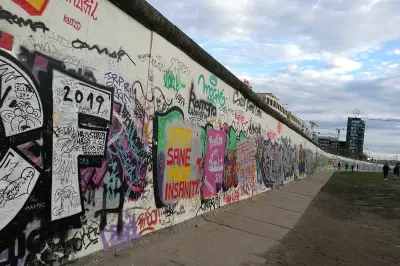
The Berlin Wall (German: Berliner Mauer; English: Berlin Wall) was first built on August 13, 1961, with a total length of 155 kilometers. Initially, it was a border fence made of barbed wire and bricks, and later reinforced into a border defense system consisting of watchtowers, concrete walls, open areas, and anti-vehicle trenches. The Berlin Wall was a symbol of Germany's division and an important landmark of the Cold War.
Tourists in Front of the Berlin Wall (Photo: Feng Ganyong)
The official name of the Berlin Wall was the Anti-Fascist Protection Rampart. It was a border defense system built by the German Democratic Republic (abbreviated as GDR or East Germany) on its own territory around the border of West Berlin. Its purpose was to prevent the free movement of people between the German Democratic Republic (including its capital East Berlin) and the Federal Republic of Germany (abbreviated as FRG or West Germany) as well as West Berlin.
Artwork on the Berlin Wall (Photo: Feng Ganyong)
Today, the wall has become an art wall where people express their artistic talents. A wide variety of colorful graffiti cover the wall. Among them, the work "Brotherly Kiss" is particularly famous and widely known. The famous "Brotherly Kiss" was created by Moscow artist Dmitri Vrubel and is one of the most famous graffiti on the Berlin Wall. It depicts Soviet General Secretary Leonid Ilyich Brezhnev kissing East German leader Erich Honecker. The painting symbolizes the strategic cooperation between the Soviet Union and East Germany. However, this work had an interesting story of loss and recovery.
Artwork on the Berlin Wall (Photo: Feng Ganyong)
This section of the Berlin Wall, now mainly for tourists to view, is the longest remaining section. This section, called the "East Side Gallery," is covered with various graffiti works. At that time, Vrubel and 117 other artists from 21 countries left graffiti on a 1,316-meter-long wall. His famous "Brotherly Kiss" was based on a photograph from 1979.
Artwork on the Berlin Wall (Photo: Wang Jue)
However, when 48-year-old Dmitri Vrubel came to Germany again, he was shocked to find that "Brotherly Kiss" had been accidentally "stolen." The original wall where the graffiti was located was empty, with only the Russian slogan above barely visible!
Artwork on the Berlin Wall (Photo: Feng Ganyong)
Vrubel was furious, saying that the erasure of "Brotherly Kiss" was not personally authorized by him. When he read in the newspaper that the Berlin Wall was going to be renovated, "Brotherly Kiss" had already been completely erased. Vrubel complained: "These barbaric actions destroyed my painting; it is an insult to the artist." On the 25th anniversary of the fall of the Berlin Wall, he gave an interview to the Russian newspaper Kommersant, recalling the circumstances of creating the work twice.
Artwork on the Berlin Wall (Photo: Feng Ganyong)
"I first saw this work outside the Berlin Wall in an early West German magazine 'Be a Soviet Person,' and as a 'Soviet person,' I did not earn any income from this painting during that period. Over the years, I have lived my life and continued painting."
Artwork on the Berlin Wall (Photo: Feng Ganyong)
"At the beginning of this century, people returning from Germany began to bring souvenirs, such as refrigerator magnets and mugs, all printed with this kiss. It was no longer only sold in the East Side Gallery but throughout the city. It began to become a symbol, an iconic work."
Taking Photos in Front of the Berlin Wall (Photo: Wang Jue)
Vrubel also said that he originally intended to create a new painting more closely related to the present, such as depicting the interaction between Obama and Putin, but he ultimately changed his mind and decided to stick with the theme of the embrace between Brezhnev and Honecker. Vrubel added: "This will be a new painting from a different perspective. It should be noted that this is not a political image; it is all about love."
Group Photo by the Spree River (Photo: Feng Ganyong)
After taking the first group photo of the trip at the Berlin Wall by the Spree River, the group moved on to the second stop: sightseeing at Bebelplatz. On the way, they saw large billboards of the German national football team's main players hanging high on buildings, giving a sense of the ongoing World Cup football tournament.
Berlin Street Scene (Photo: Feng Ganyong)
Bebelplatz is a square in the center of Berlin. It is located on the south side of Unter den Linden, the main east-west thoroughfare through the city center. To the east is the Berlin State Opera, to the west is Humboldt University, and to the south is Berlin's oldest Catholic church, St. Hedwig's Cathedral. The square is named after the 19th-century German Social Democratic leader August Bebel.
Bebelplatz (Photo: Feng Ganyong)
Arriving at the spacious Bebelplatz, the view in all directions was filled with distinctive architectural ensembles. Shen Chenwei introduced: This square was laid out by Prussian King Frederick the Great from 1741 to 1743 and was originally called Opera Square. From 1911 to 1947, it was named Emperor Franz Joseph Square after the Austrian Emperor Franz Joseph I.
Buildings Around the Square (Photo: Feng Ganyong)
What made Bebelplatz world-famous was that on May 10, 1933, members of the Brownshirts and the Hitler Youth, incited by Propaganda Minister Joseph Goebbels, held a book-burning ceremony here. The Nazis burned about 20,000 books, including works by Thomas Mann, Erich Maria Remarque, Heinrich Heine, Karl Marx, and many others.
Statues Around the Square (Photo: Feng Ganyong)
Most of the buildings around Bebelplatz were destroyed during World War II and later rebuilt. The glass dome in the square, where we are now, contains an empty bookshelf that commemorates this book-burning event. It is inscribed with a line from Heinrich Heine's 1820 poem: "That was only a prelude; where they burn books, they will ultimately burn people. Heine 1820." Every year, students from Humboldt University hold a book sale in the square to commemorate the event.
Royal Library (Photo: Feng Ganyong)
The group members strolled through Bebelplatz and took photos in front of the main buildings. Among the two symmetrical buildings, the one on the west is the Royal Library of Humboldt University; the one on the east is the State Opera House—the first major building of the Kingdom of Prussia. This state-supported, coeducational institution of higher learning was founded by the Prussian Minister of Education, the renowned German scholar and educational reformer Wilhelm von Humboldt. In addition, the main building of Humboldt University of Berlin is also exceptionally magnificent.
State Opera House (Photo: Feng Ganyong)
Humboldt University of Berlin, located on Unter den Linden in the city center, is adjacent to the UNESCO World Heritage Museum Island, the Brandenburg Gate, and the Federal Chancellery. It is the oldest university in Berlin, Germany, and was formerly known as the University of Berlin, founded in 1810. A statue of Wilhelm von Humboldt stands prominently at the entrance inside the campus.
Statue of Wilhelm von Humboldt (Photo: Feng Ganyong)
Humboldt University is the world's first new-style university that integrates scientific research and teaching. It has a very glorious history and is known as the "Mother of Modern Universities." Albert Einstein, Georg Wilhelm Friedrich Hegel, Karl Marx, and others have taught or studied here. Its Humboldtian spirit of "unity of research and teaching," "academic freedom, freedom of teaching, and freedom of learning" has influenced almost all modern universities. In 2012, Humboldt University of Berlin was selected as one of the 11 German "Universities of Excellence."
Clock in the Square (Photo: Feng Ganyong)
Humboldt University has a top reputation and strong research capabilities in the humanities, with its literature, linguistics, history, philosophy, sociology, and other disciplines ranking among the world's best. The law school of Humboldt University is one of the best in Germany.
Humboldt University of Berlin (Photo: Feng Ganyong)
In the 2015-2016 Times Higher Education World University Rankings, Humboldt University of Berlin ranked 49th in the world.
Reichstag Building (Photo: Feng Ganyong)
After completing the sightseeing at Bebelplatz, the group drove to the German Reichstag building in the center of Berlin. Its official name is "Reichstagsgebäude" (Imperial Parliament Building). It is located in the Tiergarten district of central Berlin. In the square in front of the Reichstag building, several female students were seen performing a wonderful dance show, their graceful and moving dances full of youthful vitality.
Dance Performance in the Square (Photo: Feng Ganyong)
The Reichstag building itself was originally the parliament of the German Empire (Second Reich) and later served as the parliament building of the Weimar Republic. Since 1994, the Federal Convention of Germany has elected the German Federal President here every five years. Since 1999, it has been the meeting place of the German Bundestag (federal parliament).
View of the German Chancellery (Photo: Feng Ganyong)
From the Reichstag building, looking diagonally across the distance, one can see the German Chancellery facing it. At that time, the then German Chancellor Angela Merkel worked in this building.
Photo at the Brandenburg Gate (Photo: Feng Ganyong)
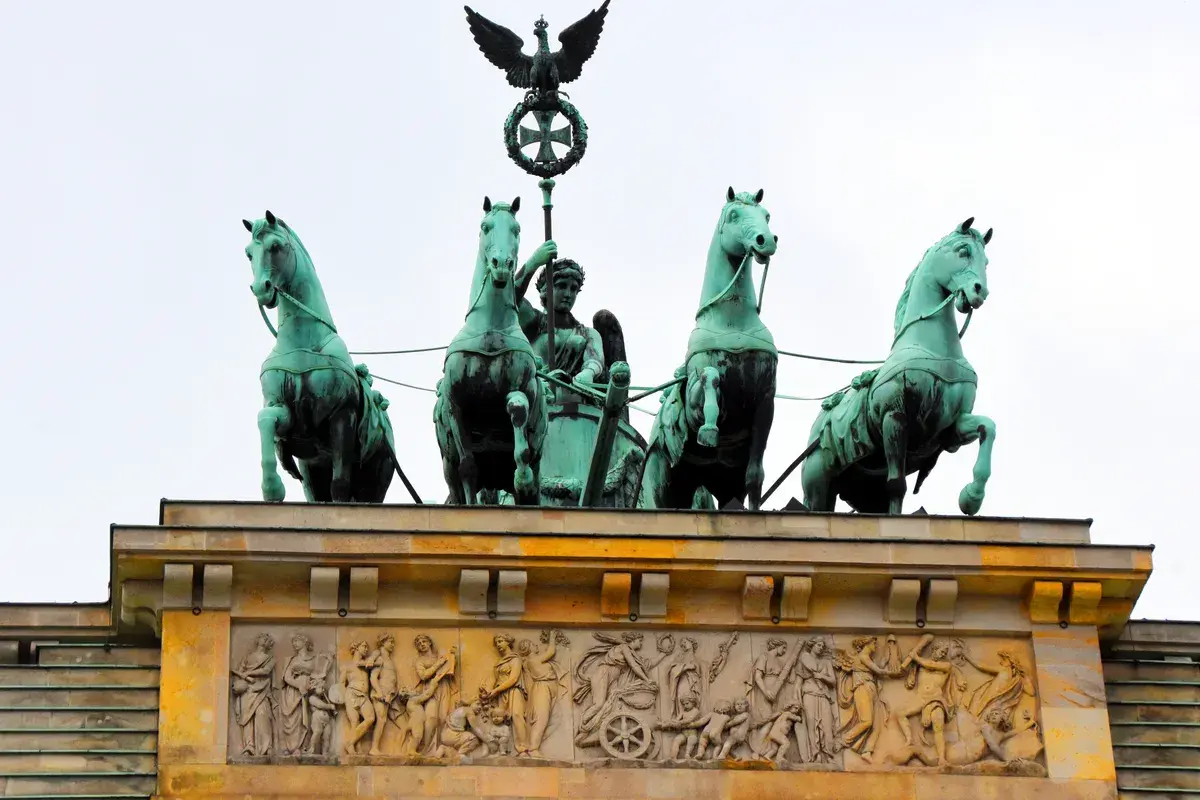
Not far from the Reichstag building is the Brandenburg Gate, located in the center of Berlin. It was originally a city gate of the Berlin wall, named after the road to Brandenburg.
Brandenburg Gate (Photo: Feng Ganyong)
The preserved Brandenburg Gate is a neoclassical building. It was commissioned by Prussian King Frederick William II and built between 1788 and 1791 to commemorate the Prussian victory in the Seven Years' War. The reporter observed that the area in front of the Brandenburg Gate was bustling with people, but inadvertently, in the midst of the noise, he saw a carriage driver quietly sitting in his carriage reading a newspaper. This scene of finding peace amidst chaos left a deep impression.
Carriage Driver in Front of the Gate (Photo: Feng Ganyong)
Charlottenburg Palace in Berlin was the last scenic spot the group visited during their Berlin tour. The palace was built between 1695 and 1699 by Elector Frederick III as a summer residence. Charlottenburg Palace is the largest Prussian Hohenzollern palace in Berlin today. The original name of the palace was Lietzenburg. The building was designed by Johann Arnold Nering at the request of Sophie Charlotte (Frederick III's wife).
Photo at Charlottenburg Palace (Photo: Xu Haiyan)
After the king's coronation, the summer residence was expanded by Eosander von Göthe. After Sophie Charlotte passed away in 1705, Frederick renamed the palace and its surroundings in her memory. Between 1709 and 1712, an orangery and a dome were added.
Charlottenburg Palace (Photo: Feng Ganyong)
The first leg of the Balkan Peninsula tour, a two-day visit to Berlin, Germany, was a whirlwind tour, but the rich cultural heritage embedded in the diverse natural scenery and cultural landscapes left deep and wonderful memories for all group members. Carrying this sense of unfulfilled excitement, the group would continue their new journey. (Text and photos: Feng Ganyong)