Self-Drive Tour of Germany's Black Forest and Castles
Self-Drive Tour of Germany's Black Forest and Castles
Initially, I planned a 20-day trip to Germany and France, driving a loop through Germany: Berlin, Cologne, Frankfurt, Heidelberg, Munich, Nuremberg, Leipzig, Berlin, then flying to Paris for 5 days.
Considering that the Benelux countries lie between Germany and France and that the chance of visiting them separately in the future is very small, I added the Benelux. The 20-day itinerary became a bit tight.
At the end of April, I contacted CYTS to prepare visa documents, specifically obtaining a notarized affidavit of kinship with an apostille. Planned departure in June. By April 30, my passport hadn't arrived yet, so I used a copy to schedule an in-person interview for mid-May. All EU visa application centers are located in Guanghua SOHO. Most embassy entrances were deserted, but the German embassy had a crowd sitting outside. However, the processing was efficient; the visa came out one week after the interview.
While waiting for the visa, our itinerary changed again. It was shortened from 20 days to 16 days. Regrettably, France was canceled. The 16-day trip was replanned, removing large German cities and focusing on the Black Forest and castles, while still including Berlin and the Benelux by car. This took a lot of effort.
After reading numerous Germany travel guides, the classic routes are concentrated on the western Romantic Road through the Black Forest and the central Castle Road. I couldn't find a combined route. The internet opportunely recommended the most beautiful German towns, and I didn't want to miss them, and I also had to include the Benelux—really wanting everything.
I told Doubao (an AI assistant) the places I intended to visit and tried to have it design the itinerary. The resulting itinerary was incomplete. Then I used WeChat's AI, which thought carefully for a long time. Its result was more comprehensive than Doubao's, but still didn't meet my needs. Combining several different plans, I finally used Google to determine the route. Without any existing guide, I created several versions of this niche and tight itinerary, finalizing it only shortly before departure.
I didn't use any of the hotels recommended by AI, and its restaurant recommendations were also of little use. Previously, netizens wrote travel guides on the internet; now they use videos more. The guides AI found were all old ones, making their value questionable. Accommodation in Germany is expensive; hotel prices are over 1000 RMB. When choosing a hotel, pay special attention to bed size—beds under 1m are not advisable. For three people, family suites are more cost-effective. The hotel's location is most important: it should be convenient for transportation and have parking. The exchange rate was around 8.1 when in Germany, rose to 8.25 upon return, and 8.4 by the end of June—soaring in just one month.
During the three days in Berlin, we bought the Berlin WelcomeCard and used only public transportation. For convenience, we searched for hotels near the train station, but mistakenly booked an Ibis chain hotel 15 minutes away from the station. After getting off the train, we walked a long way with our luggage, the wheels bumping over the square cobblestones, making a clattering sound. My mood was as gloomy as the suitcase.
European hotels check-in at 3 PM and check-out between 11 AM and 12 AM. We arrived at the hotel around 9 AM, settled our luggage, and then had to go out.
The closest building to the subway station is the Reichstag Building. We started booking a week in advance, but the official website kept having issues, so we could only book at the entrance. The earliest available time was the next day. Fortunately, we had two days in Berlin, otherwise we would have missed it. The next afternoon we came here again. This is where the famous Reichstag fire occurred and where the Soviet Red Army hoisted the red flag on the roof, declaring victory in the anti-fascist war. I must say the audio guide here is the most advanced in Berlin, with not only Chinese but also positioning and real-time narration. Walking up the spiral staircase into the fully glass dome reconstructed after WWII, listening to the commentary and overlooking Berlin, I instantly grasped the city's full view.
The Brandenburg Gate is a German landmark, built to commemorate Prussia's victory in the Seven Years' War. Originally a gate in the Berlin city wall leading to Brandenburg. The wall is gone, but the Goddess of Victory atop the Brandenburg Gate has always held a scepter and driven a chariot, guarding Berlin.
Checkpoint Charlie and the Berlin Wall Museum near Potsdamer Platz are popular photo spots for tourists. Foreign tourists usually like to photograph scenery and architecture, but a simple wooden guard booth and sandbags have become the best place for portrait photography. Everyone queues up. Formerly a border checkpoint between East and West Berlin where Allied soldiers stood guard with guns, it's now occupied by smiling tourists. The graffiti on the exterior walls of the museum highlights the German people's humorous painting style, while the black interior conveys a somber atmosphere.
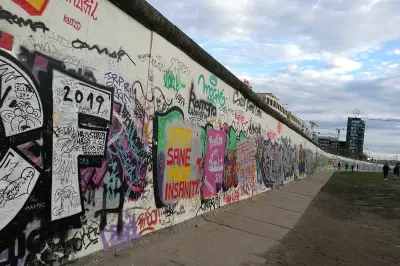
A few stops from the Berlin Wall Museum is the Berlin Wall Memorial. On the foundation of the original wall, 200 meters of the wall have been restored. Inside the wall is a lawn, outside is the road. There are few tourists; the mottled graffiti and reddish-brown metal pillars tell a poignant history.
Thanks to jet lag, I slept a full 12 hours. The hearty breakfast with various cheeses, sausages, bread, and fruits made lunch unnecessary. German pork knuckle, sausages, sauerkraut with potatoes, a serving of white asparagus, and homemade beer—besides being salty, German flavors are very appealing.
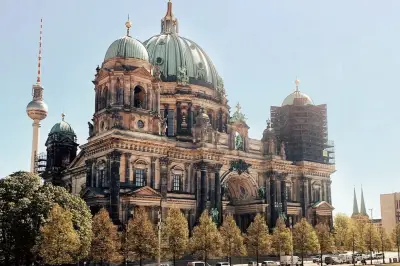
Getting off at Museumsinsel station, we arrived at Museum Island. The Berlin Cathedral with its three green domes was built in 1747, demolished and rebuilt in 1894, its dome burned by shelling in WWII, and restored in 2002. The blackened walls are full of history. Entrance to the Berlin Cathedral is charged; besides religious activities, concerts are often held here. We happened to catch a church event and listened to the sound of over 7,000 pipes echoing in the vast building.
The Altes Museum houses ancient Roman and Greek art. The Neues Museum was built at the same time as the Old Museum, and like the Berlin Cathedral, was bombed in WWII. When it reopened in 2009 after reconstruction, it preserved its original structure while adding a glass roof and side windows to allow natural light for viewing sculptures. Its collection mainly consists of ancient Egyptian artifacts and prehistoric items. The colorful bust of Queen Nefertiti of Egypt, 3,400 years old, is the museum's crown jewel.
Berlin's public transport is very convenient. All bus systems seem unattended—just board directly. Trains and subways are the same—no turnstiles or ticket gates. So no one reminds you if a train is late, canceled, or changed platforms. You need good eyesight and the ability to constantly check the information screens. The national character of being patient and unhurried is cultivated this way.
Stepping out of the delayed Cologne train station, the Cologne Cathedral stands in the square. Sights abroad are generally easy to reach; roads lead right to them, saving effort.
The entire building is a Gothic twin-tower structure, 157 meters high and very majestic. Over 700 years of industrial pollution and WWII shelling have left the exterior black and mottled, giving it a sense of history. In contrast, its neighbor, the equally Gothic Milan Cathedral, made of white marble, blends seamlessly with Milan's modern urban atmosphere.
The Cologne Cathedral is very crowded; climbing to the top also requires queuing. The stairs are only wide enough for single-file traffic, so you often have to step aside for people coming down. The 11,000 pinnacles and 109 statues accompanied me as I climbed; they are within arm's reach, allowing clear observation of the varied figures. At the top, it feels like being above the clouds; the Rhine and Hohenzollern Bridge become tiny like a model.
In the evening, we crossed the Hohenzollern Bridge to reach the residential area. Behind the cathedral, surprisingly, there was a large shopping district. We circled the Cologne Cathedral, having now fully appreciated this 700-year masterpiece from above, inside, and around. We came to Cologne only to see the cathedral, with no other plans.
The road from Cologne to Amsterdam was smooth. Throughout the entire self-drive trip, even though roads in small towns were narrow and some mountain roads were one-way, there was never a traffic jam. Traffic lights are not very common in cities, but drivers obey traffic rules. Highways are mostly without speed limits, yet traffic is orderly.
Arriving in Amsterdam, we planned to park at a P+R near the hotel, but for some reason it suddenly closed. We bought a day pass and took the metro to the Van Gogh Museum. The wall decorations of Amsterdam's metro stations are ingenious, though we couldn't understand the text. The Van Gogh Museum also requires advance booking; the official website had issues—it allowed booking but not payment. The Chinese audio guide covers most famous paintings, explaining them like a teacher. The museum closed at 18:00; in less than 2 hours, we gained a lot.
Along the canal, we chose a highly rated bar. The bar door was small and closed; we peeked in. Inside, the space was small; at the entrance, you had to hang your coat in the cloakroom. The bar and restaurant were on opposite sides. Under dim red lights, we sat at a counter-like table, very small. Homemade beer was a must-order. Grilled meat and mashed potatoes were served on wooden trays instead of plates. The sauce on the pork ribs resembled the dark color of Tianfuhaus braised pork shoulder; it was delicious. Another area had a corner sofa where diners ate. The kitchen was open, located next to our table, grilling meat. Because the space was tight, coats had to be hung at the entrance. The waitstaff here seemed similar in attitude to those in the Cologne restaurant. Though busy, they clearly loved their jobs, and their relationships with colleagues were friendly. Work is not just a necessity for survival but also part of life; their living state is relaxed and casual.
The next day's itinerary took a detour through The Hague to Brussels, Belgium. After breakfast, we first went to Zaanse Schans Windmill Village. We arrived early, and there were still free parking spots. Most tourists to Amsterdam visit the windmill village. The village had set up a small theater stage for children, as well as a band parade and an open-air market. I didn't expect Dutch windmills to have developed all over the world—not only by lakes but also by seas, deserts, mountains, and plains. Those windmills are taller, with thinner blades, generating more electricity.
The Hague's city center has no modern buildings; most are about four stories high in red tones with white window frames. The Peace Palace is the same. Built in 1907 with funding from various governments, it now houses the International Court of Justice. Currently, the case of former Philippine President Rodrigo Duterte is being heard here. The Hague's streets are neat and clean, with few pedestrians. But parking is a big problem; we circled the Peace Palace twice without finding a spot and had to leave.
Don't drive in Brussels without excellent driving skills. The streets are narrow, various vehicles mix, and the underground garage entrances and exits are only suitable for small European cars. The car barely fit into the garage, but getting out felt like a maze. Belgian fans are very enthusiastic; by noon, the area outside the bar was already full of people, and the restaurant doors were blocked by the crowd. Our car had to stop outside the bar to unload luggage. At 5 o'clock, these people changed into red jerseys and poured from various bars into the area around the Grand Place, singing, dancing, juggling—all kinds of performances expressing joy to warm up for the upcoming football match.
Perhaps the Belgians are disciplined; the fans did not appear at the Grand Place, leaving it for tourists. This square, hailed as the most beautiful in Europe, was described by Victor Hugo as a piece of jewelry inlaid like a gem. The square is not large; buildings like the National Museum, City Hall, restaurants, and the Swan Café enclose it. Hugo and Marx both lived here; the Communist Manifesto was born at the Swan Café. Hugo visited many times as well. The square gathers various architectural styles: Gothic, Renaissance, Baroque, Louis XIV. This made it a UNESCO World Heritage site. Two blocks away is the Manneken Pis statue. The various costumes made for him by Belgians are also displayed in the National Museum at the square.
Exiting the Grand Place, you can see a hill in the distance. In the opposite direction from the hill are the Royal Palace of Brussels and the Royal Park. This is the city center of Brussels. All are old buildings but maintained as if new, compact and overwhelming. Modern buildings like the EU headquarters are far from the old city center.
Throughout the entire trip, the only place with free parking was Luxembourg. The hotel was not large; each floor had a common living room. The restaurant was small but had a good selection of food, and you could squeeze various juices. Fuel prices were lowest in Luxembourg, and public transport was free. We happened to see the royal army training in a small alley. Soldiers and police officers were of all shapes and sizes, as if randomly assembled. After only a short training session, the military band led the soldiers and us to the Grand Ducal Palace. Officials, bodyguards, soldiers, citizens, tourists, and diners at roadside restaurants all waited together on the narrow street for the Grand Duke. Officials' nameplates were placed on the ground; they were repeatedly blown away by the wind—so casual. The Grand Duke and his wife, along with another important dignitary and his wife, came out. There was no security lockdown, no security check; as long as you reached out your hand, you could shake hands with the Grand Duke. So approachable.
We accidentally entered an art gallery that seemed private; it had few works but occupied a large area. Petrus Park is below the Constitution Square with the golden girl statue, a sunken park. Walking down the moss-covered steps, we entered a forest park. The spot where I had just stood now had new visitors. A moment ago I was looking down from the ground into the valley; now I was looking up from the valley floor. The valley was serene. Above the trees was noisy; a rainbow-colored tram roared over the bridge. Below the bridge, people were running, walking dogs, cycling; only the skate park had the sound of skateboards sliding. Above and below the bridge felt like two different worlds. Interesting!
The Bock Fortress is a landmark bunker in Luxembourg. In the 16th century, it made Luxembourg one of the strongest fortifications in Europe. The fortress is above ground, extending 40 meters down into the valley. Inside, it is spacious enough for a carriage, and ancient cannons are still preserved. Luxembourg is so small that it cannot separate old and new buildings like Belgium, yet it doesn't feel incongruous.
Leaving Luxembourg, we re-entered Germany. There are no borders between Schengen countries; only your phone's global roaming will notify you that you've entered another country and provide 1 hour of free data. Great service!
The road to Monschau was a country lane. Vast golden wheat fields rippled in the wind. We drove onto a dirt path in the field and up to the highest point of a hill. A small wooden table and a few chairs were fixed on a clearing—a resting spot for the farmer. Looking at the bountiful wheat fields below and the blue, not too clear sky, smelling the fragrance of wildflowers along the path, this rural life is enviable. A farming machine drove over, with many mechanical arms attached. Perhaps to preserve the tranquility of the countryside for us, it turned into another field.
We passed many villages, mostly beautiful three-story houses with sloping roofs and many sturdy iron hooks, perhaps for drying. Every village was clean, houses spaced neither too close nor too far. A church was a standard feature of each village. Farmhouses and churches were meticulously maintained, even traffic signs looked like they had been cleaned. The only unsatisfactory thing was the mirrors at intersections, which seemed not replaced for years.
Monschau is a distinctive small village nestled in the mountains of Germany, the Netherlands, and Belgium. It is a well-preserved ancient village. The church and castle are solid brick and stone structures; the houses are mostly half-timbered (Fachwerk), characteristic of Germany. With gray roofs and white walls, the half-timbered houses have brown timber frames against the white walls, a unique style.
Staying in an old half-timbered house, with wooden stairs, doors, windows, beds, tables, chairs, and an old key, and outside the window, the Ruhr River winds through the town. From different windows in the house, you could enjoy varied beautiful views.
The restored Monschau Castle stands high on a small hill. Times have changed; it is now a youth hostel. I noticed that the manhole covers were exquisitely made, with the Monschau coat of arms cast into them.
The parking lot in Monschau is not large, located beside the town. There aren't many restaurants; it is not overly commercialized and retains its original simplicity.
From Monschau to the next beautiful old town, Cochem, it's a 2-hour drive. The buildings here are over 2,000 years old. The representative Reichsburg Castle was built around 1000 AD, once the residence of counts, then an imperial palace, later the office of archbishops, and now owned by all citizens of Cochem. Staying on the opposite bank of the Moselle River, overlooking the main part of Cochem, the Reichsburg is the most eye-catching. Crossing the bridge into the commercial area, we had some ice cream and bought chocolate, then walked up the steep slope eating. The Reichsburg, after reconstruction, still retains its wall and well. Following a guide, we toured the castle. Apart from the general furnishings, the most fascinating were the knight's armor and a clever door that could be entered while drunk.
Heidelberg, famous for its university, was already 30°C in June. It was very hot outside, so we decided to drive. On the way to Heidelberg, we passed through the campus of Heidelberg University, founded in the 13th century and becoming a European scientific and cultural center in the 16th century. Many philosophers studied and worked here. The navigation directed us to a one-way narrow street. Strangely, all the cars were parked facing the opposite direction. How did these cars get in? Would they have to drive out against traffic? After circling without finding a parking spot, the navigation indicated P9 had spaces, but unfortunately we missed the turn. Further ahead, P10 could also park, with plenty of spaces. Going upstairs, we saw people operating a machine—the payment machine.
Heidelberg Castle, located on the Königstuhl hill, like other famous German buildings, has different architectural styles from 400 years of construction and reconstruction. The large wine barrel in the cellar once held wine collected as taxes in the Middle Ages and witnessed Heidelberg's rise and fall. The Pharmacy Museum contains herbs and distillation vessels. Herbal medicine is not limited to Eastern countries; Europe also used it, but by the 16th century, Germany was using scientific methods to extract and prepare medicines.
The interior of Heidelberg Castle is well preserved, but the exterior still has the incomplete Elisabeth Gate that was never rebuilt. On the other side of the castle, large lawns and trees decorate the castle.
Overlooking the old town from Heidelberg Castle, the red-roofed buildings reminded me of Qingdao's Fushan.
We drove across the Old Bridge through the city to the opposite bank of Heidelberg Castle, looking for the Philosophers' Path. The roads were mostly one-way and very narrow, making it hard to pass. We finally made it, but cars were prohibited. That unanswerable question from philosophers: how to go back on a one-way street? The old driver's skill emerged; after several maneuvers, we turned the car around. The Philosophers' Path was right ahead, but this steel monster had nowhere to go, so we had to give up. Just like Goethe, I left my heart here.
Chinese restaurants were hard to find, so we chose Japanese food. The Japanese chef was preparing dishes at the entrance and enthusiastically greeted customers. The modified Japanese cuisine didn't differ much in taste. But it is said that many Japanese restaurants abroad are run by Chinese.
Heading south from Heidelberg via Baden-Baden, we entered the Black Forest region on the B500 road. The fir trees were tall and lush, standing like soldiers neatly on both sides of the road. To compete for sunlight, the rows behind grew even straighter and taller. Sunlight, like a flashlight, could hardly penetrate the forest entirely. From a distance, the dark green needles looked black and dense, hence the name Black Forest. In Grimm's fairy tales, the big bad wolf came out of this Black Forest, while Little Red Riding Hood lived in a cabin at the forest's edge.
The scenery here consists mainly of open meadows and rolling hills. The car crossed ridge after ridge; the hills were not high, no oppressive feeling. On the slopes were farmlands, below the hills were villages. The car drove along winding mountain roads; the car and the road were part of the scenery. Blue sky, green hills, green grass, yellow wheat, with a few scattered trees and red-roofed houses—in the distance, it looked like a fairy tale, as if traveling through a painting. Such scenery was previously only seen in videos, but along the entire Romantic Road, everywhere you looked was like this.
Titisee is the highest lake in the Black Forest. The water is so clear you can drink it directly. The lake is not large, but it can reach depths of 40 meters. Staying at the Titisee Hotel, our balcony faced the lake. That day there were clouds in the sky, so the lake's beauty wasn't fully revealed. The hotel's parking lot was poorly designed; you had to drive through the bustling crowd to reach it. The buffet dinner was very rich; after dinner, we could stroll on the lakeside lawn. An elderly American-Chinese couple came to Germany every year; this was their destination this year. They recommended some nearby cultural attractions, so we decided to drive along the lake to Feldberg, the highest peak in the Black Forest. We arrived in the evening and didn't take the regular hiking path; instead, we climbed a small hill from the parking lot. Bicyclists occasionally whizzed down past us, and some had just climbed up on their bikes, exerting themselves for the thrill of speeding down from the top. We cheered them on while enjoying the view.
The next leg of the journey would take 4 hours. We left Titisee at 9 AM, passing by Hohenzollern Castle. The Hohenzollern family was one of the most influential in Europe. In 1701, they established the Kingdom of Prussia, and in 1871, Wilhelm I unified Germany and became German Emperor. After WWI ended in 1918, Wilhelm II abdicated. The Hohenzollern family no longer lives in this castle, but the head of the family is still called Prince of Prussia. Statues of famous Hohenzollern figures from various periods stand like protectors around the castle, making one admire its past glory.
The car sped across the vast plain, and a magnificent castle appeared outside the window, drawing closer. We parked far away at the foot of the mountain, took a shuttle bus past a second parking lot halfway up, and then ascended to Hohenzollern Castle. It is the largest and most influential castle on our German castle tour. Inside the castle, there were various exhibitions; within the walls, actors performed immersive shows.
Two hours after leaving the castle, we arrived at another ancient castle——Rothenburg ob der Tauber. Founded in the 9th century, it was a free imperial city of the Holy Roman Empire. It is famous for its well-preserved medieval old town, known as the Jewel of the Middle Ages. The ancient city wall, town hall, and church square are all complete. We stayed in a medieval half-timbered house right on the square. The house was large, like the old house in Monschau, with windows on several sides, but the windows were small, and the neighboring building was only 2 meters away. Looking out the window, colorful signs protruded from street shops. No need to remember addresses; just remember the color of your house. The front of the house was a restaurant, behind was a small courtyard that could park three cars. Above the restaurant were five guest rooms. Breakfast was brought directly to the table: bread, sausages, everything you need. Walking along the covered city wall walkway, light rain dripped from the walkway roof. It took 30 minutes to circle the town. At the end of the wall, we entered the streets, as if stepping into a colorful oil painting. The evening glow sprinkled on the streets; there were few people in the town. Every street and building was a different scene. We ate the local specialty, "Schneeballen" (snowballs), like twisted doughnuts covered in lots of sugar, sweet and greasy. Dinner was at an Italian restaurant under the city wall. Diners with dogs placed them under their tables; another table also had a dog, and the waiter seated them in different areas. The dogs were well-behaved, still and quiet. At 7 PM at the town hall square, it was time for the night watchman's tour. The organizer, dressed in a black cloak and carrying an oil lamp, walked through the streets and alleys, telling the story of Rothenburg.
Daybreak came, the black-clad figure disappeared, and the quiet Rothenburg suddenly became lively. A flood of tourists filled the streets. How could these tourists imagine the beauty and serenity of the night?
The car brushed past the tourists, drove out through the Rothenburg gate, and bid farewell to this lovely, fairy-tale town, entering the Romantic Road. Neuschwanstein Castle is the endpoint of the Romantic Road. It was built according to the dream of the handsome fairy-tale king, Ludwig II. He loved Wagner's music and swans. Swan motifs can be seen everywhere on the castle's wallpaper and interior decorations. Unfortunately, after its completion in 1886, Ludwig II lived there for only 172 days before his death. To repay the construction debts, the castle was opened to the public. After visiting, Disney's founder was inspired by Neuschwanstein to create Disney's white-walled, pointed-towered castle. Thus, Neuschwanstein became increasingly popular. Opposite Neuschwanstein is Hohenschwangau Castle, and at the foot of the mountain is the Swan Lake (Schwansee). Hohenschwangau Castle is where Ludwig II grew up. With its yellow walls, its architectural style is similar to Neuschwanstein. The tall Gothic main tower of Hohenschwangau echoes the white main tower of Neuschwanstein across the valley.
Hohenschwangau Castle sits on a hill in the town of Schwangau. The lush vegetation on the mountain path made us feel like we were in a jungle. What kind of Swan Lake would inspire two kings to create a fairy-tale world? What is the mysterious Swan Lake like?
A lush green flashed through the gaps in the branches. Following that green, we reached a viewing platform. This is the famous Alpsee. It is expansive, surrounded by mountains, with clear green water. Because swans inhabit it, it is also called Swan Lake, and the castles are named after swans. Following a mountain path, crossing a few small hills, there were no other tourists around, and the phone signal weakened. In the distance, a happy dog, looking back every step, led its owner down the hill. We followed them and arrived at an open area with another lake, not large, with leisurely reeds on the shore and benches for visitors beside the reeds.
In the distance, we heard the jingling of horse bells. Following the sound, we didn't see a carriage, but at the best vantage point, we saw both castles. With the landmarks oriented, we looked at Neuschwanstein and walked through the golden fields back to the main road. In the evening, we strolled along the Alpsee. Residents of Schwangau sat in twos and threes on lakeside benches. Saxophone music drifted from the opposite shore, echoing over the lake and among the mountains. After one piece ended, applause followed. When the applause died down, another piece began. After the final piece, a shout came from the opposite shore, answered by whistles from this side. The concert was over. Such understanding!
At night, opening the window, Neuschwanstein Castle stood tall in the distance, pure white under the lights.
From the castles to Munich, we had to pass through Füssen. Entering and leaving Füssen, the phone's global roaming notified us that we had entered Austria. This small town also had some resemblance to Rothenburg: colorful houses, quiet streets. We bought some supplies at the supermarket and headed to the last stop, Munich.
Rent in Munich was the highest of the entire German trip. We found a hotel not in the city center with very good value for money. We parked the car in the underground garage, checked in, and took the bus to Marienplatz. The streets here were lined with shops, crowded with people—in the shops, on the subway, in the square. We had been away from big cities for ten days and suddenly re-entered one; it was a bit exciting. At the DM store, we met compatriots and chatted warmly, exchanging shopping and travel tips. I recalled that on the last day in Istanbul, meeting compatriots felt the same. After the pandemic, fewer Chinese are traveling abroad. During the trip, we saw no large bus tour groups or Chinese restaurants. Meeting compatriots felt especially warm.
Marienplatz, like the Grand Place in Brussels, is tightly enclosed by many buildings. The New and Old Town Halls and the church are the main structures. We arrived at the town hall at 5 PM. At this time, everyone in the square was looking up, waiting for the 32 mechanical figures to perform the grand wedding of Wilhelm V. At the top of the town hall, the onion-domed tower is the Frauenkirche (Church of Our Lady), from which Marienplatz gets its name. Tourists prefer to sit in the open square, eat ice cream, buy small souvenirs, and make wishes in front of the New Town Hall.
We took the subway from the square to a famous Munich restaurant. It was only 6 PM, but the huge restaurant with hundreds of tables already had few empty tables. The owner seated us at a table that had been reserved, asking us to leave before 8 PM. The serving trays were as large as the lids used for covering dumplings. The waiters carried them quickly between tables. The pork knuckle came quickly; the dishes were very distinctive. It was clear why the business was thriving.
After a satisfying meal, we left the restaurant. At 8 PM, the DM store next to the hotel was already closed. When we went again at 10 AM the next day, it was still closed. We couldn't figure it out. Asking a passerby, we learned it was Corpus Christi day, and all entertainment venues were closed. Fortunately, a few shops were still open, so we drove there and enjoyed some shopping.
Lake Königssee is 2 hours from Munich, on the border between Germany and Austria. The scenery along the way was as vast and beautiful as the Romantic Road. The boat time we booked online was a bit late; we tried to change it but couldn't, so we queued for boarding, hoping for the best. The line was long; when we reached the front, we were rejected. Not giving up, we queued again at another boat. The attendant processed us without hesitation using the machine. The boat ride was over an hour. The guide spoke enthusiastically, occasionally playing a tune on a bugle, letting the sound echo in the valley. Midway, there was a church built deep in the mountains. Lake Königssee is a lake hidden in the mountains, meeting drinking water standards, and is the deepest lake in Germany. It was originally private property; its name sounds like "king's lake" in German, so it gradually became known as Königssee. The hike after disembarking was the longest of the entire trip, about an hour on mountain trails. Boat after boat arrived, but not many people walked to the end. The end point is the lake's far end. A small lakeside café sold fresh milk and yogurt. We emptied our pockets, leaving all coins there. It was time to say goodbye to Germany. Recorded as a keepsake!