Deep Travel Notes of Egypt in Winter 2019 (12) — Al-Azhar Mosque and Saladin Citadel in Cairo
Since the predynastic Pharaoh Menes founded the capital at Memphis (near Cairo) until the end of the Fourth Dynasty of the Old Kingdom (i.e., 3100 BC to 2494 BC), Memphis enjoyed over eight hundred years of prosperity. By the Fifth and Sixth Dynasties, the central power of the empire faced serious challenges from local forces, and the central authority of ancient Egypt existed in name only. Various local powers fought among themselves, and short-lived dynasties followed one after another like a revolving door. In a mere 150 years, Egyptian history experienced the rule of the Seventh through Tenth Dynasties.
In 2050 BC, a strong monarch, Intef I, established the Eleventh Dynasty at Thebes (Luxor). His successor, Mentuhotep II, eliminated local forces and reunified Egypt. Afterward, a series of regime changes took place. In 332 BC, Alexander the Great drove out the Persians and became the new ruler of Egypt. During this period, Memphis, though no longer the capital, remained an important commercial and cultural center.
After the death of Alexander the Great in 323 BC, Ptolemy I, the then governor of Egypt, established his own dynasty and made Alexandria the capital. Memphis began to decline.
In 30 BC, the Ptolemaic dynasty of Egypt was conquered by the Roman Empire, and Egypt became a province under Roman rule, with its political center still in Alexandria. Roman rule lasted until 639 AD, when Egypt was occupied by the Arab Islamic Empire. When Arab soldiers came to Memphis, the city was already in ruins—its temples, buildings, sanctuaries, and walls had been demolished.
With the Arab Islamic occupation, the Islamization of Egypt gradually unfolded. In 642 AD, the first mosque in Egypt, the Mosque of Amr ibn al-As, was built in Fustat (near Cairo). In 969 AD, the Islamic Fatimid Caliphate moved its capital there and renamed it Cairo (meaning "victory" in Arabic), ushering in a new era of development for the city.
In 970 AD, the Fatimids built Al-Azhar Mosque in Cairo, the fourth mosque constructed in Egypt. Originally a place for Muslim worship, it was also intended to promote Shiite Islamic thought. In 988 AD, Caliph Al-Aziz built an附属building known as the "madrasa" (school building), the predecessor of Al-Azhar University, making it the earliest institution of higher learning in the Islamic world.
Due to the rapid rise and growing power of the Fatimid Caliphate, it expanded its territory and even encroached upon the Christian holy city of Jerusalem, leading to a fierce conflict with the Roman Pope's Christian eastward expansion. In 1095, the Pope convened a religious council and launched the Crusades. The Crusaders captured Jerusalem in 1099 and occupied Egypt from 1164 to 1169. The Fatimid Caliphate was on the verge of collapse. At this time, the legendary hero Saladin appeared. He led an army into Egypt, repelled the Crusaders, saved Cairo, and then deposed the Fatimid caliph. He established his own Ayyubid dynasty, appointed himself the first "Sultan," and moved his palace into the Citadel of Saladin.
Saladin, a legendary hero, was not Egyptian but a Kurd born in Tikrit, Iraq. Originally appointed by the Seljuk sultan as a local ruler, he later joined the service of Nur ad-Din, the ruler of the Zengid dynasty of Mosul. When the Crusaders occupied Egypt, he was dispatched as the vanguard. Owing to his bravery, military skill, and resourcefulness, he defeated and drove out the Crusaders, reclaiming Egypt. At a time when Egypt was plagued by internal and external troubles and religious strife, he decisively deposed the Fatimid caliph and established the Ayyubid dynasty.
After stabilizing his regime, he prepared his troops and sharpened his weapons, continuing the campaign to expel the Crusaders. He successfully recaptured the Holy City of Jerusalem and regions like Syria, expanding his sphere of influence to Syria, the Arabian Peninsula, and Iraq. He united the once-fragmented small states under a powerful Islamic empire. At the same time, he strengthened Cairo's defenses by building a massive citadel to secure the foundation of his rule—thus the Citadel of Saladin came into being.
We visited Al-Azhar Mosque on the afternoon of December 21, 2019, and the Citadel of Saladin on January 2, 2020. This section primarily introduces the details of Al-Azhar Mosque and the Citadel of Saladin.
Al-Azhar Mosque was built in 975 AD. "Al-Azhar" means "flower" or "blooming," suggesting the area was once a garden filled with flourishing flowers, and the mosque was as beautiful as a flower. However, after over a thousand years of historical changes, the mosque now stands in the heart of Cairo, the "City of a Thousand Minarets." Across the street is the bustling Khan el-Khalili market, crowded with tourists and filled with a dazzling array of goods. In contrast, Al-Azhar Mosque retains its simplicity, solemnity, and tranquility.
The architectural style of Al-Azhar Mosque is also unique. It is a fusion of Egyptian architectural essence and Arab-Islamic art. Today's mosque is the result of continuous expansions across different historical periods. Covering an area of 12,000 square meters, it is arranged in a square layout with eight gates on the surrounding walls. A spacious central courtyard is surrounded on three sides by halls. The eastern hall consists of five arcades; the northern and southern halls each have two arcades. The mosque has five minarets, but they were not built all at once, so their architectural styles vary. The pointed minaret to the right of the main courtyard gate was built in 1469, while the twin-minaret tower next to it was built in 1514. This double-domed, double-spired tower is the most magnificent and beautiful minaret of Al-Azhar Mosque.
Al-Azhar Mosque is not only a place of religious worship but also a university spreading culture and knowledge. In the halls surrounding the courtyard, it is awe-inspiringly solemn. Many young people sit alone reading, or gather in small groups discussing issues softly.
Al-Azhar Mosque is very open: both foreign tourists and locals, men and women, can enter to visit or pray.
The Citadel of Saladin is located on the Muqattam Hill in the eastern suburbs of Cairo. It was a defensive fortification built in the 12th century by Saladin to resist the Crusaders. As the smoke of war dissipated and Saladin moved his palace inside, the Citadel gradually transformed into the political center of the country. In addition to its massive gates, towering walls, and standing towers, splendid palaces, elegant private residences, and solemn mosques were also constructed, making it truly a "city within a city," perched high above. Today, many of its buildings have been repurposed: palaces, official residences, office buildings, and squares have been converted into the Egyptian National Archives, the Egyptian Military Museum, the Police Museum, and so on. However, some things remain unchanged: the walls, towers, and mosques. Some walls and towers have been opened as viewing platforms for visitors to look down and enjoy the scenery. The function of the mosques has not changed, but the people who come to the main hall for prayer and worship have shifted from former dignitaries to ordinary citizens of Cairo.
The most magnificent building in the Citadel of Saladin is the Mosque of Muhammad Ali, built in 1830 and modeled after the great Ottoman mosques. When first completed, the entire structure was milky white, giving a sense of serene beauty, so it was called the "Alabaster Mosque." After nearly two hundred years of wind and rain, the outer walls have become a deep earthy yellow, though the domes still show traces of the original white.
The top of the Mosque of Muhammad Ali is very distinctive: four semi-circular domes surround a large central dome, and at the four corners are four small domes, perhaps symbolizing the central cohesion radiating in all directions. Two minarets, each 80 meters high, tower into the sky. In addition to these two, on the four corners of the two-story building, six smaller towers with small domes were built, making the overall roof more balanced and fuller.
Entering the courtyard, there is a central ablution fountain for Muslims to purify themselves. The spacious courtyard and the historically evocative arcades inspire reverence.
The interior of the mosque's main hall resembles many we saw in Istanbul: red carpets, circular chandeliers with many small lights hanging halfway, a vast open space above, and domes painted with various patterns.
To the east of the Mosque of Muhammad Ali, across a road, stands another mosque: Al-Nasser Mohammed Ibn Kalawoun Mosque. It is the only remaining Mamluk building in Cairo, built in 1335, and is the oldest structure in the Citadel of Saladin. Because in the 19th century, the Egyptian ruler Muhammad Ali demolished many buildings in the Citadel to build his own mosque and palace, Al-Nasser Mohammed Ibn Kalawoun Mosque survived only because it was used as a stable.
The most distinctive feature of Al-Nasser Mohammed Ibn Kalawoun Mosque is the dome of its main hall, decorated with Persian-style blue-green mosaics. The two minarets have different shapes, different heights, and are not positioned together. Only the open courtyard is conventional, with neatly arranged colonnades around it. A red carpet extends from the main gate all the way into the hall, inspiring awe and devotion.
To the north of Al-Nasser Mohammed Ibn Kalawoun Mosque, a wall separates the mosque area from the inner courtyard. Passing through a gate, one enters a large courtyard that is the Egyptian Military Museum. At the center of the courtyard stands an equestrian statue of Ibrahim Pasha on a white pedestal. He gazes forward majestically, his right hand pointing due west, as if commanding his troops to charge.
Ibrahim Pasha was a 19th-century general in the Muhammad Ali dynasty of Egypt. He was the son of Muhammad Ali. At the age of sixteen, he was sent as a hostage to the Ottoman Empire. In 1805, after Muhammad Ali had consolidated his position in Egypt, he designated Ibrahim as a Pasha (a high-ranking military and political title in the Ottoman Empire). In 1816, Ibrahim Pasha became the commander of the Egyptian army. He played a significant role in Egypt's wars against Saudi Arabia, Morea, Syria, and others. From July to November 1848, he served as regent, leading all of Egypt. The fact that Ibrahim Pasha's statue stands in the central square of the Egyptian Military Museum indicates that his outstanding military talent is recognized by all of Egypt.
In other parts of the courtyard, there are also some statues of figures, but unfortunately, no information was found about them.
In addition to the statues, various military equipment such as aircraft, artillery, and missiles are displayed in the open areas of the courtyard. There should be other exhibitions inside the building on the east side of the courtyard, but due to the language barrier and lack of strong interest, we did not go in.
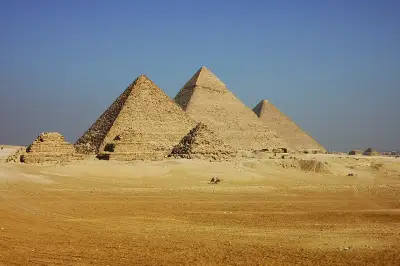
Leaving the Military Museum, we also visited the Cairo Police Museum, located opposite Al-Nasser Mohammed Ibn Kalawoun Mosque. Again, due to the language barrier, we did not go into the indoor exhibition halls. Instead, we went straight to the square behind the museum, which offers the best vantage point overlooking Old Cairo. On clear days, even the Giza Pyramids can be seen, attracting many visitors to stop and enjoy the view.
As the Year of the Tiger (Ren Yin Year) approaches, I would like to extend New Year greetings to all friends! I wish you all a happy New Year, good health, and all the best!
——End of Section——