A Thousand-Year Call — Conclusion of Egypt Trip (6)
Day six of the trip.
After breakfast, we boarded the bus back to Cairo. The five-hour drive from the Red Sea felt like the bus was constantly traveling through barren mountains or bouncing along potholed roads in the Gobi. At each full hour, the driver and guide would stop the bus, choose a direction, and devoutly perform their prayers. During these stops, we would get off to stretch our legs and drink some water. In the afternoon, we finally arrived at our hotel in Cairo, dropped off our luggage, and freshened up before boarding a night cruise on the Nile. On the boat, we watched performances of traditional Egyptian cultural treasures—belly dancing and Sufi dancing.
Belly dancing originally came from Turkish tradition, but its roots can be traced back to the Mediterranean, the Balkans, and the Middle East. It evolved from a niche, small-scale dance performed in palaces and temples into a widespread, public, performative, and folkloric dance.
The lavish decorations on the cruise ship.
The dinner and snacks prepared for passengers in the cabin.
After the guests were seated, the band played local folk music.
The belly dancer moved with graceful postures and elegant steps. The dancer must be barefoot to feel and connect closely with the earth.
Egyptian men perform Sufi dancing, characterized by rapid spinning accompanied by various movements, dazzling the audience.
Egyptian men work very hard; almost every man has two jobs. Egyptians eat only two meals a day. They have breakfast around 8 a.m., go to work, and work eight hours straight with no lunch break or rest. They finish work around 4 p.m. and return home exhausted. Meanwhile, the women have already prepared dinner at home, waiting for their husbands. After a short rest, the men go to another job to earn more money.
According to their religious rules, Egyptian men can marry women of any race or religion. They can marry countless times but can have up to four wives at once. Egyptian women, however, can only marry Muslim men. This is why Egyptian men work so hard. Due to economic reasons, many Egyptian men no longer marry multiple women. I think that in the near future, with social development and progress, there will be some changes.
A little baby was completely captivated.
Standing on the deck of the cruise ship, viewing the night scenery of the Nile.
Day seven of the trip.
Early in the morning, we got ready and went to the ancient city of Memphis in Egypt to visit the Ramesses statue. This is one of the oldest cities in the world, with a history of over 4,700 years. Located in the village of Raïna, south of Cairo, only some fragmented statues remain. The most famous is the colossal statue of the ancient Egyptian pharaoh Ramesses.
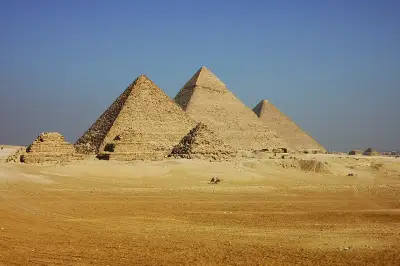
From learning history, I know that Egypt is one of the four great ancient civilizations, just like my homeland, with a long and splendid culture. After this trip to Egypt, visiting numerous pyramids, the Valley of the Kings tombs, and the Egyptian Museum, my impression of Egypt is: the highly developed funerary industry in ancient Egypt, the rampant tomb robbing in modern times, and the tourism industry that emerged from displaying stolen artifacts. Throughout human history, emperors and rulers from all times and places have fantasized about immortality, desperately seeking ways to resurrect. Chinese emperors were keen on alchemy, while Egyptian pharaohs were obsessed with mummies. They began building pyramids at the start of their reign, continuing until their death. After death, the pharaoh was made into a mummy, and all his belongings, along with countless food items, were placed inside—prepared for his return from heaven. The pyramid's pointed top, so close to heaven, was meant to be a resting place for the soul when the pharaoh returned. Egypt is dotted with pyramids, temple ruins, and statues of pharaohs, forming the core of Egyptian tourism.
Exterior view of the Cairo hotel.
Stone statues unearthed in the ancient city of Memphis.
The colossal statue of the ancient pharaoh Ramesses with a handsome face.
Rest area for tourists in the village of Raïna.
For thousands of years, the local way of life has hardly changed. Except for the daily influx of tourists pointing cameras at them, the village is still the same village, life remains the same, and they still maintain traditional handmade methods for making flatbread.
We had lunch in the village.
After lunch, we went to a papyrus painting shop in Cairo. The staff explained the traditional Egyptian paper-making and painting techniques. Papyrus was a writing material widely used by ancient Egyptians. Over 3,000 years BC, the ancient Egyptians pressed this plant into a paper-like sheet to write and paint on, exporting this skill to ancient Greece and other places. It is not paper in the conventional sense, but a writing medium. Today, Egyptians use it to create various exquisite decorative paintings, developing it into a tourism product with national characteristics.
Paintings on papyrus are rustic, exquisite, and strongly ethnic.
From the shop, we went to the Khan el-Khalili market in Cairo.
Khan el-Khalili is located in the old Islamic district of Cairo, which has over 1,000 mosques and numerous towering minarets, hence known as the "City of a Thousand Minarets." There are so many mosques that I couldn't remember their names; each is a historic, majestic, and exquisite building. The Khan el-Khalili market is set in the alleys outside these mosques, said to be the largest bazaar in Africa. It is bustling with people, crowded and lively. The small shops sell various trinkets and local specialties, many made in China but with strong ethnic characteristics. Of course, there are also snack stalls selling local cuisine, similar to night markets in China. All the shopkeepers and service staff are men; local women are not allowed to work. The fun here is to haggle fiercely. You feel as if you have traveled back to the Middle Ages, walking through the streets of One Thousand and One Nights.
Minaret outside the Grand Mosque.
The pointed structure under the minaret is a stone umbrella that folds. If it rains during prayers, the huge stone umbrellas automatically open. It is said there are dozens of such giant umbrellas in the square, which can cover the entire square when all opened.
Khan el-Khalili market.
Day eight of the trip.
Today we are going back home, ending the entire trip. Early in the morning, I walked around the hotel, taking photos as souvenirs. Then I returned to my room, packed my luggage, and headed to the airport.
Route map of this trip.
About a week after returning home, I saw on TV news that a car bomb had occurred in Alexandria, Egypt, followed by nationwide protests and demonstrations, regime changes, and many other events.
While grateful for being far from danger, I also thought of Xiao Fang and the children I had briefly met and photographed. I wish them all the best.
Although thousands of miles away, I think I will find time to go there again to explore the past and present of this mysterious ancient country beneath its heavy history!!