Egypt Travel: Two Visits to Cairo to Explore Ancient Civilization (Photos) Part 2
On our first trip to Cairo, Egypt, after finishing the first attraction—the Egyptian Museum—tour guide Yase, in order to let the delegation learn as much as possible about Egyptian culture, drove everyone to a famous mosque in downtown Cairo for a visit.
Encountering enthusiastic children on the way (Photo: Feng Ganyong)
Along the way, many interesting sights in downtown Cairo dazzled and fascinated us, like a man riding a bicycle while balancing a large basket of flatbreads on his head, weaving deftly through the city traffic with superb skill, which was truly astonishing. We happened upon a group of children just out of school, who greeted us cheerfully through the car windows, giving us a deep sense of the warmth and vivacity of the Egyptian people.
Egyptian mosque (Photo: Feng Ganyong)
Egypt now has 12 famous mosques renowned throughout the Islamic world, also popular tourist destinations for visitors from East and West. The mosque we visited was one of them. When we arrived, a prayer ritual was underway. Both men and women had to take off their shoes before entering, and women had to wear green robes and enter through a separate entrance.
Prayer hall of the mosque (Photo: Feng Ganyong)
In the front hall of the mosque, we observed the solemn scene of devout worshippers from a distance. Then we went to the back hall, where we sat on the floor, and Yase gave a comprehensive yet easy-to-understand introduction to the history of Egyptian mosques, which we found very engaging.
Group photo at the mosque (Photo: Zhang Yanling)
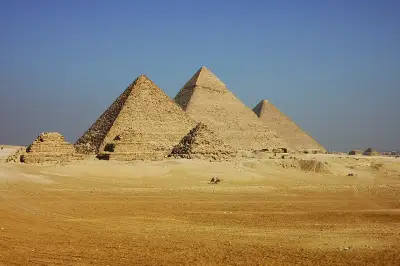
The final stop in Cairo was to visit the magnificent pyramid complex, which I had long dreamed of seeing. The Egyptian Pyramids, located southwest of Cairo, are traditionally believed to be the tombs of ancient Egyptian pharaohs (kings), but archaeologists have never found any pharaoh mummies inside the pyramids.
Entering the pyramid site (Photo: Feng Ganyong)
Pyramids were mainly built during the Old Kingdom period of Egypt. The base of the tomb is square, with four equal triangular sides (a square pyramid), whose profile resembles the Chinese character “金” (gold), hence the Chinese name “jinzita” (golden character tower). The Egyptian pyramids are among the largest building complexes ever built and are one of the most influential and enduring symbols of ancient Egyptian civilization. Most of these pyramids were constructed during the Old and Middle Kingdom periods.
Tourists at the foot of the pyramid (Photo: Feng Ganyong)
As our bus passed by the Great Pyramid of Khufu, looking up from below, it felt immensely tall and majestic. The tourists climbing on the pyramid appeared tiny in comparison. Yase directed the driver to park at a higher vantage point.
First photo at the pyramids (Photo: Zhang Yanling)
Along the way, he explained that among the many pyramids of Giza, the three most famous are those of Khufu, Khafre, and Menkaure, which are not only the grandest but also the best preserved. The high point we were driving to was also the best spot to view these three pyramids. When we got off there, we found it crowded with tourists, all taking photos.
Father and son at the pyramid site (Photo: Feng Ganyong)
The pyramids are the tombs of ancient Egyptian slave-owning kings. The ancient Egyptians’ devout belief in gods led to a deeply ingrained concept of the afterlife; they even believed that “life is but a temporary stay, while death is eternal enjoyment.” Thus, Egyptians viewed the underworld as a continuation of earthly life. Influenced by this concept of the afterlife, ancient Egyptians prepared for death with sincerity and confidence while still alive. Every wealthy Egyptian was busy building his own tomb and decorating it with various items to ensure immortality after death.
A corner of the pyramid site (Photo: Feng Ganyong)
For pharaohs or nobles, they would spend years or even decades building their tombs, commanding artisans to paint murals and make wooden models depicting activities they would continue after death, such as sailing, hunting, feasting, and the work of servants, so that they could live as comfortably in the afterlife as in life. The ancient Egyptians called this type of tomb “mastaba.” Later, a clever young man named Imhotep invented a new building method when designing the tomb for Pharaoh Djoser. The result was a six-step stepped pyramid—the prototype of the pyramids we see today. The stepped tomb designed by Imhotep was the first stone tomb in Egyptian history.
Second photo at the pyramids (Photo: Cao Qun)
After Djoser, subsequent pharaohs imitated him, building their tombs on a grand scale during their lifetimes, sparking a wave of pyramid construction in ancient Egypt. Since pyramids originated in the Old Kingdom and the largest ones were built during this period, the ancient Egyptians believed that after death the king became a god, and “a heavenly ladder should be built for him (the pharaoh) so that he could ascend to heaven.” The pyramid was such a ladder. At the same time, the triangular pyramid shape also represented the worship of the sun god, because the symbol of the ancient Egyptian sun god Ra was the rays of the sun, like the eyes of Ra. Later, the ancient Egyptians’ worship of obelisks had a similar meaning, as obelisks also represented the sun’s rays.
Large group photo at the pyramid site (Photo: Feng Ganyong)
Among all the pyramids in ancient Egypt, the largest is the Pyramid of Khufu, a pharaoh of the Fourth Dynasty. This Great Pyramid originally stood 146.59 meters high, but after thousands of years of wind and rain, the top has eroded by nearly 10 meters. Until the Eiffel Tower was built in Paris in 1889, it was the tallest man-made structure in the world. The Pyramid of Khufu is astonishing not only for its immense size but also for its superb construction techniques.
Shortly after Khufu’s death, another pyramid was built not far from his. This was the pyramid of Khufu’s son, Khafre. It is 3 meters lower than Khufu’s pyramid, but because its base is slightly higher, it appears taller. The smallest of the three is the pyramid of Menkaure, successor to Khafre. It is much smaller than the other two, with a base length of only 108 meters and a height of 67 meters, its actual volume being only one-tenth that of Khufu’s pyramid. The stones used are heavier and rougher, suggesting it may have been built in haste.
Photo with the Sphinx (Photo: Zhang Yanling)
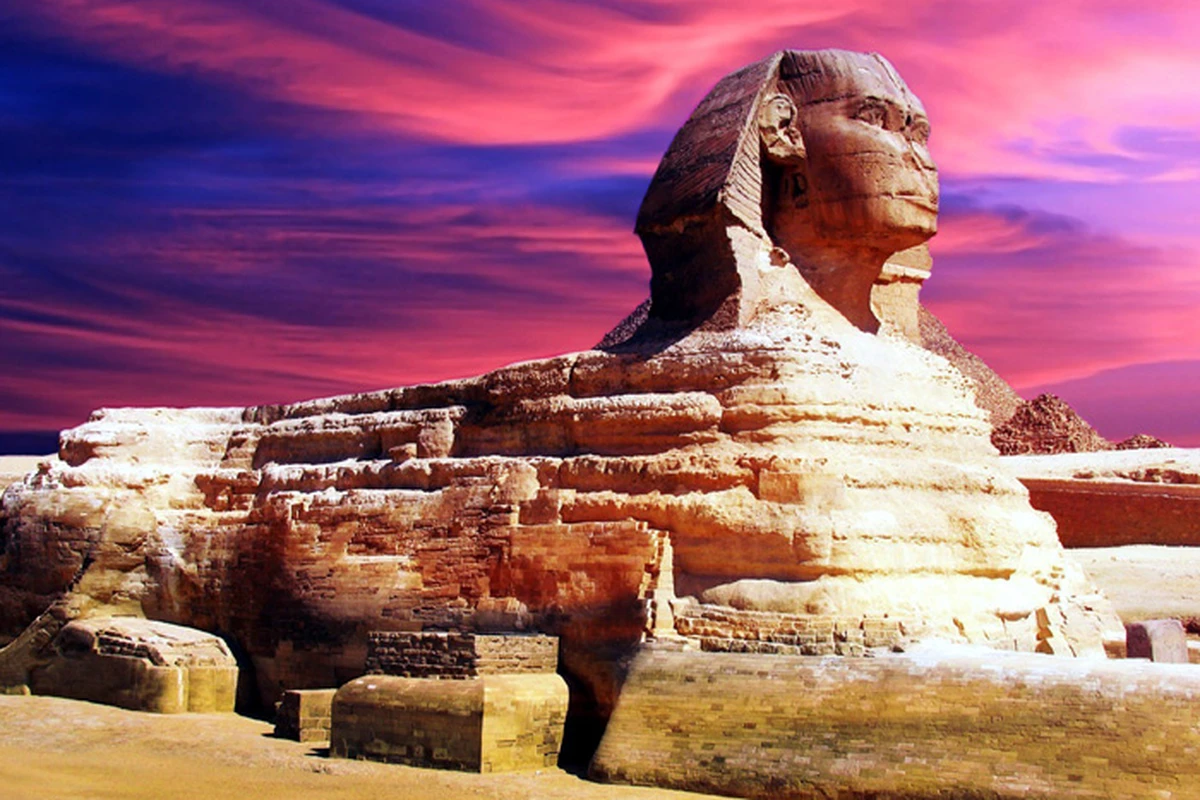
After viewing the magnificent three pyramids from a distance, the group took a bus to the Sphinx, located beside the Pyramid of Khafre. This statue was actually an important part of the Khafre pyramid complex. It features the head of Khafre carved onto the body of a lion, forming the so-called Sphinx.
Cairo street scene (Photo: Feng Ganyong)
The entire statue, except for the lion’s paws built from stone blocks, was carved from a single massive natural rock. It is more than 4,500 years old. Why a lion’s body? In ancient Egyptian mythology, the lion was the guardian of various mysterious places and also the guardian of the gateway to the underworld. Since the pharaoh became the sun god after death, such a Sphinx was created to guard the tomb for the pharaoh.
Street wall graffiti (Photo: Feng Ganyong)
With the visit to the pyramids and the Sphinx, the entire “Charming Egypt Self-Drive Tour” came to a successful conclusion. Looking back, the eight-day self-drive tour of Egypt seemed so fleeting, as if it had just begun before it ended. The precious cultural relics embodying Egypt’s ancient civilization were truly worth seeing—and left us wanting more!
Group photo before departure (Photo: Feng Ganyong)
As the saying goes, good things come to those who wait. Unexpectedly, a few months later, on February 26, 2014, I participated in the second “Charming Egypt Self-Drive Tour: Crossing the Sahara Desert, Gathering at the Red Sea,” organized by the Egyptian Ministry of Tourism and the Tourism Office of the Egyptian Embassy in China, supported by EgyptAir, and joined by nearly 200 people from domestic media, travel agencies, car clubs from all over the country, and driving enthusiasts—the largest such event ever. As one of the journalists accompanying the tour, I once again experienced an exciting ten-day journey through Egypt, recording many unforgettable memories.
Leaders seeing everyone off (Photo: Feng Ganyong)
That evening, at the departure ceremony held at Beijing Capital International Airport, Mr. Abu, Counselor of the Tourism Office of the Egyptian Embassy in China, Mr. Ala, General Manager of EgyptAir China, and Mr. Cao Qun, President of the Love Car Management Organization and General Commander of the event, delivered speeches and jointly wished for the success of this largest-ever self-drive event between China and Egypt.
A corner of the departure ceremony (Photo: Feng Ganyong)
Before departure, journalists from 20 media organizations including China Radio International, Women of China, and China Daily, together with car enthusiasts from more than 20 excellent car clubs from Beijing, Shanghai, Tianjin, Hebei, Henan, Jiangsu, Liaoning, Jilin, Heilongjiang, Hubei, Guangdong, Sichuan, Shaanxi, Gansu, Inner Mongolia and other municipalities, provinces, and autonomous regions across the country, took a group photo and then embarked on the journey.
Convoy driving in Cairo (Photo: Feng Ganyong)
On February 27, 2014, at 5:40 a.m. local time, EgyptAir flight MS956, carrying the car enthusiasts, landed smoothly at Cairo International Airport after an 11-hour flight.
Egyptian Museum (Photo: Feng Ganyong)
A large reception team from the Egyptian Ministry of Tourism, travel agencies, and armed plainclothes special police with submachine guns were waiting outside the airport. The 188 tourists boarded five buses and first headed to the Egyptian National Museum, beginning my second Cairo exploration and journey into ancient Egyptian culture.
Armored vehicle near the museum (Photo: Feng Ganyong)
The guide for the media team, Mohmaed Ahmed, nicknamed Mu Long, was a handsome young Egyptian. He was not only knowledgeable but also very warm, humorous, and witty. His vivid explanations quickly won everyone’s affection. His standard Mandarin Chinese made him quickly connect with the group.
Photo at the museum for the second time (Photo: Cao Qun)
The Egyptian Museum was my second visit. Since it is near Tahrir Square in the city center, the area is usually bustling. But when I arrived this time, perhaps because it was early, the surroundings were quiet. The empty museum entrance was a stark contrast to the usual crowds of tourists. Meanwhile, along the long streets on one side of the museum, rows of police cars and armored vehicles stretched as far as the eye could see. Armed Egyptian police and soldiers in the vehicles added a sense of solemnity and authority to the quiet atmosphere.
Armed soldiers (Photo: Feng Ganyong)
After the museum visit, the group went to the Mena House Hotel in Cairo for lunch and rest. The Mena House Hotel is world-famous for being the site where the historic “Cairo Declaration” was signed. I stayed here on my first trip to Egypt and even had the chance to see the rooms where the Chinese, American, and British leaders had stayed. So staying here again felt like coming home.
Row of cars at the hotel (Photo: Feng Ganyong)
Notably, the Mena House Hotel was also the starting point for the event’s convoy. Particularly striking was the sight of the neatly arranged Egyptian vehicles in the courtyard—all brand-new modern cars that were the participants’ rides. After the break, the group visited the pyramids and the Sphinx, just across from the hotel. The visit ended around dusk.
Dinner on a boat (Photo: Feng Ganyong)
That evening, under the night sky, everyone drove to the Nile dock and boarded a cruise boat for a night tour of the beautiful Nile. Dr. Nasser, Assistant to the Asian Affairs Department of the Egyptian Ministry of Tourism, personally attended the grand dinner and dance party held by the Ministry on the boat to welcome the “Love Car Self-Drive Egypt Crossing Sahara Desert Delegation.”
Group photo in front of the hotel convoy (Photo: Cao Qun)
With the joy of the Nile night cruise, nearly 200 car enthusiasts happily spent their first day in Cairo—full of excitement, order, and tension. On February 28, 2014, everyone would officially begin the self-drive trip across the Sahara Desert, and I would once again savor my second Egyptian journey. (Text and photos: Feng Ganyong)