Egypt Travel: Two Visits to Cairo to Explore Ancient Civilization (Photos) Part 1
Cairo is the capital of Egypt and also one of the world's famous ancient cultural capitals. Your reporter was fortunate to visit Egypt twice, exploring Cairo to uncover the mysteries of ancient Egyptian civilization with its millennia-old history. Here, you can find the Egyptian Museum showcasing traditional Egyptian culture, as well as the Great Pyramid and the Sphinx, which are among the Seven Wonders of the Ancient World, along with other renowned cultural landmarks.
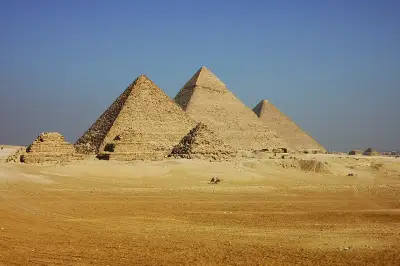
The Pyramids of Egypt (Photo by Feng Ganyong)
The first trip to Egypt took place from May 3 to May 10, 2013; the second from January 27 to March 7, 2014. Although both were self-driving trips of eight and ten days respectively, their purposes differed. The former was a solo reconnaissance and route survey; the latter was an experience with a convoy of several hundred people.
The Egyptian Museum (Photo by Feng Ganyong)
Interestingly, the two trips arranged for Cairo differed. The first trip had Cairo as the final stop, while the second made it the first stop. Comparatively speaking, the first visit to Cairo was more comprehensive. Nevertheless, each journey offered unique experiences and memories.
Mena House Hotel, Cairo (Photo by Feng Ganyong)
On the evening of May 3, 2013, your reporter, as part of the "Charming Egypt Self-Drive Tour Investigation Group" organized by the Tourism Office of the Egyptian Embassy in China and the China Auto Management Agency's Auto Global Group, along with nine others and led by team leader Zhang Yanling, departed from Terminal 3 of Beijing Capital International Airport, taking Egypt Air flight MS956 to begin the Egypt tour. After nearly 11 hours of flight, we arrived at Cairo International Airport at 6:10 local time. We then drove to downtown Cairo to check in at the Mena House Hotel.
Courtyard of Mena House Hotel (Photo by Feng Ganyong)
Little did we expect that the Mena House Hotel, where we stayed in Cairo, was the very venue of the historic Cairo Conference. From November 22 to 26, 1943, U.S. President Franklin D. Roosevelt, British Prime Minister Winston Churchill, and Chinese government leader Chiang Kai-shek held the world-famous Cairo Conference here.
Group photo at Mena House Hotel (Photo by Zhang Yanling)
The Cairo Conference resulted in the signing of the "Cairo Declaration" by China, the United States, and the United Kingdom. Its main content stated: "The purpose of the three great allies in this war is to stop and punish Japan's aggression... The three allies aim to deprive Japan of all islands in the Pacific that it has seized or occupied since the beginning of the First World War in 1914, and to restore to China all territories stolen by Japan, such as Manchuria, Taiwan, and the Pescadores." "With the above objectives in mind, consistent with the goals of other allied nations fighting against Japan, the three great allies will persist in the major and long-term operations necessary to obtain Japan's unconditional surrender." Therefore, the Cairo Declaration is an important and widely recognized international principle for handling the Japan issue after World War II, especially the problem of Japan's seizure of other countries' territories.
Corner inside Mena House Hotel (Photo by Feng Ganyong)
On the evening of May 8, 2013, while exploring traces of the Cairo Conference at this hotel, I encountered an unexpected surprise. On the third-floor corridor, our group met a hotel staff member. I politely greeted him in English, saying goodnight and nodding. He smiled at me, paused for a moment, and then quietly motioned me to follow him to a room. He opened the door and let me in. Turning on the light, he pointed to a photo on the wall for me to see.
Group photo of the three leaders (archival material)
When I looked, it turned out to be a photo of Chiang Kai-shek, Roosevelt, and Churchill together. He pointed to Chiang Kai-shek in the photo and then to the room, and I immediately understood: this was the room where Chiang Kai-shek and his wife stayed during the Cairo Conference.
Guest room where Chiang Kai-shek stayed (Photo by Feng Ganyong)
Then another staff member in a suit came in. After listening to the first staff member's introduction, he nodded to us amiably and then led us to look around various rooms. After that, we entered two more suites, which contained photos of Roosevelt and Churchill respectively. In the room where Roosevelt had stayed, we stepped onto the balcony. Although the night was dark, we could clearly see the pyramids in front, shrouded in a mysterious haze.
Group photo with hotel staff (Photo by Zhang Yanling)
Spending an evening at the Mena House Hotel in Cairo and being fortunate enough to visit the three rooms where the three heads of state stayed during the Cairo Conference was an unexpected and rare gain. Especially standing in the very place where such a world-famous historical event occurred, seeing the furniture and decorations preserved in their original historical condition—both exquisite and elegant, yet filled with a rich sense of history—I could not help but feel an indescribable reverence from the bottom of my heart.
Garden landscape of the hotel (Photo by Zhang Yanling)
Countless tourists visit Egypt, and many stay at this hotel, but it must be rare to be as lucky as our group! For this reason alone, the legendary experience at the Mena House Hotel during our Egypt trip will leave an unforgettable and wonderful memory for your reporter.
On the Nile Bridge in Cairo (Photo by Zhang Yanling)
On the morning of May 9, Egyptian time, your reporter and the "Charming Egypt Self-Drive Tour Investigation Group" left the Mena House Hotel and finally began our exploration of Cairo. Cairo spans the Nile River, majestic and spectacular, serving as the political, economic, and commercial center of the entire Middle East. It is composed of Cairo Governorate, Giza Governorate, and Qalyubia Governorate, collectively known as Greater Cairo. It is the largest city in Egypt and the Arab world, and one of the oldest cities in the world. While crossing a bridge over the Nile, the group took a final group photo with the Nile as the backdrop.
Group photo on the Nile Bridge (Photo by Feng Ganyong)
On that single day in Cairo, we would visit the Egyptian Museum, a mosque, and the pyramids. For your reporter, my earliest understanding of Egypt came from a late 1970s film adaptation of "Death on the Nile," based on one of the masterpieces of famous British detective novelist Agatha Christie.
A still from the film "Death on the Nile"
In that classic film, dubbed by Shanghai Film Dubbing Studio, I followed the Belgian detective Hercule Poirot and other tourists on a cruise along the Nile, exploring a complex triple murder case while enjoying Egypt's picturesque natural beauty along the river and its stunning cultural landmarks, leaving a deep impression of Egypt.
Magnificent stone pillar landscape (Photo by Feng Ganyong)
Especially after visiting Luxor, Hurghada, Alexandria, and other places during this Egypt trip, and seeing firsthand the awe-inspiring massive stone pillars at the Karnak Temple, a filming location for "Death on the Nile," the impression was profound. Now, the anticipation for visiting Cairo was particularly special.
Entrance of the Egyptian Museum (Photo by Feng Ganyong)
Our group first arrived at the Egyptian Museum on the east bank of the Nile in Cairo. The museum has indoor and outdoor sections, and photography is not allowed indoors. It is a treasure trove of ancient Egyptian civilization spanning over 3,000 years. Our guide, Yasser, explained that the museum houses 120,000 artifacts, of which only 40,000 are currently on display, while the rest remain in the museum's basement. Since the museum primarily collects artifacts from the Pharaoh period, Egyptians often call it the "Museum of the Pharaohs."
Group photo at the Egyptian Museum (Photo by Zhang Yanling)
The museum was designed by the famous French archaeologist Auguste Mariette, known as the "Father of the Egyptian Museum," and was first built in Bulaq, north of Cairo, in 1858. It moved twice before relocating to its current building in Cairo in 1902. The museum has over 50 exhibition halls. The purpose of building this museum was to prevent excavated Egyptian treasures from being taken abroad.
Corner of the museum courtyard (Photo by Feng Ganyong)
Entering the Egyptian Museum, one sees a magnificent, ancient, and luxurious two-story red stone building. In the museum's courtyard, numerous stone statues and artifacts stand, overwhelming the eyes. The museum's entrance design incorporates elements of ancient Egyptian art: a large arched doorway flanked by niches with European-style reliefs of pharaohs, one holding a papyrus and the other a lotus, symbolizing Upper and Lower Egypt respectively.
Sphinx in the courtyard (Photo by Feng Ganyong)
In the garden-like courtyard of the Egyptian Museum, there are statues of many famous Egyptologists, as well as sphinx statues, obelisks, and stone carvings, fully reflecting the civilization of ancient Egyptian history and culture.
Stone statues in the courtyard (Photo by Feng Ganyong)
Inside the indoor exhibition halls, a dazzling array of precious artifacts, each with its own legendary historical story. The collection spans from prehistoric times to ancient, medieval, and imperial periods, as well as Greek and Roman artifacts. It includes gigantic stone statues of pharaohs and gilded chariots, prehistoric pottery and stone tools, various artworks meticulously crafted by ancient artisans, and papyrus documents recording ancient Egyptian science, literature, history, and law. Notably, one can also see mummies made thousands of years ago, lying in gold and jewel-encrusted coffins, still preserved in original condition, truly breathtaking.
Carved reliefs on the wall (Photo by Feng Ganyong)
The Egyptian Museum has two floors, comprising over 100 exhibition halls and a large library. Exhibits are arranged chronologically in dozens of rooms. The first floor displays historical artifacts from the Old Kingdom (27th–22nd centuries BCE) to the Roman period (5th–6th centuries CE). The second floor houses thematic exhibition halls for mummies, jewelry, coffins, paintings, funerary objects, papyri, and more.
Statue garden of Mariette (Photo by Feng Ganyong)
The most famous exhibits in the museum are the treasures from the tomb of Tutankhamun, including the gold sarcophagus, gold shrine, gold throne, queen's gold crown, and other royal items. Tutankhamun's gold sarcophagus is made of 450 pounds of pure gold, the most exquisite and greatest gold artifact in human history. The young King Tutankhamun died at 18 and was buried in three nested coffins. The museum houses the innermost and outermost coffins. The gold coffin, with painted lacquer and intricate carving, holds extremely high aesthetic value.
Courtyard view of the museum (Photo by Feng Ganyong)
Tutankhamun's gold throne is also dazzling. The front sides of the seat have two gold lion heads, and the armrests are carvings of a cobra and a vulture, representing the kingship of Upper and Lower Egypt. The backrest depicts a scene of royal family life: under sunlight, the queen tenderly touches the king on the throne, their eyes meeting in harmony and warmth. The backrest is a gold plate inlaid with stones and colors, reminiscent of Chinese cloisonné. Other famous collections include the "Narmer Palette" recording the unification of Egypt around the 31st century BCE, the seated statue of Pharaoh Khafre discovered in the Pyramid of Khafre, the limestone statue "The Seated Scribe," and the statue group "Prince Rahotep and His Wife Nofret," all world-renowned masterpieces of ancient Egyptian art. (Text and photos by Feng Ganyong)