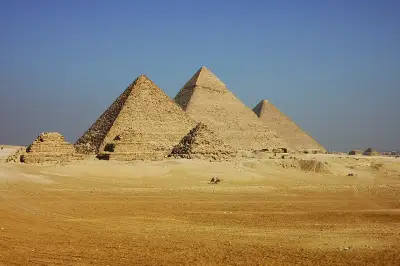
The Pyramids of Egypt
Today's tour is the original destination of my trip: the Pyramids of Giza and the Great Sphinx in Egypt. Many friends have read about this country and these attractions in middle school textbooks. But the experience of actually being there is different from what the books describe. I remember that our junior high English textbook had a detailed introduction to them, and because of those complicated numbers, I had trouble memorizing the passage. The word 'Pyramids' was also frequently misspelled.
The first stop was the Egyptian Museum. Upon entering, the first thing I saw was the finely crafted arched gateway. On one side of the gate was a relief of a pharaoh holding a papyrus, and on the other side, a relief of a pharaoh holding a lotus. The items held by the pharaohs symbolized Upper and Lower Egypt. The first floor mainly displayed general ancient Egyptian artifacts, while the precious ones were kept on the second floor. I have always believed that museum visits during travel can only be a quick glimpse to gain a rough understanding. If one wants to study in detail, one must come again specifically for that purpose.
Statues on the left and right sides
Statue at the entrance
Egypt is one of the four great ancient civilizations. The exhibits in the museum are mostly four to five thousand years old. The sheer number of artifacts is enormous, and we could only skim the surface in a single morning. What impressed me most was how well-preserved these items were, showing no signs of having weathered four to five thousand years. Among them, the exhibits that amazed me the most were:
(1) The throne of Tutankhamun. On each side of the front of the throne was a golden lion head, and on both sides of the armrests were relief statues of the protective serpent-headed, hawk-bodied deities. The most stunning part was the painting on the backrest: bathed in the golden light of the sun god, Queen Ankhesenamun was applying holy oil to her husband Tutankhamun. The colors were vibrant, and the expressions were lifelike.
(2) As is well known, ancient Egypt was famous for mummification. During this visit, I saw many specialized tools used for making mummies. One was a marble dissection table, and the other was a set of canopic jars for storing internal organs. Personally, I feel the ancient Egyptians were quite remarkable—they had such professional anatomical knowledge over four thousand years ago.
Marble dissection table for mummification
These four jars are said to contain Tutankhamun's stomach, liver, intestines, and lungs
(3) The painted limestone statue of Prince Rahotep and his wife (c. 2649-2609 BC). This was the most breathtaking to me. How could they maintain such brilliant colors after four to five thousand years? Especially the eyes—they were reportedly inlaid with natural crystal eyeballs, with a black pupil visible in the center.
The funerary masks of Yuya and Tuya. Yuya and Tuya were the parents of Amenhotep III's wife.
Head of Queen Hatshepsut, the female pharaoh of the 18th Dynasty (reigned 1503-1482 BC).
Fragmentary statue of Amenhotep IV (Akhenaten). During his reign (18th Dynasty, around 1350 BC), he was enthusiastic about religious reform. While other pharaohs had themselves portrayed as perfect, he stood alone, depicting his true self: a long, thin face, a slender neck, a protruding belly, and thick legs.
Relief showing the worship of the Aten (c. 1350 BC). A typical scene from the Amarna Period: Pharaoh Akhenaten, Queen Nefertiti, and their daughters worshiping the sun disk Aten. Here, the sun god is depicted as a disk, with each ray ending in a small hand holding the symbols of power and life.
Black standing statue of a pharaoh with gold inlay before the Tutankhamun exhibition room
Statue of Tutankhamun and his necklace. Tutankhamun ascended the throne at age 9 and died suddenly at age 19.
Pharaoh figurines and perfume vases.
Tutankhamun's gilded royal bed.
An expandable canopy umbrella used by the pharaoh when traveling.
Anubis, the god of cemeteries and mummification, also the guide for pharaohs to the afterlife.
Exquisitely crafted coffins.
Lifelike statues made of various materials.
Egyptian papyrus paintings, a local specialty.
Also, let me tell you: if you want to take photos with a camera in the museum, you must buy a camera ticket in advance. Otherwise, security will not allow the camera in. Based on my experience, using a mobile phone is fine because even with a camera, flash photography is not allowed, and the results are sometimes not as good as those from a phone.
The second stop today was the world-famous Pyramids of Giza and the Great Sphinx. The car sped along. Cairo was beautiful and modern, truly deserving the nickname 'the New York of Africa.' Tall buildings stood modern and stylish, the Nile River rippled with blue-green water, and occasionally people were seen boating on the river, making one feel as if in a European city.
But once we left the city and entered the suburbs, the scene was completely different. Dust flew everywhere, garbage was scattered, and most strangely, the houses on both sides of the road lacked doors and windows, making them look like abandoned buildings. However, upon closer inspection, people were living in them. Some buildings had long steel bars sticking out from the top, as if still under construction, but the lower floors already had doors and windows installed with people living there. When I asked the guide, she explained that in Egypt, land is sold to individuals to build houses. Many people run out of money halfway and have to cover the openings with plastic sheets to live temporarily. Others originally planned to build six stories but only finished three; they live on the three floors and will continue construction when they have money. Fortunately, Egypt is hot all year round with little rain.
Doors and windows not yet installed, but laundry has already been hung out to dry.
This building has a shop downstairs, but notice the top floor is not sealed—long steel bars are still exposed.
Regarding the pyramids and the Sphinx, as I said earlier, everyone is very familiar with them, so I won't introduce them. However, there are a few things to note when visiting here. First, when in Egypt, you must change money. As mentioned before, you need to buy a ticket to take photos in the museum, which costs money. Here, if you want to go down into the pyramid, you also need to buy a ticket. The pyramids are magnificent, but don't get too carried away, especially if traveling alone. Don't casually accept help from strangers who offer to take your photo, or they will pester you for money later, and the amount won't be small. If you don't give, they keep bothering you—they have nothing better to do sitting there, and your time for sightseeing will be wasted.
Camel enticing tourists
Side view of the Sphinx
Front view of the Sphinx
'No photos here. Go over there!'
Performance venue next to the pyramids and Sphinx, said to have shows in the evening.
Earlier at the museum, I showed you ancient Egyptian papyrus paintings. This craft is still being passed down in Egypt today. We went to a specialized papyrus shop and watched the entire production process.
Egyptian papyrus paintings are the oldest paper paintings in the world, made from papyrus harvested along the banks of the Nile. The material is similar to our reeds but feels harder, and the manufacturing process is very complex. According to the guide, a single papyrus painting takes an artisan nearly a month to complete—half a month for making the paper and half a month for painting. The pigments used are colorful: green from turquoise, blue from malachite, yellow from gamboge, red from hematite, and black from jet—all natural minerals. The magical thing about papyrus paintings is that they remain unchanged for ages and do not decay for thousands of years. In this respect, the ancient Egyptian craft surpasses our Chinese papermaking.
A day of sightseeing soon came to an end. We headed to Cairo International Airport to catch an evening flight to Luxor.