35-Day Free Travel Through 3 North African Countries and 2 Middle Eastern Countries: Egypt Chapter
If you never travel, those plots that only seem to appear in movies will never happen. Every time you walk alone to a distant land, unpredictable things seem to be waiting for you, beyond your design and avoidance.
Travel can shrink the world so that you meet friends as soon as you step out, and yet it can expand your heart to accommodate friends from all over the world, whether male or female, black or white, from any ethnicity. Travel is that interesting.
Because of the pandemic, I haven't been abroad for three years. This year, the country opened up and allowed us to go out. In November 2023, I decided to travel abroad. This time, I chose Egypt, one of the four ancient civilizations. Tunisia also became visa-free for Chinese individual travelers at the beginning of November. Then, looking at the map, I saw that neighboring Morocco was also visa-free, so I started planning a trip to the visa-free countries of North Africa. To avoid backtracking, I carefully studied the map and flight tickets. The UAE was also visa-free, so I decided to enter through Cairo and return through Dubai. At Alexandria Airport in Egypt, I met a father and son from Guangdong who were doing business in the Middle East. They told us that Oman in the Middle East was worth a visit. We immediately replanned our itinerary and embarked on a 35-day journey through 3 North African countries and 2 Middle Eastern countries. During these 35 days, I saw the architectural styles of various countries: the elegant and delicate Sheikh Zayed Grand Mosque in Abu Dhabi, the extravagant Gold Frame of Dubai, the Louvre Abu Dhabi, the artificial Palm Jumeirah, as well as the understated luxury of Oman, the blue-and-white Sidi Bou Said in Tunisia that resembles Greece's Santorini, the world-famous Casablanca in Morocco made famous by a movie, and Chefchaouen, which uses every shade of blue to the extreme. Besides admiring different natural landscapes, we also experienced the warm hospitality of students on Djerba Island, who eagerly took photos with me on campus. In Chefchaouen, Morocco, a street vendor who had been learning Chinese for a year to communicate with Chinese people added me on WeChat and asked me to teach him Chinese. A helpful Egyptian guy helped us cross the road, and an Egyptian girl kept helping me find a hotel. The kind and outgoing Moroccans, two Germans we met at a hotel in Marrakech who were eager to learn how to make our fermented bean fish, and an Omani taxi driver who spoke proudly about his country. This trip also included dolphin watching in the Gulf of Oman, playing with dolphins, praying at the Grand Mosque, and experiencing not only the grandeur of the Pyramids, Abu Simbel, and Luxor Temple but also the battle of wits with Egyptian taxi drivers and businessmen over bargaining. Moreover, we experienced some local cultures and customs, such as attending a local wedding by chance at a hotel in Alexandria, Egypt, seeing the cave dwellings of the Berbers (the earliest Tunisians) in Tunisia, and witnessing the process of endangered green sea turtles laying eggs and hatching. These are not things you can gain by sitting in an urban café under the sun reading a few books. During this trip, we used various means of transportation: 9 flights, trains, taxis, Uber, Didi international ride-hailing, and self-driving. Different countries, different visas with different requirements, different exchange rates, different currencies—these were all challenges for me. Although different ethnic groups have different languages, lifestyles, customs, and cultural backgrounds, humans on this planet are fundamentally connected. People all have emotions of love, a attachment to their short lives, a longing for fresh air and peaceful life, and a love for food. Life is inseparable from joys and sorrows, separations and reunions, and even birth and death are so similar. From the Pyramids and Valley of the Kings in Egypt to the Mausoleum of Qin Shi Huang and Qianling Mausoleum in China, even birth and death are so alike. The earth is really too small. Below, I will talk about these five countries separately.
I. Egypt – Ancient Civilization
An ancient civilization with thousands of years of history and rich culture, this was the main destination of my trip. I looked up to this great place with a sense of awe. What people revere is not just the remaining ruins, but the reflections this ancient civilization brings to all of humanity. Looking back at the night sky of human history, countless civilizations shine brightly. Ancient Egypt is the most dazzling existence, mysterious and distant, once glorious, but the turbulence of impermanence was eventually replaced by silence, disappearing into boundless darkness. And we, as humans, cannot escape the shackles of time, becoming passing travelers in the long river of history. When everything is gone, the Pyramids will still stand, becoming a timeless existence, continuing to tell their immortal stories to future generations. And humanity's contemplation of the meaning of life will never cease; perhaps here we can find the answer. Before leaving, I read travel guides saying that self-driving in Egypt is a game for challengers: pedestrians randomly cross the road, and vehicles go fast. I would scream every time I crossed the road. So we planned not to drive and used Uber for all rides. In hindsight, that was wise. Details are as follows:
Flight: Sichuan Airlines direct flight from Tianfu New Airport to Cairo, 11 hours, Airbus 330, spacious seats, meals served on board. For flights from Cairo to other domestic cities, Egypt Air uses Terminal 3, and Nile Air uses Terminal 1. We flew from Cairo to Aswan on the same day, taking a free shuttle bus from Terminal 3 to Terminal 1.
Visa: Egypt offers visa on arrival. The flight attendant will distribute entry cards on the plane. Fill it out on the plane. After landing, buy a visa-on-arrival sticker for $25 USD at a bank near customs, paste it on a blank page of your passport, and hand it to the customs officer for a stamp. Smooth entry.
Time difference: Egypt is 10 hours behind China. Egypt time is 10 hours later than China time.
Transportation: (Use Uber App)
Cairo traffic is terrible. If you need to go to the station by taxi, allow plenty of time to avoid being late. White taxis are more formal; most drivers are young and can speak some simple English. It is recommended to ask the hotel staff for an approximate price before going out and have the Arabic names of attractions written on paper to facilitate bargaining and asking directions. When taking a taxi, it is best to open Google Maps navigation yourself and ask the driver to follow it to avoid detours. I used Uber in Egypt, paying in cash, which was convenient and avoided being cheated. Just enter your destination directly. It is best to download the app and enter your information before leaving China so you can use it immediately abroad.
SIM card and WiFi: Buy a 10-day SIM card with data at the airport and put it in your phone for easy taxi booking and messaging.
For WiFi, I rented a Roaming Man in China. It worked very well. In African countries, the internet speed is slower (4G). I rented an unlimited plan with no time limit, costing 39 yuan per day. Pick up and return at the airport departure hall. I especially want to praise Roaming Man. When I set off, I rented the WiFi for 40 days, but my itinerary changed and I returned 5 days early. I told customer service, and they immediately refunded the 5 days' fee. Next time I travel abroad, I will choose them again.
Currency: EGP is called Egyptian Pound, unit L.E. ATMs in Egypt are convenient for withdrawing cash. ATMs are widespread in Egypt; any with the "123" logo can accept UnionPay savings cards for withdrawals. Currency exchange at the airport is not cost-effective: 1:30, low exchange rate plus tax. In Egypt, accommodation is settled in USD. Outside Luxor Temple, next to KFC, there is a shop that offers an exchange rate of 45 EGP. However, you can exchange as you go; there are many exchange places.
Itinerary: Cairo – Aswan – Luxor – Cairo – Alexandria
D1: Nov. 8 Chengdu – Cairo (flight)
D2: Nov. 8 Cairo – Aswan (flight)
D3: Nov. 9 Aswan – 270 km – Abu Simbel – Aswan (round-trip charter)
D4: Nov. 10 Aswan – Luxor (train or boat) 239 km; buy ticket on the day
D5: Nov. 11 Luxor
D6: Nov. 12 Luxor – Cairo (Giza area) 657 km (flight)
D7: Nov. 13 Cairo
D8: Nov. 14 Cairo – Alexandria (218 km) (Uber)
D9: Nov. 15 Alexandria
D10: Nov. 16 Alexandria
D11: Nov. 17 Alexandria – Casablanca, Morocco (flight)
Egyptian totems: Upper Egypt: eagle, Lower Egypt: snake
Food: Egypt is rich in tropical fruits and sugarcane juice. Sugarcane juice is the national drink of Egypt; mango juice is also very tasty. Fruits in Egypt are super cheap; locals sell by the kilogram. Remember to bargain when buying. Local specialty desserts include Muhalabiyya (milk pudding), which I had in Aswan at the host's sister's invitation—it tastes like our yogurt; Ruz bi laban (rice pudding); Ommali (layered dessert), etc.
Shopping: Egyptian specialties mainly include papyrus paintings, perfumes, perfume bottles, copper plates, dates, Egyptian cotton towels, T-shirts, etc.
Pharmacies: They use the internationally recognized medical symbol "Rod of Asclepius"—a snake coiled around a cup or staff. This is the symbol for pharmacies in Arab countries.
Major cities in Egypt:
1. Aswan: In ancient Egyptian, "Swenet" meaning "trade," later evolved into "AsSuan." But its pronunciation has always been "Aswan" from ancient Egypt to now. The most beautiful stretch of the Nile is in Aswan, and the cleanest city is also Aswan. From entering Aswan, you will notice that the local people have darker skin, distinctly different from other Egyptians; they are called "Nubians." Nubia has always existed as a vassal state of Egypt. Aswan was the richest place in ancient Egypt, rich in granite, lapis lazuli, azurite, gold, etc. The stone for ancient Egyptian temples and obelisks came from here.
Attractions: Abu Simbel, Old Cataract Hotel—where Agatha Christie, author of "Death on the Nile," once stayed; Elephantine Island—the most scenic section of the Nile; Aswan High Dam—one of the world's seven largest dams; Aswan Museum; Nubian Museum; Philae Temple; Aswan Train Station.
A. Abu Simbel: Abu Simbel Temple—located southwest of Aswan, built by the great Ramesses II for his beloved wife Nefertari, a very fascinating and romantic place. It takes about 4 hours to drive from Aswan, and it is only about 10 kilometers from Sudan. Although the journey is long and arduous, seeing the huge statues makes it all worthwhile. There is a magical phenomenon here: at a fixed time each year, the sun's rays illuminate the face of the king in the three inner halls. This is indeed a miracle. Therefore, the Sun Festival is held here every year, and people from all over the world gather to witness this wonder of human wisdom.
This temple was built by Ramesses II to flaunt himself and attempt to extend his life into the afterlife. The temple has two majestic pylons, a hypostyle hall with 48 huge stone columns, two spacious courtyards, and three sanctuaries, very spectacular. During the visit, you can see the evolution of architectural styles and techniques of various types of Egyptian temples.
B. Elephantine Island: Elephantine Island is an island in the Nile, one of the oldest regions in Egypt. Artifacts unearthed on the island date back to prehistoric times. Located near a large waterfall on the Nile, it marks the border between Egypt and Sudan. It is called "Elephant" for several reasons: it was once an important ivory trading area, and the giant pebbles on the riverbank look like elephants lying in the sun from a distance.
C. Water Temple – Philae Temple: Philae Temple is dedicated to the love goddess Isis. Philae is a small island in the Nile south of the Aswan High Dam. Originally, a temple was built on this island. When the British built the Aswan High Dam in 1902, Philae Island was flooded, and tourists could only see the temple's gate and columns above the water by boat. Inside Philae Temple are hieroglyphic inscriptions and vivid reliefs. Here, the goddess of abundance Hathor and the goddess of fertility Isis were worshiped. It is said that Isis has ten thousand names; she not only governs fertility but is also the protector of all people, highly revered by ancient Egyptians. In 1980, Egypt decided to move the monuments from the island to another island to restore their original appearance. At dusk, the setting sun casts a sorrowful and poignant beauty on the temple.
2. Cairo: Attractions: Egyptian Museum, Ramses Square, Giza Pyramid Complex (also called the tombs of Memphis), Great Pyramid of Giza (Khufu), Sphinx, Nile River, Saladin Citadel, Khan el-Khalili Market.
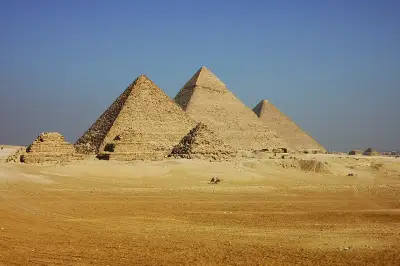
A. Pyramids and Sphinx: Located on the Giza Plateau, the Giza Pyramids are a collective name for a group of pyramids, not a single pyramid. They were built between 2600 and 2500 BC and are synonymous with ancient Egyptian civilization, one of the Seven Wonders of the World. Among the Giza Pyramids, the three larger and better-preserved pyramids are the Pyramid of Khufu (Cheops), Pyramid of Khafre (Chephren), and Pyramid of Menkaure. They are arranged according to the constellation Orion. The Pyramid of Khufu, as the tomb of Pharaoh Khufu of the Fourth Dynasty, is the largest and tallest Egyptian pyramid in the world. Built around 2580 BC, it is not only a symbol of Egypt but also the oldest building among the Seven Wonders of the Ancient World.
When mentioning the Egyptian pyramids, one thinks of the Sphinx. It is located in the pyramid complex, near the Pyramid of Khufu and Pyramid of Khafre. With a history of about 4,000 years, the Sphinx is a representative relic of ancient Egyptian civilization, along with the pyramids. It is also synonymous with Egypt. As the name suggests, the Sphinx is a statue with a human head and a lion's body, its front paws extending forward on the desert. The statue is about 22 meters high and 57 meters long. Apart from the front paws, the original Sphinx wore a crown, had a sacred cobra relief on its forehead, a long beard, and a necklace around its neck. However, after thousands of years of wind, rain, and sand burial, the crown, necklace, and other features have disappeared. The Sphinx is not right next to the Pyramid of Khafre but some distance away. After entering the Giza Pyramid complex, go around the Pyramid of Khufu and pass through a corridor to reach the Sphinx. Next to the Sphinx is a corridor where you can climb up to take photos. After visiting the Sphinx, you can walk to the Pyramid of Khafre behind it and the nearby Pyramid of Khufu.
B. Egyptian Museum: Located near Tahrir Square in downtown Cairo, a must-visit when in Cairo. It was founded in 1863. Tickets are cheap. It displays artifacts spanning thousands of years, including statues of pharaohs, mummies, the essence of Egyptian art, and everyday items of ancient Egyptians. Closed on Mondays. Here you can see the museum's treasure—the golden mask of Pharaoh Tutankhamun.
C. Saladin Citadel: Also the Egyptian Military Museum (offering a panoramic view of Cairo).
3. Luxor: The world's largest open-air museum. Main attractions include Karnak Temple, Luxor Museum, Colossi of Memnon, Valley of the Kings. The most impressive is Karnak Temple.
A. Karnak Temple: Located 700 km south of Cairo on the east bank of the Nile, Karnak Temple is a vast temple complex of ancient Egypt, the oldest temple in Thebes. Construction began around 2000 BC, with over 50 pharaohs participating in its building. Finally completed in the 3rd century BC, it is the longest-built temple in human civilization. The temple is divided into three parts by brick walls. The central part is the best preserved and largest, dedicated to the sun god Amun. The left part is dedicated to the god Montu, and the other to Amun's wife, the vulture goddess Mut, but it has not been excavated yet. In addition, there are dozens of smaller temples within the complex. Along the avenue leading to the pylon of Karnak Temple stand two rows of sphinxes with ram heads. The ram head symbolizes fertility and prosperity, while the lion body represents strength and majesty. It is said that this avenue of ram-headed sphinxes, also called the Sphinx Avenue, once extended for 3 kilometers to Luxor Temple. Throughout the temple, you can see many murals, statues, and columns reassembled from fragments using mud and stone. This is because Karnak Temple has been built for over 4,000 years and has been completed for over 2,000 years. Due to human and natural damage, the temple was once in ruins. It took many years and the efforts of countless archaeologists to present the current Karnak Temple to the world.
Inside Karnak Temple, there is a huge scarab beetle statue. It is said that walking around it counterclockwise seven times can ward off evil and bring good luck.
B. Luxor Temple: Located in the city center, it was originally a small temple used to celebrate the New Year. Later, Amenhotep III, Thutmose III, and Ramesses II expanded and restored it, using it as a place to welcome the gods Amun-Ra, Mut, and Khonsu. Hence it is also called the "Southern Sanctuary of Amun." During the Opet Festival (late May to June), grand celebrations are held here. In front of the temple is the Sphinx Avenue, originally leading to Karnak Temple but now interrupted. Inside the temple, you can see the huge statue of Ramesses II, granite obelisks, and impressive colonnades.
C. Valley of the Kings: Also known as the Valley of the Kings. The Great Pyramids of Giza and the Nile Delta were the burial sites chosen by pharaohs of the Old Kingdom. To avoid tomb raiders and to be closer to the kingdom's southern roots, pharaohs of the New Kingdom chose a different site for their tombs, now known as the Valley of the Kings. This barren valley is deep in the mountains west of Luxor, and nearly all pharaohs from 1539 to 1078 BC were buried here. When archaeologists began excavating the Valley of the Kings in the early 19th century, almost all tombs had been looted. However, tomb raiders were not professional archaeologists, and through the efforts of many archaeologists, some amazing discoveries were made in the 20th century, most notably the tomb of Tutankhamun.
Tips: 160 EGP allows you to see three tombs; must-see: Tomb of Tutankhamun, Tomb of Ramesses III and VI, Tomb of Seti I. Arrive at the Valley of the Kings by 3 PM to avoid crowds.
D. Colossi of Memnon: Two massive stone seated statues on the plain between the west bank of the Nile and the Valley of the Kings. These two Colossi of Memnon originally stood at the entrance of a pylon, about 18 meters high. The reliefs on the base depict the Nile god Hapi holding lotus and papyrus, symbolizing the unification of Upper and Lower Egypt. The statues were built by Amenhotep III during the peak of the New Kingdom. They are heavily weathered, and the faces are unrecognizable. Behind the statues was his mortuary temple, but later pharaohs dismantled it and used its stones for their own buildings. By the Ptolemaic period, the temple was completely destroyed. People thought the statues depicted the Greek mythological figure Memnon, hence the name Colossi of Memnon.
4. Alexandria: Egypt's largest seaport, second-largest city, and historic city. A summer resort on the Mediterranean coast, known as the "Pearl of the Mediterranean." Located west of the Nile mouth, about 200 km from the capital Cairo. The city stretches over 30 km from east to west, but is less than 2 km wide at its narrowest point. Major shipping lines, including Disney International, can transport container cargo from major Chinese ports to this port.
Attractions: Montaza Palace, Citadel of Qaitbay, Corniche, Bibliotheca Alexandrina, the earliest library in the world, Pompey's Pillar, Roman Amphitheater.
A. Montaza Palace: Also known as "Egypt's Summer Palace," "Montaza Palace Garden," "Montaza Garden," "Faruq Summer Palace," etc. It is the summer residence of Egypt's last king, King Farouk, located in a large scenic area at the eastern end of Alexandria's port. The palace is at the eastern end of the Corniche, formerly the summer retreat of kings and royal family members, hence also called the Summer Palace. The palace overlooks a quiet beach and is surrounded by date palm groves and gardens. Its architecture combines Florentine and Turkish styles. The building with the best view is the Haramlik Palace, built on a high ground, now converted into a luxury hotel. Today, Montaza Palace is more like a park, including a museum, several beach areas, restaurants, and a well-equipped tourist center.
B. Citadel of Qaitbay: For ancient sailors, the Egyptian coast was a nightmare; the flat coastline often deceived sailors with hidden reefs and shallows. On a dark, windy night in 280 BC, an Egyptian royal ship sank on the rocks while entering the port of Alexandria, drowning all the royal family and the bride from Europe. This tragedy shocked the Egyptian court. Subsequently, Ptolemy I ordered the construction of a high tower so that sailors could see it from far away before approaching the shore. After 12 years of construction, the Pharos Lighthouse was completed in 283 BC. Due to its massive scale and unique shape, it was considered one of the Seven Wonders of the Ancient World.
C. Pompey's Pillar: Standing on the ruins of the Temple of Serapeum, it requires climbing 100 steps to reach. Pompey's Pillar is a huge column 22 meters high, carved from red Aswan granite. This famous pillar towers over the ruins of the Rhakotis hill, where Alexander the Great grew up. For centuries, Pompey's Pillar has been a major attraction in Alexandria. Its shaft is a tapered cone of granite, with a foundation 2.7 meters deep, topped with a fine Corinthian capital. Inscriptions at the base indicate that the column was erected in AD 291 to support a statue of Emperor Diocletian. The rulers of the time, to spread Greek culture while preserving Egyptian civilization, created the cult of Serapis. The name "Serapis" comes from the Egyptian god Osirapis. Ptolemy I added Greek characteristics to create a new patron god for his people, Serapis, and built the Temple of Serapeum on the Rhakotis hill. During later religious conflicts, the temple was destroyed by Christians.
D. Bibliotheca Alexandrina: This futuristic disc-shaped building is a world-famous reading venue, providing over 2,000 seats for readers. The entire exterior is inscribed with characters from various global scripts, reflecting the library's multicultural tradition and spirit. It houses 8 million books and is also the earliest library in the world.
E. Roman Amphitheater: A representative Roman building, the amphitheater is hidden in the Kom El-Dikka excavation area. It is not large, but as an Egyptian Roman amphitheater, it is precious. Discovered by Polish archaeologists in the 1960s, it is believed to date back to the 4th century, typical of Greco-Roman architecture. Thirteen rows of European marble steps form a semi-circle, seating about 600 spectators.
Reflections after traveling to Egypt:
1. In this Islamic country, conservatism and openness coexist, fashion and tradition coexist, each leading its own trend. There are the millennia-old Pyramids, Sphinx, Luxor Temple, and Abu Simbel, as well as the modern city of Alexandria and Red Sea activities.
2. Egypt is not suitable for self-driving. Pedestrians cross the road at any time, vehicles are fast, and there are few traffic lights. Although traffic is chaotic, we did not see any accidents.
3. The entrances to scenic spots are not as grand as we imagined; some even have no gates. At the world-famous Pyramids, we doubted whether it was truly a world-class site. There is no order, and touts are everywhere. You must arrive at the Sphinx before 9:30 AM; if you are 10 minutes late, the photo spots will be crowded with tour groups, and hawkers and scammers will appear. Entering the Great Pyramid costs an additional 100 EGP. Around the pyramids, many people will approach you asking if you want to ride a camel. You can negotiate the price, but be sure to ask if the fee includes tips.
4. Accommodation and attractions are settled in USD for foreigners. Tickets can only be paid with Visa credit cards. POS machines are relatively outdated and may not work sometimes. You can try a few more times or request a different POS machine. I encountered this in Luxor when checking out of the hotel. The system said my credit card had a problem. I urgently contacted ICBC, and they said the card was fine and overseas functions were enabled; it was a POS machine issue.
5. In Egypt, you can bargain significantly when taking taxis or shopping. It is best to use a calculator to show the price.
6. Egypt has a tropical desert climate. Sun protection and moisturizing are important. The temperature difference between day and night is large; bring a jacket in the evening.
7. Try not to buy juice from small stalls; it is often mixed with tap water, unhygienic, and may cause diarrhea. Buy freshly squeezed juice without additives. Purchase bottled water from supermarkets or use hotel-provided bottled water to boil for tea or coffee; otherwise, tap water boiled smells strange.
8. Bring some essential medicines like Huoxiang Zhengqi liquid for diarrhea and colds.
Next: Morocco Chapter – Self-driving Tour