Egypt Tour (Cairo, Aswan, Luxor, Red Sea, Alexandria)
[My Other Travelogues] Warm welcome to like!
Xinjiang Tour (Urumqi, Hemu, Kanas, Kashgar)
https://you.ctrip.com/TravelSite/Member/EditNewTravel?travelId=4063111
Myanmar Tour (Barefoot into the Buddhist Country, Yangon, Bagan, Mandalay)
https://you.ctrip.com/travels/mandalay1237/3921562.html
Central Plains Tour (From Luoyang to Kaifeng, from the Divine Capital to Bianliang)
https://you.ctrip.com/travels/china110000/3739348.html?isAuthor=true
Greece Tour (Athens and Santorini)
https://you.ctrip.com/travels/athens382/3692743.html
Fujian Three Cities Tour (Fuzhou, Quanzhou, Zhangzhou)
http://you.ctrip.com/travels/quanzhou243/3635101.html
Czech-Austria Tour (Prague, Český Krumlov, Vienna)
http://you.ctrip.com/travels/prague822/3577572.html
Vietnam Tour (Da Nang, Hoi An, Hue, and Ho Chi Minh City - 8-Day Spring Festival Trip)
http://you.ctrip.com/travels/danang669/3347850.html
Angkor Tour (Phnom Penh and Siem Reap)
http://you.ctrip.com/travels/cambodia100081/3045928.html
White Nights Tour (Moscow and St. Petersburg)
http://you.ctrip.com/travels/russia100083/3043884.html
Taishun Trip (A Tranquil Journey)
http://you.ctrip.com/travels/taishun625/3175529.html
Spur-of-the-Moment - 24-Hour Flash Trip to Tianjin
http://you.ctrip.com/travels/tianjin154/3188734.html
Xiangyang Tour https://you.ctrip.com/travels/hubei100067/4135903.html?isAuthor=true
For us descendants of the Yellow Emperor, Egypt, an ancient civilization with five thousand years of culture, is a place of longing. I originally wanted to go to Israel and Jordan, but during the National Day holiday, the price was double that of Egypt, so I instantly decided to change to Egypt. Only two days after arriving in Egypt, Israel started to get a bit chaotic. After all, it's so close, so I immediately received various greetings from friends and colleagues. Fortunately, everything was safe.
When I decided to go to Egypt, I checked and heard that the security situation there is average, with rumors of thieves and scammers everywhere. So we gave up on independent travel and chose a group tour. But later I felt it wasn't as bad as the internet said, and independent travel would have been fine.
Pyramids, temples, the Nile, hot air balloons, the Sahara, the Red Sea, the Mediterranean, one dollar... The group tour itinerary was indeed a bit too packed. For four consecutive days, we got up at 4-5 AM, which made me a little "irritable," haha... Group tours are just one word: "too tiring"! Luckily, my fellow group members were amazing. By the end of the trip, we actually became people who could share travel experiences with each other~~~ Very happy. Yuanyuan, Chenxi, Zhang Jiao, Xiao Ma...
Egypt. Its architecture is so magnificent—how could there have been such wisdom four or five thousand years ago?! It must have been built by aliens; its rituals are so eerie—how could bodies from four or five thousand years ago be preserved?! It must be a curse...
Egypt: Cairo + Aswan + Luxor + Red Sea + Alexandria
I won't go into the detailed itinerary with you; anyway, it's the same old group tour itinerary, more or less the same.
Sony A7R2; Sony RX100M4; Lenses: 24-240 f3.5, 16-35 f4.0, 55 f1.8, 24-70 f4.0
[Tips]
Egypt is extremely hot! Cairo is a bit better, but in the south—Aswan and Luxor—the sun is scorching, and even the shade is sweltering. I felt like I was melting under the sun~~~
For clothing, I mainly wanted to dress myself like a female explorer, and it turned out well; Lao Bi suggested I buy a horse-face skirt before the trip, saying it would let me raise the national spirit in front of the pyramids. As it turned out, it looked good, but it was too hot, way too hot—especially when we entered the Great Pyramid of Khufu, I almost fainted from the heat...
Let me show you my outfits, haha. A year later, writing the travelogue now, they still look beautiful!
[Start of the Travelogue!]
Flew from Beijing to Cairo, with a transfer in Dubai. After getting off the plane, we went straight to the Egyptian Museum—that's the arrangement of the tour group. They only gave me time to change clothes at Cairo Airport. After all, we had been flying for over ten hours, dizzy and disoriented; I really needed to freshen up. Group tours are always so rushed.
[Egyptian Museum]
It was designed and built in 1858 in Bulaq, northern Cairo, by the famous French archaeologist Mariette, who is called the "Father of the Egyptian Museum" by Egyptians. The museum is located on the east bank of the Nile, near Tahrir Square in Cairo, close to the Nile Hilton Hotel. It is one of the world's most famous museums, officially opened in 1902, housing numerous historical artifacts from the ancient Egyptian pharaonic era to the 6th century AD. It collects over 300,000 artifacts, with 63,000 on display, about one-fifth of the total. Because the museum mainly collects artifacts from the pharaonic period, Egyptians commonly call it the "Pharaoh Museum."
The entrance design incorporates ancient Egyptian artistic features: the outer contour is a circular arch, with niches on both sides containing Europeanized reliefs of pharaohs—one holding a papyrus, the other a lotus, symbolizing the north and south of ancient Egypt.
Ancient Egyptian shoes. Wow! When I saw these, I was amazed! They are no different from our modern sandals~~~
The museum's exhibits are certainly rich. I think most tourists who come to Egypt hope the guide can tell them something they don't know. But our local guide—this Arab Egyptian in the picture—knew even less about ancient Egyptian history than I did. It was just... Why did I sign up for a group tour to have him? He just accompanied us for a superficial look~~~ I have to complain!!! Whenever he saw any artifact, he would only say, "Do you know this thing? It's four thousand years old." That's all he could say. Do I not know it's thousands of years old? It's precisely because I know the history of ancient Egypt that I want to delve deeper into the culture.
I think the once-thriving ancient civilization that existed on this land of Egypt under the rule of the pharaohs has completely disappeared. The civilization of ancient Egypt was not continued, despite its brilliance. Like a meteor, it illuminated all of human civilization and then vanished... No successors, none! Well, why should I expect the Arabs living on this land today to tell me something meaningful? What could they know? After all, their beliefs are different from those of the ancient Egyptians. They are newcomers to this fertile Nile land, and the ancient Egyptian civilization was not created by their ancestors. End of complaint... Continuing~~
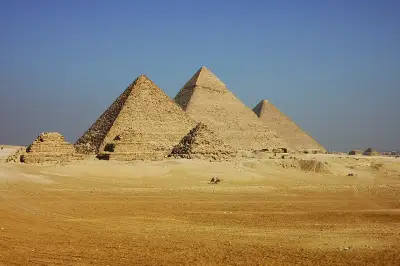
The Great Pyramid of Khufu is located on the Giza Plateau, about 10 kilometers southwest of Cairo, Egypt. It is the largest pyramid in Egypt, also known as the Great Pyramid of Giza. It was built for Pharaoh Khufu of the Fourth Dynasty of ancient Egypt, mainly as his tomb. It is the largest and tallest Egyptian-style pyramid in the world. Construction began around 2580 BC and was completed around 2560 BC. It is the central and tallest of the Giza pyramid complex, often hailed as one of the "Seven Wonders of the Ancient World." Among the 110 pyramids discovered in Egypt, the three generations of pyramids on the Giza Plateau—the Great Pyramid of Khufu, the Pyramid of Khafre, and the Pyramid of Menkaure—are the most ancient. The pyramid, shaped like the Chinese character "金" (gold), is a stone structure with a square base and a pointed top, serving as a tomb for ancient Egyptian kings, queens, or other royal family members. It is neither made of gold nor shaped like the usual pagoda. Because of its grand scale, it appears as an isosceles triangle from all sides, resembling the Chinese character "金," hence the Chinese translation as "金字塔" (golden character tower).
The Great Sphinx is located in the pyramid cemetery area of Giza, Egypt. Its head is said to be modeled after the Pharaoh Khafre, or according to some views, built by Djedefre based on his father Khufu's portrait. The statue is 20 meters high, 57 meters long, and 72 meters long if including the two front paws. The face is about 5 meters long, 4.7 meters wide, the nose is 1.71 meters long, the mouth is 2.3 meters wide and 1.93 meters deep. It wears the "Nemes" crown, with fan-shaped "Nemes" headdress hanging down from both ears, engraved with the "Uraeus" (cobra) sacred serpent on the forehead, a long beard—the symbol of kings—under the chin, a necklace around the neck, and eagle feather patterns adorning the lion's body. For thousands of years, the Sphinx was buried up to its shoulders in sand, with only a strange head visible above the horizon of the Sahara Desert. In 1817, Captain Giovanni Battista Caviglia of Genoa led 160 men to try to dig out the statue, but the sand quickly refilled the excavated pit, and this first modern attempt to excavate the Sphinx failed. It was not until the 1930s that the Egyptian archaeologist Salim Hassan finally freed the giant statue from the yellow sand. At that time, The New York Times declared: "The Sphinx has finally emerged from the impenetrable shadow of oblivion to become a landmark."
People queuing to enter the Great Pyramid of Khufu... Lao Bi and I joined in~~~
The pyramid—an ancient relic I had seen many times in history books since childhood—when it finally appeared before me, to be honest, I was a bit stunned... I actually touched the pyramid that had stood here for over 4,000 years with my own hands. Can time travel? I really wish I could travel back to the time of the ancient Egyptian pharaohs to see how the pyramids were built.
I took a photo with the Sphinx~~~ It looks really nice~~~
The horse-face skirt is beautiful, and I recommend it to sisters who come to travel. You can buy it~~~ But it's way too hot...
Inside the Great Pyramid of Khufu, the passageways are too narrow. I almost suffocated walking through them~~~
When we reached the burial chamber, what did you expect? Actually, there was nothing... The mummy is already lying in the museum~
The Arab riding a camel behind me kept following, shouting "one dollar, one dollar..." wanting me to get on. I heard that if you actually ride it, it might not be one dollar anymore.
If you are traveling independently and no one is taking photos, you can ask locals to take them for you, but you must negotiate the price in advance!
Our lovely group members~~~
[Khan el-Khalili Market]
Khan el-Khalili Market, in the heart of old Cairo, is a bustling area said to be the largest market in the Middle East. It still retains its original appearance from when it was built, with centuries-old buildings continuing centuries-old businesses.
The market was extremely crowded!
A dedicated photographer.
Group tours have many restrictions. The market was crowded, and the leader and guide kept a very tight watch on our group. At first, they wouldn't let us wander around the market. Later, we assured them we would be fine, and then we were able to stroll around... It's just a very lively market, and we didn't encounter any thieves or scammers~~~
[Abu Simbel Temples]
Located 290 kilometers south of Aswan, Egypt, built between 1300 and 1233 BC. It is said to be named after a young boy who first guided Westerners to the site. It sits on the west bank of Lake Nasser, consisting of a rock-cut pylon, giant statues of Ramesses II carved into the cliff, pillared halls, and a sanctuary. Along with other monuments from Abu Simbel to Philae, it is designated as a UNESCO World Heritage site as part of the Nubian Monuments. In 1966, due to the construction of the Aswan High Dam, the temple was relocated to a hill 60 meters above the riverbed, a successful attempt in world heritage conservation.
So the temple we see now is after the relocation.
Ramesses II, one of the most famous pharaohs in ancient Egyptian history, had a legendary life. He was a powerful king, an invincible general, a kind father, and an indefatigable builder. With these halos over his head, Ramesses II reigned for about 67 years and still enjoys these reputations today. Enemies feared him, subjects loved him, and gods blessed him. Living in the 19th Dynasty of ancient Egypt, Ramesses II left an indelible mark on human history.
He reigned for 67 years, had 8 queens, and countless concubines; he had about 100 children, of which 12 legitimate heirs died before him; under the average life expectancy of just over 40 years in ancient Egypt, he lived to over 90 years old; he loved to boast about his experiences and have them carved on buildings, placing his deified statues throughout Egypt alongside the gods. The Battle of Kadesh made him a victorious general in the eyes of his subjects; he signed treaties with the Hittites using his diplomatic skills; as a renowned builder of ancient Egypt, he preserved the glory of his time for the world. These legendary experiences and distinct personality are all concentrated in him—the most famous pharaoh in ancient Egyptian history, as hailed by historians.
The Abu Simbel Temple is considered Ramesses' greatest work, a true architectural gem of antiquity. Four colossal statues, each 20 meters high, carved from the rock face, symbolize the pharaoh sitting at the gate of his palace. Now they have become a symbol of Egyptian civilization. The temple is built on a hillside, carved to a depth of 60 meters. It was originally intended to worship the three main gods Amun, Ra, and Ptah, but actually served only one "true god"—Ramesses himself.
I also tried to have some "communication" with Ramesses II~~~
Near the Abu Simbel Temple, there is a smaller rock-cut temple dedicated to his first queen, Nefertari. The front of the temple is adorned with six statues: four of Ramesses II and two of Nefertari, depicted as the goddess Hathor. Unfortunately, after the queen died around the 24th year of his reign, construction stopped and was never fully completed. "The sun shines for her (Nefertari)," and in some legends or literary works, Ramesses II is said to have spoken many touching words of love to her. This queen is particularly famous in the eyes of ancient Egyptians, and a famous natural cosmetic brand in Egypt today is named after her.
Based on my current superficial understanding of ancient Egyptian and Chinese history, people in the 2nd-1st millennium BC strongly believed in the existence of gods. So in most cases, the high priest or great oracle was a woman, often the queen. Whether it was Nefertari, the queen of Ramesses II, or Fu Hao, the queen of King Wu Ding of the Shang dynasty. From this perspective, modern women can hold up half the sky, but women in the pre-Christian era had higher status and greater power.
Let me talk about the Egypt itinerary again. Whether you join a group or travel independently, to visit the Abu Simbel Temple, you most likely have to get up early. Because it's 300 kilometers from Aswan and you need to come back after visiting. Our schedule that day was to get up at 5 AM, head to Abu Simbel, with a 4-hour drive, arriving around 10 AM. After visiting, we had to return because we needed to catch a cruise ship with a fixed schedule. However, I also saw many independent travelers who didn't rush early. They left at noon and arrived in the afternoon, with much more time... I think that arrangement is pretty good for independent travel.
The reward for getting up at 5 AM was seeing the Sahara sunrise on the way to Abu Simbel...
That unserious local guide even promised us we would see a mirage. "You can see it every day, whenever you want." We were all amazed! So the next day, during the hot midday journey, he called us off the bus, pointed at the faintly reflective black on the road in the blazing sun, and told us it was a mirage...
Isn't that just total internal reflection?! In summer, with the sun high, the ground is scorching hot, the lower air near the ground is much hotter than the upper air, creating an inverse temperature profile. Due to thermal expansion, the lower hot air is less dense than the upper cold air, so the refractive index is lower at the bottom and higher at the top. This results in an inferior mirage that looks like a pool of water.
Well... With his level of knowledge, I didn't feel like saying much. Let's just call it what it is.
[Nile Cruise]
The golden sand sea covers the whole land of Egypt. The Nile River runs through it like a dark green ribbon, creating a fertile delta at the Mediterranean mouth. The black soil of the Nile Delta nurtured Egypt's 7,000-year brilliant civilization. Around 5000 BC, the increasingly dry climate scorched the lush grasslands of Egypt, and gradually the desert replaced the pastures. Nomadic tribes had to gather along the Nile. They settled there, farming and fishing.
In our traditional consciousness, river flooding is a disaster. But for ancient Egypt, the Nile's flood was a good thing. The flood brought nutrient-rich silt, forming the Nile Delta. The Aswan High Dam, 600 miles from Cairo, blocks the floodwaters and also traps the silt carried by the Nile. Without new sediment deposits, and with sea erosion, the delta is sinking year by year. This process is uneven: the northeastern side sinks about 5 mm per year, the northwestern side about 3 mm. The sinking leads to soil salinization and further affects freshwater resources.
So the Nile cruise is a must for group tours to Egypt. Actually, if you travel independently, you can book a better cruise yourself. Because we were in a group, we had no choice, so the cruise ship conditions were poor—especially since Lao Bi and I got a room near the engine at the stern. Whenever the ship moved, the engine noise was so loud that we had to guess what we were saying by reading lips. Sleeping at night was also hard; we had to wear earplugs or we couldn't fall asleep. With such lousy conditions, I tried to negotiate with the local guide to change rooms, but he said they had no rooms available! I was so angry! I even cursed! End of complaint... Continuing... After this group tour, I never want to join another one!
These are the cruise ships on the Nile. They are all similar in size, with differences in age and amenities.
Small boats selling goods on the Nile closely follow each big ship, mainly selling Egyptian textiles. After negotiating a price, they throw the goods up, and we throw money down.
How do the small selling boats manage to keep up with our cruise? See those two ropes? They are tied to the cruise ship; otherwise, they would be left far behind...
Every cruise ship has a pool on the top deck. When there are no activities during the day, it's nice to soak in the pool, sip a drink, and enjoy the Nile breeze...
The sunset on the Nile is also beautiful~~~ Time for silhouettes!
When the engine at the stern wasn't roaring, our room was also quite pretty~~~
Don't think that by folding a towel into an animal shape, you can make me forget the poor conditions of the cruise...
There was a peculiar thing on the Nile cruise. During the day, whether you were sitting on the top deck to enjoy the breeze or soaking in the pool, there were many flies. Once you stopped moving, flies would land on you. It shows that Egypt's sanitation is indeed not great. But strangely, once the sun set, all the flies disappeared... Not a single one left~~~ Amazing~~~
Our fellow travelers on this trip, a newlywed couple, stayed next door to our cabin. I took a picture of them—how nice it looks~~~
[Kom Ombo Temple]
Kom Ombo means "City of Gold" in ancient Egyptian. Like other temples, it has tall stone pillars and a dilapidated, desolate-looking temple hall, but uniquely, it worships both the falcon god Horus and the crocodile god Sobek, so it is also called the "Temple of Two Gods." It was built during the Ptolemaic dynasty.
This was the first temple we saw in Egypt. Even though we visited at night by cruise, it was still very impressive.
[Temple of Edfu]
The Temple of Edfu (also known as the Temple of Horus) is an ancient Egyptian temple located in Edfu on the west bank of the Nile. It is the largest and best-preserved temple after the Karnak Temple. Besides being dedicated to the falcon-headed god Horus, it was also used for religious rituals. Moreover, the inscriptions on the walls provide scholars with much information about the language, mythology, and religion of ancient Egypt during the Greco-Roman period.
The interior of the Temple of Edfu covers about 8,400 square feet, with a length of over 150 feet from the pylon to the northern wall. The pylon is 36 meters high, with two black granite statues of Horus the falcon at the entrance, and four slots for holding flags on the pylon. The pylon walls depict Ptolemy XII defeating enemies before the falcon-headed Horus and the goddess Hathor. The pillars inside the temple are in Greek style. At the entrance to the hypostyle hall, there are also two falcon statues of Horus—the left one is relatively intact, while the right one has severe damage to its lower half. The outer hypostyle hall's reliefs show Ptolemy IX worshipping Horus, while the inner hypostyle hall depicts scenes of religious ceremonies from the Ptolemaic period. There are many storage rooms for offerings. The outer sanctuary was used to place offerings, while the inner sanctuary once held a golden statue of Horus, but it is now lost. Behind the sanctuary is a replica of the sacred barque of Horus, and around the sanctuary are ten chapels dedicated to other deities.
Horus is the guardian god of the pharaohs in ancient Egyptian mythology, a symbol of kingship, and also the god of vengeance. He is the son of Osiris and Isis, depicted as a falcon-headed man wearing the Egyptian crown, a linen kilt, and holding the Was scepter (power) and the Ankh (life). This statue of the god is well-preserved, and everyone rushed to take photos with it. A little girl forced to take pictures was crying...
Visiting the Temple of Edfu meant another early start at 5 AM. All the Nile cruise ships docked at the same place, and all passengers disembarked at the same time, took horse-drawn carriages to the temple, and after visiting, returned via carriages to the ships at the same time. Not only was it crowded, but after the visit, we couldn't find our own carriage back, and then the carriage couldn't find our cruise ship... Oh my god, how can I even complain about this schedule? Couldn't they stagger the times? Couldn't they make it more user-friendly? If we were in charge of planning, it would be perfectly arranged!!!
[Karnak Temple]
The most magnificent temple left by the ancient Egyptian empire, famous worldwide for its massive scale. It is located 5 kilometers north of Luxor, with a complex of over 20 small and large temples. Inside the complex, there is a pylon 44 meters high and 131 meters wide. The Great Hypostyle Hall is 102 meters wide and 53 meters deep, with 134 giant stone pillars, imposing and breathtaking.
Can you see the obelisk in the distance in this photo?
Pyramids, temples, and obelisks are the three major symbols of ancient Egyptian stone architecture. Obelisks served three purposes: religious (dedicated to the sun god Amun), commemorative (to mark the pharaoh's reign years), and decorative. The obelisk was a powerful symbol of the ancient Egyptian empire's authority. Starting from the Middle Kingdom, pharaohs erected obelisks during amnesty years or to celebrate victories, usually in pairs at the front of temples. The obelisk is a tapering square pillar, narrowing from the base to the top, ending in a pyramid-shaped tip. It was covered with gold, copper, or a gold-silver alloy, glittering like the sun at dawn. Obelisks were carved from a single block of granite (columns were built with stacked stones), weighing hundreds of tons, with polished surfaces and hieroglyphs engraved on all four sides. Making an obelisk would consume an entire mountain. From quarrying, carving, transporting, to erecting, the wisdom and capability of the ancient Egyptians are truly incredible.
Pyramids and temples cannot be moved, so looters targeted the obelisks. There are 29 surviving obelisks worldwide: only 9 remain in Egypt, 12 in Italy, 4 in the UK, 1 in France, 1 in Israel, 1 in Turkey, and 1 in the USA. Of the 9 obelisks in Egypt, Karnak Temple has two. Just like our bronzes and ceramics... scattered around the world~~~
A long time ago, I read a book about deciphering the hieroglyphs on obelisks. The twists and turns were as difficult as deciphering the oracle bone script from Yinxu. Archaeologists have a tough job.
Karnak is indeed impressive. The columns are so thick that several people cannot wrap their arms around them; it was my first time seeing such things~~~ This photo was taken with our group members. Lao Bi was exhausted, helping to take photos for everyone~ I kept thinking about which angles would look best. But then my camera battery died, so I could only look later~~~ Couldn't take any more! The black hat didn't suit this place; my white hat was left on the bus...
In Egypt, besides the world-famous pyramids, there is another place that countless tourists long for: the "Valley of the Kings."
About 700 kilometers south of Cairo, 7 kilometers west of the Nile, across from modern Luxor, is a vast desert area that was the site of the ancient Egyptian capital Thebes. The Valley of the Kings is located in a desolate limestone canyon near the ruins of Thebes. Beneath those cliffs were the burial sites of the pharaohs of the New Kingdom (1570–1090 BC). For centuries, pharaohs carved tombs into these cliffs on the west bank of the Nile to house their noble remains. Many great colonnades and temples were also built here. This was once a magnificent necropolis, with over 60 royal tombs, burying 64 pharaohs from the 17th to the 20th dynasties, including famous ones like Thutmose III, Amenhotep II, Seti I, and Ramesses II. The largest tomb is that of Seti I of the 19th Dynasty, with a horizontal distance of 210 meters from entrance to burial chamber, and a vertical drop of 45 meters. The huge rock cavern was carved into an underground palace, with walls and ceilings covered in brightly colored paintings, sumptuously decorated, beyond imagination. The tomb entrances are often halfway up the cliffs, with narrow passages leading deep into the tomb. The patterns and hieroglyphs on the walls on both sides are still very clear.
The Valley of the Kings tombs photographed from a hot air balloon look like a small sand table... with no sense of reality~~~
Look at these hieroglyphs! From ancient Egypt 4,000–5,000 years ago, preserved to the present day... I still can't read a single one, haha, but that's not what I wanted to say. I want to say: why, after 4,000–5,000 years, are these colorful hieroglyphs engraved on the tomb walls still so vivid? It's unbelievable... I truly admire the ancient Egyptians.
In Anyang, Henan, we also discovered China's earliest known writing, the oracle bone script. "A single oracle bone shocked the world." Whether in ancient Egypt or China, the earliest human writing was pictographic, like simple drawings. It is said that over 100,000 oracle bones have been discovered, with more than 4,500 characters, of which about 1,500 have been deciphered. If someone can decipher the remaining ones, there is a big reward~~~
Among the many tombs in the Valley of the Queens, the Mortuary Temple of Hatshepsut is worth seeing. It is the tomb of the first female pharaoh of ancient Egypt. Hatshepsut's life was full of legend, somewhat similar to China's Empress Wu Zetian. She was the queen of Pharaoh Thutmose II of the 18th Dynasty. After Thutmose II died, his adopted son Thutmose III succeeded, but Hatshepsut held the real power. Thutmose III did not want to be a puppet and struggled with his stepmother, but was deposed and sent to be a priest at the Karnak Temple. Hatshepsut crowned herself pharaoh. After Thutmose III regained the throne, he carried out a purge of his stepmother Hatshepsut and her supporters, erasing all traces of the queen, except for the buildings at Karnak. Her tomb in the Valley of the Queens did not escape: all inscriptions praising her achievements were eradicated.
Hatshepsut's fate proves once again that human affairs are like flowing water, while mountains and rivers are eternal. Seeing this once-formidable female pharaoh now reduced to a corpse in a cave, I couldn't help but sigh: The Nile flows northward, washing away countless heroes; success and failure both become empty; as we sip tea and chat about ancient and modern events, it's just fodder for future laughter.
The existence of the Valley of the Kings and the Valley of the Queens allowed me to see the evolution of ancient Egyptian burial forms: from simple mastabas to pyramids, and then to the Valley of the Kings.
In the Early Dynastic Period, Egyptians commonly used pit graves as burial sites, usually in the desert and built with stones or mudbricks. Tombs were equipped with offerings, food, and water for the deceased to use in the afterlife. At this time, nobles and royalty used mastabas as the standard tomb form—a slightly sloping rectangular bench-like structure, resembling the benches people used daily; hence the name mastaba. Mastabas were the standard burial form for nobles and royalty, and for the pharaoh, it was a reproduction of his earthly home.
With the progress of ancient Egyptian civilization, during the Old Kingdom, pyramids became the main tomb form for pharaohs. Djoser introduced the step pyramid, an innovation based on earlier mastabas. The pyramids of this period were grand in scale, such as the Giza pyramid complex (we even entered one of them), and were decorated with rich reliefs and spells describing the afterlife and interactions with gods.
Entering the New Kingdom, mummification became more complex, often accompanied by metal objects, jewelry, and ornate coffins. At this time, tomb forms and decoration further developed. Thutmose I carved a new royal cemetery in Thebes, the Valley of the Kings. The tomb passages in the Valley of the Kings were widened, providing large walls and ceilings for paintings and texts. Funerary texts shifted to papyrus scrolls placed in coffins and tombs, forming the later Book of the Dead.
Hot air balloon rides are also available in Egypt. I only learned about this when I joined the group. Since I had come all this way, I had to do it. So another early morning at 5 AM...
Jumping and blurry me~~~
Yuanyuan and her husband, my lovely group members~~~
What was I taking a picture of? The hot air balloons in the sky, of course...
Lao Bi and I had already been on a hot air balloon once in Bagan, Myanmar. That time we saw pagodas; this time we saw royal tombs.
[Small Sailboat on the Nile]
Lao Bi and a boy on the small sailboat were rowing together... Laughing so happily~~~
The Sahara Desert formed about 2.5 million years ago. It is the world's largest hot desert, covering about 9.32 million square kilometers in northern Africa. The climate is extremely harsh, making it one of the most inhospitable places for life on Earth. "Sahara" is a transliteration of the Arabic word for "great desert," which comes from the language of the indigenous Tuareg nomads, meaning "great wilderness."
We spent a day in the Sahara. Another early start at 5 AM!
Abu Simbel Temple, Temple of Edfu, hot air balloon, Sahara—this trip I had already gotten up at 4–5 AM for four days in a row... I have to say, as tourists, we were quite dedicated. It was the most tiring trip of my travel career!
When in the Sahara, you have to ride a dune buggy. It reminded me of 10 years ago in Cambodia when I couldn't ride one of these desert buggies on my own, but this time it was no problem!
There was a Russian tour group in the Sahara at the same time as us. Their guide had a good idea—he tied headscarves for all of them, which was interesting...
We had two days at the Red Sea to rest. It was indeed a rest. I was so tired that I couldn't bring myself to get up at dawn anymore... Fortunately, I chose the two-day rest option when I booked the group tour. I almost chose one day~~~ Applause for my wise decision!
Lounging by the sea, playing, snorkeling... So happy!
Here is a picture of our local Arab guide. I'm posting it just so other travelers can remember this face~~~ His Chinese was poor, his itinerary was mediocre. Avoid him~~~
[Alexandria]
Alexandria is a port city on the Mediterranean coast of Egypt. It is Egypt's most important seaport and the second-largest city. Alexandria has a population of about 3.34 million. The port is located at the head of a bay with a free trade zone. Historically, Marco Polo described it as the world's largest port, on par with Quanzhou's Citong Port in China.
Alexandria was the last stop on our Egypt tour. Group tours are annoying: we wanted to do some city walking, but the leader and guide didn't allow it! However, the Mediterranean is indeed very beautiful!
"Pompey's Pillar" is the most famous surviving monument today. It originally stood in the Temple of Serapis in Alexandria, now on a small hill near an Arab cemetery. It is 30 meters high, made of polished red granite, with a base diameter of about 3 meters and a top diameter of about 2.5 meters. However, it has nothing to do with Pompey; it was erected by Diocletian in 293 AD.
[Montaza Palace]
Also known as the Summer Palace, Montaza Palace was the residence of King Farouk, the last king of Egypt. It is located in a vast scenic area at the eastern end of Alexandria, surrounded by gardens (the palace is encircled by a large garden), with stunning views and beautiful surroundings.
Busy Lao Bi... Even on vacation, he can't take a break. He spent a fortune on international calls~~~
Yuanyuan took this photo of me. It's so atmospheric... I absolutely love it!
[Citadel of Qaitbay]
The Citadel of Qaitbay was built on the site of the ancient Lighthouse of Alexandria, one of the Seven Wonders of the World. In 1480, the citadel was built using the stones from the lighthouse, named after Sultan Qaitbay. Two of the recognized Seven Wonders of the Ancient World are in Egypt: one is the Great Pyramid of Giza, ranked first, and the other is the Lighthouse of Alexandria, ranked seventh. In 330 BC, the mighty Macedonian king Alexander the Great conquered Egypt and founded a city named after himself at the northwestern tip of the Nile Delta, on the southern coast of the Mediterranean. This city, strategically important, became the capital of Egypt for the next 100 years, one of the most prosperous cities in the world, and the largest international transit port in the Mediterranean and the Middle East. The remains of the Lighthouse of Alexandria are on the island of Pharos near the city of Alexandria. From here, one can enjoy a beautiful view of the city and the Mediterranean.
Inside the citadel, we encountered children from various stans. Probably because they rarely see people with yellow skin, when they looked at me with eager eyes to take a photo, I agreed! But I think they were beautiful—big eyes, clear facial features—very pretty~~~
Inside the citadel, a girl came up and asked Lao Bi and me in English if we could give her a gift. I was wondering what she meant. Did she want to exchange gifts? But it turned out she just wanted something for free... What a mess. Even if I had something, I wouldn't give it.
Snapshots of Alexandria's streets~~~
[Other Observations in Egypt]
What I found hardest to accept was the traffic in Cairo. There are no lane markings on the roads. All cars squeeze together however they can. On a road that should have three lanes, five or six cars can go side by side. It all depends on who has steady nerves and doesn't fear a collision! If cars scrape against each other, there's no need for traffic police to intervene. The two drivers just get out and argue, out-talking and out-fighting each other~~~
Have you ever seen armed police accompanying tourists?!
Egyptian essential oils are quite famous. On the last day, after negotiating with the leader and guide, we were allowed to go shopping at a large mall in Cairo... I bought some essential oils to bring back as gifts for friends~~~
Oh, one more thing to record, though I didn't capture a photo. At the mall in Cairo, Lao Bi met a young Egyptian playing table tennis. Table tennis, well, China reigns supreme. Although Lao Bi hadn't held a paddle in a long time and was a bit rusty, he definitely won against the Egyptian guy. Table tennis is our national sport; ordinary people are no match.
As usual, I'll end with a photo of the two of us. During the 2024 National Day holiday, after Lao Bi and I visited Yinxu, we gained a deeper understanding of ancient Egyptian civilization. Whether or not the civilization of ancient Egypt has been passed down, it remains an indispensable part of humanity's cultural treasure. Ancient Egyptian civilization is one of the four great ancient civilizations and one of the most brilliant in world history. Ancient Egyptian culture is profound, extensive, and colorful, and it was a cultural hegemon in the West Asia-North Africa-Mediterranean cultural sphere, holding an important position in the world cultural system. Moreover, its influence on later generations in literature, medicine, science, and many other aspects has been profound. The hieroglyphs created by ancient Egypt greatly influenced later Phoenician letters, and Greek letters were created based on Phoenician letters. Additionally, the pyramids, the Lighthouse of Alexandria, the Temple of Amun, and other structures demonstrate the Egyptians' superb architectural skills and mathematical knowledge. They also made great achievements in geometry, calendars, and other fields. The transmission of culture (civilization) requires shared beliefs and values. That is why our Chinese civilization can truly last five thousand years and will surely be passed down forever...