Tour of Shanxi's Ancient Sites (Part 6): Xinjiang
After coming down from the Giant Buddha Temple, I once again waited for a taxi to the long-distance bus station. Coincidentally, a bus from Jishan to Houma was passing by, so I got off at the county landmark south of Xinjiang by the roadside (three flying wild geese), 8 yuan. At the landmark, I transferred to the county town’s No. 1 bus, 1 yuan, and headed to Longxing Temple.
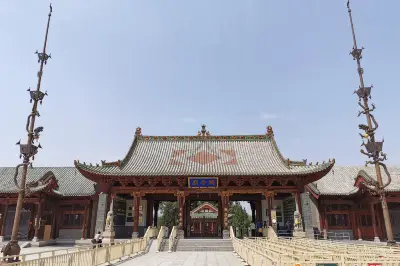
Longxing Temple, a nationally protected major cultural relic site, sits on a high mound at the northern end of Longxing Road in Xinjiang county town. The temple was first built in the Tang Dynasty, originally named Biluo Guan, and renamed Longxing Temple in the first year of Emperor Gaozong’s Xianheng reign (670 AD). In the fifth year of Huichang (845 AD), Emperor Wuzong launched a large-scale anti-Buddhist campaign, leading to widespread demolition of temples; nearly all the temple buildings were destroyed, and only the pagoda courtyard survived. During the Song Dynasty, Emperor Taizu Zhao Kuangyin resided here, changed the temple into a palace, and later monks reclaimed it, restoring the name Longxing Temple. The main surviving structures are the Mahavira Hall and the Longxing Pagoda. In 1990, the mountain gate and 108 blue-stone steps were rebuilt.
The Mahavira Hall is five bays wide and two bays deep, with a hanging-mountain roof of cylindrical tiles. Its beam framework dates from the Yuan Dynasty. Inside are painted clay sculptures from the Song and Jin periods: Vairocana Buddha, Sakyamuni Buddha, Locana Buddha, with attendants Guanyin, Kshitigarbha, Manjusri, and Samantabhadra. The main Buddha statues are 4.5 meters tall.
Behind the hall stands the Longxing Pagoda. According to stele inscriptions, the pagoda was first built in the Tang Dynasty, originally eight stories high. In the 42nd year of Qianlong in the Qing Dynasty (1777), it was recoated and raised to thirteen stories. The pagoda is octagonal, about 43 meters high, entirely built of polished blue bricks. The bracket sets under each eave imitate wooden structures, and each story has an inscribed plaque. The pagoda is exquisitely structured and elegant, with a majestic presence that seems to "vie with heaven in height." Climbing to the top, the ancient city of Jiangzhou spreads out before you, though you can no longer see the "Sleeping Ox" layout (Jiangzhou City was also called Sleeping Ox City, said to have a layout resembling a reclining ox). Looking west from the hill, you can see a twin-spired Catholic church that looks like the Xujiahui Church in Shanghai, but it's not close, so I didn't go.
After leaving Longxing Temple, I found a small eatery on Zhengping Street and ordered some boiled dumplings. A young man at the next table also looked like a solo traveler. I went over to ask, and sure enough, he was a traveler from Dalian, coming from Wutai Mountain, heading in the opposite direction. We moved to the same table and exchanged all sorts of information about Shanxi. He hadn't started his Jiangzhou sightseeing yet, so I asked a local elderly man about the way to Jiangzhou Hall. It turned out I could take a nearby small alley, and he told me to turn left, then right, go straight, and ask again when I reached the Experimental Primary School. The alley was quiet, with many forks. While I hesitated, a middle-aged man on a motorcycle came by. I stopped him to ask, and he said, "Let me give you a ride," dropping me right at the school. Once again, I met warm-hearted locals in Shanxi—truly grateful. The security guard at the Experimental Primary School told me to follow the road uphill beside the school. At the top, I saw a building where pupils were chasing and playing; that was the Music Tower. Behind it was the Bell Tower, and further up was the Drum Tower—collectively called the Three Towers of Jiangzhou.
In the Ming and Qing dynasties, prefectural and county towns often had city towers, commonly called drum towers. But Jiangzhou uniquely had three towers standing side by side, arranged in a south–north tripod pattern: the Bell Tower in the south, the Music Tower in the east, and the Drum Tower slightly to the north. They are a nationally protected major cultural relic site. The Drum Tower was originally built during the Zhizheng era of the Yuan Dynasty, with repairs in the Ming and Qing. Its surviving timber structure dates from the Ming Dynasty. Because it had fallen into disrepair, a rescue renovation and repainting were carried out in 1994, giving it a brand-new look. The Drum Tower stands on the west side at the top of Qixing Slope, facing east. It has a massive base of mixed brick and stone, with arched gateways running east–west through it. The tower itself has triple eaves and a hip-and-gable roof, with each tier gracefully receding. The ground floor is five bays wide and two bays deep. The second and third floors are each three bays wide and one bay deep; the second floor offers a distant view. Embedded in the east side of the base are two stone steles from the 27th year of Qianlong (1762): "Record of the Construction and Repair of the Drum Tower" and "Repair of the Drum Tower."
The Bell Tower was first built in the first year of Qiande in the Northern Song (963 AD). After a fire completely destroyed it, it was rebuilt on the ruins, with repairs in the Yuan and Ming. The current structure dates from the Wanli period of the Ming, with Qing-era patching. Renovations in 1979 and 1994 gave it a fresh appearance. Standing on high ground with a towering square platform, the tower has arched doorways on all four sides, each set with stone couplets. Its roof is a cross-shaped hip-and-gable with glazed tile trimming. Inside hangs a massive bell weighing ten thousand jin, cast at the "Tianqing Guan" in the northern pass during the Tiande and Dading reigns of the Jin Dynasty. But the courtyard gate was locked, so I couldn't go in.
The Music Tower—its founding date unknown—is a Ming-era structure. Collapsing from age, it was rescued and repaired in 1983. It faces north, three bays wide and two bays deep, with a front veranda on the south side. The platform is 2.5 meters high, the central bay is broad, and a small forward extension (baosha) is added. The middle section of the roof rises up, resembling a pavilion; it's said that performances could be staged simultaneously on different levels. The roof is a flush-gable type with cylindrical tiles. North of the tower, stone-built Qixing Slope rises step by step, originally leading to the City God Temple. This Music Tower served as a stage for staging operas to honor the gods and was the main venue for festive opera performances in town. The broad, sloping area in front allowed audiences to watch without obstruction.
Entering through the Drum Tower's archway, a short walk brought me to the gate of No.1 Middle School. With the guard's permission (he checked my ID), I entered the campus; the Hall of Jiangzhou stood at the end of the road.
Jiangzhou Hall measures 29.20 meters east–west and 15.40 meters north–south, covering 311.28 square meters. Built in the Tang Dynasty, the current hall is a Yuan-era reconstruction and a nationally protected major cultural relic site. The hall originally dates from the Tang, and four large stone lotus-shaped column bases in an inverted-bowl style remain inside, testifying to Tang splendor. For over a thousand years, this was the main hall of the prefectural yamen, where a clear mirror hung high, yamen runners bellowed, and commoners with grievances could beat the drum to enter the hall; right and wrong were decided solely by the conscience of the magistrate. Little wonder that at the center, in front of the main seat, lies a broken "Fish Kneeling Stone," said to signify that even fish drink water according to their conscience. The hall is also called "Shuaizheng Hall" (Hall of Command). History records that after stabilizing the Li dynasty, Emperor Taizong Li Shimin ordered General Zhang Shigui of the Left Vanguard to set up headquarters and recruit troops in Jiangzhou for an eastern campaign against Gaoli; recruitment took place right in the main hall of the yamen. The white-robed tiger general Xue Rengui enlisted here, went on to pacify the east and west, and ultimately built a platform to receive his command at Fenhe Bay—all closely tied to Shuaizheng Hall. The hall is seven bays wide and eight rafters deep, with a single-eave hip-and-gable roof of cylindrical tiles, bracket sets of five puzuo with a single descending ang. It is vast, towering, and majestic. Normally, prefectural main halls followed a standard of five bays, but Jiangzhou alone has seven—a rarity in China. Only three prefectural halls survive nationwide, and Jiangzhou Hall is the finest among them. Its architecture is bold and unadorned, with columns—especially those at the front and back—so thick one can hardly wrap one’s arms around them. To open up interior space, many inner columns were omitted. The transverse beams are stacked in three layers, connected to long longitudinal purlins and lintels, and supported by massive vertical pillars that reach the roof, creating a sturdy structure. Most of the beams and columns were peeled logs minimally shaped, with no uniform standards. Overall, the surviving building is a Yuan reconstruction. Around the hall remain a few subsidiary structures. In front, there were originally three roll-shed baosha bays; the upper parts are gone, but the foundations remain. Two rows of side rooms stretch north–south on either side—once offices for clerks and runners. In the middle, a slate-paved path leads to a wooden and stone memorial archway at the south end. Behind the hall are several rooms of the Second Hall, where officials rested. On the west side, a small garden with a bridge, flowing water, rockeries, and pine trees offered a place for officials to unwind. Further back is the yamen garden—Jiangzhou Prefectural Garden (Jiangshouju Yuanchi)—for the magistrate, his wife, and his daughter to amuse themselves. On the east side of the north wall inside the hall, a stone tablet 116 cm high and 70 cm wide, "Seven Admonitions for Civil Officials," inscribed in the first year of Jianzhong Jingguo under Emperor Huizong of the Song (1101 AD), carries an imperial edict by Emperor Zhenzong Zhao Heng.
I walked back to the Experimental Primary School, and someone pointed out that diagonally across the road was a path leading to the main street, Longxing Road. There I took No.1 bus, 1 yuan, back to the county landmark, then waited at the roadside station for Ma No.36 bus, 2 yuan, to Houma Railway Station. I boarded train 7806 from Houma to Linfen, got off at Linfen, and checked into the Railway Hotel near the station—a standard room for 80 yuan.
After dropping my bags, I went to a travel agency next to the hotel to ask about a one-day trip to Hukou Waterfall. They didn't offer half-price tickets, so I gave up. Then I talked to taxi drivers; they wanted 180 yuan including the entrance ticket. I said I'd buy my own ticket and just pay for the ride. One driver said 100 yuan, we high-fived to seal the deal, and he'd pick me up at the hotel entrance the next morning. Still not entirely at ease, I walked to Bingzhan Road bus station to check long-distance bus options.
I had chosen to stay near the station for convenience. But it was impossible to shower—not because of no hot water, but because the shower head was too close to the wall and rusted in place; the hot water ran practically down the wall, so unless you stuck yourself to the wall you couldn't get wet. And there were mosquitoes. Even more absurd: when I went to the front desk for mosquito coils, the reply was, "We've submitted a request to the leadership, but it hasn't been approved yet." They laughed it off as a state-run enterprise thing. So I went to a small supermarket and bought a box of coils myself. The TV signal was lousy too. But after a long day, I was too exhausted to care.
(Xinjiang, Longxing Temple)
(Xinjiang, Music Tower, with Bell Tower in the distance)
(Xinjiang, Drum Tower)
(Xinjiang, Jiangzhou Hall)
(Xinjiang, Alleyway)