Luoyang Lijing Gate, Han Hangu Pass Ruins, Xiaohan Ancient Road Shihao Section Ruins, Ruicheng Guangrenwang Temple, Ruicheng Yongle Palace
2021 Grand Tour Day 1~2 (May 27~28): Luoyang Lijing Gate, Han Hangu Pass Ruins, Xiaohan Ancient Road Shihao Section Ruins, Ruicheng Guangrenwang Temple, Ruicheng Yongle Palace
Due to the pandemic, I had accumulated a lot of vacation days, so I decided to take a month off and drive with my girlfriend along the Northwest Grand Loop and the Silk Road, and also take Route 315 to Eboliang and Mangya in Haixi Prefecture. Since I couldn't book hotels in those two places before the end of April, and the online travel guides added some exaggerations, I felt a bit anxious. So I started planning two months in advance what to bring. Food and drink came first: self-heating meals, instant noodles, Red Bull, drinking water, coffee, etc. Disposable towels, disposable socks, disposable underwear, outdoor shoes, tissues, sleeping bags, tent… they filled up the entire back seat.
I prepared dozens of pages of pre-trip guides, including Baidu Maps driving routes, attractions along the way, and brief introductions, afraid of missing any place. I was especially worried about not getting rooms at Wusute Waterish Yadan and Mangya, so I booked the Waterish Yadan RV Camp and Mangya Xigang Hotel early. Although the whole itinerary was tight, once we reached Dunhuang, we planned not to rush—just drive and stay wherever we ended up each day.
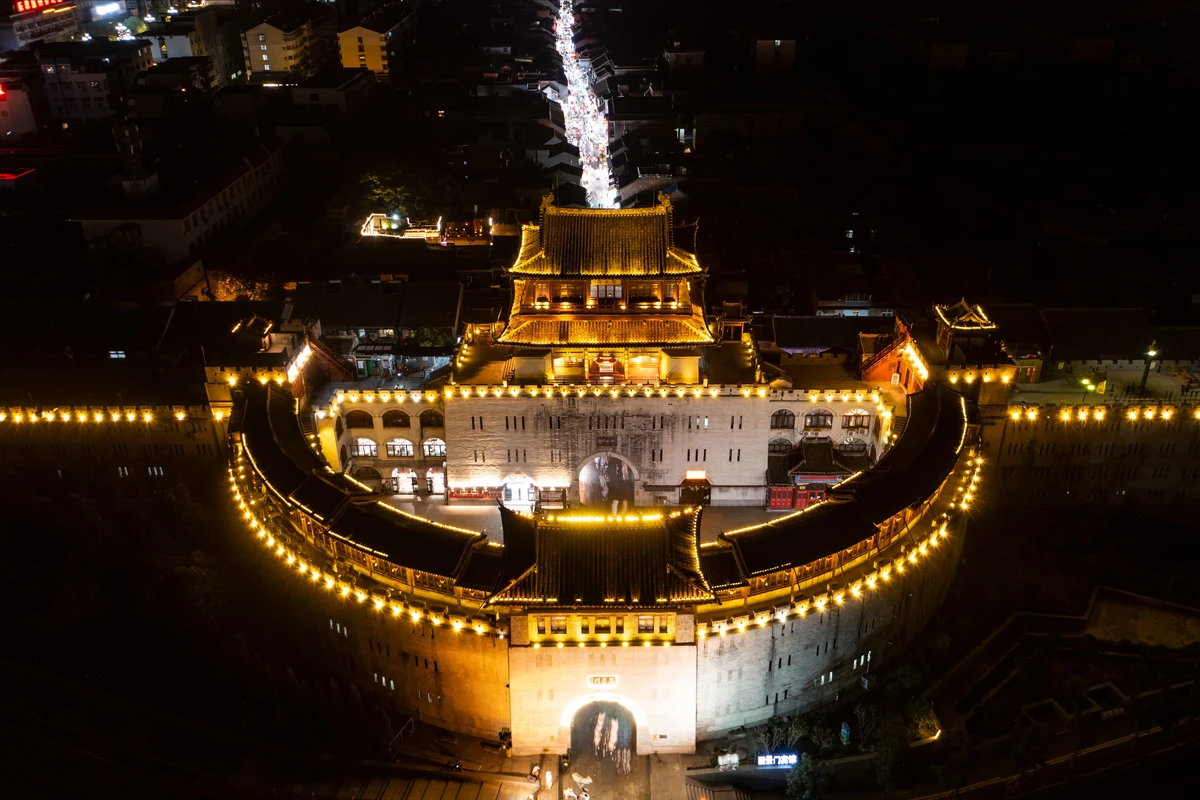
We set off from Nanjing at noon, first drove straight to Luoyang for one night, and went to see the night view after arriving. Earlier I saw a spectacular photo of a city gate at night online and thought it was Lijing Gate. On the way to Lijing Gate, I did see a magnificent gate from afar, but when I arrived at Lijing Gate itself, it didn't match. Back at the hotel, I studied the map and compared various photos. It turned out the spectacular gate was Yingtian Gate, not far from Lijing Gate, with Mingtang Square behind it. If you want to take a photo of the gate's reflection, you should go to Dingding Gate. As the eastern starting point of the "World Heritage—Silk Road," Dingding Gate is also one of the heritage sites in Luoyang, along with the ruins of Han-Wei Luoyang City, the Xin'an Han Hangu Pass ruins, and the Xiaohan Ancient Road Shihao Section ruins. Luckily, Luoyang is not far away, so that can wait for another time.
Lijing Gate was rebuilt in 2002. Inside the gate tower are attractions like Tianhou Temple, Jiulong Hall, Xianliang Temple, Guanyin Pavilion, and Chenghuang Temple. We weren't very interested in such replica ancient buildings. The old city historical and cultural district behind it was quite lively, and the food was cheap.
In Luoyang, we chose the Guobao Borui Hotel again. I had stayed there a year and a half ago and found the design and service excellent. Since then, I never consider any other place in Luoyang. This time, surprisingly, we got the same room as before. Opening the door, the scent of books (the hotel's bookhouse) greeted us—a coincidence.
The next day, we first went to the Xin'an Han Hangu Pass ruins, 34 km away, a 50-minute drive. There are three Hangu Pass sites: the Wei Pass ruins have been submerged by the Sanmenxia Reservoir. The current Sanmenxia Lingbao Hangu Pass scenic area is the site of the Qin Pass, where Laozi wrote the Tao Te Ching, but it's a reconstructed scenic area. I had been there before and found it not bad.
Han Hangu Pass was moved east at the suggestion of Yang Pu, a general from Xin'an during Emperor Wu of Han's reign. According to the Book of Han, in the third year of the Yuanding era (114 BC), "the Hangu Pass was moved to Xin'an," more than 2,100 years ago. The Eastern Han commentator Ying Shao noted: "At that time, General Yang Pu of the Tower Ship had great merit but was ashamed to be a person outside the pass, so he petitioned to move the pass east, using his family property for expenses. Emperor Wu also liked the idea of expanding the territory, so the pass was moved to Xin'an, 300 li away from Hongnong." Thus, Xin'an changed from being "east of the pass" to "within the pass." The famous Tang poet Wang Changling's line "The moon of Qin times, the pass of Han times" refers to the Xin'an Hangu Pass.
There weren't many tourists here. The ticket was 20 yuan. After crossing the bridge from the entrance, there was a wall—the so-called "Eight Steep Mountain." Turning left, the gate was about 1 km away. In addition to the city wall, a building next to it contained archaeological remains of dikes, drainage channels, horse tracks, etc. Crossing the bridge and turning right was a short ancient road, recorded as 58 meters, with clear rut marks. At the end of the road, there were stone inscriptions on the cliff, with characters like Wang, Zhao, and the Shangyuan era of Tang Gaozong clearly visible—seemingly a Tang dynasty "I was here" graffiti.
Next, we went to the Xiaohan Ancient Road Shihao Section ruins, about 72 km away via highway, a 1-hour 10-minute drive. The parking lot was large, but the visitor center was not operating, so it was free. We climbed up a section but still couldn't figure out which road was the Xiaohan Ancient Road. We went back to the visitor center to find a restroom, but it was guarded and not open. We asked where exactly the Xiaohan Ancient Road was, and only then learned we hadn't climbed far enough. So we climbed again, saw a locked iron gate, and were told that outside was the Xiaohan Ancient Road. I took a few photos with a drone but still wasn't sure.
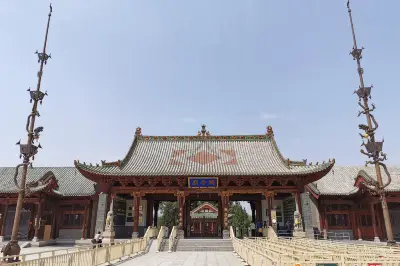
Then we went to the most anticipated sites of the day: Guangrenwang Temple and Yongle Palace in Ruicheng, Shanxi. From the Xiaohan Ancient Road Shihao Section ruins to Guangrenwang Temple was about 100 km, 1.5 hours. Guangrenwang Temple is one of the three existing Tang dynasty wooden structures with complete beam-frame construction in China (the other two are the East Main Hall of Foguang Temple and the Main Hall of Nanchan Temple in Wutai County; some say four, including Tiantai Nunnery in Changzhi Pingshun). Guangrenwang Temple is the only Taoist one. It is commonly known as Wulong Temple (Five Dragons Temple), and Guangrenwang is actually the Azure Dragon deity among the dragons.
Although Guangrenwang Temple has a ticket booth, you don't need to buy a ticket—just register. As we entered, our eyes lit up. Though the site was not large, the layout was very tasteful. I searched online and learned that Wang Shi and others donated funds, and experts from the Architecture Department of Tsinghua University, referencing Liang Sicheng's "A Pictorial History of Chinese Architecture," designed and built the protective facilities. It was new but not vulgar. That's just my personal opinion—to each their own. But compared to some ancient buildings that lose their antiquity and gain a touch of vulgarity after renovation, this was much better. On the wall next to it, there was a detailed introduction to the distribution of ancient buildings in Yuncheng and Linfen cities. We took photos of all of them as references for future travel planning.
When we went, the main hall's door was not open, so we couldn't enter. A pity. Maybe another time.
Next, we went to Yongle Palace. Yongle Palace is only 2 km from Guangrenwang Temple. We went to Guangrenwang Temple first, planning to return to Yongle Palace later, because we expected Guangrenwang Temple to be small and not take much time, and then we could slowly enjoy Yongle Palace.
Yongle Palace is a Yuan dynasty building, a Quanzhen Taoist temple. Originally located by the Yellow River, it was moved north entirely to its current site of the ancient Wei state ruins due to the construction of the Sanmenxia Reservoir. So when entering the scenic area, you first see the ancient Wei state city wall ruins. Yongle Palace's mural "Chaoyuan Tu" (The Chart of the Heavenly Procession) is famous far and wide. Seeing it in person was even more breathtaking. Photography was strictly prohibited. I found some pictures online as a reference.
After viewing the murals in the three main halls, we walked to the sides and found a sign for "Lu Zu's Tomb." I hadn't seen any introduction online before. It turns out that Lü Dongbin was indeed from Yongle Town, Ruicheng, Shanxi (Hedong Puzhou Hezhong Prefecture), and Yongle Palace was rebuilt on the basis of the Song dynasty Lü Zu Temple. But whether it's real or not is uncertain; there seems to be a Lü Zu Tomb in Handan, Hebei (Huangliangmeng Lüxian Temple). Many famous figures' tombs have such situations. Next to Lü Zu's Tomb was also a relocated Song dynasty tomb, which was very exquisite.
The ticket was 60 yuan, but well worth it.
We left Yongle Palace around 5:00 PM and drove to Weinan, 130 km, about 2 hours. After crossing the Yellow River into Shaanxi, we saw a Tongguan Ancient City under construction on a hill to the left. Perhaps it should be called Tongguan "New" City.