Setting Out for Spring – 2019, March, Self-Driving, Spring Outing. (Part II) Yuncheng, Xiezhou, Yongji.
For northerners, spring brings a deeper sense of renewal. The vast land transforms from bleakness and howling winds to a time when frost diminishes and warm breezes return, heralding the new year. At the spring equinox, the vibrant essence of spring greets us head-on. The wind shifts from biting to gentle, trees go from bare to budding, and flowers are on the verge of blooming. As if overnight, spring arrives, and pear blossoms cover the trees like snow. Traveling at this time, one can truly experience 'the best of spring, with a thousand miles of orioles singing and green foliage set off by red blossoms.' On March 20th, my wife and I followed the footprints of spring and embarked on a spring outing.
Day 1 (2019,3,20): 6:26 AM, departed from Daxing, Beijing, on G4 Expressway. Arrived at Yinxu Ruins at 12:06 PM (odometer: 495 km). 12:40-3:20 PM, lunch at 'Shengdeli,' visited Yinxu Ruins. 3:48 PM, Ma's Manor. 5:20 PM, checked into Lavande Hotel (543 km). 7:38 PM, dinner at '76 Ren Laoshi Handmade Braised Noodles.'
Day 2 (2019,3,21): 6:47 AM, departed from Lavande Hotel, Anyang, on Nanlin Expressway. 8:17 AM-12:10 PM, visited Hongqiqu Youth Cave Scenic Area (631 km). 4:59 PM, arrived at Manxin Hotel, Yuncheng (1050 km). 6:33 PM, dinner at 'Longxingmei Noodle House.'
Day 3 (2019,3,22): 7:46 AM, checked out and departed. 8:00-8:50 AM, visited Colorful Salt Lake (1057 km). 9:22-11:00 AM, visited Xiezhou Guandi Temple (1082 km). 11:56 AM-12:43 PM, lunch and visited Yongji Puji Temple (1150 km). 1:10-2:26 PM, visited Guanque Tower (1157 km). 5:25 PM, checked into Xi'an Aegean Sea Hot Spring Hotel (1327 km). 6:45 PM, dinner at 'Lintong Impression.'
Day 4 (2019,3,23): 8:10 AM-12:08 PM, visited Huaqing Palace. 12:50-3:10 PM, visited Giant Wild Goose Pagoda (1396 km). 3:41 PM, checked into Ibis Hotel (1405 km). 6:00-9:08 PM, dinner at 'Liuxiang Noodles,' strolled around Muslim Quarter.
Day 5 (2019,3,24): 8:50-11:55 AM, visited Xi'an City Wall. 12:10 PM, lunch at 'Old Tongguan.' 12:43 PM, departed for Hanzhong. 4:30 PM, checked into Hanzhong Binjiang Garden Hotel (1670 km). 6:00-9:00 PM, strolled along Han River, had dinner.
Day 6 (2019,3,25): 6:22-7:50 AM, walked along Han River. 8:42 AM, checked out. 9:19 AM-1:50 PM, visited Xianma Township, Hongfu Road, Hanshan Peak, Yangchun Town, and Nanzheng Nanhu Lake to enjoy rapeseed flowers (1750 km). 2:00 PM, headed towards Guangyuan. 3:50 PM, checked into Hampton by Hilton Guangyuan (1915 km). 6:05-8:30 PM, dinner and strolling.
Day 7 (2019,3,26): 8:28 AM, departed. 9:16 AM-12:08 PM, visited Zhaohua Ancient Town, lunch at 'Zhaohua Taste' (1946 km). 5:08 PM, checked into Leshan Golden Begonia Hotel (2389 km). 5:30-9:10 PM, visited confluence of three rivers, Leshan Giant Buddha, dinner at 'Leshan Taste.'
Day 8 (2019,3,27): 6:50-8:00 AM, walked along the river. 8:42 AM, checked out and departed (2406 km). 9:41 AM-2:25 PM, took Jiayang Small Train in Qianwei (2471 km). 4:40 PM, checked into Yucheng Impression Hotel, Ya'an (2642 km). 5:05 PM, strolled, dinner at 'Pangshi Fish Restaurant.'
Day 9 (2019,3,28): 8:40 AM, departed. 12:42-3:48 PM, visited Qionghai National Wetland Park (2943 km). 4:04-5:30 PM, visited Lushan Mountain. 6:08 PM, checked into Xichang Meilishanshui Hotel (2957 km). 7:20 PM, dinner at 'Niumuke.'
Day 10 (2019,3,29): 8:00 AM, departed towards Lugu Lake (2960 km). 1:45 PM, arrived at Lugu Lake gate in Yanyuan County (3201 km). 2:30-3:18 PM, visited Caohai and the Marriage Bridge (3205 km). 4:03 PM, parked at Daluoshui Village parking lot (3221 km). 4:20 PM, checked into Mani Stack Hotel. 4:50-8:00 PM, strolled by the lake, had dinner.
Day 11 (2019,3,30): 6:50 AM, took photos by the lake. 9:20 AM-3:40 PM, circumnavigated the lake (3299 km). 6:30-8:00 PM, strolled and had dinner.
Day 12 (2019,3,31): Explored Daluoshui Village and Lugu Lake.
Day 13 (2019,4,1): 9:30 AM, headed towards Lijiang. 2:00 PM, checked into Shuhe Mozhu Wanshe Inn (3496 km). 2:30-5:30 PM, lunch at 'Xiaoguofan,' visited Shuhe Old Town. 6:20-10:00 PM, visited Lijiang Old Town, dinner at 'Gebi Laowang.'
Day 14 (2019,4,2): 6:20-8:40 AM, strolled through Shuhe Old Town. 9:26 AM, headed towards Panzhihua. 3:48 PM, checked into Zhuxia Hotel, Panzhihua (3763 km). 6:20-10:00 PM, strolled, dinner at 'Yibagu.'
Day 15 (2019,4,3): 8:50 AM, headed towards Dongchuan Red Land. 3:02-6:10 PM, visited Dongchuan Red Land, took photos (4165 km-4205 km). 7:26 PM, checked into Dongchuan Century Lijing Hotel (4249 km).
Day 16 (2019,4,4): 7:50 AM, headed towards Bijie. 12:30-5:40 PM, visited Baili Dujuan Scenic Area (4689 km). 9:55 PM, checked into Bijie South Excellence Hotel (4770 km).
Day 17 (2019,4,5): 9:00 AM, headed towards Longsheng, Guangxi. 3:49 PM, arrived at Longji Rice Terraces ticket office (5351 km). 5:38 PM, arrived at Ping'an Village parking lot (5392 km). 6:35 PM, checked into 'Seven Stars with Moon Resort Hotel.'
Day 18 (2019,4,6): 6:30-8:00 AM, took photos of Longji Rice Terraces. 9:40 AM, departed for Dongjiang Lake in Zixing, Chenzhou, Hunan. 3:10 PM, checked into Zixing Dongjiang Lake Qishi Hotel (5856 km). 4:00-7:00 PM, strolled, dinner at 'Qiaozui Fish.'
Day 19 (2019,4,7): 7:20-11:30 AM, visited Dongjiang Lake. 12:10 PM, headed towards Yingtan, Jiangxi. 6:45 PM, checked into Yingtan Fontainebleau Hotel (6451 km).
Day 20 (2019,4,8): 7:00 AM, headed towards Jiande, Zhejiang. 11:00 AM, arrived at Jiande Qili Yangfan Scenic Area parking lot (6785 km). 11:40 AM-1:35 PM, strolled along Fuchun River, had lunch at Kaiyuan Fangcaodi Country Hotel. 2:30 PM, checked into Tonglu Daman Hotel (6841 km). 6:00-9:40 PM, explored Tonglu county town.
Day 21 (2019,4,9): 6:30-8:00 AM, strolled along Fuchun River. 9:50-11:30 AM, visited Daqishan National Forest Park. 6:20-9:10 PM, strolled and had dinner in Tonglu county town.
Day 22 (2019,4,10): 9:50 AM-3:00 PM, visited Fuchun River, Tianmu Creek, Fenghuang Mountain, Tongjun Cable Bridge, and Binjiang Park, lunch at 'Zhangmuniang.' 7:00-8:40 PM, strolled and had dinner in Tonglu county town.
Day 23 (2019,4,11): 9:00 AM, headed to Nanjing (6885 km). 12:02 PM, lunch at Yixing 'Dushunxing Zhengjiang Guogai Noodles.' 2:08 PM, checked into Orange Crystal Hotel Yixianqiao Branch, Nanjing (7247 km). (Had a medical test in Nanjing, doctor's appointment two days later.)
Day 24 (2019,4,12): 8:45 AM, headed to Xinghua. 11:06 AM-1:50 PM, visited Xinghua Qianduo Scenic Area (7466 km). 4:50 PM, checked into Suzhou Geya Hotel (7696 km). 5:30-9:20 PM, visited Jinji Lake, had dinner.
Day 25 (2019,4,13): 9:40 AM-1:45 PM, visited Jinji Lake. 2:20 PM, checked into Lefuquan Suite Hotel. 5:40-9:30 PM, visited Pingjiang Road, dinner at 'Dingshengxian.'
Day 26 (2019,4,14): 8:50 AM, headed to Tianmu Lake. 10:59 AM-1:30 PM, visited Tianmu Lake Landscape Garden, lunch (7876 km). 2:45 PM, checked into Nanshan Bamboo Sea Inn (7921 km). 4:20-7:30 PM, enjoyed Yushui Hot Spring at Tianmu Lake.
Day 27 (2019,4,15): 9:17 AM, headed to Nanjing. 12:30 PM, arrived at Nanjing Zhongshan Hotel (8056 km). (Picked up lab results and saw doctor at Nanjing General Hospital.) 3:15 PM, headed to Xuzhou. 6:50 PM, checked into Xuzhou Pengcheng Hotel (8394 km).
Day 28 (2019,4,16): 5:40 AM, departed for Beijing. 12:46 PM, arrived home in Daxing, Beijing (9076 km).
Beijing – Henan--Anyang--Hongqiqu – Shanxi--Yuncheng--Yongji – Shaanxi--Xi'an--Hanzhong – Sichuan--Guangyuan--Leshan--Qianwei--Ya'an--Xichang--Lugu Lake – Yunnan--Lijiang – Sichuan--Panzhihua – Yunnan--Dongchuan – Guizhou--Bijie – Guangxi--Longsheng – Hunan--Zixing – Jiangxi--Yingtan – Zhejiang--Tonglu – Jiangsu--Nanjing--Xinghua--Suzhou--Liyang--Nanjing--Xuzhou – Beijing.
Many people may not know much about Yuncheng, and some may only know it as a place name. But Yuncheng is actually quite remarkable.
Yuncheng, anciently called Hedong, is the hometown of Guan Yu and gained its name from being a 'city of salt transport.' It is one of the important birthplaces of Chinese civilization. Legends such as Nüwa mending the sky and the Yellow Emperor's battle with Chiyou both took place in Yuncheng. Yuncheng is a place of outstanding people, not only the birthplace of the famous Shu Han general Guan Yu but also giving rise to eminent civil and military figures like Zhang Yi, Sima Qian, Wang Wei, and Liu Zongyuan.
From Hongqiqu to Yuncheng is about 400 kilometers. We arrived at 5 PM and checked into Manxin Hotel.
The hotel was cozy; although the room was not large, it was very clean and comfortable.
Not far from the hotel was 'Longxingmei Noodle House,' which had a pleasant atmosphere. The Kung Fu Yellow River carp was average, the honeyed sweet potatoes were delicious, and it was our first time trying the Yam Min Geda (a local dish), which was quite novel.
Nanfeng Square was lively in the evening, with several dance groups scattered around dancing joyfully.
In the morning, we went to Yuncheng Salt Lake. In the distance, white dikes like piles of snow were salt fields where workers were shoveling. The water surface nearby looked like it was frozen, with a layer of white salt exuding on the surface.
The salt lake is the most iconic landscape of Yuncheng. Along with the 'Ogden Salt Lake' in Utah, USA, and the 'Kuchuk Salt Lake' in Siberia, Russia, it is known as one of the world's three largest sodium sulfate-type inland salt lakes, and it is the earliest salt lake developed by Chinese ancestors. According to historical records, over 5,000 years ago, our ancestors discovered and used salt from Yuncheng Salt Lake.
Mr. Zhao Puchu inscribed the 'Song of the South Wind': 'The gentle south wind can relieve the resentment of my people; the timely south wind can increase the wealth of my people.' Legend has it that Emperor Shun once played a five-stringed zither at Woyun Hill by the salt lake and sang this most ancient Chinese song.
Yuncheng Salt Lake is known as the 'Dead Sea of China.' As a 4A scenic spot, it seemed questionable. It was desolate and lonely, with no tourists or staff in sight, and even guidance signs were absent. You had no idea how to enjoy it. Whether the advertised saltwater floating, black mud spa, hot spring therapy, etc., actually existed was uncertain. Perhaps due to the season, it felt as if it was closed. Anyway, we took a quick look around and said goodbye.
The sky seemed hazy, and the salt pond was still, without a ripple, as if frozen. In good weather, it might have looked like a thin layer of ice or a mirror.
Another famous attraction in Yuncheng is the Xiezhou Guandi Temple located in Xiezhou Town.
Changping Village, southeast of Xiezhou, is the birthplace of Guan Yu. This loyal, righteous, and upright general of the Eastern Han Shu Kingdom was later deified as 'Great Emperor' and honored as 'Saint of War.' Ancient people said, 'In Shandong, there is the Saint of Culture; in Shanxi, there is the Saint of War.' In the Chinese world, the Saint of War is known for his moral character and is revered as the 'God of Wealth,' ranking first among civil and martial wealth gods.
The Guandi Temple was built to worship Guan Yu, who has become an integral part of traditional Chinese culture and a moral model and spiritual sustenance for countless people. Guan Yu's faith and worship have spread globally through the construction of Guandi Temples. According to statistics, there are currently over 30,000 Guandi Temples in more than 30 countries and regions worldwide. The Xiezhou Guandi Temple was first built in the ninth year of the Kaihuang reign of the Sui Dynasty (AD 589), expanded and renovated during the Song and Ming dynasties. The existing buildings were reconstructed over more than a decade after a fire in the 41st year of the Kangxi reign of the Qing Dynasty (AD 1702). It is considered the ancestral temple of all Guandi Temples. In terms of history, scale, grandeur, content, and artistry, the Xiezhou Guandi Temple can be called a 'sacred hall of traditional Chinese moral culture,' hence the saying, 'To see the best Guandi Temples, go to Shanxi; the best in Shanxi is in Xiezhou.'
Before entering the Guandi Temple, a stone memorial archway outside the bell tower caught my eye. Built in the tenth year of the Chongzhen reign of the Ming Dynasty (1637), it is a four-pillar, three-door, five-roof structure.
The front plaque reads 'Wan dai zhan yang' (Eternal Admiration).
The back plaque reads 'Zheng qi chang cun' (Righteousness Forever Present).
The carvings on the stone archway are exceptional, with figures, auspicious beasts, and celestial birds vividly lifelike. The delicate carving and vivid forms make it a rare masterpiece of stone carving art.
The bell tower is a relic from the Qianlong period, with a drum tower corresponding on the west side.
We arrived at the main gate of the Guandi Temple scenic area and purchased tickets to enter. The temple faces south, with a well-organized layout of front court and rear sleeping quarters. The central axis connects two main parts: the Jieyi Garden (Oath Garden) and the main temple, with auxiliary buildings like the bell and drum towers on both sides.
The current Xiezhou Guandi Temple actually consists of four parts: the Guandi Ancestral Temple, the Guandi Family Temple, the Guandi Ancestral Tomb, and the Imperial Garden. The Guandi Family Temple is located in Changping Village, Guan Yu's birthplace, about 8 kilometers away. The Guandi Ancestral Tomb is in the Shipangou Valley of Zhongtiao Mountain south of the family temple, featuring a statue of Guan Yu that is 80 meters tall, the world's tallest and largest. The part in Xiezhou Town comprises the Guandi Ancestral Temple and the Imperial Garden.
Upon entering the Guandi Temple, the first thing to catch the eye is a garden landscape: peach and plum blossoms in full bloom, green tiles and red walls, ancient pines and drooping willows, and pavilions and towers. It felt like entering a large garden.
This garden is called Jieyi Garden, opposite the main temple. From south to north, it features the Sanyi Pavilion, Junzi Pavilion, Lotus Pond, and the Jieyi Archway.
At the southernmost end is the Sanyi Pavilion, also called the Oath Pavilion, named after the stone carvings of Liu Bei, Guan Yu, and Zhang Fei taking the peach garden oath inside.
Behind Sanyi Pavilion is Junzi Pavilion, originally built in the first year of the Tianqi reign of the Ming Dynasty (AD 1621). Originally called Lotus Pavilion, it stands on a high platform with corridors and plain columns, simple and elegant.
Inside the pavilion hang many plaques praising Guan Yu. A thousand-year-old camphor wood root carving of the 'Immortal Guan Gong,' weighing about 1.5 tons, is exquisitely crafted and lifelike.
The pavilions and corridors are adorned with carved beams and painted rafters, with ancient pines and cypresses swaying gracefully.
Jieyi Garden was originally called Lotus Pond and was once occupied by a unit. After restoration, it became a garden with hills, water, flowers, and greenery, integrated with the Guandi Temple. It is now at its most beautiful.
Jieyi Archway is the entrance to Jieyi Garden, facing north opposite the main temple. It is a pure wood structure with ornate bracket sets under the eaves. Unlike typical archways, it has a rear covered shed attached, giving it an imposing and magnificent appearance. The front plaque reads 'Jieyi Yuan' (Oath Garden), and the back reads 'Shan xiong shui kuo' (Majestic Mountains and Vast Waters).
On the north side of Jieyi Archway along the central axis stands an old screen wall—the Four-Dragon Wall—which separates Jieyi Garden from the main temple area and is the southernmost building of the main temple.
The Four-Dragon Wall was built during the Xuande reign of the Ming Dynasty (AD 1426–1435). It is made of glazed tiles and features four flying dragons, along with auspicious beasts like phoenixes, qilins, and jade rabbits. Due to its age and previous lack of protection (reportedly a road once ran between the screen wall and Jieyi Garden), the wall has tilted southward, supported by wooden posts on the back. Although the dragon shapes on the front are faded and some parts have fallen off, the remaining sections still convey its former beauty and grandeur.
Dragon walls are not uncommon in China, such as in Datong and Beijing. The highest standard is the Nine-Dragon Wall, typically with an odd number of dragons (1, 3, 5, 7, etc.). A four-dragon wall seems unique to this place; I wonder about its significance.
In front of the Four-Dragon Wall, three iron bars are crossed and connected, planted into stone blocks on the ground—a very distinctive shape. Later, I learned that this is called a 'bihu,' also known as 'xingma' or 'dangzhong' (blocking the crowd), a barrier used in front of ancient government offices to block pedestrians.
Seeing the bihu, the most intuitive feeling is that the three interconnected iron bars symbolize the Peach Garden Oath of brotherhood. Further, this 'righteousness' is deeply rooted in the land and in the hearts of the people. Its function as a crowd barrier also symbolizes Guan Yu's status. In the past, passersby—civil officials would get out of their sedan chairs, military officers would dismount from horses, and even the emperor had to get out of his sedan chair to show respect. Another layer of meaning is that Guan Gong is revered not only by Confucianism but also by Taoism and Buddhism, making Guan Gong the only deity spanning the three major religions of Confucianism, Taoism, and Buddhism in China. These three small iron bars are a symbol of loyalty and integrity, and a symbol of unity and cohesion for the Chinese nation. I gradually understood why the Chinese people worship Guan Gong: not just for health, safety, and prosperity, but more for revering this loyalty and integrity, focusing on a spiritual pursuit.
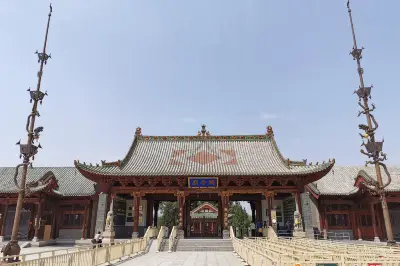
Directly facing the Four-Dragon Wall is the main gate of the temple—Duanmen. The construction date of Duanmen is unknown; it was rebuilt during the Jiajing reign of the Ming Dynasty. It is a brick structure with brick carvings, simple and elegant. The lintel is inscribed with 'Guandi Temple,' and on the back of the gate is a plaque reading 'Fu Han Ren Wu' (Supporters of the Han Dynasty). The side gate lintels read 'Jing guan guan ri' (Loyalty Pierces the Sun) on the east and 'Da yi can tian' (Great Righteousness Reaches Heaven) on the west.
Flanking Duanmen are a pair of iron lions, appearing quite old. They were cast during the Wanli reign of the Ming Dynasty, majestic and imposing.
Behind Duanmen is Zhimen, the second gate of the main temple, one of the 'Five Gates of the Son of Heaven' according to the Rites of Zhou. To the east and west of Zhimen are the 'Wenjing Gate' and 'Wuwe Gate.'
Zhimen serves a dual purpose: it is both a gate and an 'overpass stage,' with the north side serving as a stage, integrated with the platform base and eaves.
Continuing north is Wumen, the main gate of the Guandi Temple. The lintel bears three gold characters 'Guandi Temple,' and in the center of the steps is a danbi stone with two dragons playing with a pearl, a symbol of imperial authority.
Passing Wumen, we see the second archway on the central axis—the 'Shan Hai Zhong Ling' archway (Convergence of Spirits from Mountains and Seas). It is a pure wood structure with bracket sets shaped like a fishnet, and exquisitely carved wooden decorations.
North of the 'Shan Hai Zhong Ling' archway is the 'Yushu Tower' (Imperial Book Tower). The existing building dates from the Kangxi period, with the name inscribed by Emperor Qianlong. The tower has an elegant and floating appearance. The stone carvings on the side railings and the wood carvings inside are rare artworks.
The horizontal plaque on the back of the tower reads 'Jue Lun Yi Qun' (Peerless), a comment by Zhuge Liang about Guan Yu, inscribed by the magistrate of Xiezhou, Yan Rusi.
The last building in the main temple area is the main hall—Chongning Hall. It was first built during the Chen and Sui dynasties, and got its name in the third year of the Chongning reign of the Song Dynasty (AD 1104) when Emperor Huizong granted Guan Yu the title 'Chongning Zhenjun.' The hall houses a statue of Guan Yu wearing an imperial crown and robe, accompanied by attendant officials. In front of the hall are ancient pines and cypresses, with a pair of stone ornamental columns, two incense burners, and a pair of iron flagpoles. The platform is spacious with curved balustrades.
Under the main hall eaves hangs a large plaque inscribed 'Shen Yong' (Divine Bravery) by Emperor Qianlong of the Qing Dynasty.
On the lintel hangs a plaque inscribed 'Wan shi ren ji' (Ultimate Example for All Ages) by Emperor Xianfeng.
Surrounding the hall are 26 giant stone columns carved with dragons. The eight front columns feature double dragons soaring, while the other 18 columns on the other three sides have single dragons in deep relief. The carvings are delicate, bold, and lively.
On both sides of the hall are two bronze and two iron Green Dragon Crescent Moon Blades.
In front of the hall on each side are iron figures and iron lions from the Shunzhi reign, standing guard. One iron figure has lost an arm.
To the west and east of Chongning Hall are a bell pavilion and a stele pavilion, added during the Qing Dynasty. The bell pavilion on the west side was reinstalled in the 14th year of the Jiaqing reign (1809) and houses an iron bell cast in the 17th year of the Shunzhi reign (1660).
The stele pavilion on the east side contains a stele inscribed with a poem by Prince Heshuoguo of the 12th year of the Yongzheng reign (1734).
Behind Chongning Hall is the rear palace sleeping quarters. At the courtyard gate, a pair of iron figures and iron lions look more peaceful.
The rear palace is the last building complex of the Guandi Ancestral Temple.
Entering the courtyard, beyond a garden area, guarded by iron figures and lions on both sides, is a grand and beautifully ornate four-pillar, three-door, double-eave wooden archway. It is the tallest and highest-ranking archway on the central axis. Its construction date is unknown; it was rebuilt in the sixth year of the Tongzhi reign (1867). The central plaque reads 'Qi su qian qiu' (Awe-inspiring Spirit for a Thousand Autumns), inscribed by Empress Dowager Cixi. The archway is elegant and exquisitely made, with a glazed gourd on the ridge symbolizing blessings and prosperity, flanked by glazed phoenix kisses. The decorative panels feature carvings of lotuses, chrysanthemums, auspicious beasts, etc. The lower lintel in the central bay has relief carvings of dragon heads and flowers. Pillars are supported by drum-shaped stone bases.
The 'Qi su qian qiu' archway was built during Cixi's regency, hence the design of 'phoenix above, dragon below,' unique outside Beijing.
In front of the archway on both sides stand iron figures and iron lions. The iron lions are uniquely shaped, with a small lion crouching below. Time has taken its toll, creating holes in the iron lions and blurring the inscriptions.
Behind the 'Qi su qian qiu' archway is the Chunqiu Tower (Spring and Autumn Tower), Guan Yu's sleeping palace, considered the masterpiece of the Guandi Temple. It is named after Guan Yu reading the Spring and Autumn Annals at night. Its construction date is unknown; it was rebuilt during the Wanli reign of the Ming Dynasty and renovated in the ninth year of the Tongzhi reign of the Qing Dynasty (1870).
The Chunqiu Tower is majestic, standing toweringly among ancient trees. The seated statue of Guan Yu in armor inside is a rare art treasure. The Chunqiu Tower has three unique features in its ingenious architecture. The upper-level corridor pillars rest on hanging lotus columns on the lower level, giving a sense of suspension—first wonder. On the second floor, there is a shrine with a warm chamber, housing a side-view statue of Guan Yu reading the Spring and Autumn Annals at night. The chamber walls are inscribed with the entire text of the Spring and Autumn Annals in regular script—second wonder. The tower apex aligns precisely with the Big Dipper—third wonder.
The Chunqiu Tower is seven bays wide and six bays deep, a two-story, three-eave hip-gable roof structure, 33 meters high. Both floors have surrounding corridors with railings for distant views. The eaves feature carvings of dragons, phoenixes, clouds, flowers, figures, and animals, with exquisite craftsmanship. The roof is covered with colorful glazed tiles that shine brilliantly.
The plaque 'Hu shi zhen jun' (Guardian True Lord) inside the tower is an authentic work by Empress Dowager Cixi.
To the left and right of Chunqiu Tower are the Seal Tower and Blade Tower, identical in appearance, both built in the 27th year of the Qianlong reign (1762). The Blade Tower houses Guan Yu's Green Dragon Crescent Moon Blade.
Outside the Guandi Ancestral Temple, a new Imperial Garden was built on the site of the original rear garden. During this spring season, the garden is in full bloom and quite scenic.
On the way to Guanque Tower, we passed by Pujiu Temple. We didn't go in but had lunch nearby. Many local electric cars offer combined tours of Guanque Tower, Pujiu Temple, and the Yellow River Iron Oxen.
Pujiu Temple is located on the top of Eyuan Ridge, 3 kilometers east of Puzhou Ancient City, Yongji City. It is the setting of the classic Chinese drama 'The Story of the West Wing' (Xixiang Ji).
Since its initial construction in the early Sui Dynasty, it has weathered many changes, undergoing multiple rises and falls.
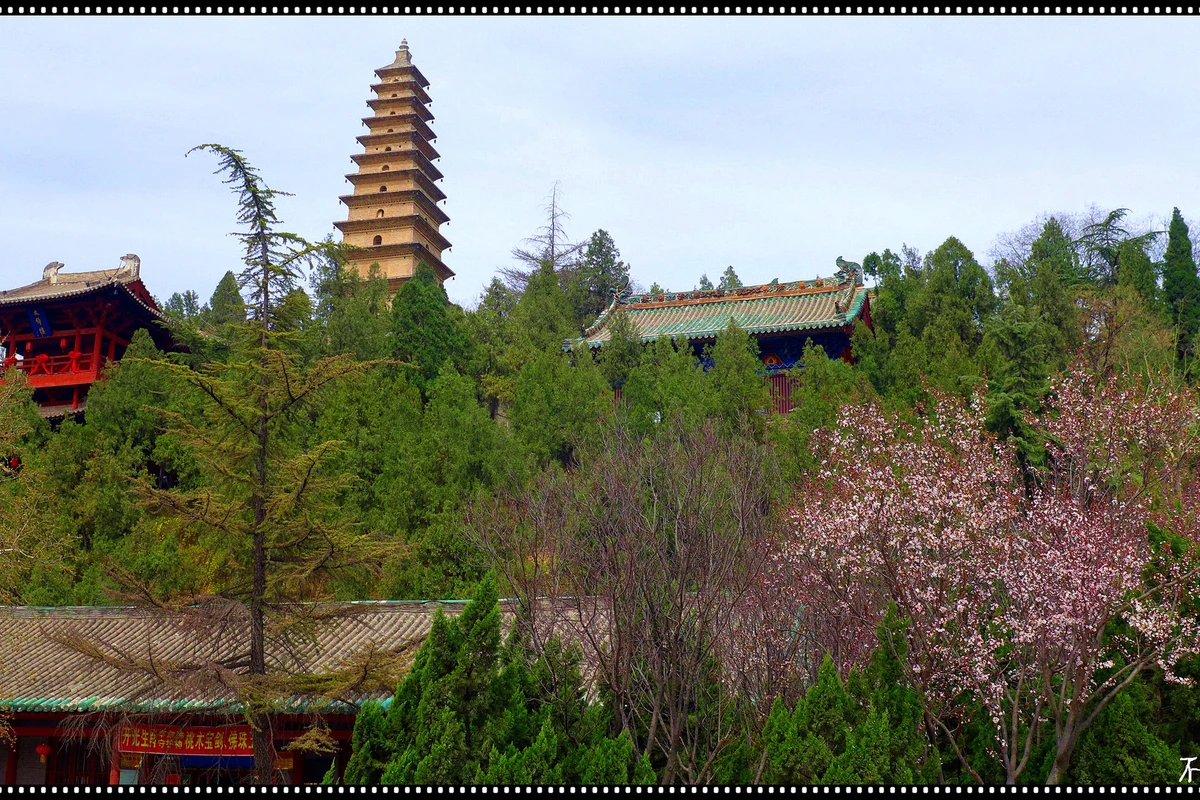
The Sarira Pagoda, also known as 'Yingying Pagoda,' was built in the Tang Dynasty and renovated in the Ming Dynasty. It has a special feature: when struck with a stone, the pagoda emits an echo resembling a frog's croak. Different striking points produce different echo effects, a rare phenomenon. There are three other echo-producing buildings in China: the Echo Wall at the Temple of Heaven in Beijing, the Baolun Temple Pagoda in Henan, and the Stone Qin at Dafo Temple in Tongnan County, Sichuan.
Apart from the Sarira Pagoda, the other buildings of Pujiu Temple were reconstructed after the mid-1980s, based on the Tang Dynasty temple layout and the storyline of 'The Story of the West Wing.' Overall, the temple is built on the hillside with varying heights, nestled among green trees, creating a harmonious and picturesque scene of pagodas, halls, towers, and corridors.
Guanque Tower is about 5-6 kilometers from Pujiu Temple, a 10-minute drive.
The entire scenic area is called Guanque Garden. We strolled across a long stone arch bridge to the foot of Guanque Tower.
Guanque Tower, also known as Guanque Tower, got its name from the magpies that nested on it. First built during the Northern Zhou period (about 557-580), it existed for over 700 years through the Sui, Tang, Five Dynasties, Song, and Jin dynasties. During the early Yuan Dynasty, Genghis Khan's iron cavalry invaded the Central Plains, and it was destroyed in the war, leaving only ruins. In the early Ming Dynasty, the ruins still existed, but due to frequent flooding and channel changes of the Yellow River, its location became hard to find. People used the west gate tower of Puzhou as the 'Guanque Tower' (quoted from Baidu).
What truly made Guanque Tower famous was the talent Wang Zhihuan of the Tang Dynasty. He climbed the tower and wrote the timeless masterpiece: 'The sun along the mountain bows; The Yellow River seawards flows. You will enjoy a grander sight; If you climb to a greater height.'
The current Guanque Tower was completed in 2002, built in Tang Dynasty style with reinforced concrete. Although it lacks some ancient charm and weathered texture, it is tall and imposing.
Externally, Guanque Tower appears as four eaves and three stories, but it has six interior levels, standing on a high base with a total height of 73.9 meters. The first floor's theme is the eternal masterpiece and the grand scenes of Puzhou in the Tang Dynasty; the second floor features 'Long-standing Splendor' (Root culture of Chinese ancestors); the third floor 'Ancient Civilization'; the fourth floor 'Loess Charm'; the fifth floor 'Unprecedented Prosperity'; and the sixth floor 'Endless View,' fully displaying the Tang Dynasty atmosphere and Chinese civilization.
Inside, Guanque Tower is more like an exhibition hall, with poetry, murals, musical instruments, and calligraphy, all showcasing the splendid culture of the Chinese nation. The painted decorations of Guanque Tower are a highlight; the Tang-style painting art, once lost in China, was restored after extensive research by experts from the National Cultural Heritage Administration and applied to Guanque Tower, adding a touch of antiquity and elegance to this modern Tang-style building.
On the sixth floor, there is a statue of Wang Zhihuan to commemorate the great poet. In addition to Wang Zhihuan, many ancient scholars left immortal verses about climbing Guanque Tower. Li Yi of Tang wrote: 'West of Guanque Tower, a hundred-foot mast; The river islets and clouds blend into the vast. The Han Dynasty's flutes and drums flow with the water; The Wei Kingdom's mountains and rivers are half under the setting sun...' Chang Dang of Tang wrote: 'Towering above flying birds, High above the mundane world. The sky encloses the plains; The river flows into the broken mountains...' These popular poems, along with the name Guanque Tower, have been passed down through generations, flowing like the endless Yellow River.
Standing on Guanque Tower and looking into the distance, the view is no longer as in ancient times. Fields and farmlands stretch endlessly, and the misty Yellow River flows to the horizon.
Leaving Guanque Tower, on the way to Xi'an, we made a brief stop at the Yellow River bank at Fengling Crossing. This area is at the bend where the Yellow River turns east, at the border of Shanxi, Shaanxi, and Henan provinces. Since ancient times, it has been a strategic point on the Yellow River. A poem goes: 'One river divides north and south; The Central Plains are naturally complete. The cloudy mountains connect to Shanxi soil; The misty trees enter Shaanxi terrain.' From here, we crossed the Yellow River Bridge and entered Shaanxi.