Yuncheng: Where Does 'Thirty Years East of the River, Thirty Years West' Originate?
All photos in the article were taken by the author of 'Black and White Touch' and are copyrighted. Unauthorized use is strictly prohibited.
What are some must-see attractions in Shanxi? Did your ancestors come from the Big Locust Tree?
Besides 'Before the world's worries, worry; after the world's joys, joy,' what else does Yueyang Tower have?
This article shows you all about Yellow Crane Tower: inside and out, past and present.
'The gentle south wind blows, to ease my people's anger; the timely south wind comes, to enrich my people's wealth.'
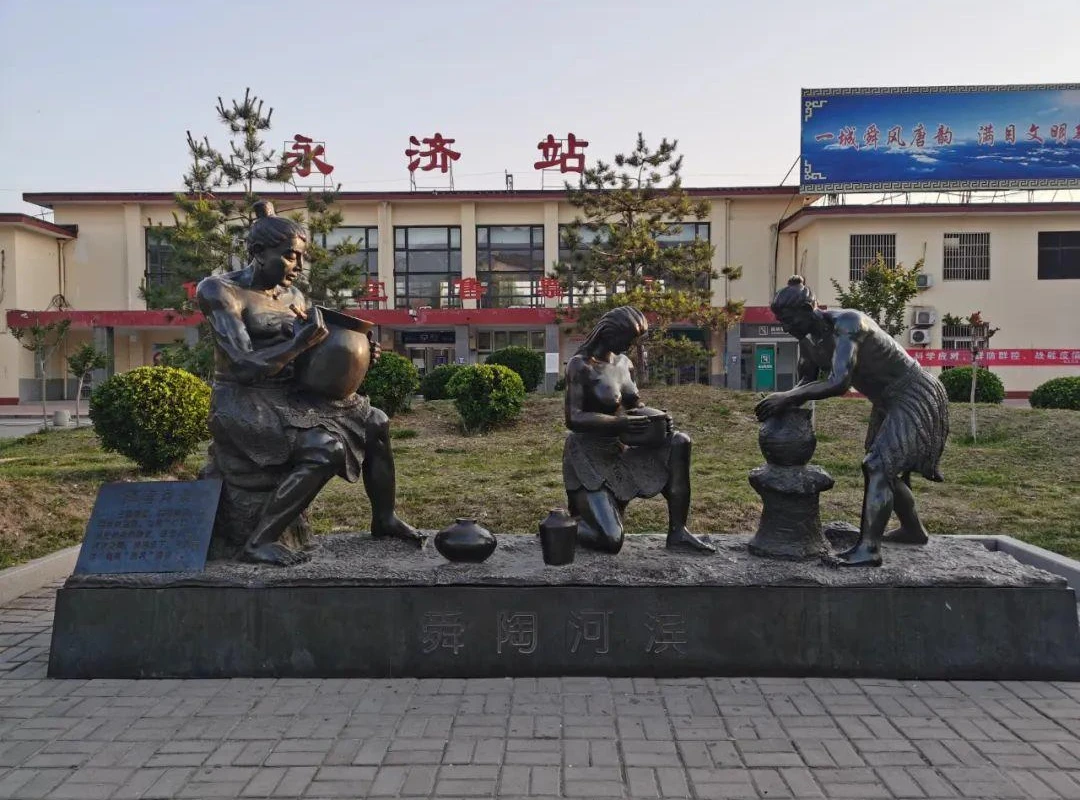
In the 21st century BC, Emperor Shun tilled the land at Lishan, fished in Leize, made pottery by the river, and established his capital at Puban. He showed compassion and benevolence, bringing peace and order to the realm.
(Sculpture of Shun Making Pottery by the River outside Yongji Station: Shun made pottery for three years, producing fine and durable wares. Through his actions, he inspired the makers of inferior pottery to reform, and thus Hebin pottery became famous throughout the world.)
'No army of thousands could withstand him; alone with his blade he slew Yan Liang. Because Yunchang's martial skills were supreme, even fierce generals fell helpless.'
In the 2nd century AD, Guan Yu, a native of Xieliang in Hedong, followed Liu Bei through thick and thin, never abandoning him. He passed five passes and slew six generals, rode alone for a thousand li, besieged Xiangfan, flooded the seven armies, captured Yu Jin, and beheaded Pang De. His loyalty, righteousness, benevolence, and bravery awed the entire land.
(Statue of Guan Gong outside Yuncheng Station)
'The sun beyond the mountains glows; the Yellow River seawards flows. You can enjoy a grander sight; by climbing to a greater height.'
In the early 8th century, the 35-year-old gifted poet of the glorious Tang dynasty, Wang Zhihuan, faced false accusations that stalled his career and blocked his ambitions. He traveled to visit friends and wandered through famous mountains and rivers. Upon ascending Stork Tower, he gazed upon boundless flat fields and the mighty surging river, which stirred his lofty and unrestrained emotions.
(Sculpture of Wang Zhihuan at Stork Tower)
'Waiting for the moon in the western chamber, the door half-open to the wind. Shadows of flowers move on the wall; I suspect my jade-like beauty approaches.'
At the end of the 13th century, Wang Shifu, disgusted by the corruption in officialdom, resigned and channeled his frustrations into playwriting, producing the enduring classic 'The Romance of the Western Chamber'. In the play, Zhang Sheng and Cui Yingying fall in love at first sight at Pujiu Temple. With the help of the maid Hongniang, they break free from feudal constraints and eventually become a couple.
(Sculpture of Yingying Listening to the Qin at Pujiu Temple)
All these historical events and stories took place in the Yuncheng region of southern Shanxi, east of the Yellow River, where Shanxi, Henan, and Shaanxi meet. Shun's capital Puban is the ancient name for Yongji. Stork Tower and Pujiu Temple are both in Yongji. Guan Gong's hometown in Hedong Xieliang is located in present-day Xiezhou Town, Yuncheng.
Today's article will take you on a tour of Hedong Yuncheng.
(Sculpture in Xiezhou Guandi Temple, Yuncheng)
Guan Yu is revered as the 'Martial Sage' through the ages. Temples dedicated to Guan Gong are countless across the country, such as the Guandi Temple in Jingzhou and Guanlin in Luoyang (where his head is buried). Many Buddhist temples have a Jialan Hall, which also enshrines Guan Gong.
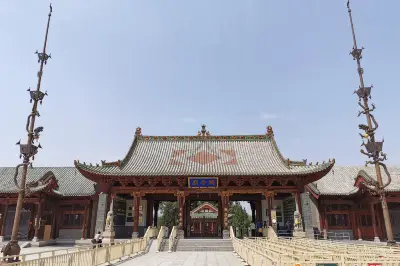
As Guan Gong's hometown, Yuncheng naturally has its own Guandi Temple. Moreover, this temple is the ancestor of all Martial Temples, first built in the ninth year of the Kaihuang reign of the Sui Dynasty (589 AD).
Before entering the Guandi Temple, I should clarify the pronunciation of 'Xiezhou.'
If you look it up in a dictionary, 'Xiezhou' is pronounced 'xiè zhōu,' but online you might find the pronunciation 'hài zhōu.'
Actually, 'hài zhōu' is the local dialect pronunciation. Standard Mandarin does not have the sound 'hài' for 'Xie.' Nevertheless, some experts suggest pronouncing it 'hài zhōu' and propose adding this pronunciation to the dictionary.
Upon entering the main gate of the Guandi Temple, the first thing you see is the Sworn Brotherhood Pavilion.
As the name suggests, the pavilion commemorates the 'Oath of the Peach Garden.' Although the oath is a story from the Romance of the Three Kingdoms, it reflects Guan Gong's loyal and brave heart. Inside the pavilion, there is a stone stele with a line-carved depiction of the peach garden oath.
Behind the Sworn Brotherhood Pavilion is the Gentleman Pavilion, originally built in the first year of the Tianqi reign of the Ming Dynasty (1621). It was originally named Lotus Pavilion because of the lotus pond created when Zhang Tangzun, the governor of Xiezhou, built the Sworn Brotherhood Garden. Later, it was renamed the Gentleman Pavilion.
Behind the Gentleman Pavilion is the Sworn Brotherhood Arch, the gate to the Sworn Brotherhood Garden. Built in the Ming Dynasty, it is imposing, with a plaque reading 'Sworn Brotherhood Garden' inscribed by Yan Rusi, the prefect of Xiezhou during the Qianlong reign of the Qing Dynasty.
Exiting the Sworn Brotherhood Garden to the north from the arch, you reach the main temple of Guandi.
Between the main temple and the Sworn Brotherhood Garden stands a four-dragon screen, a glazed screen wall from the Jiajing reign of the Ming Dynasty, featuring four differently shaped glazed flying dragons. In front of the screen are crossed iron pillars cast during the Yongzheng reign of the Qing, called 'bihu,' commonly known as 'dangzhong,' serving as a marker for civil and military officials to dismount from their sedan chairs and horses here.
The first gate of the main temple is the Duanmen, where civil officials would leave their sedan chairs and military officials would dismount.
The second gate is the Zhimen, commonly called the Main Gate, reserved for the emperor. To the east, the Wenjing Gate is for civil officials, and to the west, the Wuwei Gate is for armored warriors.
The third gate is the Wumen, the southern gate of the imperial palace. Inside the gate hall, there are portraits of Zhou Cang and Liao Hua, as well as colored paintings depicting the main events of Guan Yu's life.
In front of the Wumen, there is a red-faced, long-bearded 'Guan Gong' statue that tourists love to take photos with.
Behind the Wumen is the 'Shan Hai Zhong Ling' Arch. Passing through it, you arrive at the Imperial Book Pavilion.
(Shan Hai Zhong Ling Arch)
The Imperial Book Pavilion was originally named the 'Bagua Pavilion' because its second floor has a wooden floor with a hollow octagonal shape, giving it the name of the Eight Trigrams. In the 27th year of Qianlong (1762), it was renamed to commemorate the Kangxi Emperor's calligraphy plaque 'Yi Bing Qian Kun' (Righteousness Illuminating Heaven and Earth).
Behind the Imperial Book Pavilion is the main hall of the Guandi Temple, the Chongning Hall. It got its name because in the third year of the Chongning reign of the Northern Song (1104), Emperor Huizong conferred upon Guan Yu the title 'Chongning Zhenjun' (True Lord of Exalted Peace).
In front of the hall stand ancient pines and cypresses, complemented by a pair of ornamental stone pillars, two incense burners, and a pair of iron flagpoles. On either side are a bell pavilion and a stele pavilion.
Inside the hall, a wooden shrine houses a seated statue of Guan Yu in imperial attire. Outside the shrine are gold pillars carved with cloud dragons, and above the shrine hangs a horizontal plaque with the Kangxi Emperor's calligraphy 'Yi Bing Qian Kun' (Righteousness Illuminating Heaven and Earth).
In the central bay of the hall hangs the horizontal plaque 'Shen Yong' (Divine Valor) in the calligraphy of the Qianlong Emperor. By the entrance stands a bronze incense altar and a pair of iron cranes:
The bronze altar is covered with knife scars, said to be Guan Gong's whetstone from the past.
On one side of Chongning Hall, a section of ancient sunken wood attracts much attention. This rare timber from ancient times was buried deep in the silt of old riverbeds by sudden natural disasters such as earthquakes, mudslides, and flash floods. Over thousands of years, it transformed into this sunken wood that is neither stone nor wood.
The wood's arduous formation process mirrors Guan Gong's self-discipline, virtue, and talent, by which he cultivated himself into a sage. Thus, the display of this sunken wood symbolizes the immortality of Guan Gong's spirit.
Another wonder in front of Chongning Hall is a giant footprint. Legend has it that one day, Liu Bei and Zhang Fei came to visit Guan Yu. When they were about to leave, Guan Yu rose to see them off. His first step covered three meters, leaving this footprint, and his second step landed on Zhongtiao Mountain, 12 kilometers away.
Continuing forward after exiting Chongning Hall, you reach the Sleeping Palace. The first thing that catches your eye is a towering archway: the 'Qi Su Qian Qiu' (Awe-Inspiring Through the Ages) Arch.
To the east and west of the arch are the Seal Tower and the Blade Tower respectively. The Seal Tower contains a jade model of the 'Han Shouting Marquis' seal, while the Blade Tower displays a model of the Green Dragon Crescent Blade.
Behind the arch is the Spring and Autumn Tower, the crowning masterpiece of the Guandi Temple. It was built between the first and eighteenth years of the Wanli reign (1573–1590). The tower is named after the statue inside of Guan Yu reading the 'Spring and Autumn Annals' at night.
Tradition holds that the Spring and Autumn Tower has three unique features: First, the columns of the upper corridor stand on the hanging lotus columns of the lower floor, which appear suspended in mid-air with internal supports, creating a floating sensation. Second, on the second floor, inside a warm shrine, there is a side-view statue of Guan Yu reading the 'Spring and Autumn Annals' at night, and the entire text of the annals is inscribed in regular script on the walls of the cabinet. Third, it is said that the top of the tower aligns directly with the Big Dipper.
Behind the Guandi Temple is the Guandi Imperial Garden, a northern-style classical garden restored on the site of the original rear garden of the ancestral temple. Inside the garden, halls and pavilions rise majestically, open corridors wind elegantly, hills and waters are clear and bright, flowers and trees vie in splendor, the scenery is magnificent, and the essence nourishes the soul.
At the center of the garden stands a giant 'Fortune and Longevity' tripod, imposing and meaningful, a sight to behold.
On the northeast and southwest sides, water features named 'Blessed Land' and 'Grotto Heaven' exude spiritual resonance and complement each other from afar.
Loyalty and Righteousness Hall, Painted Boat Studio, Moon-Grasping Pavilion, and others are arranged in charming disorder, like a world unto themselves.
Peonies of every color bloom in profusion, a feast for the eyes.
The Yuncheng Salt Pond is China's oldest salt-producing area. Legend has it that as early as the times of Yao and Shun, people were already consuming the natural crystallized salt from this pond. The opening lines 'The gentle south wind blows, to ease my people's anger; the timely south wind comes, to enrich my people's wealth' are from the eternal 'Song of the South Wind,' which Emperor Shun composed on his five-stringed qin when he toured the salt pond and saw the glittering white salt grains covering the surface.
(The back of the 'Salt Pond' stone is inscribed with the 'Song of the South Wind')
Manual salt harvesting began in the Spring and Autumn and Warring States periods. After the Sui and Tang dynasties, the extraction techniques became increasingly sophisticated. Workers would channel brine into pools, and through sun-drying and evaporation, crystalline salt was produced.
(Salt-making scene displayed at Stork Tower)
The Yuncheng Salt Pond is located in the southern part of the Yuncheng Basin, leaning against the Zhongtiao Mountains to the south and lying east of the Yellow River, hence also known as the 'Hedong Salt Pond.' Ancient records say: Hedong pond salt was transported west to Qin and Long, south to Fan and Deng, north to Yan and Dai, and east to Zhou and Song, supplying over twenty prefectures of China.
Today, the salt lake not only provides table salt but has also become a wellness destination. Visitors can soak in health-promoting hot springs and experience salt therapy and mud therapy.
Yuncheng Salt Lake is one of the world's three major sodium sulfate-type inland salt lakes, rich in salt content similar to the Dead Sea in the Middle East. The levels of heavy metals such as lead, mercury, and cadmium are lower than in the Dead Sea, while elements like sodium, calcium, and magnesium are higher. The density of the lake water reaches 1.25–1.29 grams per cubic centimeter, providing buoyancy about 30% greater than freshwater. People can float without sinking, hence Yuncheng Salt Lake is known as 'China's Dead Sea.'
When approaching the salt pond, you might notice an unpleasant smell, but the sunset scenery is beautiful. Many people still gather by the lake to take in the view. When the weather is hot, the salt lake takes on iridescent hues, becoming extraordinarily lovely. A couple of years ago, it even made national news for turning into a 'Rainbow Lake.'
(Image from the internet: Microorganisms living in Yuncheng Salt Lake produce different colors in high temperatures, making the whole lake look like a giant color palette)
The two sites above are both in Yuncheng city proper. About 60 kilometers west of Yuncheng is Yongji, the second stop on a Yuncheng journey, home to the famous Stork Tower, the Yellow River Iron Oxen, and Pujiu Temple.
Stork Tower is one of China's four great cultural towers, the other three being Yueyang Tower in Yueyang, Hunan; Yellow Crane Tower in Wuhan, Hubei; and Prince Teng Pavilion in Nanchang, Jiangxi.
They are called 'cultural towers' because they all stand by water at strategic communication points, initially built for military surveillance. Over time, their military function fell into disuse, and they became places for climbing and enjoying the view. Ancient literati would ascend these towers to gaze afar, taking in the vastness of mountains and rivers, reflecting on the rise and fall of history, and lamenting the vicissitudes of life. Moved by the scenery, their inspiration would surge, producing a succession of masterpieces.
All four cultural towers are renowned because of immortal literary masterpieces.
Fan Zhongyan ascended Yueyang Tower and wrote: 'Be the first to bear the world's worries, and the last to enjoy its pleasures.'
Cui Hao ascended Yellow Crane Tower and wrote: 'The yellow crane once gone won't return again; white clouds drift idly for a thousand years.'
Wang Bo ascended Prince Teng Pavilion and wrote: 'Sunset clouds and lone wild duck fly together; autumn water shares the sky's hue in one color.'
Wang Zhihuan ascended Stork Tower and wrote: 'You can enjoy a grander sight, by climbing to a greater height.'
'Notes on Yueyang Tower,' 'Yellow Crane Tower,' 'Preface to Prince Teng Pavilion,' and 'On the Stork Tower' are all timeless masterpieces. 'Yueyang Tower' and 'Prince Teng Pavilion' are lengthy, flowing, and eloquent, with gorgeous language, balanced parallelism, vivid descriptions, and heartfelt emotions, carrying lofty and profound meanings that are astonishing. 'Yellow Crane Tower' is an octet, natural and grand, ethereal and far-reaching, so much so that even Li Bai admitted it surpassed his own. But among the four, my favorite is 'On the Stork Tower.'
The sun beyond the mountains glows; the Yellow River seawards flows.
You can enjoy a grander sight; by climbing to a greater height.
It's a five-character quatrain, with few words and simple diction. Every schoolchild can recite and understand it, whereas the other three pieces probably only become appreciated in middle school with the help of a dictionary. Words like 'gloomy wind howls, muddy waves surge into the sky,' 'sunless and misty,' 'lush grass grows thick' would mystify elementary students; the loftiness of 'without such men, with whom shall I associate?' and the ethereal quality of 'only the Yellow Crane Tower remains in vain here' would feel intangible to them. But the directness of 'the sun beyond the mountains glows, the Yellow River seawards flows' and the simple truth that 'you have to stand higher to see farther' are things every child can grasp. Because of that, when I was in school, I thought this poem was too easy, like a nursery rhyme. So simple, anyone could have written it—how could it become a timeless classic?
Now, re-reading it, I have a different feeling. With the simplest words, it paints the most common scene: sunset over the mountains, the Yellow River flowing to the sea. With the plainest language, it states the simplest truth: climb higher to see farther. Yet it's precisely this extreme simplicity and plainness that outlines grandeur and depth, broadening one's mind and filling one with aspiration.
If you translate the same meaning into colloquial language (which it practically already is) or use flowery expressions, the artistic conception would vanish. Seemingly simple, these twenty characters are actually extremely concise, each word in perfect parallelism and symmetry, yet without any trace of artifice. This is truly supreme skill resembling clumsiness, great music that is silent, a great form that has no shape—using simplicity to master complexity, moving a thousand pounds with four ounces...
Not everyone can write like this. Take me, for example; I've used all these idioms to describe the poem, appearing fancy but actually verbose and superficial. To express a simple yet profound truth in plain language, while providing beauty, blank space, and reverie—that is the charm of 'On the Stork Tower.'
Because of 'On the Stork Tower,' I came to ascend the Stork Tower.
Stork Tower is located on the east bank of the Yellow River, west of the ancient city of Puzhou in Yongji. It was first built during the Northern Zhou period (557–581). The tower is magnificent, with ingenious structure and beautiful surroundings. During the Tang and Song dynasties, scholars would climb to enjoy the scenery, leaving behind many immortal poems. It was destroyed by war in the early Yuan dynasty.
(Looking down from Stork Tower over a hundred li of fertile fields)
In the early Yuan, Genghis Khan's iron cavalry swept across the Central Plains. The Jin ruler, relying on the natural barriers of mountains and rivers making Puzhou easy to defend, ordered a stubborn defense. Mongol forces successively captured Pingyang, Jiangzhou, and Weinan in Shaanxi, and repeatedly attacked Puzhou. In the first year of the Jin Yuanguang era (1222), during the final battle, the Jin garrison commander Hou Xiaoshu, fearing that Stork Tower might fall into Mongol hands and be used for reconnaissance, ordered it burned. At the same time, he also ordered the destruction of the world-famous Puzhou Grand Floating Bridge. According to records, the scene was tragic, with flames lighting up half the night sky of Puzhou City. Henceforth, Stork Tower was destroyed by war, leaving only ruins.
The Stork Tower we see now is a Tang-style reconstruction completed in 2002, with four eaves and three floors, fully displaying the grace of the great Tang.
On the square below Stork Tower, there is a 'Stork Sound' spot where clapping makes you hear the cry of storks—truly magical.
Inside Stork Tower, exhibits showcase the historical stories that took place here, the famous figures born here, and local folk life. You'll be surprised to learn that it's not just Wang Zhihuan; this small Hedong city has also produced luminaries like Liu Zongyuan and Yang Guifei—truly a land blessed with outstanding people.
(A mural in the first-floor hall, 'Flag Pavilion Wall': the story of Tang poets Wang Zhihuan, Wang Changling, and Gao Shi testing poetic skill)
(Statue of Liu Zongyuan: one of the Eight Masters of the Tang and Song, from Yuxiang in Hedong)
(Sikong Tu: from Yuxiang in Hedong, a Tang poetry critic, author of 'The Twenty-Four Styles of Poetry,' which had a great influence on later poetry creation, criticism, and appreciation)
(Sangluo Wine: Puzhou's Sangluo Wine was first brewed at the end of the Northern Wei, with a history of 1600 years. It was listed as imperial wine in the Song Dynasty and praised by poets through the ages, known as 'Crane Goblet.')
(Musical instruments such as bells, stone chimes, and guqin displayed on the top floor of Stork Tower)
From the top floor of Stork Tower, looking north, you can overlook the Sheng Tang Square below. The lake in front is called 'Stork Shadow Lake,' and to the east and west are sculptures of storks spreading their wings.
Sheng Tang Square is laid out on a symmetrical axis like a chessboard, with lawns in geometric patterns using plants of different colors, and lotus flowers crafted from colored tiles that are pleasing to the eye.
Wang Zhihuan stood right here, gazing into the distance, and composed 'On the Stork Tower.' 'The sun beyond the mountains glows' was what he saw; 'the Yellow River seawards flows' was what he imagined. The mountain near Stork Tower is Zhongtiao Mountain to the east, but if the mountain in the poem is Zhongtiao, it wouldn't be where the sun sets. If it's Mount Hua, 70 kilometers to the southwest, then it truly proves 'you have to stand higher to see farther.' Perhaps even the line 'the sun beyond the mountains glows' was the poet's imagination.
It was cloudy that day, so the Yellow River to the west was faintly visible, but I couldn't see the mountain peaks.
Apart from 'On the Stork Tower,' there is another article in elementary school Chinese textbooks called 'Salvaging the Iron Oxen.' The story, about the Song Dynasty monk Huaibing using buoyancy to retrieve iron oxen from the Yellow River, also takes place in Yongji.
The site of the iron oxen salvage is the Pujin Ferry ruins in Yongji. Pujin Ferry was a very important crossing on the Yellow River in ancient times. As early as the Spring and Autumn period, the first bridge over the Yellow River connecting Qin and Jin was built here—the Pujin Bridge, known as the 'First Bridge Over the Yellow River.' Later dynasties constructed floating bridges here, often using wooden stakes to secure the bridgeheads.
(Replica of Pujin Bridge in the scenic area)
In the early Tang, Puzhou (the ancient name of Yongji) was a link between Chang'an and Hedong (Yuncheng region). In the 12th year of Kaiyuan (724), to ensure the smooth passage of the Qin-Jin route and the supply of salt to Chang'an, Emperor Xuanzong ordered a large-scale renovation of the Pujin Bridge. Wooden stakes were replaced by iron oxen, and bamboo cables were replaced by iron chains, making the bridge much sturdier and more durable. During the Song Dynasty, Pujin Ferry remained an important crossing on the Yellow River. In the transition from Jin to Yuan, the floating bridge was destroyed by war, leaving only the iron oxen on both banks. Later, due to flood storage from the Sanmenxia Reservoir, silt deposition, and the shifting of the Yellow River's course, the oxen were buried in the riverbed. This led to the story of Monk Huaibing salvaging the iron oxen. The saying 'thirty years east of the river, thirty years west of the river,' expressing the fickleness of worldly affairs, also derives from the Yellow River's tendency to change course, with villages sometimes lying east and sometimes west of the river.
In 1989, the Pujin Ferry ruins were excavated, bringing to light four iron oxen, four iron figures, two iron mountains, four iron pier columns, a set of seven star-shaped iron pillars, and Ming Dynasty embankments, all cast during the Kaiyuan era.
(Ming Dynasty embankment)
In addition to anchoring the cable bridge, the giant iron oxen also served to suppress the river. The I Ching says: 'The ox represents Kun, Kun is earth, earth triumphs over water.' As the saying goes, 'confront soldiers with generals, stem water with earth.' Placing iron oxen on the riverbank was a deterrent to the flooding Yellow River, symbolizing the conquest of floods for the people's benefit. The seven star pillars are arranged like the Big Dipper, representing heaven. Thus, with heaven and earth both present (the iron oxen as earth), the entire cosmos is encompassed.
The Yellow River Iron Oxen are a treasure in the history of world bridges. Renowned Chinese bridge expert Mao Yisheng once said, 'Among floating bridge ground anchors, the Pujin Bridge iron oxen are the most famous.' These anchors are beautifully shaped, majestic, and powerful. Beside each iron ox stands an iron figure leading it, representing four different ethnic groups, all lifelike, serving as historical testimony to the might of the Tang Dynasty and the wisdom of ancient laborers.
Pujiu Temple was originally a pure Buddhist sanctuary built in the Sui Dynasty, but now it has become a popular 'pilgrimage site for love.' The secular world and the monastic gate were originally polar opposites, yet now they are one, all because of Wang Shifu's Yuan Dynasty zaju play, 'The Romance of the Western Chamber.'
(Amitabha Hall in Pujiu Temple, enshrining Amitabha Buddha)
('May You Be United Forever' and 'Namo Amitabha' at the entrance of Pujiu Temple)
(Behind 'May Lovers Be United in Marriage' stands a pagoda)
Pujiu Temple has stood for a thousand years, enduring many vicissitudes, repeatedly rising and falling. What we see today is a reconstructed building from the 1980s, with towering halls, sprawling scale, and impressive grandeur.
The temple houses a great bell tower, pagoda courtyard, Grand Buddha Hall, Heavenly King Hall, Arhat Hall, and other Buddhist sanctuaries. Nearly every hall witnessed a scene from 'The Western Chamber.' Moreover, the temple has constructed some classic settings from the play, such as Zhang Sheng's West Study, Pear Blossom Deep Courtyard, and the Study Courtyard. Even the most magnificent pagoda is called 'Yingying Pagoda.' In this bustling secular world, can Buddhist disciples still peacefully chant sutras?
Why does 'The Romance of the Western Chamber' have such power to turn a Buddhist sanctuary into a lover's paradise?
'The Romance of the Western Chamber' tells the story of scholar Zhang Junrui from Luoyang and Miss Cui Yingying, the daughter of a minister, who meet by chance at Pujiu Temple and fall in love at first sight. With the help of the maid Hongniang, they dare to break free from feudal constraints and secretly unite, fighting for freedom in marriage. It expresses dissatisfaction with and rebellion against the feudal marriage system, as well as yearning and pursuit of true love.
If 'On the Stork Tower' is a pinnacle of Tang poetry, then 'The Romance of the Western Chamber' is a masterpiece of Yuan opera. It boasts brilliant literary talent, vivid characterization, a complete storyline, and a grand structure—rare among Yuan zaju. More importantly, the play conveys an ideal of love that transcends fame and fortune, deeply inspiring countless young men and women to bravely pursue love for centuries.
Let's take a look at those story settings in the temple.
The Great Bell Tower: the second courtyard building of Pujiu Temple. In 'The Western Chamber' (the Jin Dynasty version by Dong Jieyuan), during the 'White Horse Rescue' episode, Zhang Sheng, Madam Cui, and Abbot Faben ascended the tower to observe the battle array right here.
Pagoda Courtyard Corridor: the third building along the central axis. When Zhang Sheng toured the temple in the play, he 'climbed the precious pagoda and circled every corridor'—this is that courtyard.
Yingying Pagoda: originally named the 'Sarira Pagoda,' it is a worship structure in the temple. Because the love story of Zhang Sheng and Yingying took place beneath it, it's commonly called 'Yingying Pagoda.'
Yingying Pagoda has a magical echo effect: striking a stone west of the pagoda produces a 'croak, croak' like a frog's call. Because of this, it is known as one of China's four famous echo structures, alongside the Echo Wall of Beijing's Temple of Heaven, the Baolun Temple Pagoda in Henan, and the Stone Qin of the Giant Buddha Temple in Tongnan, Sichuan. It also shares fame with the Shaking Head Pagoda in Shan State, Myanmar, the Musical Tower in Szolnok, Hungary, and the Leaning Tower of Pisa in Italy, being called one of the world's six great pagodas by scholars.
I tried striking the stone at the foot of the western steps and indeed heard the frog sound—amazing!
Behind Yingying Pagoda is the Grand Buddha Hall, which houses rare stone-carved Buddha statues from the late Southern and Northern Dynasties. In the play, 'Zhang Junrui Disrupts the Rites' takes place here.
Arhat Hall: This is where Zhang Sheng counts arhats while touring the temple in the play.
Pear Blossom Deep Courtyard: The living quarters of Madam Cui, Yingying, and Hongniang at Pujiu Temple in the play. Episodes like 'Astonished by Her Beauty,' 'Reneging on the Engagement,' 'The Invitation Feast,' 'Jumping Over the Wall,' and 'Interrogating Hongniang' all take place here.
West Chamber: The dwelling of Yingying and Hongniang, from which the play gets its name. In the opening poem 'On a Moonlit Night of the Fifth Day,' the line 'the door half-open to the wind' refers to the West Chamber door.
(Yingying's boudoir)
East Chamber: The room of Yingying's younger brother, Huanlang.
Interrogating Hongniang: Hongniang takes Yingying to Zhang Sheng's study for a secret rendezvous. When Madam Cui discovers it, she calls Hongniang for interrogation, blaming her for tarnishing the family's reputation. Hongniang argues back, saying that the whole affair was caused by Madam's broken promise of marriage. In the end, Madam Cui has no choice but to consent to the marriage.
Rear Garden: The place where Yingying burns incense and prays to the moon every night. 'Boundless sorrow in my heart, all poured into these two deep prostrations.' Here, Zhang Sheng and Yingying exchanged poems over the wall on moonlit nights.
Every year on Qixi (Chinese Valentine's Day), Pujiu Temple holds a Love Culture Festival. Truly, 'All the world's temples shun romance, except Shanxi's Pujiu Temple.'
Leaving Pujiu Temple, the Yuncheng journey comes to an end.
Tour Hedong, Guan Gong's hometown; amid the secular and sacred, hear the frog's croak; the Yellow River Iron Oxen and salt pond's glory; on Stork Tower, recite the poem once more.
Does such a Yuncheng spark your desire to visit?