From the Ancient Architecture of Shanxi to the Cliff Canyons of Southern Taihang: A 10-Day Self-Drive Tour of Shanxi and Henan During the National Day Holiday
In the blink of an eye, three-quarters of the magical 2020 has passed, and the long-awaited National Day holiday is upon us. Of course, while most parts of our country are safe, the pandemic situation abroad is not optimistic, so overseas travel is probably out of the question for another year or two. This year, the National Day holiday combined with the Mid-Autumn Festival gives us an eight-day break. With these eight days, planning a medium-to-long-distance trip within China should be a good choice. A good friend planned to take advantage of the holiday and the toll-free expressway policy for a self-drive trip to Shanxi and Henan. Over twenty years ago, I visited places like Datong, Mount Heng, the Hanging Temple, Taiyuan, and the ancient city of Pingyao during multiple business trips to Beijing. As for setting foot in Henan, it was even earlier, not long after I started working, when I enjoyed company tourism welfare and visited the Longmen Grottoes in Luoyang and the Shaolin Temple on Mount Song. Time flies—over twenty years have passed, and these places must have changed greatly. They say: Forty years look to Shenzhen, one hundred years to Shanghai, one thousand years to Beijing, two thousand years to Henan, three thousand years to Shandong, four thousand years to Shaanxi, and five thousand years to Shanxi. Indeed, tracing the five-thousand-year civilization of China, if Shanxi claims second place, no one dares claim first. Shanxi is one of the cradles of Chinese culture, rich in cultural and historical heritage. Beyond the places I've been—Datong (home to the Yungang Grottoes), Hunyuan (with the Hanging Temple on Mount Heng), Taiyuan (the capital of Shanxi, with Jinci Temple), and Pingyao (a representative of Shanxi merchant culture)—Shanxi, a province dotted with ancient sites and cultural landscapes, still has many I haven't visited: Mount Wutai, one of the four famous Buddhist mountains; Yingxian County (with the oldest and tallest wooden pagoda in the country); the Wang Family Compound in Jinzhong, which stands out in residential architecture; and the magnificent Hukou Waterfall on the Yellow River at the border of Shanxi and Shaanxi, to name a few. Meanwhile, Henan in the Central Plains, though not comparable to Shanxi in historical culture, is after all the ancestral homeland of many Chinese people. From the division of Jin by Han, Zhao, and Wei around 300 BC, China's political and military center shifted to Henan, which had a more advantageous geographical location. Countless dynasties established their capitals here, humanity multiplied here, and dynasties rose and fell here. Remembering our origins leads us to the path home. Henan's history is no empty boast. And then there's the Taihang Mountains, straddling the borders of Shanxi, Henan, and Hebei. This mountain range, stretching northeast to southwest for over 400 kilometers, has withstood hundreds of millions of years of weathering, majestic and magnificent. As the saying goes, 'The eight-hundred-li Taihang stretches across the land, and five thousand years of civilization bring natural treasures.' It has created numerous scenic spots in China. While other famous mountains have one scenic spot per mountain, the Taihang has at least a dozen scenic areas, and even the roadside offers beautiful views. Moreover, deep in the Taihang in October, the stunning, intoxicating autumn colors can be found—the mountains are awash with vibrant hues, the forests are tinged in a riot of colors, and a kaleidoscope of shades spreads across the hills. So when my friend proposed this plan, I was very interested. However, since he planned a self-drive trip taking about twenty days, and would only be skimming the surface of Shanxi and Henan, my wife and I didn't have that much time but really wanted to join. After considering and planning, we decided to switch our approach. Because we had business at home on October 1st and 2nd, we could only leave on the 3rd. We first took a high-speed train to Shijiazhuang, Hebei, to meet our friends who had driven out on October 1st, and then started the Shanxi-Henan self-drive tour together. Upon reaching Henan, we adjusted according to our own schedule: on October 12th, we flew back to Shanghai from Zhengzhou, while letting our friends continue their Henan self-drive and return journey.
October 3rd: Shanghai – Jinan West (G14 high-speed train) – Shijiazhuang (D1632 train). Overnight at Swan Lake Hotel, Shijiazhuang.
October 4th: Shijiazhuang – Hanging Temple, Hunyuan (306 km, about 4.5 hours' drive). Hanging Temple, Hunyuan – Yingxian Wooden Pagoda (57 km, about 1 hour). Yingxian Wooden Pagoda – Datong Guanghua Shengshi Business Hotel (81 km, about 1.5 hours).
October 5th: Datong Guanghua Shengshi Business Hotel – Yungang Grottoes (20 km, about 0.5 hours). Yungang Grottoes – South Gate of Mount Wutai Scenic Area (240 km, about 4 hours). South Gate of Mount Wutai – Zhizhe Yuanju Inn, Taihuai Town (26 km, about 45 minutes).
October 6th: Zhizhe Yuanju Inn, Taihuai Town – Atour Hotel (Liuxiang Branch), Taiyuan (210 km, about 3.5 hours).
October 7th: Atour Hotel, Taiyuan – Jinci Park (25 km, about 40 minutes). Jinci Park – Wang Family Compound, Lingshi (127 km, about 1 hour 40 minutes). Wang Family Compound – West Gate Parking Lot of Pingyao Ancient City, check-in at Huazhu Xinglongyi Inn (53 km, about 1 hour).
October 8th: West Gate Parking Lot of Pingyao – Hukou Waterfall on the Yellow River (285 km, about 4 hours). Hukou Waterfall – Jiyuan Business Hotel, Jishan (115 km, about 1 hour 45 minutes).
October 9th: Jiyuan Business Hotel – Yunqiu Mountain Scenic Area, Xiangning (18 km, about 30 minutes). Yunqiu Mountain – Shuiyunjian Villa, Wanxian Mountain, Henan (312 km, about 5 hours).
October 10th: Shuiyunjian Villa – Guoliang Village (4.4 km, about 15 minutes). Guoliang Village – Huazhu Rural Guesthouse, Yuntai Mountain Scenic Area, Jiaozuo (95 km, about 2.5 hours).
October 11th: Huazhu Rural Guesthouse – Hongshi Gorge, Yuntai Mountain (2.3 km, about 10 minutes). Huazhu Guesthouse – Zhengzhou Museum (105 km, about 1.5 hours). Zhengzhou Museum – Huazhu Tiancheng Hotel (40 km, about 45 minutes).
October 12th: Zhengzhou – Shanghai (flight FM9346).
On October 3rd, we chose to take high-speed trains to Shijiazhuang mainly based on the approximate arrival time of our friends who had driven out on October 1st. Also, Shijiazhuang is not a hot tourist city, so holiday flights and train tickets are easy to buy, and dining and accommodation prices won't skyrocket during the holiday. High-speed trains were our first choice for comfort and price advantage over flights during the holiday. When choosing train connections, we found that transferring via Jinan West from Shanghai to Shijiazhuang was actually better in terms of departure times, travel duration, and cost than the direct train. In the end, we took the Shanghai–Jinan West high-speed train, then after about an hour transferred to the Jinan West–Shijiazhuang bullet train. The total travel time, including the transfer wait, was about 6 hours, similar to the direct train, but the departure and arrival times were more convenient for the transfer. The Swan Lake Hotel in Shijiazhuang, where we stayed, is near Shijiazhuang Railway Station, chosen for easy access after our evening arrival. This hotel also operates a very large and luxurious bathhouse, so its decor is quite opulent. The rooms are huge, making it one of the largest and most comfortable hotels on our entire trip. Shijiazhuang itself isn't a hot tourist city; its surroundings include the ancient city of Zhengding and Cangyan Mountain in Jingxing County, about 50 km southwest. Over twenty years ago, I visited Cangyan Mountain, which boasts the unique 'Bridge-Tower Hall'—a bridge perched between towering cliffs, with the sky visible above and a deep abyss below, similar in style to the Zhaozhou Bridge. A tower is built on the bridge, and within the tower is a hall housing three large Buddha statues. It's truly a scene where 'a thousand-zhang rainbow bridge barely visible, sky light and clouds flying together with the tower,' a paradise rivaling fairyland. It is now one of the three great Hanging Temples in China. I have a deep impression of Cangyan Mountain, but this time we were only passing through Shijiazhuang, so there was no time to revisit. I strongly recommended it to my friend, and later, after arriving in Shijiazhuang on the afternoon of October 3rd, he skipped Zhengding Ancient City and went to Cangyan Mountain instead. After visiting, he agreed it was worth the trip.
On October 4th, we left Shijiazhuang for Shanxi, officially starting our Shanxi self-drive tour. That day we planned to stay overnight in Datong, northern Shanxi. On the way via Hunyuan, we first visited the Hanging Temple on Mount Heng. The drive from Shijiazhuang to the Hanging Temple took about four and a half hours. We left Shijiazhuang at 8:30 a.m. and arrived near the Hanging Temple by 1 p.m. Since August 1st this year, Shanxi Province has offered free entry to scenic spots until December 31st, but only on workdays; weekends and holidays are not free. So we booked the 15-yuan first-entry ticket for the Hanging Temple. If you want to climb it, there's an additional 100-yuan climbing fee, which is not free on any day. Compared to my visit over twenty years ago, the surrounding environment has improved a bit, but the management is still lacking. There is a large parking lot near the temple gate, but for some reason, officials blocked the road several kilometers away, preventing self-drive cars from entering. Walking in would take a long time, so we had to park in a makeshift private lot by the roadside and take an unlicensed taxi to the temple, wasting time and posing safety risks. Because of the holiday, many tourists were queuing to climb the temple. Access is restricted to protect the structure, with only 80 visitors allowed in at a time. Looking at the crowd, we'd have to wait two to three hours to climb. We didn't have the patience, so we saved the 100 yuan, viewed the exterior, and quickly left. It was only 3 p.m. after leaving. Nearby, there are cars to the Mount Heng scenic area. Since I had been there and knew that Mount Heng, though one of the Five Great Mountains, lacks distinctive cultural or natural scenery compared to the others, we decided to skip it. Instead, we went to Yingxian, over 50 km from Hunyuan, to see the wooden pagoda. For lovers of ancient architecture, the Yingxian Wooden Pagoda is definitely worth a visit.
As for accommodation in Datong, it was somewhat baffling. Although the Yungang Grottoes are famous, Datong shouldn't be considered a super-hot tourist city. Yet during the National Day holiday, hotels near the ancient city cost seven to eight hundred yuan, which wasn't surprising. We ended up in a very basic business hotel not far from the train station, in a cramped spot, at nearly 400 yuan a night—likely more than double the usual price. Very poor value.
During the National Day holiday, the Yungang Grottoes saw huge crowds, and the parking lot was vast. Walking from the farthest parking spot to the entrance took about ten minutes, and the distance from the entrance to the grottoes themselves was also substantial. I recommend taking the shuttle bus: 10 yuan one way, 15 yuan round trip. The return boarding point is at the Yungang Grottoes Museum.
After visiting the Yungang Grottoes in Datong, we headed to Mount Wutai. Mount Wutai is a world-renowned Buddhist mountain with a long history of temple construction and a large complex of temples. It tops the four great Buddhist mountains of China and is known as 'Golden Wutai.' It's a spiritual center for Buddhist followers, but as non-followers, we came as tourists to see the natural scenery, experience the atmosphere of a Buddhist holy land, and just check it off our list. During the holiday, the core area of Taihuai Town was packed with visitors, and self-drive cars clogged the roads, making walking the main mode of transport; private cars became a hindrance. Due to the large number of tourists, accommodation in the modest-sized Taihuai Town was tight and prices soared. On October 5th, we stayed at Zhizhe Yuanju Inn, located a bit north of Taihuai Town. The owner, a local, had converted his own home into the inn and wasn't greedy. Compared to other guesthouses charging a thousand or eight hundred, his prices were very fair, and he was honest. We wanted to try a northern heated brick bed (kang). The bed was huge but a bit hard—clearly not as comfortable for us southerners used to soft mattresses.
In Taiyuan, there were more accommodation choices, and hotel prices during the holiday were fairly stable. On October 6th, we checked into the Atour Hotel (Liuxiang Branch). As a chain brand, it excelled in comfort and its own value philosophy. Taiyuan itself is not a hot tourist city; it's more of a transit hub. But as the provincial capital, it's the premier place to taste authentic Shanxi cuisine. Among northern cuisines, many Shanxi dishes suit southern palates well.
Jinci Temple is the one place you cannot miss when in Taiyuan. The Jinci complex includes the free Jinci Park, so it's large. Before visiting, one should do some research to not miss the 'Three Treasures' and 'Three Wonders' of Jinci; otherwise, the trip would be in vain. The Wang Family Compound in Lingshi, Jinzhong, and the ancient city of Pingyao are important cradles of Jin culture and the cradle of Shanxi merchant culture. After seeing the Wang Family Compound and visiting Pingyao Ancient City, it's clear that today's Shanxi coal bosses are mere floating clouds. On October 7th, we stayed at a Huazhu-branded guesthouse inside Pingyao Ancient City, the Huazhu Xinglongyi Inn. It's converted from a historic old building, right next to the famous Rishengchang Draft Bank. So its architectural layout is similar to some paid historic residences in the city, offering great viewing value. Coupled with Huazhu's design style, the value for money was superb. Later, in Yuntai Mountain and Zhengzhou, whenever a Huazhu guesthouse was available in our chosen area, it became our top choice.
Pingyao Ancient City is often called the 'Northern Lijiang,' but it felt much cleaner and more orderly than Lijiang despite also being crowded. If you can get up early in the morning, the streets of Pingyao at dawn reveal the true appearance of an ancient city—definitely a great place to slow down and relax.
After feasting our eyes on Shanxi's ancient architecture and residences, we drove nearly 300 kilometers to Hukou Town on the border of Shanxi and Shaanxi to see China's second-largest waterfall, Hukou Waterfall. Standing before it, we fully experienced the mighty roar of the wind and the Yellow River's surging power, as if it were roaring. However, this year, due to high water levels in the Yellow River basin, the increased flow actually made the waterfall's drop appear smaller, and many areas prone to danger from flooding were closed off. As for which side offers a better view—Shanxi or Shaanxi—each likely has its own charm.
To save time, we didn't linger long at Hukou Waterfall. After viewing it, we rushed to the Yunqiu Mountain Scenic Area, over a hundred kilometers away at the junction of Shanxi, Shaanxi, and Henan. Because it was getting dark, we temporarily checked into Jishan County, the closest town to the scenic area. Since it's remote and not a tourist hotspot, accommodation options were limited. On October 8th, we chose the Jishan Juyuan Business Hotel near the expressway exit. As a newly opened hotel, it had good facilities, and there were a few restaurants nearby, making dining convenient.
Yunqiu Mountain Scenic Area in Xiangning, Shanxi, is a lesser-known spot. We came here partly because it was on our return route to Henan after the waterfall, but mainly because a hardcore backpacker friend of my companion had been there recently. In Yunqiu Mountain, there's an ice cave cluster discovered and opened to the public only in the second half of 2019. Many people know about the ten-thousand-year ice cave in Ningwu, Shanxi, but the ice caves in Xiangning are a recently discovered group, much larger in scale. Due to its remote location and recent opening, few knew about it, and currently few tourists visit. Perhaps we were just ignorant, but it was the first time we'd seen such a bizarre landscape. Its peculiarity lies in the fact that, given the climate outside the cave, ice shouldn't form at all. Yet inside, ice never melts year-round; the deeper you go, the thicker the ice. Typically, ice caves are found only in extremely high latitudes or exceedingly cold places like the North and South Poles, Siberia, or certain snowy mountains, and they are few and small. But in the distinctly four-seasoned Shanxi, how can there be such a permanently frozen cave? It's inexplicable. I've seen ice caves formed by natural meltwater under Iceland's glaciers, but the Yunqiu Mountain ice cave cluster is even more peculiar and beautiful. The stunning ice caves make for spectacular photos with every snap. Moreover, the autumn scenery of Yunqiu Mountain itself is quite nice. It's well worth a visit.
On the return trip to Henan, our sightseeing was more spontaneous. My companion wanted to see the famous Guoliang Cliffside Road in the Taihang Mountains. The Guoliang Cliffside Road is within the Wanxian Mountain Scenic Area in Huixian County, Xinxiang, Henan. From Yunqiu Mountain in Shanxi, it's over 300 kilometers, taking more than five hours. We left Yunqiu Mountain after 3 p.m., originally planning to stay in Lingchuan County, Shanxi, before dark and head to Wanxian Mountain the next morning. Coincidentally, my companion's friend, who was also on a self-drive tour in Henan these days, had just stayed overnight in Wanxian Mountain. He suggested we drive directly there that evening and stay inside the scenic area. This way, the next morning before 8 a.m., we could drive through the Guoliang Cliffside Road into Guoliang Village. Otherwise, after 8 a.m., we'd have to take the scenic shuttle bus to the cliffside road entrance and walk into the village, which would be inconvenient and time-consuming. Taking his advice, we headed straight for Wanxian Mountain. After exiting the expressway at Lingchuan, we began driving on provincial roads through the Taihang Mountains, which gradually narrowed into county roads. The next day we learned that one section was the famous Kunshan Cliffside Road. Unfortunately, it was already dark, and we were so focused on the road that we couldn't see any scenery and missed this beautiful stretch.
Upon arriving at Wanxian Mountain, we first bought entrance tickets. Since my friend had booked our inn and pre-registered our license plate, our car could enter the scenic area. Surprisingly, Wanxian Mountain offered free first-entry tickets to residents of six cities, including Shanghai. So we only had to pay 45 yuan each for the compulsory transport ticket, even for self-drivers. Our inn, Shuiyunjian Villa, was near the entrance, a relatively large establishment run by local siblings. The rooms were good, and their farm-style cooking was delicious. After nearly six hours on the road, we were tired and hungry—anything would have tasted good.
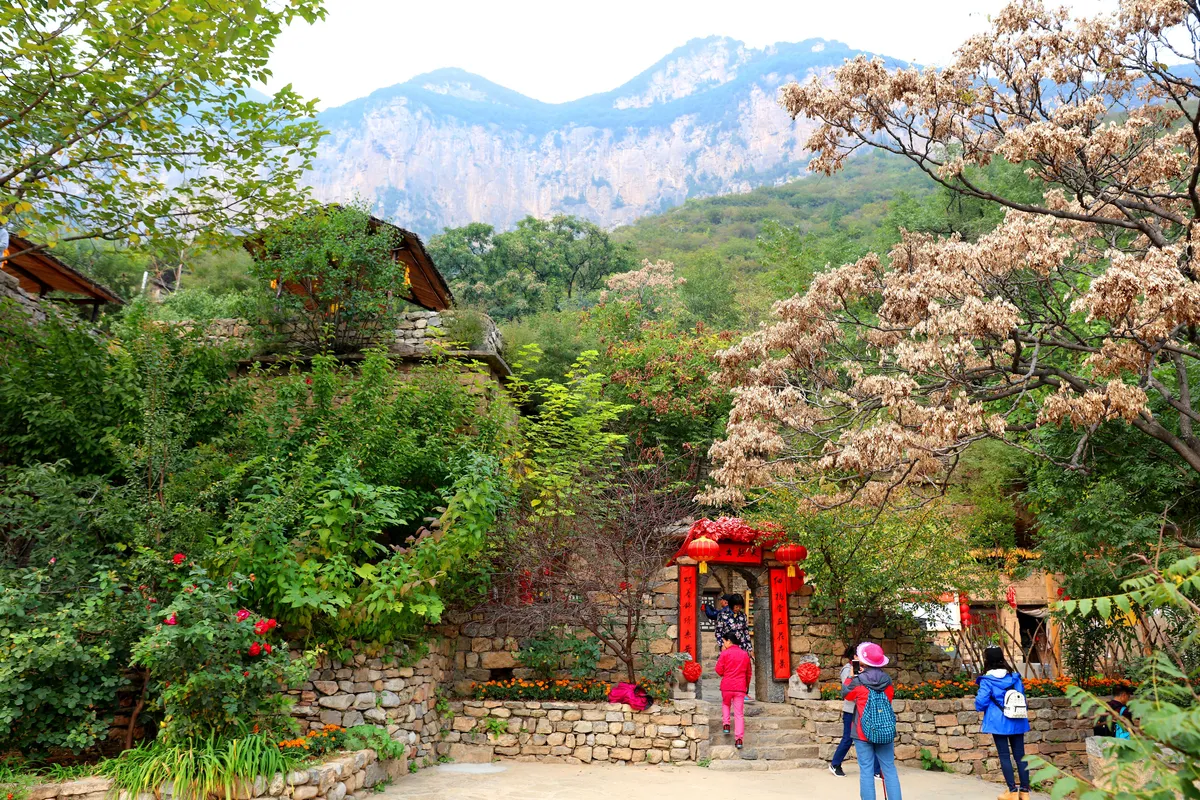
The visitor center of Wanxian Mountain is in Nanping Village. The entire scenic area comprises Guoliang Village, the Guoliang Cliffside Road, Nanping, and Luojiazhai, among others. The highlight is the Guoliang Cliffside Road, a 1,250-meter corridor carved entirely by hand over five years. Because the road is narrow and precipitous, outside vehicles are prohibited after 8 a.m. daily. We drove through it just before 8 a.m. into Guoliang Village. Seeing this daunting, deep-set road, I marveled at the courage of the excavators. Guoliang Village is small; thanks to the road, it's now connected to the outside world and has become a filming and sketching base. Villagers have lifted themselves out of poverty through tourism. Today, the cliffside road isn't the only access; another road has been built to the village, but it's one-way—exit only. The best spot to view the cliffside road is from the side of that exit road. After leaving Guoliang Village, we roamed the ridges, ravines, and winding mountain roads of Wanxian Mountain at leisure. The autumn colors there were actually quite nice, though we were about a week too early for peak foliage.
After touring Wanxian Mountain, considering our booked flight back from Zhengzhou on October 12th, we decided to visit the Yuntai Mountain Scenic Area in Jiaozuo, also in the Taihang range, known for its mountainous waterscapes. From Wanxian Mountain to Yuntai Mountain, about 100 km, a two-hour drive. Yuntai Mountain is large; we planned to see the core Hongshi Gorge area, so we chose to stay in the nearby Anshang Town. This time we picked Huazhu Rural Guesthouse, a villa-style building with few rooms, away from the main road, quiet, and close to a dining street, the visitor center, and the shuttle bus station.
October 11th was the last day of our Shanxi-Henan trip. In the morning, we toured Hongshi Gorge. Like Wanxian Mountain, Yuntai Mountain offered free entry to Shanghai ID holders, but the 65-yuan transport fee was not waived, and self-drive cars couldn't enter. The scenic area is large with many spots, highlighted by canyon clusters and dynamic waterfalls, springs, streams, and pools creating a mountainous waterscape wonder. Hongshi Gorge epitomizes Yuntai's landscape. Indeed, to those who think 'the north offers mountains, the south offers water,' Hongshi Gorge's unique emerald waters amidst red cliffs are rare in the north, earning it the nickname 'the Jiuzhaigou of Henan.' The gorge is compact, so it gets crowded, but two to three hours are enough to explore it. After Hongshi Gorge, we skipped the other sites and ended our Yuntai Mountain tour around noon. Since our flight was early next morning, for convenience we chose the Huazhu Tiancheng Hotel near Zhengzhou Xinzheng International Airport. This Huazhu was a hotel, not a guesthouse, with stylish, smart decor and spacious, comfortable rooms. From Yuntai Mountain to downtown Zhengzhou, about 100 km, took around an hour and a half. Arriving among the skyscrapers of Zhengzhou, we decided to visit the Zhengzhou Museum since the Henan Museum was closed for renovations. The new museum's architecture is striking, modeled after a Shang dynasty bronze square cauldron unearthed in Zhengzhou, symbolizing 'Triple Vessel Stands in the Central Plains.' As Henan lies at the cradle of Chinese civilization, the museum has a rich collection spanning from prehistoric times to the Tang and Song dynasties, with outstanding Shang and Zhou bronzes and Tang and Song stone carvings renowned in academic circles.
For our last meal in Henan, we definitely chose Henan cuisine. Not far from the hotel, we found a restaurant called Yushenghe. Previously, my impression of Henan food was limited to the abundant Huimian noodles, but this elegantly decorated, orderly establishment completely overturned that notion. Henan cuisine can be so exquisite and thoughtfully prepared.
Zhengzhou Xinzheng International Airport also gave me a new perspective on Henan. I used to know Zhengzhou as a transportation hub in the Central Plains and a populous province, with its railway station ranking among the top in scale and passenger volume. I didn't expect the airport terminal to be so avant-garde and novel in architectural design and decoration. The airport is large and very busy, truly reflecting a region's economic development level.
Shanxi Province offered free first-entry tickets to all scenic spots nationwide on workdays (Monday to Friday) from August 1 to December 31, 2020. Saturdays, Sundays, and holidays were not free. Free tickets required advance reservation, with capacity limits; entry would be denied once the daily limit was reached. Free and paid tickets could be booked through online platforms. Most scenic spots in Shanxi could be reserved via official WeChat accounts like Youxx, xxxx, etc. Yungang Grottoes: reserve via 'Yungang Grottoes Official WeChat'; Hanging Temple: via 'Hengshan Scenic Area' WeChat; Mount Wutai: via 'Mount Wutai Visitor Center' WeChat; Yunqiu Mountain: via 'Yunqiu Mountain Scenic Area' WeChat. Note: Mount Wutai, Hanging Temple, and Yunqiu Mountain only allowed reservations or purchases one day in advance.
Ticket info:
Hanging Temple: entrance 15 yuan, climbing fee 100 yuan (not free even on workdays). Visitors could decide on-site whether to buy the climbing ticket based on crowd size.
Yingxian Wooden Pagoda: 60 yuan.
Yungang Grottoes: 120 yuan, shuttle bus 10 yuan one way, 15 yuan round trip (optional).
Mount Wutai: 135 yuan. Extra incense fees for temples like Wuye Temple, Xiantong Temple, Pusa Ding. Self-drive cars allowed inside.
Jinci Museum: 80 yuan, Jinci Park free year-round (actually a public park outside Jinci).
Wang Family Compound, Lingshi: 60 yuan.
Pingyao Ancient City comprehensive ticket: 125 yuan, valid for 3 days, covers 23 sites. Entry to the city is free.
Hukou Waterfall: 100 yuan, compulsory transport 20 yuan.
Yunqiu Mountain: entrance 80 yuan, compulsory transport 25 yuan. Ice cave ticket 120 yuan (not covered by workday free policy). Cable car to Jade Emperor Peak 70 yuan, electric cart from Ice Cave to Tarpo Ancient Village 10 yuan (optional).
Both Wanxian Mountain and Yuntai Mountain in Henan offered free entry to residents of six provinces/cities, including Shanghai, at the time (2020), even during holidays. The transport fee was not waived. We weren't clear on the exact policy duration; we learned about the free entry only when buying tickets on-site. For Wanxian Mountain, if staying overnight at an inn inside, you must pre-register your license plate through the inn to drive in. Transport tickets still required. Self-drive cars could access Guoliang Cliffside Road before 8 a.m. daily.
Wanxian Mountain: entrance 62 yuan, compulsory transport 45 yuan.
Yuntai Mountain: entrance 135 yuan, compulsory transport 65 yuan.
Zhengzhou Museum: free entry, on-site reservation with ID.
Road conditions in Shanxi and Henan are generally good. Apart from caution needed on the cliffside roads in the Taihang mountains, self-driving isn't particularly difficult. Taiyuan and Zhengzhou have vehicle restriction policies; check before driving in. When navigating from Datong to Mount Wutai, set the destination to the north entrance of the scenic area. There's a mountain road, but it saves over a hundred kilometers compared to the south entrance via full expressway. Yuntai Mountain Scenic Area is large with multiple visitor centers. If focusing on Hongshi Gorge, stay near the Anshang Visitor Center, which is closest to the gorge and has good facilities.
Datong in Shanxi is near the Mongolian Plateau, and Mount Wutai has high elevation, so temperatures at these two places fluctuate greatly; dress warmly. When we visited during the National Day holiday, a cold front brought morning and evening temperatures down to around -6°C in Datong and -3°C on Mount Wutai.
For a province like Shanxi, dotted with ancient sites, a week-long trip is far from enough; you have to be selective. We merely skimmed the surface. In Henan, we only made a few stopovers on our return trip. I've already put a proper exploration of the Central Plains in a suitable season into my self-drive plans.
On October 3rd, we took the G14 high-speed train from Hongqiao Railway Station. Three hours later, we arrived at Jinan West Station. Without exiting, we waited over fifty minutes and transferred to D1632 to Shijiazhuang. A little over two hours later, we arrived at Shijiazhuang Station around 9 p.m. We chose this transfer because there were more options than direct trains, the total time was similar, and the price was the same. The Shanghai Hongqiao–Jinan West G14 was a Fuxing bullet train, China's fastest and best-equipped high-speed train, with a top speed of about 350 km/h. The Jinan West–Shijiazhuang ride was a bullet train at about 200 km/h. Riding these modern trains was so comfortable—watching the scenery, snacking—and Shijiazhuang seemed to arrive quickly.
After exiting the station, we immediately met our companion who had driven and arrived a few hours earlier. Our hotel, Swan Lake Hotel, was only a few minutes' drive from the station. Since we were just transiting, our companion chose it for convenience. Because we arrived after 9 p.m., and though it was a holiday, the night market scene here couldn't compare to southern cities; most shops and restaurants were closed. We hurriedly looked for food near the hotel. Only a hot pot restaurant called Pifu was still open. The taste was decent. We ate and drank our fill past midnight, then rushed back to the hotel to rest, as we had over 300 km to cover the next day. The hotel was quite nice, luxurious-looking with large rooms—great value. At breakfast the next morning, we realized the hotel mainly operates as a big bathhouse, which explained the decor style.
After breakfast, we checked out and began our National Day self-drive. Leaving the orderly, broad streets of Shijiazhuang, we soon hit an uncrowded expressway. Under clear skies with blue sky and white clouds, we arrived in Hunyuan, Shanxi, around noon. Exiting the expressway, a long line of coal trucks stretched for kilometers. My last visit here was over twenty years ago, and the streets seemed little changed—still messy. Following our navigation toward the Hanging Temple, the road was blocked for unknown reasons, and we were forced to detour. After winding through, we found ourselves only a few kilometers away but with no further road. Cars were parked everywhere. A local immediately approached, offering parking for a fee. Walking would take over half an hour, but unlicensed minivans offered rides to the temple gate for 10 yuan each. To save time and energy, we took one. Dodging the barriers, we reached the temple gate in minutes. The large parking lot was nearly empty, which made us wonder why our car wasn't allowed in. The management here is poor.
The midday sun shone into the valley, illuminating the Hanging Temple. It was a holiday, so although the first-entry ticket wasn't free, crowds were pouring in. The square inside was teeming. Seeing this, we held off buying climbing tickets.
The Hanging Temple in Hunyuan is perched on the cliffs of Cuiping Peak, the second main peak of Mount Heng. Known as China's number one aerial pavilion, it was built in 491 AD during the Northern Wei Dynasty. It's a unique temple combining Buddhism, Taoism, and Confucianism, famed for its perilous location, intricate structures, and ever-changing forms. It looks like it could collapse at any moment, yet has stood for 1,500 years—a world wonder.
When I came twenty-plus years ago, there were fewer than thirty visitors in total. Stepping on the creaking floors, I toured the seemingly rickety temple in about ten-plus minutes. The modest halls housed cast bronze, iron, and clay sculptures of high artistic value. With few people, no one rushed you. Today was different. Possibly due to the holiday, tourist troops kept arriving. A long queue formed at the climbing entrance. To protect the temple, access is limited to 80 visitors at a time. Staff warned of a three-hour wait. We decided against it. Standing on the opposite side of the gorge, we admired the temple perched on the western cliffs of Cuiping Peak. From a distance, it looks like 'one court, two buildings.' Two majestic three-story halls with yellow roofs and green eaves face each other in mid-air, connected by winding corridors and plank paths. The whole temple is supported by only a few dozen bowl-thick wooden pillars, tens of meters above ground, using half-embedded beams and rock support. The verandas, railings, and columns form a complete frame structure. It's hard to imagine how they built it back then; ancient wisdom is unparalleled. Facing such uncanny workmanship, we felt it best not to tread on it—just looking up was enough! A cold front brought biting winds into the valley. Chilled, we decided to leave after viewing it from afar.
The incredible Hanging Temple is one of the eighteen sights of Mount Heng. Naturally, visiting Mount Heng, one of the Five Great Mountains, would seem logical. But like me, those who've been there probably wouldn't recommend it. Ranking it among the Five Great Mountains is a bit undeserved. Mount Heng and the Hanging Temple are separate scenic areas, less than 5 km apart. Mount Heng, alongside Mount Tai, Mount Hua, Mount Song, and Mount Heng (South), forms the Five Great Mountains, supposedly second in rank. Scenically, aside from a few temples like Sanyuan Palace and Beiyue Temple, and a reservoir visible in the distance, there's not much distinctive. Seeing it was still early, my companion and I decided to go to the originally unplanned Yingxian Wooden Pagoda. We called the unlicensed driver to take us back to our car. I doubt I'll ever visit the Hanging Temple a third time. I hope it, listed by Time magazine as one of the world's ten most precarious buildings, will stand long.
Yingxian is in Shuozhou, Shanxi. From Hunyuan, it's just over 50 km, all expressway. An hour later, we arrived and saw the tall pagoda peak from afar. Walking toward it along a broad, flower- and tree-lined approach, we felt the surroundings were much better than Hunyuan. The tall red walls around the pagoda had a grandeur reminiscent of Beijing's Forbidden City.
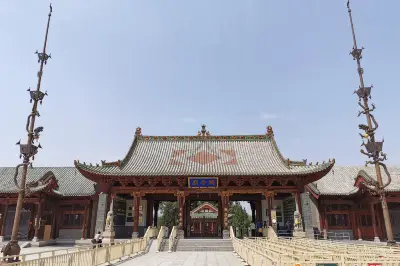
Shanxi is a province of cultural relics, dubbed an ancient architecture museum. It has the most extant ancient buildings in China, with pre-Song Dynasty structures accounting for over 70% of the national total. The Yingxian Wooden Pagoda is one of them. Its full name is the Sakyamuni Pagoda of Fogong Temple. Built in 1056 during the Liao Dynasty, it is the tallest and oldest wooden pagoda in China. Entering the pagoda courtyard with its leafy trees and iron guardian lions, one feels a sense of historical depth. The pagoda stands on a 4-meter-high platform, with the base divided into two levels: the lower square, the upper octagonal. The pagoda has 9 stories, 5 visible levels and 4 hidden ones, appearing as 5 levels and 6 eaves from outside. You can't easily notice its tilt. Its ability to withstand a thousand years of wind and frost lies in its structural design—joined by mortise and tenon, balancing rigidity and flexibility, effectively dissipating energy. In the 1930s, locals mistakenly thought the visible level's original walls were too heavy and replaced them with doors and windows, as seen today. But these doors and windows no longer support the columns, altering the once-integrated column network and planting seeds for future tilting. Thus, though we couldn't see the tilt up close, reports say the maximum inclination has reached 11.3 degrees. To protect the relic, ascending is now prohibited; we could only view it from outside. Walking around, we marveled at this purely wooden treasure. The pagoda and its gatehouse bear over 50 precious inscribed plaques by notable figures through history, including two emperors of the Ming Dynasty, attesting to its historical importance. Looking north from the base, there's the rear courtyard of Fogong Temple, all built in Ming and Qing times. A brick bridge connects the two courtyards, a world of Buddhism. Further north, construction was ongoing for unknown structures—hopefully not damaging the original layout.
Exiting the pagoda courtyard, the street ahead is called 'Liao Dynasty Street,' lined with pseudo-Liao-style ancient buildings with carved beams and painted eaves. Shop signs flutter; businesses thrive. The street is almost entirely food stalls, with many selling cold noodles. Online reviews said 'Er Nü Liangfen' ranked first. Its shop was packed. We retreated and tried a less crowded one. Cold noodles here are made from potato starch, smooth and delicate, with local touches like black dried tofu. Tasty.
From Yingxian to Datong is over 80 km, about an hour and a half drive. We entered Datong as the city lights blazed. Our hotel was near the train station. For some reason, Datong had the priciest hotels on this trip—often over a thousand or five to six hundred yuan. Our business hotel, though near the station, wasn't in a great location, probably normally under 200 yuan. Holiday premium was extreme, nearly 400 yuan, yet it was full, with noisy late-night arrivals. Fortunately, a dining street was nearby, but nothing special. We ate casually with a drink and rested. Over 400 km on the road made us quite tired.
Datong is Shanxi's second-largest city, at the junction of Shanxi, Hebei, and Inner Mongolia, a northern gateway known as the 'Key to the North.' Historically called Yunzhong or Pingcheng, it was the capital of the Northern Wei and a secondary capital for the Liao and Jin. I visited over twenty years ago: dirty streets, severe pollution—my first impression. Apart from the Yungang Grottoes worth seeing, the dilapidated Shanhua and Huayan Temples had few visitors. But in recent years, I heard a mayor named Geng oversaw massive demolition and reconstruction: in 2008, the city walls were restored to Ming specifications, and the Bell Tower, Kuixing Tower, Taiping Tower, and Four Archways were rebuilt. These 'new ancient sites,' along with the Drum Tower, now stand in Datong's ancient city, practically creating a new old town, one of the 'Eight Sights of Datong.'
This morning, the cold front was still strong; temperature dropped to -5°C. We bundled up in thick clothes. After a meager breakfast (barely filling), my companion and I decided to skip the rebuilt ancient city since we'd later visit Pingyao. We also skipped Shanhua and Huayan Temples because Mount Wutai awaited with plenty of temples. Given last night's full hotel, we expected crowds at the grottoes, so we headed straight there—the main reason for coming to Datong.
After checking out, we drove through city streets lined with parked coal and cargo trucks and headed to the Yungang Grottoes. In under half an hour, we exited at the Yungang expressway exit, and traffic began to clog. Slowly following the stream of cars, we finally entered the huge parking lot, packed to the brim. The Yungang Grottoes are the biggest tourist draw in Shanxi. We had to park far away and walk about ten minutes to the entrance. The scene was totally different from my visit twenty years ago.
Speaking of Datong, the first thing that comes to mind is the Yungang Grottoes. As one of China's four great grottoes, they stretch for a kilometer from east to west, with 45 main caves, over 1,100 smaller niches, and more than 51,000 statues—one of the largest grotto clusters, representing the pinnacle of fifth-century world sculpture and a world-renowned art treasure. Being the first large-scale cave group sponsored by royalty, initiated by the imperial family during the Northern Wei, and ending with the capital's move to Luoyang, their magnificence and artistry are apparent.
With tickets pre-booked online, we swiped our IDs to enter. The new Tan Yao Square greets you with a statue of the famous monk Tan Yao of Northern Wei. With Emperor Wencheng's support, he promoted Buddhism through cave excavation, monastic reform, and scripture translation. Caves 16–20, known as the 'Five Caves of Tan Yao,' were also overseen by him. After the square and gate, the Buddhist Procession Avenue boasts thirteen pairs of 'elephant-riding four-sided divine pillars,' with Indian-style six-tusked white elephants and Xianbei-costumed figures, reflecting cultural exchange during the Northern Wei. Beyond the avenue, the newly built Lingyan Temple sits on an island in a lake, a three-courtyard complex based on descriptions by the geographer Li Daoyuan in his 'Commentary on the Water Classic.' With a large lake, boats, and blue sky reflected, the scenery is nice, but these new additions are just preludes. The core lies on the northern cliffs of Wuzhou Mountain, where the caves are carved.
To save time, we bought shuttle tickets and rode directly to the cave cluster. Here was the real theme—crowded as expected. The grottoes are divided into early, middle, and late periods. The middle period represents the zenith, with complex structures, brilliant colors, and rich content, showing prosperity and the sinicization of cave art. We started from Caves 1 through 13, quickly taking them in. The exquisite Maitreya statues, robust Buddhas, finely crafted shrines, and vibrant sculptures, despite weathering and vandalism, deeply impressed us. Skipping unfinished Caves 4, 14, and 15, we reached Caves 16–20, the 'Five Caves of Tan Yao.' Here, Tan Yao incorporated imperial features, exuding majesty. Especially the open-air seated Sakyamuni in Cave 20, 13.7 meters tall, with a full face and broad shoulders, is a monumental masterpiece and a must-photo spot. Officially, photography inside caves is banned, but enforcement is much looser than at Mogao Grottoes, so many capture the exquisite statues in memory and on camera.
In 494, after Emperor Xiaowen moved the capital to Luoyang, large-scale royal excavation ceased, but folk enthusiasm continued for generations. Caves 21–45 to the west of Cave 20 belong to the late period, smaller and less refined due to their folk origins. Our tour ended there. Overall, among China's four great cave complexes, Yungang is smaller in scale and number than Mogao, but excels in carving refinement and grandeur.
From the open-air Buddha of Cave 20, we walked to the Yungang Exhibition Hall on the opposite slope—a semi-underground modern museum with a simple, grand design, boasting a 40-meter arch. The sunken plaza in front, with radiating brick passages, symbolizes Yungang's multicultural art. Exhibits mostly came from post-1949 archaeological digs at the site, plus recovered scattered relics and those returned from abroad.
The exhibition hall is also the shuttle bus terminus. We rode back to the start, since we needed to head to Mount Wutai in the afternoon, over 200 km away. We only glimpsed Lingyan Temple from the lakeside and left. There's a pseudo-ancient commercial street at the exit with various services. Lunchtime came, so we ate there. Datong has many culinary specialties, like hundred-flower shaomai and haggis soup. At a restaurant on the street, we ordered haggis noodles, shaomai, and fried bread—tasted mediocre. Eating at scenic spot gates is never ideal. After lunch, we bid Datong a hasty farewell.
We drove toward the south entrance of Mount Wutai Scenic Area. Before the trip, media reports of holiday crowds and entry restrictions made us worry about tickets. Since the official WeChat account didn't allow advance booking, we nervously booked through a travel agency, with pickup at the south entrance. Thus, we set our navigation there. This ended up adding over a hundred kilometers to our journey, because our inn was north of Taihuai Town, and coming from Datong we should have entered via the north entrance—shorter and less crowded.
At the south entrance, we retrieved tickets and drove in (ticket windows and gates operate 24 hours). Although many cars were arriving and queues long, ticket supply was normal. After driving over ten kilometers inside, we reached the core area near Taihuai Town. It was already dark and traffic clogged; after much maneuvering, we found our inn, Zhizhe Yuanju, in a quiet north spot. The owner, a soft-spoken local, was polite. The inn was newly renovated and clean. We booked a kang room—the bed was huge, enough for three or four. As it was late and the inn didn't serve dinner, he recommended a nearby restaurant, warning us not to order things like wild mushrooms—pricey and not authentic. That boosted our impression. Following his advice, we ate at the recommended Jiaotong Hotel restaurant, ordering home-style dishes including youguo meat (fried shredded pork), a common Shanxi dish resembling Shandong's moo shu pork, with pork loin, bamboo shoots, fungus, scallion, ginger, garlic, and a lard finish—simple yet flavorful, great with rice. Stir-fried kaolaolao, a oat noodle dish with diced beef, mushrooms, and fungus, served as both vegetable and staple, was tasty.
After dinner, on the way back, we noticed a temple with night lighting—Guanghua Temple, the only one on Mount Wutai with night illumination. The cold front had dropped temperatures below zero; we hurried back, unable to bear the biting wind. The owner told us it was Guanghua Temple.
Mount Wutai tops China's four sacred Buddhist mountains, known as 'Golden Wutai,' the bodhimanda of Manjusri. Broadly, 'Mount Wutai' isn't a single mountain but a cluster of peaks on the 'Roof of North China,' covering 2,837 square kilometers, with the highest point at 3,058 meters. Named for the five terrace-like flat-topped peaks: East Wanghai, South Jinxiu, Middle Cuiyan, West Guayue, North Yedou. Narrowly, it refers to the scenic area, centering on Taihuai Town, cradled among the five terraces. Taihuai Town contains over half of Mount Wutai's temples, truly the Buddhist core. Locals call the town area 'inner,' and outside 'outer.' The 135-yuan mountain entry ticket covers the inner area; the outer is free. Outer area attractions appeal to ancient architecture or trekking enthusiasts and devout pilgrims. Trekking or pilgrimage to all five terraces covers 150 km, taking two to three days. Most, like us, are tourists or casual worshippers coming to Taihuai for Buddhist scenery or to pray. Due to its elevation, it's cooler, making it a summer retreat, health, holiday, and sightseeing spot—hence the nickname 'Clear Cool Mountain.' The inn owner said one can cover all five terraces in a day by booking a special minibus (350 yuan per person, private cars prohibited). Not being followers or trekkers, we skipped it and stayed within Taihuai.
After breakfast at the inn, the owner advised us not to drive, as roads were congested and parking difficult. Most temples are within walking distance in Taihuai. He suggested a path starting from behind the inn, climbing Pusa Ding from the back, then working downward.
A dozen minutes later, we reached Pusa Ding, the foremost of Mount Wutai's ten Yellow Sect (Lama) temples, perched on Lingjiu Peak. It offers a grand vantage point: below, Tayuan Temple, its white pagoda, and Wuye Temple spread out; at the foot of the opposite hill, Shancai Cave's pagoda forest lines up; atop, forested Da Luoding. From the highest point, 108 stone steps ascend steeply from a large screen wall—common in Mount Wutai temples, symbolizing 108 afflictions; climbing them means liberation from all sorrows.
Descending slowly from Pusa Ding, we reached Tayuan Temple. Its Heavenly Kings Hall unusually enshrines Empress Dowager Li of Wanli Emperor, not Maitreya; the main gate is perpetually closed, entry via rear. The Great White Pagoda here is Mount Wutai's icon, tall, imposing, graceful—a symbol of the foremost Buddhist mountain. Next to Tayuan is Xiantong Temple, once part of it. After entering, turn left along a 100-meter path to reach the temple. Xiantong Temple features diverse architectural styles, one of the most interesting on Mount Wutai. Buildings of wood, brick, and bronze, eras mixed—some say 'A Buddhist kingdom of temples, a hundred art palaces.' Xiantong is a masterpiece. Aligned north-south, seven halls line the central axis: Guanyin, Manjusri, Mahavira, Wuliang, Qianbo, Bronze, and Sutra Repository. From afar, the bronze hall, bronze pagodas, and white Sutra Hall halfway up the slope stand out. The most precious is Wuliang Hall, resembling a European building from outside, painted white. Inside, three brick cave vaults with arched ceilings connect, using advanced mechanics—a masterpiece of ancient Chinese brick architecture. Behind it, on a tiered platform, is another highlight: the Bronze Hall, cast from 100,000 jin of bronze, square, double-eaved, 5 meters high, with exquisite latticework. Originally five bronze pagodas stood around it, representing the five terraces; only the east and west originals remain, 13 stories, 8 meters tall, covered in Buddha images, with square bases and corner figures. Three later iron replacements were added. All were gilded, shining brilliantly.
Wuye Temple, also called Wanfo Pavilion, in the heart of Taihuai, is the most popular for its supposed efficacy. Crowded with worshippers, it has an open layout—once an imperial palace for Qing emperors. The 'Fifth Lord' inside is actually a manifestation of Manjusri, the Dragon King, and thus the most revered.
Lastly, Shuxiang Temple, founded in the early Eastern Jin (317–420), one of the five great temples. Inside, an 11.6-meter tall wooden Manjusri riding a lion sits on a stone pedestal. The statue is said to be modeled on Emperor Qianlong. Named after Manjusri, its incense rivals Wuye Temple.
Mount Wutai has over 200 temples, but only a fraction are open to tourists, all modest in size and layout. By midday, we decided to stop temple-hopping and strolled back toward our inn through Taihuai's streets. The weather was fine; the red walls and yellow tiles of Pusa Ding stood out against the blue sky, while white pagodas and clusters of temples reflected in the lake.
Back near the inn, we ate at another recommended restaurant, Xianrenju, for a simple lunch. After thanking the owner, we drove away toward our next destination, Taiyuan. By now, Mount Wutai's autumn colors were blooming, the surrounding forests adorned in dazzling hues. We hoped to see more brilliant autumn colors ahead.
Taiyuan, the capital of Shanxi, historically called Jinyang or Dragon City, has over 4,700 years of history and a 2,500-year city-building history. 'Controlled by mountains and rivers, it sits on the shoulder of the world,' a strategic ancient capital. Surrounded by mountains on three sides, the Fen River, the Yellow River's second-largest tributary, flows through. After over three hours, we entered Taiyuan. Over twenty years had passed since my last visit. As the provincial capital, Taiyuan had transformed greatly: high-rises, flower-lined streets, the Fen River meandering, spanned by various bridges. In historically deep Shanxi, apart from suburban Jinci, most of Taiyuan's ancient sites were destroyed in the Liberation War or later torn down. Our purpose in Taiyuan was to taste authentic Shanxi cuisine and enjoy better accommodation. We stayed at the Atour Hotel Liuxiang Branch, a chain with notable comfort and philosophy, at a price comparable to our Datong hotel but incomparably better. After a short rest, we sought food. We found Lao Yuanzi restaurant nearby, highly rated online, specializing in Shanxi cuisine. Among northern cuisines, Shanxi food suits southern tastes well because of vinegar. Their classic sweet-and-sour pork meatballs, with perfectly balanced sugar and vinegar, was my favorite. The ambiance was great, with a singer resembling and sounding like Ping An performing 'People Say Shanxi's Scenery Is Good,' amazing everyone. Sated, we explored Taiyuan's night scene in Mao'er Lane food night market. Every city now promotes night markets, but northern ones often lack the vibrancy, variety, and richness of the south. We wandered, but being full and finding nothing unique, we soon returned to rest.
After hotel breakfast, we checked out. Before leaving, we wanted to try and pack Haoganggang Haggis, a famous Taiyuan snack. This over-a-decade-old shop, known for haggis soup, had many branches. We drove to its Liuxiang shop. Despite the early hour, a long queue had formed, with no parking nearby. We had to give up.
A slight regret over missing haggis, but we wouldn't miss Jinci: 'Without seeing Jinci, a trip to Taiyuan is in vain.' Jinci, originally Tang Shuyu Temple, was built to honor Tang Shuyu, founder of the Jin state, and his mother Yijiang. It's Taiyuan's most representative attraction, but located 25 km southwest at the foot of Xuanweng Mountain. Jinci boasts 'Three Wonders' and 'Three Treasures,' a must-see. Approaching Jinci, the area had transformed since my last visit when I bounced along in a rickety bus through farmlands and messy buildings. Now, wide roads, clean environment, tree-lined.
Buying tickets, we faced a long queue at the entrance. Actually, you first pass through Jinci Park, a free public area, where they check temperature and IDs. The grand gate there also reads 'Jinci,' but the real gate lies deeper within. Inside the park, lawns, pavilions, and water features abounded—all new, none existed two decades ago. The park is large and beautiful, with a southern garden feel. Our main focus was Jinci, so we rushed through toward the real gate. Behind it is what is now officially Jinci Museum. The inner gate, though similar in style, is smaller; its plaque 'Jinci' was inscribed by Marshal Chen Yi. Entering, the first sight is Shuijing Tai, a Ming-Qing building that looks like a temple but is actually a stage. The side facing the entrance is the backstage, with a plaque 'Sanjin Mingquan.' During the holiday, many visitors gathered at the front where a performance about Jinci's history was underway. Leaving the stage, we walked to Duiyue Archway—'dui' meaning to repay, 'yue' to proclaim, i.e., repaying and proclaiming ancestors' virtues, or maybe promoting maternal virtue. Beyond the arch is the Xian Hall, one of Jinci's Three Treasures, a Jin Dynasty structure built entirely with mortise and tenon, no nails. The plaque is original. It was used to display offerings to the Sacred Mother. Behind it, separated by the Yushao Flying Bridge (another Treasure), is the Sacred Mother Hall. The bridge, a cross-shaped stone structure over the Yushao Spring (one of three Jin springs), was recorded by Li Daoyuan in the 6th century. The Sacred Mother Hall, the main hall, was built in 984 during the Northern Song, the most valuable of the Three Treasures. Inside, the vast hall has no pillars—a highlight. The eight front columns feature eight carved wooden dragons. Inside, housed in the hall (now off-limits for preservation) are the 'Three Wonders' prime: 43 Song Dynasty painted sculptures—one Sacred Mother, five eunuchs, four male-attired female officials, and 33 maids, collectively called 'Song Dynasty Maiden Sculptures.' They date from the Northern Song Yuanyou era, over 900 years old. Except two small later Ming additions, all are original. The Sacred Mother, in phoenix crown and ceremonial robe, sits dignifiedly. Crowds blocked the barrier, making close viewing impossible. Outside to the right is another wonder, the Zhou Cypress, over 3,000 years old, a national treasure. Leaning at a 45-degree angle against the hall's roof, it's supported by a younger cypress that grew beneath it. After viewing the cypress, we climbed to the Reading Terrace for a panoramic view of the various halls, pavilions, bridges, and kiosks across the museum—a royal sacrificial garden of immense cultural and scientific value, a precious legacy. On the south side, there's the Shuimu Tower and Nanlao Spring Pavilion, crowded with visitors. The plaque reads 'Jinyang First Spring,' and this Nanlao Spring is the third of Jinci's Three Wonders. It remains the main source of Jin waters, a constant 17°C, flowing from a dragon's mouth into a clear pool divided by a stone weir with ten equal holes, splitting into three streams south and seven north. A story goes: centuries ago, two villages fought over water. The magistrate devised a cruel solution: he placed 9 copper coins in boiling oil; each village sent a person to retrieve coins—the number of coins determined the number of water channels. A 17-year-old from Beicun jumped in, retrieved seven coins, but died from burns. The magistrate awarded seven channels to Beicun. In memory, a small white pagoda was built in the stream, burying the youth's bones beneath. To the left of the spring is Jinci Academy (Wang Ancestral Hall), with the main hall Ziqiao Temple, originally a Ming official's villa. It once housed Wang clan ancestral tablets. Now, there's even a cafe inside—creative.
After about three hours of wandering Jinci Museum, surrounded by ancient trees and genuine antiquities, we realized it was late. We still wanted to see the Wang Family Compound in Lingshi. We hurried out, ate something by the parking lot, and set off.
Leaving Jinci, the scenery shifted from strange mountains to green plains—the Jinzhong Plain. 'People say Shanxi's scenery is good, land fertile, water sweet, grains fragrant' likely refers to here. Jinzhong is a crucial part of Huaxia civilization, a cradle of Jin culture and Shanxi merchant culture. Its most famous spot is Pingyao Ancient City. Twenty years ago, I visited Pingyao and Qiao Family Compound. This time, after discussion, we went to the Wang Family Compound.
Though less famous than Qiao, the Wang Compound is more grandiose—hence 'After Wang, no need to see other compounds.' Its area is four times Qiao's, the largest among Shanxi merchants, 'First Compound of Sanjin.'
Exiting the expressway at Lingshi, a grand archway proclaiming 'Wang Family Compound' greeted us. After a few kilometers, traffic crawled, but we soon parked in a large lot with a distant view of the compound built on a loess slope. The compound, like a fortress perched on the hill, is majestic, surrounded by rolling mountains. Constructed over 300 years through Ming and Qing, with five forts, six alleys, and one street covering 250,000 square meters, it's hailed as 'First Residential Compound of China,' 'Chinese Folk Forbidden City,' or 'Shanxi's Forbidden City.' The Wangs rose from farmers to merchants to officials, their wealth and status built over centuries, declining only in the late Qing. Its 45,000 square meters dwarf Qiao's 4,500; Qiao was a merchant's residence, Wang an official's, so scale and aura are incomparable.
Entering with tickets, we started at the Gaojiaya cluster, built by brothers Wang Rucong and Wang Rucheng from 1796 to 1811, spanning 19,572 square meters with 35 courtyards and 342 rooms. The layout followed feudal hierarchical rules, with the front-hall, rear-chamber courtyard style dating back to Western Zhou. Decorations feature brick, wood, and stone carvings rich in symbolism, displaying deep cultural heritage and the Wang family's governance philosophy. The main courtyards, Dunhou and Ningrui, are three-entry quadrangles, each with an ancestral hall, embroidery towers, kitchens, and schools, plus shared gardens and servant quarters. Encircled by high walls and gates, 65 interconnecting doors link spaces that are both integrated and independent. The exquisite carvings of flowers, birds, landscapes, legends, and opera figures on bricks, stones, and wood embody Qing decorative art, blending Confucianism, Taoism, and Buddhism with folk traditions. The dwellings maintain northern residential style: sturdy, practical, and unpretentious, while the rear courtyard uses cave-dwelling architecture, feeling very grounded.
Crossing a small bridge connecting Gaojiaya and Hongmenbao, we entered the east gate of Hongmenbao, also known as West Compound or Hengzhen Fort, where the clan elders once lived. This is a fortress-like city built against the mountain. From the North Wall, the highest point, the whole compound and Jingsheng Town spread out below: grey houses layered in four symmetrical tiers along a main axis, forming a 'Wang' character and also hinting at a dragon's shape. The 88 courtyards each have unique features. Overlooking, the compound faces water with hills behind, offering distant views. Mianshan Mountain, 8 km away, seems within reach. The fortress has watchtowers at northeast and northwest corners; one can imagine the tight security. We wandered through deep lanes and winding paths like a maze, spending over three hours. The Wang Compound is more than a residence—it's an architectural museum, with ingenious building techniques and decorations, combining northern grandeur with southern elegance, and fusing carvings, paintings, and calligraphy into a brilliant pearl of northern residential architecture. No wonder the saying goes, 'After Wang, no need to see other compounds.' After seeing it, we felt today's Shanxi coal bosses are mere fleeting clouds compared to the Wang family. With our Pingyao accommodation booked, we turned back and drove 40 km to Pingyao, passing by where we'd come.
At sunset, we reached Pingyao Ancient City, parked at the West Gate lot, and walked in through Fengyi Gate toward Huazhu Xinglongyi Inn on West Street. It was my second visit after more than twenty years. Back then, Pingyao had just gained World Heritage status, and many facilities were still rough, but it was indeed the best-preserved ancient county seat in the country. Now, the core area is pedestrian-only—no vehicles allowed. After witnessing a glorious sunset over the ancient city, we arrived at an old courtyard in Ming-Qing style: our inn, Huazhu Xinglongyi. It's a typical Pingyao courtyard residence; about 3,700 similar ancient dwellings survive in the city. The inn has three courtyards: first, second (a small garden), and third (guest rooms). It blends harmoniously with surroundings, using retro decor to highlight carved beams, green bricks, and serene courtyards, giving the feel of a deep mansion. The garden is an oasis of green, with vines, babbling streams, potted plants, birds, and flowers. After freshening up, we hurried out for dinner. Turning right outside, we saw a scaffolding-covered facade next door—it was the Rishengchang Draft Bank, which I'd visited twenty-plus years ago. The Jin merchants' greatest innovation was the draft bank, precursor to modern banking, with owners putting up capital and managers running operations. Rishengchang was China's first draft bank.
From the inn, a right turn led to the bustling South Street, where the market tower, Pingyao's symbol, stands. I remembered it well. The area was lined with shops and crowded. We headed to Tianyuankui Restaurant, rated number one online. The well-positioned eatery near the market tower had nostalgic decor and served authentic Pingyao flavors. Their signature dish, Long Dragon Eggplant, is a must: a whole eggplant sliced and fried crispy yet juicy, coated with honey vinegar—sweet and sour, perfectly balanced. Their yellow rice cake with osmanthus syrup was also delicious. Pingyao's most famous culinary icon is Pingyao beef, especially the Guanyun brand, known for being delicious, nutritious, not greasy, not dry, suitable for all. The restaurant's beef was a bit too tender, but overall, the food was excellent. Wealth and prosperity breed refined tastes and abundant cuisine—a food paradise indeed.
After dinner, we strolled the nighttime streets to digest. The ancient city, bathed in the glow of red lanterns and colorful lights from shops and inns, exuded age and vicissitude. The narrow streets, lined with traditional buildings, bustled with people. Pawnshops, escort agencies, snuff bottle stores mingled with modern bars and karaoke lounges. The sound of night-watch clappers and pop music interwove, blending the ancient with the contemporary, East with West, making the night vibrant and enchanting. Turning right from South Street to Yamen Street, we saw the 600-year-old Tingyu Tower (Listening Rain Tower), also called Guanfeng Tower. Beyond it is the old county yamen, now closed for the night, with few visitors. Pingyao, the most complete ancient county seat, with 2,700 years of history, preserves Ming-Qing style intact. Millennia of history have settled all the glamour, leaving this weathered city and dreams of gallant knights. The stories of Pingyao continue, memories remain. Many compare Pingyao to Lijiang, but someone once remarked: 'Lijiang is a pure maiden, shimmering with freshness; Pingyao is a deep, experienced beauty, calm through storms and favor.'
We chose to go out early in the morning. At dawn, Pingyao quietly basked in gentle sunlight, revealing its true ancient-city appearance—peaceful, serene, without noise, as if history had reappeared. The usually crowded spots were now silent, doors shut. After breakfast in a deep alley, we again wandered the deserted South Street, Ming-Qing Street, the liveliest but now tranquil. The Ming-Qing-style buildings, with their ticket houses, banks, and pawnshops, all had deep rut marks on granite thresholds, telling of past prosperity.
Entering Pingyao is free, but many internal attractions require tickets. A 125-yuan comprehensive ticket covers 22 sites, valid three days, with single entry each: Pingyao City Wall, Rishengchang, County Yamen, Confucian Temple, City God Temple, Lei Lüetai Former Residence, Baichuantong, Tongxing Gong Escort Agency, Qingxu Temple, China Escort Museum, China Draft Bank Museum, Tianjixiang Museum, North China First Escort, Weishengchang Collection Museum, China Chamber of Commerce Museum, Weitaihou Draft Bank Museum, Ancient Residence Expo, Huiwulin Martial Arts Hall, China Rare Newspapers Museum, etc. (Currently, in the second half of 2020, free on workdays with reservation). Today being a holiday, the ticket wasn't free. We planned to leave around noon. Having visited some spots before and knowing many share similar layouts, half a day wasn't enough to cover all 22, so the 125 yuan wasn't cost-effective. We skipped it, freely wandering the ancient streets and alleys, feeling the age and history, transported back in time. Hidden deep in alleys, Helan Bridge, surrounded by ornate brick, wood, and stone carvings in residential areas, was full of life. Without a ticket, we couldn't enter the county yamen, but the free inspector's office near Helan Bridge was worth a look, matching the yamen in grandeur. Shanxi is a major vinegar-producing province, competing with Zhenjiang, and shops selling mature vinegar are everywhere. But this ancient city is even more intriguing than genuine Shanxi vinegar.
Pingyao Ancient City remarkably preserves the basic Ming-Qing county-town appearance, one of China's four best-preserved ancient cities, alongside Huizhou, Langzhong, and Lijiang. With Lijiang, it's one of the only two entire ancient cities designated World Heritage Sites. We walked to the South Gate, Yingxun Gate, welcoming the gentle southeast breeze. The gate has inner and outer doors with a barbican in between. On the wall, an overview states: Pingyao, 90 km south of Taiyuan, was built in the Western Zhou, over 2,000 years ago; it's the best-preserved Ming-dynasty brick county wall and a UNESCO World Heritage site. Standing before the gate, we looked at distant history, sighing at the changes. Through Pingyao's streets, we quietly felt its antiquity: draft banks, escort agencies, Zhao Family Compound, markets, South Gate Square—fragments of stories unfolding, as if we were crossing into an epic tale. Suddenly, music sounded: a group of women in ancient costumes, hair in buns, strolled in small steps down the street; then a team of yamen runners with placards marched valiantly. It was the famous 'Again Pingyao' troupe advertising in character, transporting us back in time.
Four main streets, eight smaller ones, seventy-two winding alleys crisscross, with Jin merchant history ubiquitous. We couldn't explore every corner, but we could buy the renowned Guanyun beef and a bowl of Pingyao wantuo (a local snack) to taste the city. Before leaving, we happily visited the free silver vault—once China's financial hub—marveling at exquisite silver jewelry and its layout, similar to old draft banks like Rishengchang, compensating for missing that visit.
At noon, we left Pingyao, driving southwest toward Linfen. After a simple meal at Linfen service area, we continued to our destination: Jixian Hukou Waterfall on the Shanxi-Shaanxi border. The terrain transformed into loess plateau with gullies. When we took the scenic shuttle to the entrance and saw mist rising in the distance, we knew: the waterfall's spray. Crossing the long Dragon Bridge over surging yellow water, we heard the rumbling, then the full view—overwhelming!
The Yellow River rushes south, squeezed by mountains at the Shanxi-Shaanxi boundary near Jixian and Yichuan. Suddenly narrowing from 300 meters to just over 50 meters, the river rages, mountains echo, as if a giant kettle boiled, plunging into a deep trough—forming Hukou Waterfall, a great spectacle and China's second largest. Its width and height aren't extreme, but the flow is: in winter, as low as 150–300 cubic meters/sec, icy, serene; in April breakup, suddenly over 1,000, sometimes 8,000, thunderous with ice chunks; summer, 1,000–2,000, spray shooting skyward, creating mist and rainbows; autumn rains swell it to 3,000+, the entire drop united, roaring. This year, massive floods had closed the Shanxi side in August. Now reopened, many areas were still submerged and cordoned off. Standing before the waterfall, we were awed by the overwhelming power: yellow water pouring down, surging, churning, spraying, roaring. On the Shaanxi side, a huge national flag hung, and the majestic Yellow River Cantata played, making our blood boil. With high water, both main and side falls were terrifyingly magnificent, but the increased flow reduced the apparent drop. Midstream, a shiny rock called 'Turtle Rock' barely peeked out, adding mystery.
As we were about to leave, we marveled: despite the four-hour drive, it was absolutely worth it. Without witnessing Hukou's grandeur, one hasn't truly experienced the Yellow River. Only here can you hear its heartbeat. Suddenly, the line 'The Yellow River's waters come from heaven, rushing to the sea never to return' struck us with its full force. Here, the Yellow River sprints with a roar, a struggle—truly the spirit of the mother river.
Driving away, we stopped at a viewpoint a few kilometers downstream, overlooking 'Mengmen Mountain' midstream. This huge rock, carved with 'Lying Down to Control the Torrent,' splits the river, which rejoins after. Legend says 1,500 years ago, the waterfall was here, five kilometers upstream from now. From the height, the river winding past the rock, meandering downward, fully displayed the mother river's unique desolation and grandeur.
After nearly two hours, we left Jixian, Linfen, and entered Jishan, Yuncheng. It was dark. We planned to visit Yunqiu Mountain tomorrow but chose to stay in Jishan, the nearest county town, for safety and convenience. Yunqiu Mountain sits at the southern end of Lüliang Mountain, at the junction of Xiangning and Jishan/Xinjiang, but Jishan in Yuncheng is closer. Despite its remote loess plateau location, this small town was brightly lit, with clean streets and ample facilities. We stayed at Juyuan Business Hotel near the entrance, new with large rooms, surrounded by various restaurants. We tried a local hot pot fish-style restaurant; it was good.
After breakfast in Jishan, we rushed to Yunqiu Mountain Scenic Area, about a dozen kilometers and twenty-plus minutes away. I knew nothing about it before; my companion mentioned ice caves, and I thought he was mistaken—I knew of a ten-thousand-year ice cave in Ningwu, Xinzhou. At the scenic gate, the parking lot had few cars. The entrance is at Kangjiaping Village. The visitor center was spacious, staff pleasant, briefing us on routes. The ice cave cluster is on the front mountain; the highest peak, Jade Emperor Peak, and other sights are on the back mountain. Few visitors meant no need for free ticket reservation; we just bought transport tickets. We told staff we'd first go to the back mountain, then walk to the front.
Twenty-plus minutes later, we reached the back mountain. Before us, peaks were draped in brilliant autumn colors—the most vibrant season. The path leads to Zushi Temple and Jade Emperor Peak. We took a cable car to Jade Emperor Peak, the highest point at 1,629 meters, offering a panoramic view. During the ride, the dazzling hues outside the window were mesmerizing. From the midway station, it was about 500 meters up; after 40 minutes of climbing, we reached the top. The climb rewarded us with stunning views, challenging our will, and clearing our lungs. The Jade Emperor Pavilion, a 15-meter-tall double-eaved cross-shaped pagoda on a vaultless base, houses the Jade Emperor and the sun and moon gods. Standing atop, the land wore its brilliant cloak: azure sky, hillsides aflame with red leaves, forests tinged gold. Distant Zushi Temple appeared through mist like a fairyland. Thousands of peaks vied in beauty, showcasing the mountain's grandeur, peril, wonder, elegance, and charm. For city dwellers breathing polluted air, deep breaths here were rejuvenating.
Descending, we walked along paths strewn with colorful leaves, through beautiful natural scenery and karst landscapes toward the front mountain. The Yuanyang Bridge was unavoidable—spanning a deep chasm between sheer cliffs, 219 meters long, 195 meters high, 2 meters wide, Shanxi's longest and highest glass bridge. Standing before it, with colorful vegetation below and hazy distant mountains, it felt transcendent. Nature's gifts left us enchanted.
After over three hours, we reached the ice cave on the front mountain. Yunqiu Mountain Ice Cave Cluster is one of the world's three great ice cave wonders, formed during the Quaternary glaciation about three million years ago—truly ten-thousand-year ice. It is the largest natural ice cave cluster discovered in China, a complex geothermal anomaly type whose formation mechanism still baffles global experts. Its oddity: outside, conditions shouldn't allow ice, yet inside, ice columns never melt year-round, thickening deeper in. Typically, ice caves are only in polar or extremely cold regions; but in temperate Shanxi, such a permanently frozen cave is inexplicable. With 16 caves now found, Cave No. 1 opened only in 2019, so few knew—though increasing publicity is changing that.
Ice cave entry wasn't free; we paid 120 yuan. Donning provided parkas and helmets, we entered. Immediately, a chill hit—temperatures stay below -4°C year-round. Inside, stunning ice pillars, bamboo shoots, stalactites, and flowers appeared. Walking carefully on the wooden boardwalk, with ice-covered walls, we saw huge white ice columns and inverted ice cones bathed in warm light, like a natural chandelier. Winding up the walkway, an ice palace emerged; through gaps, irregular windows glowed with varied colors—like a fairytale world. The interconnected chambers on three levels, totaling 199 meters long, up to 12 meters wide, 15 meters high, felt like a maze. Sometimes in the Moon Palace, sometimes in an underwater dragon palace, we marveled. Every angle revealed ice worlds: needles, shoots, columns, curtains, drapes—myriad forms. Millions of years of ice, with colorful lighting, made every snapshot a masterpiece, a visual feast. Compared to the Vatnajökull ice cave I'd seen in Iceland, Yunqiu's surpassed it in size, diversity, and beauty.
After this mind-blowing spectacle, we took an electric cart to Tarpo Ancient Village on the front mountain. Over 2,500 years old, named after Laozi's legendary stay, the village is nestled by mountains and water, with lush forests, diverse architecture, and unique folk customs. Its well-preserved primitive village and cave dwellings are rare in Shanxi, earning it the title 'living fossil of residential architecture,' a site of great historical value. Now surrounded by colorful forests, with high blue sky and birdsong, it exuded northern rustic charm and purity.
To reach the shuttle bus, we passed through Shenxian Valley: babbling streams, green hills, the sound of flowing water music, fiery red leaves, persimmon trees heavy with fruit—a return to nature. As we left, glancing back, clouds churned over distant peaks, half on earth, half in sky, guarding the village's tranquility. Though only half a day, we realized Shanxi has such wonderfully beautiful places!
After nearly six hours at Yunqiu Mountain, we dragged our tired legs out of the scenic area past 3 p.m. After a snack at the parking lot, we rushed to the next target: Wanxian Mountain Scenic Area in Henan, a schedule based on our Shanxi tour's end and my return flight.
In Shanxi, dominated by cultural landscapes, this nature-and-ice-cave wonder of Yunqiu Mountain was an unexpected delight. Compared to the water-rich south, Shanxi lacks natural scenery, so this gem is even more precious. Our destination, Henan, is also a province of rich human landscapes. A saying goes: 'A history of Henan, half the history of China.' Abbreviated as Yu, Henan was historically called Zhongyuan, meaning 'the central plain in the world,' indicating its geographical superiority. This advantage made it a strategic battleground, fueling countless historical conflicts and enriching Chinese history.
Embarrassingly, I'd only been to Henan once over twenty years ago, briefly visiting Shaolin Temple and Longmen Grottoes near Luoyang. In three decades, the world has turned upside down; Henan must have changed greatly. But this time, my Henan itinerary was brief. After absorbing Shanxi's rich history and culture, we decided to focus our short Henan time on natural scenery, given the route, and concentrate on the northern Taihang Mountains bordering Shanxi. The Taihang range is indeed great, creating many scenic spots. Unlike other mountains with one scenic area each, the Taihang has at least a dozen, even roadside beauty.
Originally, we planned to drive about three hours to Lingchuan in Shanxi's Taihang area. From Yunqiu Mountain to Wanxian Mountain is over 300 km, taking five-plus hours, with a winding mountain road from Lingchuan. For safety, we'd stay overnight in Lingchuan and proceed the next morning. Coincidentally, my companion's hardcore backpacker friend, who had recommended Yunqiu Mountain, was currently touring Henan. Based on his experience, he urged us to press on to Wanxian Mountain that night and stay inside. The advantage: before 8 a.m. next day, we could drive through the Guoliang Cliffside Road into Guoliang Village ourselves. We took his advice, had him book our inn, and registered our plate.
By nightfall, we reached Lingchuan but didn't stop. From there, the road was winding, narrow, tunnel after tunnel, pitch black outside. We drove with intense focus. The next day, we learned: Wanxian Mountain abuts Wangmangling. Wangmangling is in Lingchuan, Shanxi; Wanxian Mountain in Huixian, Henan, at the provincial border. Here, the southern Taihang drops sharply, with a thousand-meter vertical difference from peak to valley floor. Wangmangling is at the top, Kunshan midway, Wanxian Mountain at the bottom. The section we drove in darkness was actually the most beautiful Kunshan Cliffside Road—the youngest, narrowest, and most dangerous in the Taihang, 7.1 km long with a 2.5 km tunnel and 156 'skylights.' That night, we only experienced tunnel after tunnel, seeing nothing.
After over five hours, we reached Wanxian Mountain's main gate, passed with our plate number, and parked at the ticket office. To our surprise, the scenic area offered free entry to six regions including Shanghai, though the 45-yuan transport ticket was mandatory even for self-drivers. With the main ticket waived, we didn't mind. Soon we arrived at Shuiyunjian Villa, near the entrance. Our friend's friend was also staying there. A world apart, reunited. After checking in, we rushed to dinner. Without lunch and only snacks, after climbing Yunqiu Mountain and driving over five hours, we were exhausted and starving. The farm dishes tasted heavenly. Over dinner, we discussed their experience on Guoliang Cliffside Road before turning in.
After breakfast at the villa, we bid farewell; they headed to Wangmangling. We sped to enter Guoliang Village before 8 a.m., so we could drive the Guoliang Cliffside Road.
Wanxian Mountain covers 64 square kilometers, peaking at 1,672 meters. It includes Guoliang Village, Nanping, Luojiazhai, etc. We focused on Guoliang. From the low valley villa, we drove up the winding mountain road. Around us, soaring peaks, layered ridges, deep ravines, flying waterfalls, and meandering streams presented a mix of majestic rock walls and elegant pastoral charm. Before 7:30 a.m., we reached the 'Cliffside Corridor' monument at the road entrance, alone. The towering, massive mountain and distant pinnacles were staggering—sheer planes like ax cuts, imposing. The phrase 'mighty Taihang' was realized here. With no one around, we drove through. The tunnel echoed; every interval, a skylight (35 total) opened to the 300-meter-deep, 500-meter-wide, 6,000-meter-long red sandstone canyon. In a few minutes, we traversed the 1,300-meter road. It took only minutes for us but five years for the builders. Perched atop 200-meter cliffs, Guoliang Village had been reached for 600 years only by a 720-step 'Sky Ladder' made of uneven rocks and carved steps, where accidents were frequent. In 1972, the village party secretary Shen Mingxin led 12 villagers, selling their goats and herbs to buy hammers and chisels. Without electricity or machinery, they dangled from ropes, carving inch by inch with bare force. In five years, they bored through the cliff, connecting the village to the world. This road, wrought in a spirit of 'Yu Gong's determination' and 'Taihang spirit,' is incredible to modern minds.
After its 1976 discovery, a Japanese TV crew filmed it, calling it the 'Ninth Wonder of the World.' It's ranked second among the world's most dangerous roads and third among the most unusual. As the earliest built, it's hailed as the 'Father of Taihang Tunnels.' Seven such cliffside roads exist in the southern Taihang's cliffs; Guoliang's is the shortest in construction time but most famous.
Emerging from the tunnel, the cliff ends. Guoliang Village sits on the precipice at the canyon's end, beautifully framed by red cliffs, blue sky, and white clouds. Tourism boomed after the road opened, later becoming a film location. Today, it's touted as 'Chinese Film Village' and a sketching base. Stepping into the village, a palette of vivid autumn colors—layer upon layer—spread across the mountains. The surrounding autumn hues, red leaves everywhere, enchanted every visitor. Immersed in beauty, listening to birds, we felt utterly refreshed. Guoliang Village is a treasure: besides the corridor, there's the Grand Canyon, Heavenly Lake, Shouting Spring, Black Dragon Pool Waterfall, White Dragon Cave, and more. The village itself is a world of stone: stone houses, stone mills, stone walls, stone tables, stone kang... everything stone. The commercial street buzzes with tourists and shops—a modern, commercialized village. It's that heroic feat of carving the corridor that made today's scenery possible, letting the hidden beauty be seen, and bringing prosperity to the villagers.
We intended to visit Shouting Spring, but taking the electric cart to the endpoint, we heard it was another half-hour hike. Our legs still aching from yesterday's climb, we gave up.
Now, a new winding road opposite the corridor provides vehicle access, with one-way traffic (exit only via this road). The cliff-top viewing platform along it offers the best panoramic view. Before leaving, we stood there admiring the full scene: a trumpet-shaped canyon opening before us. To the left, the canyon's end with Guoliang Village perched on the cliff, a small waterfall below. To the right, the canyon widens; the opposite mountain divides into two: upper yellowish limestone peaks piercing the blue sky, lower red sandstone cliffs a hundred meters high with flat tops extending outward—the Red Rock Grand Canyon. The Guoliang Tunnel snakes along, its skylights above hundred-zhang sheer walls, while above that, lush vegetation. Below the waist, vertical bare rock forms a red belt around the mountain. From here, walking tourists on the corridor looked like ants; occasional cars moved like toys, appearing and disappearing. Through the mist, the cliff-top village and colorful distant mountains seemed like an enchanting paradise.
By 10 a.m., we left Guoliang Village and freely drove around Wanxian Mountain. Following signs toward Danfen Ditch, the road was steep with sharp turns, flanked by majestic walls. Northern mountain grandeur indeed differs from the south. Across a deep valley, two peaks towered, majestic. Stopping at a viewpoint, a vast southern Taihang panorama unfolded: layered mountains or jagged pinnacles, spectacular and imposing.
'A since olden days autumn brings sorrow and desolation, yet I say autumn surpasses spring.' Wanxian Mountain's autumn isn't bleak; it's the most flamboyant season. With gentle breezes and perfect sunshine, the autumn foliage was exquisite. Driving through, the most beautiful autumn scenes constantly filled our eyes. Stopping to walk along mountain paths, we felt uplifted.
At Danfen Ditch, alone again, we admired the grand canyon from a height, surrounded by embracing peaks, with rushing water echoing below. A descending boardwalk led into a narrow gorge, winding like a dragon along the valley floor. The terrain was so precipitous that without the artificial walkway, it would be impassable. We soaked in the natural beauty and conquered the rugged, combining the male, magnificent, strange, secluded, and steep. A map indicated Danfen Ditch connects to Longtan Ditch downstream; a dry waterfall scar marked a cliff, and the towering peaks were a geological feature called collapse pinnacles. The empty walkway suggested a long distance; with our car parked above, we abandoned the hike and drove away.
Given our itinerary, we figured a visit to Henan's other famous Taihang site, Yuntai Mountain Scenic Area in Jiaozuo, was feasible time-wise. Around noon, we left Wanxian Mountain, exited the vast Taihang range, had a quick lunch at Nanyao Town, Huixian, and drove over 100 km to Yuntai Mountain.