Journey from Huashan through Shanxi to Yan'an
2020 was indeed an unusual year. In June, we traveled to Guizhou and wrote a travelogue titled '2020 Guizhou Trip', recounting our journey from Shanghai to Zunyi, then south to Tongzi, to Guiyang, and finally flying back to Shanghai from Xingyi. Along the way, we took regular buses to various scenic spots, some by public bus, others through local one-day or two-day tours. We finally made it to Mount Fanjing and witnessed the red summit emerging as the clouds lifted—a great experience. In the following months, we arranged a trip every month. During this special period, there were far fewer travelers than in normal years, so airfare and hotel prices were cheap, and attractions were not crowded. This was a perfect opportunity for off-peak travel. Right after the October mini-holiday, we embarked on a trip from Huashan to the Yuncheng area in Shanxi, and then on to Yan'an.
On October 13, my wife and I (an elderly couple) boarded the train from Shanghai to Huashan. We slept in a sleeper compartment and arrived at Huashan Station early the next morning. The weather was bad, raining. We went to our pre-booked hotel in Huayin County, dropped off our luggage, grabbed rain gear, and decided to head up the mountain. There is a free shuttle bus in the county that goes to the Huashan Tourist Center. We waited for that bus, but the driver insisted on seeing a health code before letting us board. In our haste, we couldn't open it right away, and we said we'd show it once on board. The stubborn driver refused to move—we'd never heard of needing a health code for a public bus before. The standoff escalated until police were called. After hearing our situation, two young police officers offered us a ride in their car and drove us to the scenic area. Truly kind-hearted people! The old Shaanxi folk are honest and simple; we met good souls everywhere. It's a pity we didn't take a photo with them.
This is the Lotus Lantern in the scenic square; Huashan is associated with the legend of splitting the mountain to rescue a mother. Below is a distant view of Huashan.
Huashan is a famous scenic spot. Despite the rain, visitors from all over the country kept coming. We decided to just take the cable car to the North Peak and explore. We barely had to queue and boarded the cable car, gliding through clouds and mist until arriving at the North Peak cable car station. When we stepped out, the rain stopped, and as the clouds parted, we caught a glimpse of Huashan's graceful silhouette—a sight many photographers long to capture. We walked as if in a painting, and even when light rain returned, we didn't bother with umbrellas, our outdoor jackets sufficing.
Ahead is the Canglong Ridge (Green Dragon Ridge). Steps have been carved and railings installed, but climbing up and down is still quite strenuous.
Looking down from the heights of the North Peak, the view was splendid.
Should we climb further to the West Peak? It was raining again and the stone steps were slippery. Assessing our capabilities, we decided to turn back. We followed the descent path on the other side toward the cable car station, enjoying some scenery along the way.
Taking the cable car back down, we looked back at the silhouette of Huashan. Farewell, Western Great Mountain, Huashan.
In the afternoon, we visited the Xiyue Temple, located north of Huayin County. It could be called the 'Forbidden City of Shaanxi' due to its grand scale. Unfortunately, we don't have many photos, probably because my phone ran out of power. In the main hall, there are two large murals whose content resembles the deities in 'Ode to the Nymph of the Luo River'—a pity we didn't capture them.
This was taken from the rearmost and tallest Sutra Depository Pavilion in Xiyue Temple. The photo below showing a distant view of Huashan is from the best vantage point—Huashan truly resembles the Chinese character '山' (mountain). Too bad the fog was heavy that day, obscuring the view. The ancients chose the site for Xiyue Temple with great care, just as with the Dai Temple at Mount Tai.
The next day, we took a train to Yongji in Shanxi. Shanxi is rich in tourism resources and very considerate to the elderly. We had already visited most places like Taiyuan, Datong, Wutaishan, Pingyao, and several grand courtyards. However, we hadn't been to the Yuncheng area, which boasts many cultural relics and historical sites. This time, we chose to travel north from here to Yan'an, instead of from Xi'an, precisely to visit the Pujiu Temple, Guanque Tower (Stork Tower), the great iron oxen unearthed at the Pujin Ferry site, the Great Locust Tree in Hongdong, Yao and Shun Temples, Fengling Ferry, and more. Originally, we planned to spend a day visiting Fengling Ferry from Yongji, but after reading someone else's travelogue that described it so vividly, we felt we had already experienced it vicariously and decided to skip it. On the train to Yongji, while crossing the Yellow River Bridge, we saw the river bend and the pass tower.
Yongji is a very tidy city. We stayed in the downtown area near the city government, which was bustling and conveniently located. What impressed us most were the moon-shaped cakes that cost only 1 yuan each—crispy outside and tender inside, really delicious.
A good friend of ours, who didn't go to Huashan, had arranged to meet us in Yongji. She flew from Shanghai to Linfen and then took a high-speed train to Yongji to join us. The next day, the three of us took a public bus to Puzhou, which was very convenient—the bus stop was right next to the Pujiu Temple in Puzhou. I'm a fan of 'The Romance of the Western Chamber' (Xixiang Ji). Reading Wang Shifu's original work years ago, I was deeply moved by its beautiful verses. Later, I grew fond of its adaptations in Peking opera, Kunqu opera, and Yue opera, especially the Pingtan (Suzhou ballad singing). This time, I finally arrived at the birthplace of the story, Pujiu Temple.
The temple's structures such as the mountain gate, main hall, pagoda, side rooms, and character statues were all familiar. Yet they pale in comparison to the cultural value of the Yuan-dynasty drama 'The Romance of the Western Chamber'.
Near the memorial archway of the scenic area, there was a locally-run tourist shuttle. For 20 yuan per person, it would take you to all three attractions.
First, we went to the farthest one, Guanque Tower, by the Yellow River. The original structure was long gone, and the current one was rebuilt based on ancient poems, relocated and designed anew, yet still magnificent. The real treat was encountering a flock of wild geese migrating south, their calls echoing. They flew overhead, forming a 'V' shape one moment, then a straight line the next. It was my first time witnessing real wild geese heading south.
We arrived at the Pujin Ferry site. Here, several years ago, the sensational Yellow River Great Iron Oxen were unearthed. These were the anchor bases for the floating bridge's cables in ancient times. Throughout history, the Yellow River flooded and changed course many times, submerging the bridge's anchor bases under the sand. Based on historical records, people finally located the legendary iron oxen and guardian figures, identifying the site of the famous ancient Pujin Ferry on the Yellow River. It turned out that the river's position had shifted, but the oxen remained in place. They are cast from iron and weigh quite a bit. Besides the four sets of iron figures, oxen, and pillars shown in photos, there is a massive, deep iron foundation cast together beneath them, visible in the underground exhibition hall; the entire ensemble was lifted when unearthed. Past top central officials have all visited. I find it puzzling why Shanxi Province doesn't heavily promote such an important site—I, a lover of cultural relics, stumbled upon it by chance. I'd venture to predict that another set of great iron oxen is still buried on the other side of the Yellow River.
The rural market in Puzhou caught the interest of our female companion. No stall fees were required, and the market was quite orderly, with prices following the local going rates and surprisingly cheap. We ate some local noodle dish whose name we didn't catch—the taste was okay, but the hygiene conditions were a bit lacking, and we ended up with an upset stomach.
We arrived in Yuncheng, a much larger city, but it didn't feel as neat and comfortable as Yongji. We visited the Salt Lake; the biggest feature of the attraction is the inscription by Guo Moruo (Guo Lao).
We visited two Guan Di (Lord Guan) temples. One is in Changping, the birthplace of Guan Gong (Guan Yu). So we also visited his ancestral temple. Judging by the thousand-year-old cypress trees in the temple, this is an authentic site.
In the distance is a newly built scenic area with a giant Guan Gong statue; it was a bit too far, so we skipped it—that's for those driving.
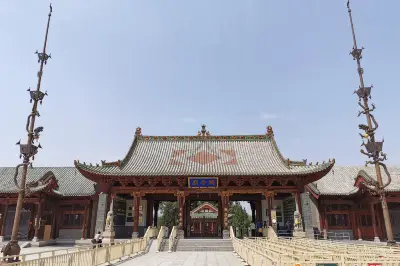
The other is the Guan Di Temple in Xiezhou, the archetype of all Guan Di temples in China and the largest in scale.
Inside, there are also several millennium-old cypress trees. Whether it's the main hall, the iron incense burners, or the iron guardian figures, they all exude a strong sense of history, unlike the coastal temples that appear splendidly modern at first glance.
The Christian church in Yuncheng also had its unique character.
Yuncheng is very close to Linfen, and the high-speed train got us there quickly. Hongdong County is 30 kilometers north of Linfen. From the train station to our hotel, we paid an extra 50 yuan for a ride that dropped us right at the entrance of the Great Locust Tree Scenic Area in Hongdong.
This is a famous attraction, a must-visit for tour groups. It was our first time. In Hongdong County, humming the lyrics of 'Yutangchun', we walked along the street of 'Su San's Departure', where the legendary Su San Prison is said to be located.
Instead, we had a bowl of meatball noodles at the food court across the street—our tastes didn't agree, so I'll leave it at that. Not far away is Hongdong Railway Station, and for just a few yuan, we returned to Linfen.
We visited the newly built Yao Temple, but it didn't leave much of an impression.
At the West Bus Terminal in Linfen, there are long-distance buses to Yan'an. Early in the morning, we boarded a bus to Yan'an. We didn't arrive until 3 p.m. I heard they're building a high-speed rail, so in the future, it won't take eight hours. While crossing the Yellow River, we saw the river below the bridge.
When I was in school, I was deeply impressed by He Jingzhi's poem 'Returning to Yan'an'. His excitement upon returning to Yan'an after ten years leaps from the lines, with the verse 'Time and again in my dreams I return to Yan'an' constantly echoing in my ears. I had long yearned to visit Yan'an but could never make it happen. This time, I finally resolved to come.
On the Yan'an Bridge, I took a photo of Baota Mountain (Pagoda Mountain). Now I was truly in Yan'an, staying right by the South Gate, next to South Gate Square. Looking up, I could see Baota Mountain; behind us was Phoenix Mountain. I heard this was once the bustling Nanguan Market. There's an old photo of Yan'an: a group of uniformed young people strolling on the main street, with a small Nanguan gate tower in the background. Today, a replica of that city gate tower has been built on the site. The old street scenes are long gone, and the area has become a city square. Below is the view I took from Baota Mountain showing our hotel's location at South Gate Square.
We arrived at the hotel after 3 p.m., dropped our luggage, and rushed to the Date Orchard (Zaoyuan). Fortunately, the site closed late, so we made it in time. The Zaoyuan scenic area was newly renovated; there weren't many visitors, and we toured quickly, just to say we'd been there.
Back in the city, it was already dark, perfect for capturing night scenes.
Yan'an, like other cities across China, has become a modern city. The night view is beautiful, with a Wanda Plaza, pedestrian streets, and even traffic jams.
The next day, we joined a local one-day tour to Hukou Waterfall on the Yellow River, Nanniwan, and other places.
At Nanniwan, we met local villagers and bought some of their oily millet. Back home, we made porridge with it—it was delicious.
A few years ago, we had visited the Yellow River Hukou Waterfall from the Shanxi side, which is the opposite bank. The perspective was different, but the roaring grandeur of the Yellow River was much the same.
Along the way, we passed a former educated youth settlement. The apples produced there are the real Luochuan apples: sweet and tangy, juicy and crisp, costing only 2 yuan per jin (1/2 kg). What a pity we couldn't carry much. We brought a few jin back to Shanghai within our capacity, and we haven't finished them yet.
The appearance of apples doesn't tell you much; it's all about the origin and variety. The local purchase price for first-grade apples is 5 yuan per jin.
Back in Yan'an, we went looking for food. A food festival was being held on the pedestrian street, featuring snacks from all over the northwest. We had some hele (buckwheat noodles). The noodles likely contained buckwheat and were pleasantly chewy.
At noon on the third day, we were set to fly back to Shanghai. Early that morning, I was the first non-local visitor to enter the Baota Mountain scenic area. It no longer looked like the old photos; there were well-paved stone step paths everywhere. In just a few minutes, I reached the platform of Baota Mountain and could overlook the Yan River Bridge.
I climbed in one go to the back summit where a newly built pavilion stood, only to be blocked by a large dog, proof that I was the first visitor up the mountain—the staff hadn't yet taken the guard dog back.
Below is the newly restored beacon tower, said to be a relic from the Song Dynasty.
At the foot of Baota Mountain, there are cliff carvings with inscriptions by Fan Zhongyan, Mao Zedong, and Chiang Kai-shek, illustrating Yan'an's history.
This is an inscription by Chiang Kai-shek for Sun Yat-sen's birthday, written in 1947 after Hu Zongnan captured Yan'an. Some characters have been chiseled away and are illegible. What remains visible might have been deeply carved on the original spot; the story behind it has never been reported.
At noon, the three of us took a taxi to Yan'an Nanniwan Airport. I asked if this was the airport where Mao Zedong departed for the Chongqing negotiations. The driver said no, that small airport has become part of the city, called 'Baimi Dadao' (Hundred-Meter Avenue). Soon, Yan'an's high-speed rail station will be built at Dongguan. The current Yan'an airport is not far from the city center; the taxi fare was only 31 yuan, whereas the airport shuttle bus costs 20 yuan per person.
Yan'an is developing rapidly, while its revolutionary sites are well-preserved, allowing future generations to discern the remnants of history. Our trip from Huashan, through Shanxi, to Yan'an was drawing to a close. It turns out many travelers follow this route—on the same bus, there was an elderly couple from Shanghai doing the same. Throughout the scenic spots, we often heard the soft Wu dialect. During the pandemic, group tours became rare, while independent travelers like us became more common. But be careful not to fall for private tour guide ads, of which there are many on Baidu. The whole journey was leisurely and self-arranged, adapting as we went. For example, we originally planned to take a high-speed train to Hongdong County, but when we found a more convenient taxi, we took it, saving time and money. Another time, when we spotted a rural market from the bus, we got off to explore. We've traveled many times now, and already on the plane we were discussing the itinerary for our next trip.