Stork Tower and Puzhou Ancient City
Stork Tower and Puzhou Ancient City
On the east bank of the Yellow River lies Puzhou City, a prefectural or sub-prefectural seat since ancient times. A floating bridge spanned the river here, and merchants traveling between Shanxi and Shaanxi crossed at this point, making the city naturally bustling and a key military fortress. During the Northern Zhou Dynasty, General Yuwen Hu was stationed here and built a tall tower to better observe the surroundings. After its completion, storks, sparrows, magpies, and other birds often came to rest and play, so it became known as Stork Tower or Stork and Magpie Tower.
During the Tang Dynasty, a famous dancer and musician named Yang Yuhuan emerged from this area. During the height of the Tang, her fame spread across the land. In particular, when Yang Yuhuan and her husband, Emperor Xuanzong (Li Longji), returned to her hometown of Puzhou for a visit, it further boosted the local economy.
During the Tang Dynasty, especially its golden age, Puzhou was a prosperous area not too far from the capital. Many literati and refined scholars visited, resulting in the famous poem "Climbing Stork Tower":
As daylight fades beyond the hills,
The Yellow River to the sea spills.
If you would see a thousand miles,
Climb one more storey on this tower.
The author of this poem is generally recognized as Wang Zhihuan, one of the four great frontier poets of the Tang Dynasty. However, history has seen some controversy: some attribute it to Zhu Bin, a recluse of the High Tang period, as noted in ancient poetry books. Yet others claim it was by Wang Wenhuan, though no one knows who Wang Wenhuan was. I suspect that when the woodblocks were carved for printing, the carver carelessly mis-carved the character "Zhi" into "Wen". In those days, revising a printing block was no easy task, and so a muddled case arose. The main reason is that people back then had little awareness of intellectual property rights, otherwise later generations wouldn't be left in doubt. But these debates are not crucial.
Wang Zhihuan was from Taiyuan and was clever from a young age. He was dashing and handsome—in other words, very good-looking—and universally admired, with extraordinary literary talent. He inherited an official post but was soon framed and dismissed, after which he traveled widely, writing poems and rhapsodies. Unfortunately, few of his works survive. It is said that when Empress Wu Zetian read "Climbing Stork Tower," she was delighted and richly rewarded the author. However, the recipient of the reward was not Wang Zhihuan but Zhu Zuori; someone had fraudulently passed off Wang's poem as his own. It's possible that Wang knew about this from the start, had a good relationship with that person, but was sidelined himself. When the emperor requested poems, he let him use it. Or it may have been recited by others until it reached the empress's ears. Later, Wang was reappointed to office, people spoke up for him, and he recovered his reputation. At the time, some surely knew that the impostor lacked the talent to produce a poem of such caliber.
Over the centuries, ravaged by successive wars, only the descendants of storks and sparrows remained; Stork Tower was long gone. The Yellow River shifted its course restlessly between the east and west banks, and even its original site vanished. In 1994, the then top national leader visited Yongji and toured the Pujin Ferry ruins. Naturally, the conversation turned with interest to Stork Tower. Seizing the rare opportunity, local officials struck while the iron was hot and launched a project to rebuild this famous ancient tower. In 1997, the state, province, and locality jointly funded the reconstruction. The leader inscribed the plaque "Stork Tower" and also wrote out Wang Zhihuan's "Climbing Stork Tower" by hand. On National Day 2002, it officially opened to the public, with an admission fee of 60 yuan.
Today it has become a famous scenic area. The Tang-style replica of Stork Tower is magnificent and spectacular. From the observation deck on the top floor, you can take in the surrounding landscape, with the winding Yellow River stretching endlessly. As the park's landscaping continues to improve, it will become even more beautiful, allowing visitors to further appreciate the Yellow River scenery of southern Shanxi.
Upon entering the Stork Garden scenic area, you'll see Stork Reflection Lake. Though not large, it is charming, and the arch bridge across it echoes Stork Tower, creating a distinctive charm.
Finally, the bas-relief panels outside the first floor of Stork Tower each tell a story. For example, the Goddess of the Nine Heavens rides a phoenix, immortals soar on cranes, a Central Asian man drives a lion, along with dragons, qilin, phoenixes, and more, all vividly carved. Unfortunately, the stories behind many of the images are not explained; if you have time to study them carefully, it would surely provide endless fascination.
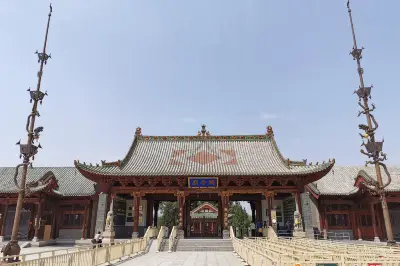
To the west of the scenic area today lies the Puzhou Ferry, with the Yellow River beach right before your eyes, offering a completely different world of scenery. Not far west are the Pujin Ferry and the Puzhou Ancient City ruins. At the ancient city ruins, only the bell tower and the south gate remain, evoking a deep sense of history's vicissitudes.
I came here after visiting the Universal Salvation Temple. I had planned to take the tourist bus route 2, but buses were scarce. I struck a deal with an elderly gentleman with an electric cart on the roadside for a round trip of 30 yuan. In two hours, I visited Puzhou Ferry, Stork Tower, Pujin Ferry ruins, and the Puzhou Ancient City ruins in succession.
Behind the mountains the sun bids goodbye,
The Yellow River to the sea flows nigh.
To see a thousand miles with your eyes,
Just board a plane and up you fly.
— by Dasong Wanjun, December 23, 2020