A One-Day Tour of Pujindu Ferry Ruins, Guanque Tower, and Pujiu Temple
December 21st is the winter solstice, a very rare date for it, since it almost always falls on the 22nd. In the north, people eat dumplings on this day. The anticipation I felt for this day as a child is something today's young people probably can't understand. Naturally, dumplings came to mind, and while wondering which place had the tastiest ones, I thought of Yongji's beef dumplings. Why not go enjoy the scenery of Yongji and then have a bowl of its famously delicious beef dumplings?
In the morning, I took the high-speed train and arrived at Yongji North Station at 10:42. I had planned to take a public bus to Pujiu Temple, but a taxi driver stopped me, explaining that the bus would be very slow, that time is precious when traveling, and that the meter would be used so there'd be no overcharging. These were all very reasonable points, so I changed my mind and hopped into the taxi.
It was indeed fast. I reached Pujiu Temple at 11:14, and the taxi fare was fifty yuan.
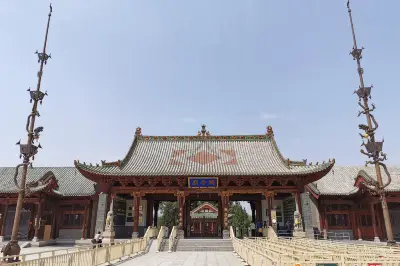
You could say the present-day Pujiu Temple is entirely a tourist development built around Wang Shifu's story "The Romance of the Western Chamber" in 1986. The main theme promoted here is "love," and the Buddhist atmosphere seems a bit subdued. The original temple only had a relic pagoda and a Bodhisattva cave remaining. The relic pagoda has now been renamed "Yingying Pagoda"—a rather odd name, and I'm not sure whose idea it was. In any case, a place with a story attracts more tourists, especially young people. Since there's a love story here, that adds to its charm. The tourism marketing has been quite successful.
The entrance fee for Pujiu Temple is normally 50 yuan, but today it was free.
I left Pujiu Temple at 12:50, planning to go to Guanque Tower. I found the bus stop, but there weren't many buses. Just then, a man in his sixties approached and offered me a ride in his private car—15 yuan one way, or 30 yuan round trip. After thinking it over, I got into his elderly-style vehicle. First, we went to Puzhou Ferry. This is right on the Yellow River floodplain. When the water is high, there are tourist boats. This year, the Yellow River's flow went through Shaanxi. The old man said, "Ten years on the east bank, ten years on the west—that's what they mean by that saying. This year, our Shanxi side has no water."
After snapping a few photos, we got back in the car and headed to Guanque Tower.
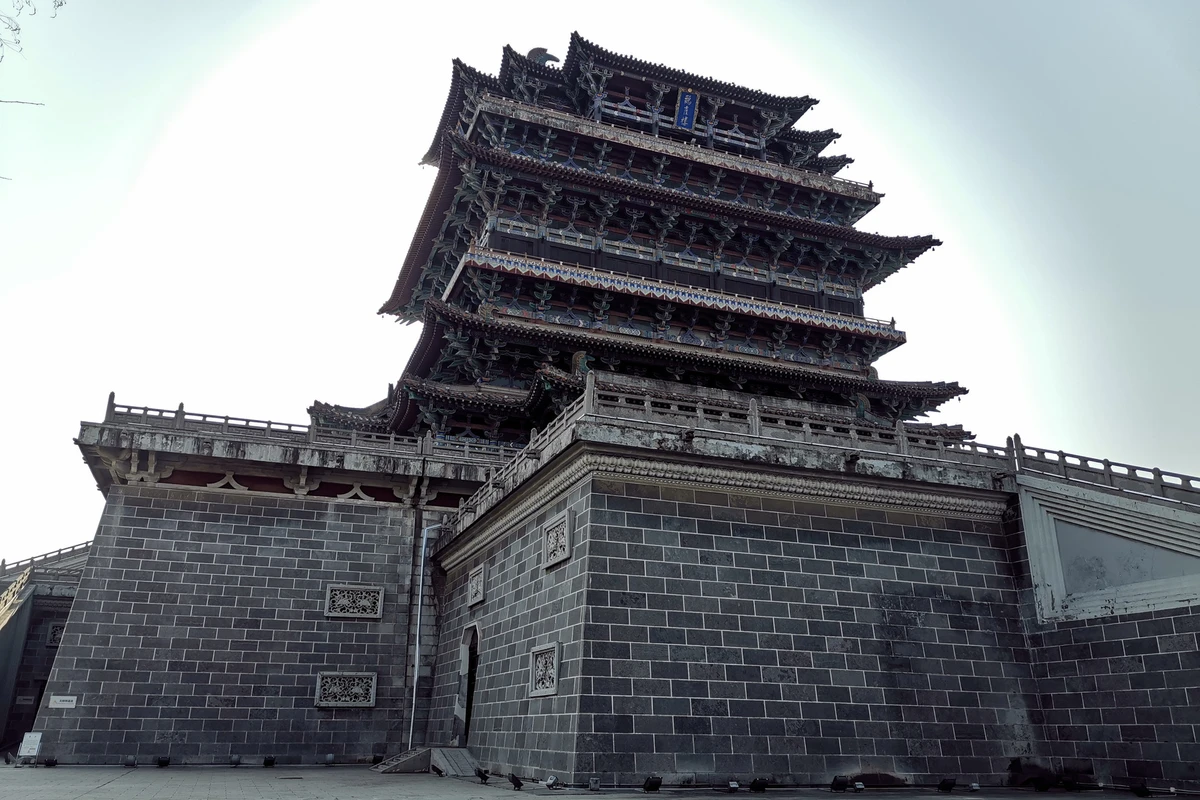
The current Guanque Tower is newly built. Nobody knows exactly where the original one stood. It was probably somewhere along the Yellow River bank west of ancient Puzhou City—could have been inside or outside the city walls. It likely functioned as a military installation at the time. Construction on the new tower began in 1997, and it opened to the public on National Day in 2002. The ticket price is 60 yuan, but today it was free.
You could say that aside from the name, today's Guanque Tower has nothing to do with the original. This is essentially a newly built tourist attraction borrowing the name "Guanque Tower." Its biggest draw is Wang Zhihuan's famous poem: "The white sun sets behind the mountains, the Yellow River flows into the sea. To see a thousand miles further, climb one more story higher." People come here just to climb to the top and gaze at the Yellow River. I explored every floor, and also paid close attention to the reliefs and plaques around the tower. Altogether, I spent about sixty-five minutes.
These details have already been described in my travelogues about Pujiu Temple and Guanque Tower, so I won't repeat them here.
After leaving the scenic area, I got back in the old man's car and headed to the next spot—which is also the focus of this article—the Pujindu Ferry Ruins.
Dating back to around the Spring and Autumn and Warring States periods, Pujindu was already a Yellow River ferry crossing with a floating bridge. This shows how extremely important its position was. During the reign of Tang Emperor Xuanzong, Puzhou, as a vital area near the capital, was designated a secondary capital. The floating bridge was extensively renovated, and four iron oxen, four iron human figures, two iron mountains, four iron piers, and a set of seven-star iron posts were cast. At the time, these served as excellent reinforcement and protection for the great Yellow River bridge. Each iron ox weighs 30 tons—a colossal casting project for its era, reflecting the advanced level of smelting and casting technology back then. Even today, these iron oxen and figures look vividly lifelike and spectacularly imposing.
Over the past thousand-plus years, especially after the Jin and Yuan dynasties, huge changes took place here. The Yellow River's main channel shifted, rendering the former floating bridge worthless. Eventually, it was buried under silt and sand. In 1989, it was discovered and excavated, giving us a glimpse of Pujindu's former glory.
Ancient Puzhou held a very important position, so naturally the city itself was bustling. Puzhou also produced one pivotal historical figure—Yang Yuhuan, the Precious Consort Yang. Whether she brought significant economic benefits to her hometown, there are no records, so I can't speculate. If it were today, the impact would certainly be huge.
During the War of Resistance, enemy troops were stationed in Puzhou. Its complete disappearance came after Liberation, linked to the construction of the Sanmenxia Reservoir. Low-lying areas along both banks had to be relocated. Today, only a few remnants of crumbling walls remain, but that doesn't detract from the historical value of Puzhou and Pujindu.
The highlight of today's heritage park is seeing the excavated relics—the giant iron oxen and figures. Next is the floating bridge reconstruction in the scenic area. This doesn't take too much time. I hurriedly made a round, spending about 20 minutes. Admission here is 50 yuan (off-season price).
Leaving the Pujindu Ferry Ruins, I arrived at the Ancient Puzhou City ruins. They aren't open to the public at the moment—mainly just the bell tower and east gate remnants. I took a few photos nearby.
I was back at the Pujiu Temple bus stop in Xixiang Village by 14:45, ready to take the Tour Bus 2 to Yongji for dumplings. The bus was indeed very slow—28 stops to cover about 16 kilometers, especially within Yongji city where stops felt like just a hundred or two hundred meters apart.
I asked several people along the way, and they all recommended Liu Jie's dumplings. I searched online and learned that Yongji's beef dumplings were originally invented by this very establishment. I got off at the Department Store stop, walked a few minutes to Liu Jie Dumpling House. At that hour, there weren't many customers. I ordered a plate of beef dumplings—the filling was pure meat with no vegetables. The taste was truly excellent. After finishing my meal at 15:50, I hurried back to the bus stop. Taking a bus to the high-speed rail station takes about an hour and fifty minutes; I planned to buy a ticket for the last train once I was on the bus.
While waiting, a taxi came by offering shared rides to the station for 10 yuan. I got in. It was indeed fast—about twenty minutes. So I bought a ticket for a 5 PM bullet train.
This day trip to Yongji was a bit rushed time-wise, but rich in rewards. I gained a deeper understanding of these newly rebuilt scenic spots, and most importantly, I tasted authentic Yongji beef dumplings.
Author: Dasong Wanjun, written on December 25, 2020