2021 Spring Trip to Shanxi: Yuncheng's Guandi Temple and Wulaofeng (Part of a 9-Day Independent Tour through Datong, Yingxian, Mount Wutai, Yuncheng, Changzhi)
After finishing the Mount Wutai itinerary, I caught the K603 train at the Wutaishan Railway Station in the wee hours, heading to the next stop: Yuncheng.
Day 5: Maybe it was the exhaustion from climbing, but I slept surprisingly well on the overnight hard sleeper. I arrived punctually at Yuncheng Railway Station at 9:40 a.m.
Leaving the station, I took a bus to the apartment I had booked. The apartment itself was nothing special, but the supermarket in the Dongxing Xiangshang Plaza downstairs really deserves a mention. As someone who drinks milk like water, I had been unable to buy fresh milk ever since arriving in Shanxi—no supermarket stocked it, and I was suffering badly. I had asked at several supermarkets in Datong but came up empty. I'd encountered similar situations in Ningxia before. It's so strange: these provinces have an abundance of mutton, yet no fresh cow's milk. Finally, in this Yuncheng supermarket, I found pasteurized milk, which was a lifesaver. As an aside, the best milk I've ever tasted is in Xinjiang. There's a chain fresh-milk shop in Urumqi (I think it's called Zhengfei); their pasteurized milk is absolutely divine, leaving brands like Zhiyou, Youbei, Meiji, and Asahi in the dust. Do try it if you have the chance.
Now, back to the main trip. Leaving the apartment, I set off first for the Haizhou Guandi Temple. You can take bus No. 11 directly from the city center; the ride is about an hour, and it drops you right at the temple gate. After visiting, simply wait across the road from where you alighted to catch the bus back (there's no signpost).
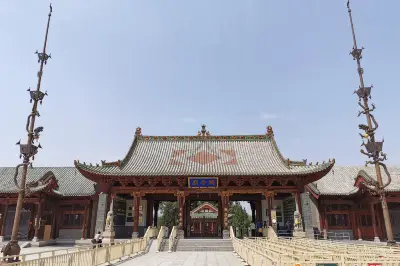
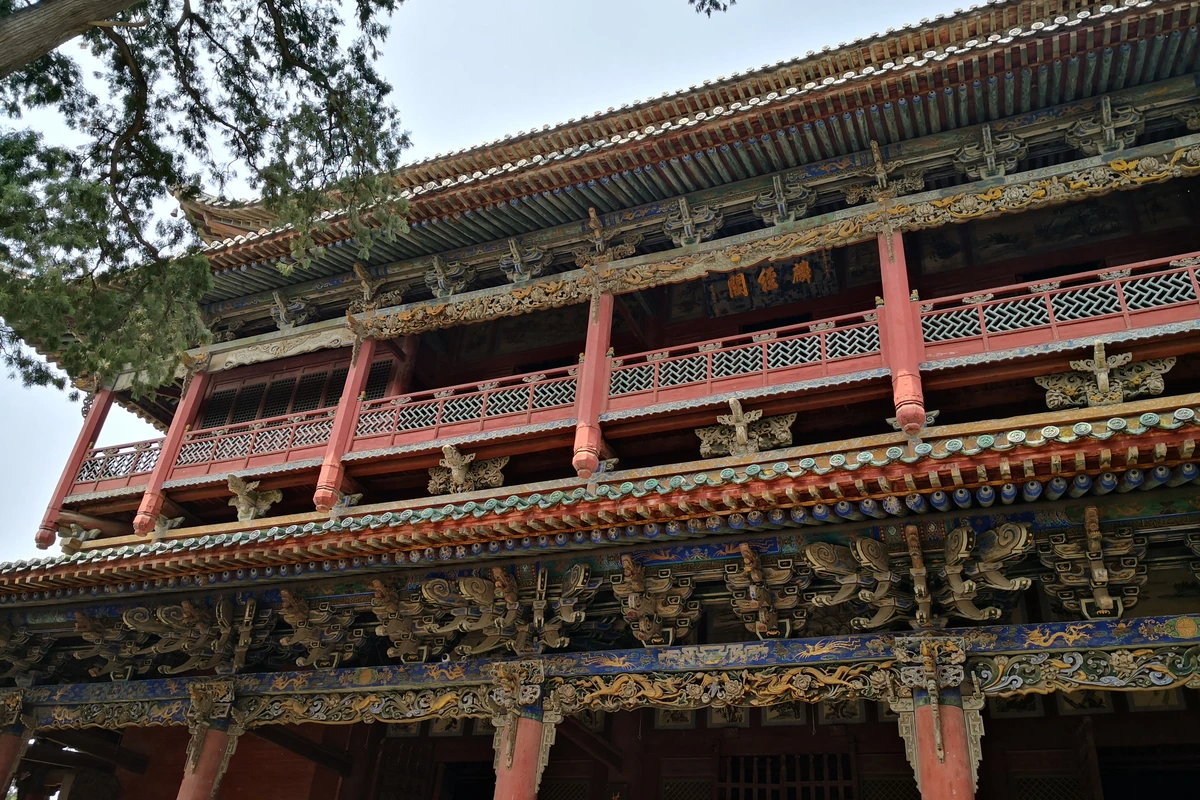
Ticket reservation for the Guandi Temple is done via a WeChat mini-program, but it was quite smooth. With the free reservation and my ID card, I entered. The Haizhou Guandi Temple in Yuncheng is one of China's three major Guandi temples. Guan Yu was defeated and fled to Maicheng, where Sun Quan's troops killed him in present-day Dangyang, Hubei. His head was later presented to Cao Cao. Thus, his head is buried near Luoyang, Henan, at Guanlin; his body rests at Guanling in Dangyang; and his soul returns to his hometown of Yuncheng, Shanxi—that is the Haizhou Guandi Temple. The entire complex was built almost to the scale of a royal palace, because Guan Yu was posthumously revered as the Martial Sage. The temple boasts calligraphy by Kangxi, Qianlong, and Empress Dowager Cixi. Yet the most remarkable structure is the innermost building, the Chunqiu Tower. Its second floor seems to hang suspended above the first, and the corridor pillars, from a distance, appear to dangle outside the ground floor. In fact, hidden horizontal beams inside make it possible—this architectural technique is called 'suspended beams and hanging pillars'. Pause here to study it carefully, and you'll be awed by the ancient craftsmen's ingenuity.
With that, the historic architecture tour is complete. Further ahead lies a large modern park with newly built landscapes—nothing worth seeing. But at this time of year, there was a vast peony garden in full bloom, a sight in its own right. One peony plant bore three different colors of blossoms, truly stunning.
Leaving the Guandi Temple, I took bus No. 11 back to downtown Yuncheng, grabbed a simple late lunch, and rushed to the Salt Lake Scenic Area. And that Salt Lake area, I must say, was the biggest trap of the trip. It's a 4A-rated scenic spot, but due to a moment of oversight, I failed to notice it wasn't on the list of free-entry attractions! I had hesitated about visiting it because online reviews were genuinely poor. But I considered two things: first, it's very close to the city center, just a few bus stops away and convenient; second, I assumed it was also free (it might be the only 4A spot not included). So, I decided to go.
The salt lake itself is vast, with a road cutting right through it, so the bus stop is roughly at the lake's heart. Stepping off the bus, I could already see the endless stretch of salt lake. But from the drop-off point, it's still a 10-15 minute walk to the ticket office. Ugh, my cheap streak got the better of me again—I lost another chance to cut my losses. At the ticket office, I showed my You Shanxi mini-program reservation and was told flatly that free entry did not apply. I couldn't believe my ears; I quickly rechecked the official free-entry list on the mini-program and, sure enough, this spot wasn't on it. But if it's not on the list, why the heck does the mini-program allow you to make a reservation? That's just entrapment.
Well, since I was already there, the pure admission fee was not expensive—only 10 yuan (the ticket seller strongly recommended combo tickets with activities, which I ignored). But I still couldn't let it go. I asked staff what the difference was between the view outside and inside. The staff member's exact reply was: 'The water inside is a slightly darker color.' Sigh. Even then, I didn't back down; I bought the ticket and went in. Talk about not knowing when to quit. Inside the 'China Dead Sea Salt Lake Scenic Area', the scenery was exactly the same as outside. The fabled colorful waters or snow-like salt blooms were nowhere to be found—probably the wrong season. In short, I felt like I'd paid an intelligence tax. And to add insult to injury, back at my apartment, I gazed out the window at the distant view and realized the entire salt lake vista could be seen perfectly from there. Ugh, I felt my IQ needed a top-up.
Day 6: My second day in Yuncheng was set aside for climbing Wulaofeng. There's no direct bus or long-distance coach from Yuncheng to the Wulaofeng Scenic Area. You have to catch a bus heading to Yongji and get off midway at Wulaofeng. However, the drop-off point is at least 3 kilometers from the scenic area ticket office, all uphill. If possible, I highly recommend hiring a local car to save energy—after all, there's a long mountain trail ahead. After hopping off, we found that because it wasn't peak season yet, the rumored local tricycle taxis were nowhere to be seen. We had no choice but to start trudging uphill, though luckily there is just one straight road, so getting lost is impossible. We hadn't walked far when we lucked out: a young man delivering pastries up the mountain gave us a lift for 15 yuan for two people, right to the ticket office. I was so happy I could have burst into 'Today Is a Good Day.' Showing my reservation record and ID card, and scanning a QR code to sign a no-smoking fire prevention notice, we entered the scenic area smoothly.
Wulaofeng Scenic Area can be roughly divided into four sections. The first section is from the main gate to the start of the hiking trail, via scenic-area shuttle. The second section is from the trailhead to Lingfeng Temple (on Taiyi Peak); I suggest taking the route via Xiaohongya and Dahongya—it's only 1.2 kilometers with 2,399 steps, about an hour at a normal pace. From Lingfeng Temple, the trail splits into a Y-shape. I recommend climbing the main peak, Yuzhu Peak, first. First, because that route is more strenuous; second, the other route can be used for descending, so you don't backtrack. The third section, from Lingfeng Temple to Yuhuang Hall at the summit of Yuzhu Peak, also takes around an hour but is slightly more difficult. After reaching the top, return to Lingfeng Temple. The fourth section is from Lingfeng Temple to Qipan (Chessboard) Peak, ending at the Immortals' Chess Platform. This path is mostly flat, very easy, and takes under 30 minutes. By this point, you've covered all the major sights of Wulaofeng. For the descent, you can either return the same way from Chessboard Peak to Lingfeng Temple and then to the trailhead—the shortest way—but I suggest not backtracking. Instead, descend from Chessboard Peak via the Liangshidian (Granary God Hall) and Heilongtan (Black Dragon Pool) side. This trail is gentler than the ascent route but longer, about 2.5 kilometers, with a section of cliffside boardwalk.
In terms of pure natural scenery, Wulaofeng totally outshines Mount Wutai. The terrain is rugged yet elegant, covered in lush vegetation. At this season, wildflowers bloom in profusion: yellow forsythia, white exochorda, red peach blossoms, pink cherry blossoms and bladdernut—not in overwhelming seas of color, but scattered just perfectly like stars. Best of all, the park was so sparsely visited that it felt like our own private retreat, allowing us to soak in the beauty undisturbed.
Wulaofeng isn't like Huangshan, where every few steps there's a famous named sight; along the trail, there aren't many designated viewpoints. But that doesn't stop you from glancing up and suddenly noticing a rock that looks just like a hand or an animal, full of wild charm. See? A pair of eyes that discover beauty, plus a rich imagination, matters so much.
When climbing Yuzhu Peak, there's a fork. The official park sign advises taking the right-hand path. Actually, if there are few visitors, both trails can reach the summit. The left path is a stone staircase leading to a long suspension bridge that takes you to the peak. The right path climbs steep, original stone steps and iron ladder rungs directly up. On our ascent, the weather was foggy, even drizzly, and the trail was very slippery. We met several groups of hikers who turned back due to safety concerns. In our experience, the right-hand ascent in wet, slippery conditions is indeed quite dangerous. The first half consists of irregular, smooth natural rock steps that require hands and feet; the second half is an open-grill ladder, which is decidedly unfriendly to someone like me with a fear of heights. Going up was okay, but going down in the rain? Way too risky—absolutely avoid. The left-hand ascent is far less challenging: the stone steps are newly built and uniform. Only the suspension bridge—a cable-stayed footbridge—is long, and beneath it yawns a bottomless abyss, which might make the faint-hearted quiver. We descended via this route. The bridge vanished into thick fog, making me blurt out thoughts of 'what unknown depths lie beyond the clouds.' Halfway across, in the gorge, the biting mountain wind was palpable, and the whole bridge swayed noticeably. My poor heart hammered wildly; both hands gripped the iron cables so tightly that I entirely forgot to take a photo midway across.
Compared to the thrill of climbing Yuzhu Peak, Chessboard Peak felt tame. But from there, you get a full panoramic view of Yuzhu Peak's entire silhouette.
Coming down the mountain, this time no lucky ride appeared. We hiked all the way from the scenic area back to the road and, again, flagged down a bus returning from Yongji to downtown Yuncheng.
That marks the end of the Yuncheng leg. A word on the food in Yuncheng: we tried a highly-rated local restaurant on a review platform, located inside the Huanghe Dasha Hotel. It was quite busy, and I seemed to spot many local officials entertaining guests there. I won't name the restaurant, but the dishes... well, they were beyond words. The famous Yellow River carp arrived lukewarm, barely warm—forget freshly cooked; it probably hadn't even been reheated. Fenjiu beef? I couldn't detect any Fenjiu liquor flavor, and it clearly was pressed composite meat that fell apart at the touch of chopsticks, leaving only a salty taste. We ordered a 'mung bean cake'—when chatting with the waitress later, the honest lady told us it wasn't mung bean at all but made from peas. We didn't know whether to laugh or cry. Then there was the 'crispy pork', which had an indescribable off-flavor. It was the only dish I took one bite of and immediately spat out. For a die-hard carnivore like me, that hurt. I advise everyone to order with caution.
After a good night's sleep, I was ready to head to Changzhi the next morning and start my journey into the Huguan Taihang Grand Canyon.
1. Unless you visit the Salt Lake Scenic Area at the right season—at least in spring—there's absolutely no need to go in. The views inside and outside are identical. Plus, this attraction is not included in the free-entry program for visitors from Jiangsu, Zhejiang, and Shanghai.
2. To get from downtown Yuncheng to Haizhou Guandi Temple, take bus No. 11 directly. The return bus stop has no sign; just wait by the roadside.
3. There is no direct bus to Wulaofeng Scenic Area. You need to take a bus headed to Yongji, available near the train station or at the long-distance bus station. Tell the driver to drop you at Wulaofeng. Note that there are two Yongji-bound bus routes: one takes the expressway and bypasses Wulaofeng, while the other takes the southern route and passes it. Confirm beforehand. The drop-off point is about 3 km from the scenic-area gate; I suggest hiring a local ride to save energy.
4. From the Wulaofeng trailhead to Lingfeng Temple halfway up takes about 1 hour (via Xiaohongya/Dahongya route). From Lingfeng Temple to Yuhuang Hall at the summit of Yuzhu Peak takes another hour. For the descent, consider going down via Heilongtan (Black Dragon Pool); the slope is gentle, the scenery good, and you avoid backtracking. This way, the descent also takes about an hour.