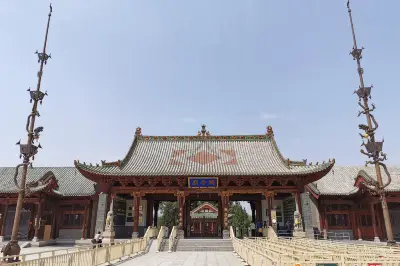
Pujin Ferry Site: The Millennia-old Giant Iron Oxen of the Yellow River
After visiting Guanque Tower, I came to the Pujin Ferry Site 1.9 kilometers away. It is located just outside the West Gate of Puzhou Ancient City, 18 kilometers southwest of Yongji City, Shanxi Province, covering a total area of 2,268 square meters. According to the 'Records of the Grand Historian: Annals of Qin,' a pontoon bridge was built here as early as the Qin Dynasty. The existing site was first discovered in the late 1980s. The archaeological findings at the Pujin Ferry Site provide precious physical evidence for the study of ancient politics, economy, culture, military affairs, bridge construction, smelting and casting techniques, craft modeling, changes in the Yellow River, hydrogeology, and other disciplines. In 2001, the Pujin Ferry Site was designated by the State Council as one of the fifth batch of National Key Cultural Relics Protection Units.
The entrance to the Pujin Ferry Site is now open to the public free of charge.
Pujin Ferry has been a vital communication hub between Qin and Jin since ancient times, and many dynasties built pontoon bridges here. According to the 'Zuo Zhuan,' in the first year of Duke Zhao, Prince Cheng fled to Jin and constructed boats on the river. The Pujin Ferry Site in Yongji remained an important crossing on the Yellow River. During the Song-Yuan transition, the pontoon bridge was destroyed in the flames of war, leaving only the iron oxen on both banks. Later, due to flood storage from three reservoirs, the riverbed silted up, the river shifted westward, and the iron oxen were buried in the floodplain.
From March 1988 to August 1989, a group of iron artifacts, including the giant iron oxen cast in the Kaiyuan reign of the Tang Dynasty, were excavated and opened to the public. The Pujin Ferry Site is famous for these iron oxen, which are unique in China and rare in the world, truly deserving the title of 'national treasure.'
The casting of the Pujin Ferry iron oxen used 1.6 million jin of iron, consuming four-fifths of the annual pig iron output of the entire Tang Empire.