The Stork Tower: One of China's Four Great Historical and Cultural Towers
In June, I took a trip to Yuncheng and Linfen in southwestern Shanxi. After landing at Yuncheng Airport, following my travel plan, I took a taxi to the high-speed rail station to go to the Stork Tower in Yongji City, which is known as one of China's four great historical and cultural towers. Near the Stork Tower, there are three relatively famous attractions: besides the Stork Tower, there are the Great Iron Ox of the Yellow River and the Pujiu Temple. Transportation to these attractions is not very convenient. It is over 80 kilometers from Yuncheng Airport to Yongji City, over 70 kilometers from Yuncheng North Station to Yongji North Station, and 36 kilometers from Yongji North Station to the Stork Tower. Taking the bullet train and then a bus is very time-consuming. On the way to the high-speed rail station, the taxi driver suggested chartering a car. He asked for 400 yuan, which we bargained down to 300 yuan. The toll was 40 yuan and the parking fee was 5 yuan, which we had to cover, totaling 345 yuan. It took half a day, and at the end, he dropped us off at our hotel in Yuncheng. We arrived at the hotel at four in the afternoon. If we had gone on our own, we might have had to stay overnight in Yongji City. Although we spent a bit more money, it saved time and was worth it.
The Stork Tower is located in Puzhou Town, Yongji City, Shanxi Province, at the intersection of Shanxi, Shaanxi, and Henan provinces, in the "Golden Triangle of the Yellow River" region. Along with the Yellow Crane Tower in Wuhan, the Yueyang Tower in Yueyang, and the Tengwang Pavilion in Nanchang, it is one of the four great historical and cultural towers of China. The Stork Tower, anciently called the Stork and Magpie Tower, got its name because storks and magpies often perched on it. Its original site was on the bank of the Yellow River southwest of the ancient Puzhou City in Yongji City. According to the "Puzhou Prefecture Annals": "(The Stork Tower) used to be on a high mound in the Yellow River southwest of the prefectural city, where storks and magpies often perched, hence the name." The tower was originally built as a multi-story structure by General Yuwen Hu (of Xianbei ethnicity) of the Northern Zhou Dynasty (557–581 AD) to guard the outer reaches of the river. Due to its magnificent size, unique structure, imposing grandeur, and advantageous location with beautiful scenery, literati and poets from various dynasties often climbed the tower to enjoy the views, express their feelings, and left many immortal verses overlooking the great river. The Tang Dynasty poet Wang Zhihuan, upon climbing the tower, was inspired to write: "The white sun sets behind the mountains, the Yellow River flows into the sea. To see a thousand miles further, ascend one more story." This timeless masterpiece, which inspires enterprising spirit and national rejuvenation, has long been widely acclaimed.
Ticket prices for the Stork Tower: free for those aged 60 and above; in 2021, free for visitors from Jiangsu, Zhejiang, and Shanghai.
Stork Tower Guide Map
Stork Tower Information Sign
After its completion, the Stork Tower stood through the Tang and Song dynasties, remaining intact until the Mingchang period of the Jin Dynasty (1190–1196 AD). The plaque inscribed "Stork Tower" by Li Kui, a record officer of Hezhong Prefecture in the Tang Dynasty, still existed. It was destroyed by war in the early Yuan Dynasty (1222 AD). Wang Yun of the Yuan Dynasty recorded in his "Account of Climbing the Stork Tower": "In the third month of the Zhiyuan Renwu year (1282), I came to the Jin Prefecture as an official. In the tenth month, on the Wuyin day, I went on business to this prefecture, and thus was able to climb the site of the tower. I lingered there, my thoughts soaring beyond the clouds. Although the magnificent sight and grand terrain were no longer as before, the majesty of the mountains and rivers, and the splendor of the mist and scenery, were no different from ancient times. By the early Yuan, the tower had already been destroyed." In the early Ming Dynasty, its foundation still existed, but later due to the flooding of the Yellow River, the site was submerged, leading to the loss of the tower and scenery. People then used the west gate tower of Puzhou as the "Stork Tower," and many continued to climb and compose poems. The early Qing poet Shang Deng'an wrote: "The mountains and rivers only favor those who love to roam, drawing the sun's chariot across the evening stream. The verse for a thousand-mile view is so fine, to this day the shadow falls on the west tower." The west gate tower truly could not live up to its great reputation. For hundreds of years, the Stork Tower left countless visitors with endless regret.
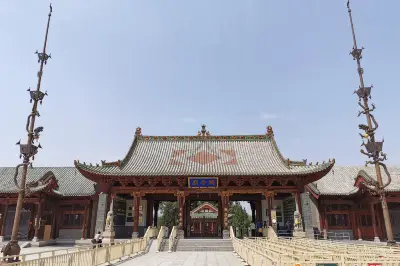
Inside the main gate of the Stork Tower scenic area
The scenic area is neither too big nor too small. From the main gate to the tower is about one li (500 meters). This sightseeing car can take you around the entire area, costing 6 yuan per person. The main focus is on the tower, and there is not much else around.
In December 1997, Yongji City broke ground on the bank of the Yellow River, starting the reconstruction project of the Stork Tower, which was the first restoration since its destruction in the early Yuan Dynasty over 700 years ago. The new Stork Tower is currently the largest Tang-style building in China. Its exterior features four eaves and three stories, with a total height of 73.9 meters, a total floor area of 33,206 square meters, and a total weight of 58,000 tons. Its architectural style fully reflects the Tang Dynasty style, because the Stork Tower was built in the Northern Zhou Dynasty but flourished in the Tang Dynasty. This restoration aimed to recreate the Tang Dynasty appearance.
Looking from the Stork Tower to the front square
Looking from the Stork Tower into the distance is the Yellow River
Looking into the distance from the Stork Tower
Statue of Wang Zhihuan on the Stork Tower.
Bus stop outside the Stork Tower scenic area
Bus stop outside the Stork Tower scenic area. Although there are buses passing by, even the scenic area staff don't know how often they come. Visiting the Stork Tower takes about 40 minutes. Although everything seen is new imitation ancient architecture, it still counts as having been to one of the four great towers.