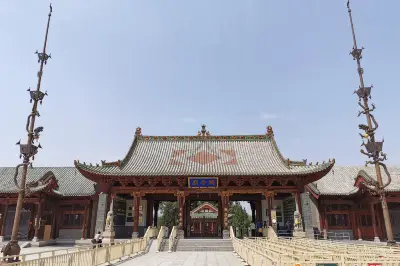
The Setting of 'The Romance of the Western Chamber' and a Sanctuary of Love — Pujiu Temple
Pujiu Temple is located on the Emei Plateau, 3 kilometers east of Puzhou Town, Yongji City, Shanxi Province. The plateau is 29–31 meters high, with ravines to the south, north, and west, and flat terrain only to the northeast. Originally, the temple grounds extended 200 meters east–west and 350 meters north–south, covering an area of about 70,000 square meters. The site is elevated and open, with wide views. The temple faces south, perched high on the plateau. A thousand-year-old Buddhist monastery, Pujiu Temple was first built in the early Sui Dynasty and has undergone cycles of destruction and revival. In 1986, the state allocated funds for its full restoration.
Legend has it that during the Five Dynasties period, the military governor of Hedong rebelled. The Later Han court dispatched Guo Wei to suppress him, besieging Puzhou for over a year and causing great suffering. Guo Wei summoned a monk from the temple for advice, and the monk said, 'If the general shows mercy, the city will fall!' Guo Wei immediately broke an arrow as a pledge. The next day, the city was taken, and all its people were saved. Henceforth, the temple was renamed Pujiu Temple (Temple of Universal Salvation). With the publication of 'The Romance of the Western Chamber,' Pujiu Temple—'unrivaled among all Buddhist temples under heaven'—gained immense fame. Its relic pagoda was also renamed 'Yingying Pagoda' and became widely known. The beautiful love story has touched hearts for centuries, making the temple a celebrated tourist destination both in China and abroad.
Pujiu Temple offers free admission for seniors over 60 and, in 2021, for residents of Jiangsu, Zhejiang, and Shanghai. Since 1998, it has hosted the 'World Couples Month' event in Yongji.
A striking feature is the large 'Heart Lock' in the square in front of the temple. One side bears the inscription 'May all under heaven be united in marriage,' and the other 'United in heart forever.'
The temple is built into the hillside. The steps leading up from the entrance gate are extremely steep. If you'd rather not climb them, you can take the wooden walkways on either side—though they involve a slight detour.
The Great Bell Tower of Pujiu Temple stands 17 meters tall, a double-eaved, hip-and-gable roof structure in imitation Tang style. A plaque reading 'Great Bell Tower' was written by the renowned Chinese painter and calligrapher Dong Shouping. The couplet in front of the tower was composed by the contemporary calligrapher Wei Junxiu. It reads: 'Towering across the vault of heaven, this hundred-foot high tower stands alone in majesty; The bell's sound shakes the universe, emptying all thoughts to enlighten humanity.' The couplet not only carries a rich Buddhist flavor but also perfectly captures the scene, with its ancient and vigorous calligraphy.
This Great Bell Tower appears in the 'White Horse Lifts the Siege' scene from 'The Romance of the Western Chamber' as an observation platform. The story goes that Sun Feihu, a general guarding the Pujin Bridge, heard that Cui Yingying, the daughter of a prime minister staying temporarily at Pujiu Temple, was exquisitely beautiful. Determined to take her as his wife, he surrounded the temple with 5,000 troops. The monks were in panic. The elderly mistress, desperate, promised that anyone who could drive away the bandits would win Yingying's hand in marriage, along with a rich dowry. This reward was exactly what Zhang Sheng hoped for. He devised a plan to send a letter to Puguan Pass, calling on his classmate and friend General White Horse to rescue them. To demonstrate the general's might, Zhang Sheng invited the old mistress, Abbot Faben, and other monks to ascend the Great Bell Tower and watch the two armies clash and General White Horse capture Sun Feihu alive.
Pujiu Temple—the first temple where I've seen cave dwellings—also preserves a few surviving ancient structures.
Inside the Bodhisattva Cave of Pujiu Temple
Inside the Bodhisattva Cave of Pujiu Temple
Inside the Bodhisattva Cave of Pujiu Temple
The Pear Blossom Courtyard of Pujiu Temple, also known as 'Cui's Private Courtyard' or 'Yingying Courtyard,' was the temporary residence of Cui Yingying's family as they passed through Hezhong Prefecture. The charming and intricately carved gate with its plaque 'Pear Blossom Deep Courtyard' is eye-catching. On either side, a poetic couplet reads: 'In the pear blossom courtyard melts moonlight bright; By the willow catkin pond breezes soft and light.' It captures the elegance and tranquility of the place. Both the plaque and the couplet are authentic works of the esteemed scholar Wang Jisi. The scenes 'Invitation to a Banquet,' 'Refusal of the Betrothal,' 'Climbing over the Wall,' and 'Interrogating Hongniang' from 'The Romance of the Western Chamber' all take place in this courtyard.
The Relic Pagoda of Pujiu Temple, also called 'Yingying Pagoda,' was named by later generations in memory of Yingying. The pagoda is square in plan, with thirteen stories, and stands about 50 meters tall. It has layered eaves and a very subtle taper. Although rebuilt during the Ming Dynasty, it retains a distinct Tang Dynasty charm. Uniquely, when you stand in front of the pagoda and strike a stone, the tower emits a loud echo remarkably like the croak of a toad. Depending on where you stand, the echo seems to come from different levels of the pagoda. This rare acoustic effect has earned it a place among China's four great echo structures, alongside the Echo Wall of the Temple of Heaven in Beijing, the Baolun Temple Pagoda in Henan, and the stone 'qin' of the Great Buddha Temple in Tongnan County, Sichuan.
Yingying Pagoda of Pujiu Temple
Yingying Pagoda of Pujiu Temple
Yingying Pagoda of Pujiu Temple
This is a special tourist bus parked outside Pujiu Temple; its departure times are unknown. We toured the temple for about an hour, then concluded our visit to Yongji and returned to downtown Yuncheng.