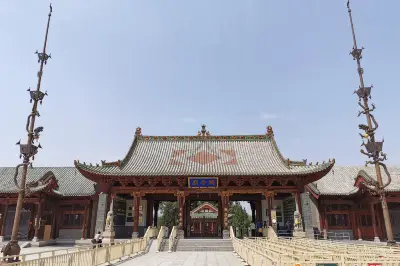
Shanxi’s Above-Ground Relics: A Family Jaunt
Shanxi Province is right next to Henan. Since I work in Zhengzhou, I took advantage of the summer break to bring my family on a loop tour of Shanxi’s above-ground cultural sights.
I’d been thinking about visiting Shanxi for two years, but couldn’t make it last year because of the pandemic. As the saying goes, ‘For above-ground relics, look to Shanxi.’ And it just so happened that my daughter said something that made sense: most of the places we visited in Shanxi were related to temples and Buddhas. That’s sort of true, isn’t it? But anyway, once we decided on Shanxi, I spent an afternoon putting together a simple map-based itinerary. We’d enter from the southeastern corner, head all the way north to Datong, then loop back from Datong down to Yuncheng, and re-enter Henan at Sanmenxia to get back to Zhengzhou. (The route and actual trip had a few differences, haha.)
Setting off from Zhengzhou, we headed northwest, passing through Jincheng in Shanxi, then on to our first stop: Pingyao Ancient City. On the drive, some highway sections only allowed 70–80 km/h, so no speeding—lots of mountain roads. We left a bit after 8 a.m. and drove nearly four hours, finally arriving at Pingyao Ancient City from Zhengzhou, the capital of Henan. This was a place I’d always wanted to visit!
Lucky for us, there are plenty of guesthouses inside the ancient city. As long as you book in advance, the owner will meet you at the entrance and drive you into the city. Entry to the town itself is free, but there are over a dozen small scenic spots inside that require tickets. This trip, thanks to our Zhejiang province ID cards, we got free entry to most of the sights. I heard Shanxi offers this benefit to visitors from Jiangsu, Zhejiang, and Shanghai. That saved us a big chunk on admission fees—awesome!
Pingyao isn’t big, but it’s steeped in history. And you can sample all sorts of local snacks.
We arrived on a Monday, and the ‘Encore Pingyao’ show we wanted to see is closed on Mondays, so we waited for the next day’s 2 p.m. performance. That worked out well: on Tuesday morning, the family toured every little spot inside the ancient city.
After watching ‘Encore Pingyao’ with a heart full of awe, we drove on to our next stop, Qiao Family Courtyard. The guesthouse owner told us that Wang Family Courtyard was bigger and more impressive, and it’s to the south, closer to Zhengzhou. We thought we’d visit it on the way back. So we simply kept driving, planning to spend a day at Mount Wutai. Unfortunately, the weather didn’t cooperate: they said Mount Wutai was closed due to rain and mudslides. So we detoured to Yanmen Pass in Dai County. Since there’s poetry about Yanmen Pass, it seemed like a great place to take the kids. After checking into a hotel near the pass, we tried the local spicy rabbit heads—really tasty.
Thinking we’d visit Yanmen Pass, the hotel front desk told us it was also closed because of the recent rain. Left with no choice, we drove to the next spot: the Wooden Pagoda in Ying County!
Seeing this ancient pagoda, built without a single nail, was a testament to masterful craftsmanship. There’s a legend that the birds around the pagoda have no toes and can’t land on the ground, so many black birds roost on the pagoda. I won’t go into what kind of birds they are.
After the pagoda, we drove to Mount Heng, the Northern Sacred Mountain!
The Hanging Temple on Mount Heng was something I’d always wanted to see. Whether from afar or up close, it’s simply stunning. Just imagine: what kind of people, with what kind of technology, built such a suspended temple back in the day? Inside, there are many Buddha statues, large and small—make sure to pay your respects to each one, hehe.
That evening, we drove to Datong and stayed inside its ancient city. Why does Shanxi have so many old towns? Clearly, they’ve done a great job preserving them!
In the morning, just after sunrise, we walked happily from our hotel to the Nine-Dragon Screen inside Datong’s ancient city.
Near the Nine-Dragon Screen, there are also two famous temples, like Huayan Temple. So we kept strolling around.
After paying respects at Huayan Temple, the next stop was the place I was most looking forward to on this road trip: the Yungang Grottoes.
Having already seen the Longmen Grottoes in Luoyang, the two sites have distinct styles—and I’ve read that even the rock type is different. All those Buddhas, large and small, show how devout the people were back then.
When we finished at the Yungang Grottoes that day, it started pouring. The water ran fast, flooding the streets. Luckily, it didn’t last long. Shanxi has mountains, waters, temples, and ancient cities. The hotel front desk also mentioned the Earth Forest, with an entry fee of 50 yuan per person. That was the first admission fee we paid on this Shanxi trip. The Earth Forest is best seen at dusk, when the sun sets—perfect for photos. But we went in the morning.
After visiting the Earth Forest, it was time to head back south from the northernmost point of Shanxi. We drove in the direction of Yanmen Pass, skirting around it, and arrived in Taiyuan. Taiyuan also has an ancient city, but it’s newly built. So we stayed near the Taiyuan Ancient County Town, arriving around 7 p.m. After a quick check-in, we walked just over ten minutes into the old town. It’s a reconstructed site—needless to say, the only thing worth remembering is one tasty dish: Yingpan sausage noodles. Haha…
In the morning, we picked our next spot: the Mengshan Giant Buddha. This Buddha is only 8 meters shorter than the Leshan Giant Buddha and carved into the cliffside.
After seeing the Buddha in just two hours, we headed to the Jinci Temple in Taiyuan, which was on our itinerary. Jinci has ‘Three Treasures and Three Plaques’ and so on—we hired a guide to explain everything. Impressive!
With plenty of afternoon left, the Wang Family Courtyard that the Pingyao guesthouse owner had mentioned was added to our schedule.
The Wang family had power and money, but the courtyard’s management could use some improvement. The guided tour was thorough, but a little more visitor-friendly touches wouldn’t hurt. Still, that didn’t stop us from continuing our road trip to the next stop: the Great Locust Tree in Hongdong.
The Great Locust Tree represents our roots. Countless families once left from here, scattering like leaves across the country, helping to build our great Chinese nation. Root-seeking is a wonderful lesson—for kids and adults alike! That evening, we drove to a place with awe-inspiring torrents.
From the Great Locust Tree, we drove straight to our next day’s destination: Hukou Waterfall. This was the last planned stop of our road trip. That night, we hadn’t checked carefully when booking on Ctrip—our hotel ended up being in Shaanxi! Because Hukou Waterfall straddles the border: one side is Shaanxi, the other Shanxi. It didn’t mess up our plans. The next morning, we headed back to the Shanxi side, since Shanxi offers free entry to people from Jiangsu, Zhejiang, and Shanghai, while Shaanxi doesn’t, haha.
Gazing at the wild waves, you see an attitude—the unyielding spirit of the Yellow River! This great nation of five thousand years, this surging river, bears witness.
Finally, here’s a map. From Hukou, we drove all the way to Yuncheng. We had thought we might see the Guan Gong temple and the salt-drying fields in Yuncheng. But when it looked like another temple, the kids decided: back to Zhengzhou! So, taking turns driving, we ended our six-day journey exploring Shanxi’s above-ground relics.
Our self-drive itinerary was simple, and I’ve narrated it like a travelogue. Still, I hope it gives you readers some useful pointers.