2018 National Day in Yuncheng: The Li Family Compound’s Tradition of Charity and the Guandi Temple’s Spirit of Loyalty
Visiting the Li Family Compound was an unplanned part of our itinerary.
On October 6, after leaving behind the awe-inspiring Hukou Waterfall on the Yellow River in Shaanxi, we took the Qinglan Expressway east, then switched to the Hubei Expressway heading south. When we were about 40 kilometers from our destination, Yuncheng in Shanxi, near the Yanjing exit in Wanrong County, large tourist signs kept appearing along the road. The 4A-level Li Family Compound was just 1.5 kilometers from the Yanjing exit. It was not yet noon – so why not pay a visit?
As we arrived at the entrance, we learned that the Li Family Compound carries an impressive reputation. It was the family residence of Li Ziyong, the richest man in southern Shanxi during the late Qing Dynasty and early Republican period. Built in the Daoguang reign of the Qing Dynasty, it is located in Yanjing Village, Wanrong County. In Shanxi, the Li Family Compound, along with the Qiao Family Compound and the Wang Family Compound, is known as one of the “Three Lotus Flowers of Jin Merchants,” with a saying that goes, “Visit the Qiao family for fame, the Wang family for courtyards, and the Li family for charity.”
Inside the Li Family Compound, there is a “Hundred-Virtue Wall” featuring 365 characters for “goodness” (善) written in various calligraphic styles, urging the Li descendants to perform good deeds every single day, without fail.
The Li ancestors fled famine from Hancheng County in Shaanxi (today’s Hancheng City) to Wanquan County in Shanxi (now Wanrong County) during the Yongle period of the Ming Dynasty. Through diligence and intelligence, they built their wealth and became the richest family in southern Shanxi. For generations, the Li family practiced compassion and charity. Whenever disasters struck, they would purchase grain, set up broad porridge stations, aid the poor, and carry out great acts of kindness. They even had a strict rule for the porridge they distributed: when a chopstick was stuck into the porridge, it must not fall over.
To promote the traditional Chinese virtue of generous giving, the Shanxi provincial government transformed the Li Family Compound into the Shanxi Charity Museum.
The Li Family Compound was designated a provincial-level key cultural relic protection unit by the Shanxi Provincial People’s Government in June 2004, and later upgraded to a national key cultural relic protection unit by the State Council in 2013. On either side of the main gate of the primary residence, the Li family carved excerpts from the “Zhu Family Instructions,” including the frugal admonishment: “Whenever you eat a bowl of congee or rice, remember its origins are not easy; for every half-thread of silk or grain of rice, always think of the toil and hardship involved.” These words serve as a constant reminder for generations entering or leaving the gate.
The inner spirit of the Li Family Compound is compassion and charity, while its outward expression is a treasure trove of architectural artistry.
Beyond courtyards, living quarters, and gardens, the old compound’s buildings feature many clever and exquisite details. Functionally decorative carvings in brick, wood, and stone—the “Three Carvings”—along with painted murals and ironwork, depict themes from famous historical anecdotes, literary works, opera librettos, religious myths, folk customs, and everyday life.
If the Li Family Compound embodies a culture of charity, the Guandi Temple exalts the spirit of loyalty and righteousness. On October 7, the last attraction of our long holiday, we traveled to Xiezhou to see the renowned Guandi Temple.
There are countless Guandi Temples across China, but only the one in Xiezhou, the hometown of Guan Yu (Guan Yunchang), in Yuncheng, boasts the largest scale, richest content, most exquisite architecture, and greatest visual impact. Remember, “Xiezhou” is pronounced “hài zhōu” — don’t get it wrong!
In Chinese history, only Guan Yu, styled Yunchang, was a defeated general who died with his head severed from his body, yet was ennobled as a marquis by an emperor while alive and worshipped as a god by the people after his death—an achievement without parallel before or since. His story is vividly told in the Romance of the Three Kingdoms, and his acts of loyalty and bravery have been passed down through the ages. Today, we won’t recount those tales; we’ll simply invite you to see the temple built to honor him after his death.
The Xiezhou Guandi Temple was first established in the ninth year of Emperor Kaihuang’s reign in the Sui Dynasty (AD 589). It was expanded and renovated during the Song and Ming dynasties, but was destroyed by a great fire in the 41st year of the Kangxi reign in the Qing Dynasty (1702) and took over ten years to restore.
Covering a total area of 220,000 square meters with more than 200 rooms, the temple is divided into the main temple and the Sworn Brotherhood Garden. It is the largest surviving palace-style Taoist architectural complex and martial temple, hailed as the “Ancestor of Guan Temples” and the “Finest Martial Temple.” Inside hang inscribed plaques such as the Kangxi Emperor’s “Righteousness Illuminates the Universe,” Emperor Qianlong’s “Divine Valor,” Emperor Xianfeng’s “Eternal Paragon for All Ages,” and Empress Dowager Cixi’s “Awe-Inspiring Majesty.” The most representative structure is the “Spring and Autumn Pavilion.” In 2012, the “Guansheng Cultural Architectural Complex” was placed on China’s tentative list for UNESCO World Heritage Sites.
Along the central axis, you’ll find, in order: the Screen Wall, the Duan Gate, the Zhi Gate, the Meridian Gate, the Shanhai Zhongling Archway, the Imperial Book Pavilion, the Chongning Hall, and the Spring and Autumn Pavilion.
Many design elements of the Guandi Temple have an imperial grandeur reminiscent of royal architecture and gardens. While imperial screen walls often feature nine dragons, the Guandi Temple’s screen wall has four dragons. Comparing Guan Yu to a dragon is the highest praise. The Four-Dragon Wall revolves around the dragons, arranged in three tiers representing the heavenly palace, the mortal world, and the ocean.
Sadly, most of the exquisite human figure sculptures on the Four-Dragon Wall have had their heads chopped off by thieves, leaving them decapitated like their master, Guan Gong. The difference is that Guan Gong was beheaded by enemies on the battlefield—a scene of tragic heroism—while these artworks’ heads were stealthily stolen, evoking helplessness and sighs.
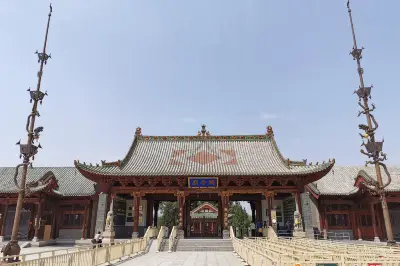
The Duan Gate, with its red walls and green eaves, echoes the color scheme of the Forbidden City, exuding solemn dignity and extraordinary poise.
Between the Four-Dragon Wall and the Duan Gate, hitching posts lie quietly on the ground, signaling to all civil officials and military officers passing through that they must dismount and proceed respectfully, never with disrespect or haste.
Stepping through the Duan Gate, you encounter the Zhi Gate, Meridian Gate, Shanhai Zhongling Archway, Imperial Book Pavilion, Chongning Hall, and the Spring and Autumn Pavilion one after another, as if strolling through a palace. The scenery shifts with every step, each one breathtaking. Who else commands such posthumous majesty as Guan Yu?
Even the minor decorative elements radiate the same aloof pride and dignity as their lord.
The lonely Green Dragon Crescent Blade stands silently beside the steps, never again to see its master mounted and charging into battle.
Only the gleaming stone altar in front of the hall bears deep blade marks, which later generations interpret as Guan Gong sharpening his weapon on the night of the 13th day of the fifth lunar month each year. According to legend, his spirit would descend and test the keenness of his Green Dragon Crescent Blade on the whetstone. And a huge footprint under the corridor? Folklore says it’s where Guan Gong, impatient to charge into battle to protect his sister-in-law, aid his sworn brother, and restore the Han Dynasty, stepped—one foot still in the corridor, the other already atop Zhongtiao Mountain three li away.
Thus the rolling Yangtze River flows east, its waves washing away heroes… So many events, ancient and modern, all surrendered to jest and laughter. In the river of history and the unfolding of real events, Guan Yunchang may not have been as supremely great as the Romance of the Three Kingdoms portrays. Yet it is his unwavering loyalty, his primacy of righteousness, and his peerless valor that captivate the world and remain the source of his spiritual power.