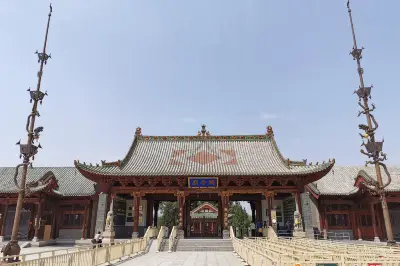
Ruicheng, Yongle Palace (A September Journey through Henan and Shanxi)
On the morning of September 18, an Iveco minibus with only two passengers pulled out of the station. Leaving Henan, we entered Shanxi again. The driver was warm and chatty, introducing the scenery along the way and remarking with a sigh, "Very, very few people go to Ruicheng to see Yongle Palace, and if they do, they're solo travelers like you." On the road, we encountered the lively sound of suona music—it was a farmer's family marrying off their daughter. Back at the hotel, I looked at the photos. In one, a man was holding a sign that read: Dowry: 100,000 yuan. Oh, a local custom. It is said that when it comes to murals, Yongle Palace can rival Dunhuang. For single panels alone, one hall covers over 400 square meters, and the three halls together total more than 1,000 square meters—a unique sight in China. It is truly magnificent and unprecedented. A Yuan Dynasty Daoist temple, Yuan Dynasty murals! The colors are vivid, the lines fluid, and the figures, deities, and immortals each have distinct forms and rich expressions, almost coming to life.
There were no tour groups here, so no chance to eavesdrop on a guide's commentary. I had to hire a guide. Photography was also prohibited, so I could only take a few reproduction shots from a picture book. It's said this place is highly esteemed in art circles. This temple was relocated from the reservoir area because of the construction of the Sanmenxia Dam. The relocation, from 1957 to 1967, took a full ten years. Don't worry about damage—the engineers and craftsmen of that era were top-notch in both dedication and skill! In the Hedong region, across the land of Yuncheng, it seems that exploring ancient sites is the main pursuit. There are ruins of the ancient capital of the Wei state from the Western Zhou period. At Yongle Palace, I met another solitary traveler admiring the murals—a successful middle-aged sculptor. The two of us teamed up and braved the rain to visit the Tang Dynasty Guangrenwang Temple (also called Five Dragon Temple, known for its distinctive dougong brackets) hidden in a Ruicheng village, and then the City God Temple with architecture spanning the Song, Yuan, Ming, and Qing dynasties, covering them all one by one. Sharing: