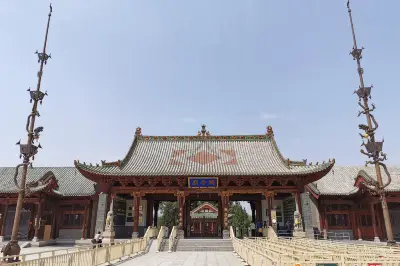
2022 Two-Day Self-Driving Tour from Taiyuan to Yunqiu Mountain and Wulaofeng
Bask in the sunshine, breathe the fragrance of flowers. No talk of joy or sorrow, nor days gone by. Pack your bags and bloom to your heart's content.
I bought a Yuncheng annual tourist pass during last year's National Day holiday, and it's still valid this year. Of the slightly famous scenic spots in Yuncheng, Wulaofeng was the only one I hadn't climbed yet. Going all that way just for Wulaofeng seemed a bit wasteful, so why not slip in Yunqiu Mountain from Linfen as well?
Yunqiu Mountain is quite intriguing—its reputation is so modest that many people in Shanxi haven't even heard of it. But at some point, it quietly became a 5A-rated scenic area. Since it's a 5A, it shouldn't disappoint, right?
On July 25, 2022, we departed from Taiyuan at 7 a.m. Passing the Lingshi section, we ran into a heavy rainstorm. After driving through the rain for twenty minutes, the sky cleared up, cloudless and bright, with not a trace of the downpour. I couldn't help but sigh: China is truly vast—indeed, it's sunny in the east while it rains in the west.
We arrived smoothly at the Yunqiu Mountain scenic area after 11 a.m. (When exiting the highway, everyone had to scan the venue code and show proof of a negative nucleic acid test.)
Yunqiu Mountain is where ancient sky observation and timekeeping began, where the culture of Zhonghe took root, and where the Longmen branch of Chinese Taoism originated and spread. They publicise it as being on a par with Wudang Mountain, boasting the grand reputation of 'North Yunqiu, South Wudang.' The hype feels almost as overblown as Moutai liquor's sales pitch!
The scenic area features a rich variety of plant species and uniquely marvellous natural landscapes.
Past Zhenwu Summit, the God of Wealth Hall and the Lord Guan Hall stand on either side.
Wulong Palace takes about thirty to forty minutes to see. From there, we took the shuttle bus to Babao Palace.
Babao Palace was first built in the early Qing Dynasty. It is said to have been jointly constructed by the Huashan and Longmen sects, making it a rare temple combining Confucianism, Taoism, and Buddhism under one roof.
The Sanzu Hall inside Babao Palace enshrines Confucius, Sakyamuni, and Laozi (Li Er).
The Jiuku Tianzun Hall is dedicated to the Three Eastern Saviours of Suffering.
After leaving Babao Palace, we flagged down a vehicle to go up to Kangjiaping ancient village.
After lunch, we took the cable car (50 yuan) up to Zushi Peak—it was already past 2 p.m.
Yulian Cave was established during the Yuan Dynasty. It was the cultivation site chosen through divination by the Yuan-era hermit Qiu Chuji (Changchun Zhenren) and his direct disciples Sun Zhijian and Lü Zhizhong. Qiu Chuji founded the Longmen branch of Quanzhen Taoism, so Yulian Cave became its birthplace.
Sanqing Hall is a wooden-stone structure with a hanging-saddle roof, housing Taoism's highest divine pantheon, the 'Three Pure Ones and Four Sovereigns.'
The 'Three Pure Ones' are the Yuanshi Heavenly Lord (Jade Purity), the Lingbao Heavenly Lord (Supreme Purity), and the Daode Heavenly Lord (Grand Purity). The 'Four Sovereigns' are the four celestial emperors, second only to the Three Pure Ones, who rule all things in heaven and earth: the Jade Emperor, the Central Heaven North Star Great Emperor, the Gouchen Shanggong Heavenly Emperor, and the Empress of the Earth.
Ta'erpo got its name from Laozi (Li Er) who once roamed here. This ancient village has a history of around 2,000 years.
The village is built into the hillside, featuring cave dwellings carved from the earth and tile-roofed houses of wood and stone—a living fossil of surviving ancient dwellings.
The next day was for Wulaofeng. While booking tickets online, I found that the area around Wulaofeng wasn't very lively, but the web said the Shen Tan Grand Canyon, ten kilometres away, was bustling at night, so I booked a guesthouse near Shen Tan.
After eight, it was dark. When we got near the guesthouse, everything was pitch black; even the streetlights were off. What kind of place had we come to?
Luckily, we were exhausted. The guesthouse was so quiet, and after washing up, we fell asleep almost immediately...
Passing Yongji Electric Motor Factory, we saw it was quite lively there. We stopped for breakfast and browsed the market. The flatbreads from Jishan were simply delicious. We didn't reach Wulaofeng until 11 a.m.
Wulaofeng was originally called Wulaoshan (Five Elders Mountain). It was named after five ancient elders who presented the ancient emperors with the 'He Tu' and 'Luo Shu' diagrams.
Before the 'Book of Changes' was written, Wulaofeng was an early centre for spreading He-Luo culture and one of the birthplaces of the northern Quanzhen Taoist sect, hailed as the '62nd Blessed Land in Taoism.'
By 3:30 p.m., we were heading down the mountain. Along the way, we noticed rows of plastic greenhouses around Yongji villages, many seemingly filled with persimmon trees. Are persimmons famous in this area?
Five hours later, we were back in Taiyuan without a hitch. When exiting the highway, the toll collector saw my Jin A licence plate and asked where I had entered the highway; seeing I hadn't left the province, they simply stuffed a huge travel permit through the window. Just as I was wondering why, someone snatched it back again fifty metres on. No one checked my health code or nucleic acid test certificate—that was rather considerate.