Yuncheng: A Hidden Gem - 1, 2 & 3 Day Itineraries
Many people are unfamiliar with the name "Yuncheng." Which province is this city in? What is there to see and do?
This is the biggest misconception about Yuncheng. Here you'll find brilliantly colored salt ponds, exquisite ancient architecture, and stunning murals.
Everyone knows the verse "The white sun sets behind the mountains, the Yellow River flows into the sea," but few realize that the "tower" to "ascend a further storey" is the Stork Tower (Guanque Tower) in Yongji County, Yuncheng, Shanxi. The poet Wang Zhihuan was also from Yuncheng.
Yuncheng has produced a remarkable number of famous figures. Sima Guang, who smashed a water vat to save a child and later compiled the historical work Zizhi Tongjian; Lu Lun, author of the line "About to pursue with swift riders, heavy snow weighing down bows and sabers"; Liu Zongyuan, one of the Eight Great Prose Masters of the Tang and Song dynasties and the first to launch a "regional jab" ("Yongzhou's wilderness produces strange snakes…"); Guan Hanqing, a leading playwright of the Yuan dynasty.
If you're a fan of historical gossip, this is also the birthplace of Yang Yuhuan (Imperial Consort Yang)…
Yuncheng's heritage goes far deeper. This is where 5,000 years of Chinese civilization began. The first fire in the Nine Regions was kindled at Xihoudu, and the first silkworm in China was raised by Leizu. The Yellow Emperor and Chiyou fought a great battle here over the salt ponds, and Emperor Yu established his Xia dynasty capital here.
Yuncheng truly is a lost treasure of a travel city.
I spent three days in Yuncheng at the end of July and have distilled the highlights into one-, two-, and three-day itineraries. Choose one based on your time and interests.
Recommended route: Yuncheng Museum → Yuncheng Salt Lake → Guandi Family Temple → Haizhou Guandi Temple
If you want to deeply understand a city, first visit its museum.
This is especially true for a city with such a long history. You'll discover that the ground beneath your feet, the weathered buildings before you, and even the most unassuming alleys are filled with countless stories.
The Yuncheng Museum holds 5,000 years of China's wind and rain. In the "Seeking Roots of Huaxia" hall, you can see one of the most important findings of China's first modern archaeological excavation: the earliest discovered half of a silkworm cocoon. It corresponds to the legend of "Leizu starting silkworm breeding."
The "Salt Through the Ages" (Gu Salt Chronicles) hall on the second floor shows Yuncheng's history of prospering because of salt. Once you know this story, visiting the salt lake becomes much more than just looking at a big salty pond.
In the "Outstanding People" hall, one after another familiar name will pop up until you become numb. Apart from the figures mentioned earlier, you may not know "Wang Tong," but you've definitely loathed his grandson. The culprit who forced you to memorize the entire Preface to the Pavilion of Prince Teng: Wang Bo.
You may not know who "Madam Wei" is, but she had a student you definitely know: Wang Xizhi, the sage of calligraphy.
This is also the hometown of the legendary immortal Lü Dongbin and the hero Guan Yu.
Another hall you absolutely shouldn't miss is "The Splendors of Civil Architecture," showcasing famous historical buildings from Yuncheng. In addition to the Stork Tower from "ascend a further storey," there is another primary school text called "Salvaging the Iron Oxen." The actual massive iron oxen from the Yellow River are displayed right opposite the Stork Tower. Then there's Yongle Palace, with its perfectly preserved Yuan dynasty murals; the Flying Cloud Tower (Feiyunlou), ranked alongside the Yingxian Wooden Pagoda as the "Northern Pagoda and Southern Tower"; and the Guangrenwang Temple, one of only four remaining Tang dynasty wooden structures in China... In a county you may have never heard of, there are national treasure–level sites.
Allow about 2–3 hours for the Yuncheng Museum. Definitely listen to a guided tour (volunteers are available, free of charge). Without guidance, you'll likely end up just thinking, "Oh wow, awesome / that looks so cool / what a beautiful bowl."
But following a guide lets you travel through five millennia in just a short time.
Compared to Chaka Salt Lake and Qarhan Salt Lake, Yuncheng Salt Lake is not as famous. Yet it is one of the world's three largest sodium sulfate–type inland salt lakes, and its brine buoyancy is about 30% greater than freshwater. That's why it has a well-known nickname:
"China's Dead Sea."
The scenery is equally impressive. Under the blazing sun, the salt ponds turn pink. So be sure to choose the right season; otherwise, you might only see a big pool of murky water.
I deliberately went at the hottest time around noon. As soon as I stepped into the salt pond, the water near my feet had already turned a faint pink.
Because light reflection is greater from a high angle, the drone's perspective is even better, with higher color saturation.
Guandi Family Temple, Bronze Statue & Haizhou Guandi Temple
As mentioned earlier, Yuncheng is Guan Yu's hometown. There is more than one Guandi Temple here. On the way from the salt lake to Haizhou, you'll first pass the Guandi Family Temple.
On the hill opposite the family temple stands a large bronze statue of Guan Yu.
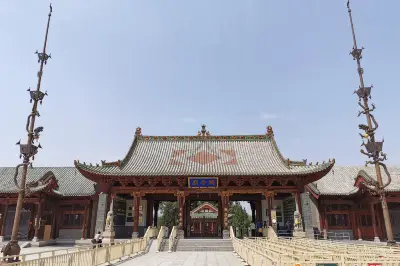
More famous than the family temple is the Guandi Temple in Haizhou (pronounced "hai" with a falling tone). This is the largest martial temple in China, originally built during the Chen and Sui dynasties.
It's worth noting the plaque above the temple gate.
A friend commented: "Could it be that those two characters read 'Shen Yong' (Divine Bravery)…?"
The first day ends here, full and fulfilling. If you're just passing through or short on time, this route works well.
If you have more time after exploring downtown Yuncheng, you can head to the surrounding counties.
Renting a car or driving yourself is recommended, as Yuncheng's attractions are scattered across various counties and public transport is limited.
In the morning, you can go straight to Yongji County and follow this route: Pujiu Temple → Stork Tower → Yellow River Iron Oxen.
In the afternoon, move on to Ruicheng County to visit Fenglingdu, Yongle Palace, and Guangrenwang Temple.
Pujiu Temple (Setting of The Story of the Western Wing)
The three sights in Yongji County are close together. First up is Pujiu Temple, where the famous drama The Story of the Western Wing takes place. Inside is the Yingying Pagoda.
This is also the origin of the term "hongniang" (matchmaker), still used today.
Not far from Pujiu Temple is the Stork Tower. Compared to the other three of the "Four Great Towers" — Tengwang Pavilion, Yellow Crane Tower, and Yueyang Tower — the Stork Tower shares Yuncheng's low-key character. Many people can recite "The white sun sets behind the mountains" but don't know the poem is called "On the Stork Tower."
The Stork Tower was rebuilt in 1997, and many criticize this. I think it's unnecessary. The fame of the Four Great Towers comes not from the bricks and mortar but from the literary heritage behind them.
You can climb to the top floor and gaze into the distance at the Yellow River, watching the great river flow east, and feel the heroic spirit Wang Zhihuan once felt.
If your memory serves, you might recall another primary school text, "Salvaging the Iron Oxen." The actual iron oxen are on display at the old Pujin Ferry site opposite the Stork Tower.
You can first visit the museum to learn about the origin of the oxen (which consumed a quarter of the world's iron at the time), then head up to see the real thing.
Every time I see something I read about in innocent childhood appear before my eyes, a special feeling arises.
Since the three scenic spots are very close, driving takes little time. In the afternoon, you can explore Ruicheng County.
Ruicheng: Fenglingdu + Yongle Palace + Guangrenwang Temple
If you're a Jin Yong fan, this is a must-visit spot. Here, Guo Xiang first met Yang Guo — a single glance that shaped her destiny.
Guo Xiang's disciple took the Buddhist name "Fengling Shitai," unconsciously carrying a trace of melancholy. It's one of Jin Yong's unfulfilled longings.
Uh... Fengling Shitai's own disciple is actually far better known...
"Miejue Shitai" (the Abbess Miejue)...
In reality, Fenglingdu is a ferry crossing at the junction of three provinces (Shanxi, Shaanxi, and Henan), where a rooster's crow can be heard in all three. It's a strategic point contested by many armies. In the Three Kingdoms period, Cao Cao's campaign against Ma Chao took place here.
The Yellow River rolls eastward, day after day, year after year. Our ancestors were born here, grew up here, and grew old here.
Yongle Palace is one of the three main ancestral temples of Quanzhen Taoism. There are two highlights. First, the perfectly preserved Yuan dynasty murals inside, often called the "Oriental Gallery."
I strongly recommend hiring a guide; otherwise you might mistakenly think the Jade Emperor and the Queen Mother of the West are a married couple (actually, the Queen Mother's proper partner is the Eastern Sovereign, Donghua Dijun).
The other highlight is the world–renowned relocation project. When viewing the murals, you'll notice cutting marks. That's because the entire Yongle Palace was "moved."
Its original site was in the flood zone of the Sanmenxia Reservoir. To protect the cultural relics, Premier Zhou Enlai personally approved the dismantling of the original palace. The murals were cut into pieces, then reassembled and pasted onto the walls of a newly built palace in the exact original order.
The relocation of Yongle Palace broke new ground in many ways, costing over 2.2 million yuan at the time, and is hailed as the "Number One Project" in China's cultural relics history.
Guangrenwang Temple is about 2 kilometers behind Yongle Palace. It may look like a tiny temple, but it is one of only four surviving Tang dynasty wooden structures in China. Even if you're not an architecture buff, it's worth a visit to check it off your list.
If you still have time and are driving, you can see some other sights. I went to Wuwang Ancient Ferry, one of the rare places in China where a pontoon bridge is still in use. The bridge is supported by boats, and the opposite bank is Shaanxi.
Day 3 route: Houtu Temple + Li Family Courtyard + Feiyun Tower.
Still recommend driving; these three spots are quite far apart.
In the morning, start with the Temple of Houtu ("Imperial Heaven and Mother Earth"). Houtu is the central god and earth mother in ancient Chinese mythology; more popularly she is called "Houtu Niangniang."
There is also the Autumn Wind Pavilion, where Emperor Wu of Han composed his "Ode to the Autumn Wind."
Behind the pavilion is the Five–Color Altar, containing earth of five colors. Next to it is the ancient road where Zhang Yi departed to become the prime minister of Qin. During the War of Resistance, the Eighth Route Army also passed this way.
Shanxi's "courtyard residences" are not limited to the Qiao and Wang families; Yuncheng has the Li family, famed for their "benevolence."
Because one master of the Li family married an English wife, the courtyard features several Gothic architectural elements — unique among Shanxi merchant family compounds.
Here you can also find China's earliest security door. Japanese soldiers battered it for a long time but couldn't break it open, leaving only bayonet marks.
The Yingxian Wooden Pagoda is world–famous. Yet Feiyun Tower, equally renowned and paired as the "Northern Pagoda and Southern Tower," remains largely unknown.
Sigh, Yuncheng's attractions are always so understated.
Three days in Yuncheng passed quickly. I visited many places but still left wanting more.
In fact, Yuncheng has over 240 sites, including relics and former residences of famous people. Three days only scratches the surface of the highlights. A trip here will absolutely exceed your expectations.
Don't let this treasure of a travel destination stay hidden any longer. Before August slips away, come and see the salt lake soon.
Travelogue Contents: 1. Foreword 2. One-Day Yuncheng Itinerary: City Sights 3. Two-Day Itinerary: Yuncheng Yongji County + Ruicheng County 4. Three-Day Itinerary: Yuncheng Wanrong County 5. Conclusion Travel Information Hotel Index Itinerary Index Flight Index Website Navigation Travel Index Cruise Index Corporate Travel Index Join & Cooperate Affiliate Distribution Alliance Friendly Links Corporate Gift Cards Procurement Insurance Agent Agent Cooperation Hotel Joining Destination & Scenic Area Cooperation More Join & Cooperation About Ctrip About Ctrip Ctrip Hot Topics Contact Us Join Us User Agreement Privacy Policy Business License Security Center Ctrip Content Center Intellectual Property Trip.com Group Algorithm Announcement