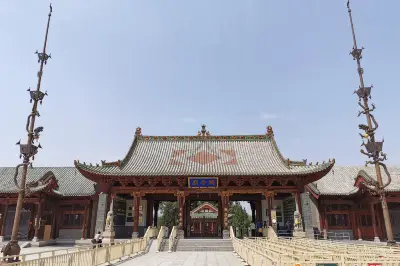
Houtu Temple in Wanrong, Yuncheng
Fenyin Houtu Temple, commonly known as Houtu Temple and now also called Wanrong Houtu Temple because of its location, lies in Miaomiaoqian Village on the east bank of the Yellow River, 40 kilometers southwest of Wanrong County, Yuncheng City, Shanxi Province. Situated on the south bank of the Fen River and the east bank of the Yellow River, it was designated a fourth batch national key cultural relic protection unit in 1996. Fenyin Houtu Temple was the principal temple established by Emperor Wu of Han for sovereign worship of the earth deity. Many emperors of the Han, Tang, and Song dynasties personally offered sacrifices to Houtu here.
The temple's original site was the famous 'Fenyin Shui Land' in Chinese history, which during the Eastern Zhou period belonged to the State of Wei and was also called 'Wei Shui'. When King Hui of Qin attacked Wei, crossing the river to seize Linyin, it referred to this area. It was a natural earthen mound located two li northwest of the ancient Fenyin County seat of Han times, to the southeast of the original confluence of the Fen and Yellow Rivers. According to the Northern Wei geographer Li Daoyuan's 'Commentary on the Water Classic', 'On the mound at the northwest corner of Fenyin City there is a Houtu Temple.' Emperor Xuanzong of Tang described it as 'where the Fen River joins the Yellow River, with Mount Liang on the opposite foothills, a terrain of piled mounds, naturally peculiar.' Legend has it that in remote antiquity the Yellow Emperor once offered sacrifices to the earth god here by sweeping the ground to create an altar, which later led to the construction of the Xuanyuan Sweeping Altar within the temple.
In the second year of Yuanshou (121 BC), Emperor Wu of Han wished to worship the earth god Houtu to complement his sacrifices to the heavenly god Shangdi. The Grand Historian Sima Tan and the ritual official Kuan Shu proposed that a round altar should be built in a marsh for worship. Fenyin met the conditions for establishing such a shrine. Around that time, a local man named Gongsun Pangyang and others saw a crimson glow beside the Fen River and reported it to the emperor. Thus, a temple was built on the Fenyin mound, and the emperor came in person to worship, later decreeing that he would do so once every three years. During Emperor Wu's reign, he personally offered sacrifices to Houtu eight times. (Records of the Grand Historian, Volume 28: Treatise on the Feng and Shan Sacrifices: 'The Son of Heaven now established the cults of Taiyi and Houtu, personally performing suburban sacrifices every three years.') It is said that the 'Ode to the Autumn Wind' was composed on a journey to sacrifice to Houtu. Afterwards, Emperor Xuan of Han came three times, Emperor Yuan of Han three times, Emperor Cheng of Han once, Emperor Ai of Han once, and Emperor Guangwu of the Eastern Han, Liu Xiu, once to personally worship Houtu.
In the sixth month of the fourth year of Yuanding (113 BC), a shaman named Jin from Fenyin discovered a precious tripod near the temple. It measured eight chi and one cun in circumference and three chi six cun in height, and was unlike ordinary tripods. After Emperor Wu confirmed it was an ancient ritual vessel, he had it taken to Ganquan Palace and placed in the suburban temple.
After Emperor Cheng of Han ascended the throne, Chancellor Kuang Heng and Imperial Secretary Zhang Tan submitted a memorial arguing that the sites for sacrificing to heaven and earth should be in the southern and northern suburbs of the capital Chang'an, in accordance with ancient ritual. They noted that traveling to the Tai Altar at Yunyang and Houtu Temple at Fenyin was both exhausting for the people and perilous—especially crossing wide rivers with the dangers of wind and waves. Therefore, in the first year of Jianshi (32 BC), the southern and northern suburbs were established in Chang'an to replace the Tai Altar and Houtu Temple respectively. After a period of reversals, this arrangement was finally settled, and the southern and northern suburban altars eventually evolved into Beijing's Temple of Heaven and Temple of Earth.
After the Han dynasty, although Fenyin ceased to be the primary site for Houtu worship, there were still emperors who came in person to sacrifice there, such as Emperor Xuanzong of Tang and Emperor Zhenzong of Song.
In the 11th year of Kaiyuan (723) and again in the 12th and 20th years, Emperor Xuanzong of Tang personally worshipped Houtu to pray for a good harvest. During temple repairs, three more precious tripods were unearthed, leading to Fenyin County being renamed Baoding (Precious Tripod) County.
In the sixth month of the third year of Dazhong Xiangfu (1010), Xue Nan, a presented scholar from Hezhong Prefecture, and others petitioned to sacrifice to Houtu. In the seventh month, court officials submitted another memorial requesting it. In the second month of the following year, Emperor Zhenzong of Song personally worshipped Houtu, elevating the rite to the same level as the Feng and Shan sacrifices at Mount Tai, making it a major state ceremony.
During the Jin and Yuan dynasties, because the temple was in a relatively remote location and it was inconvenient for the emperor to travel, sacrifices were delegated to officials. After the Ming dynasty built the Temple of Earth, official Houtu ceremonies were no longer held at the temple, which then became a place of folk worship.
After its renovation in the 11th year of Kaiyuan (723) of the Tang dynasty, the temple was described as 'magnificent in scale, equal to a royal residence.' In the third year of Dazhong Xiangfu (1010), due to the sacrificial requirements, Emperor Zhenzong had the temple expanded and rebuilt to a national standard, making it a representative example of Northern Song religious architecture. Local gazetteers praised it as 'solemn and grand, the foremost temple in the realm.'
It was rebuilt many times over the centuries. In the ninth year of Tongzhi (1870) of the Qing dynasty, after the temple was inundated by the Yellow River, the county magistrate Dai Ru relocated it to the current site and rebuilt it.
The temple faces south and measures 240.81 meters from north to south, 105.21 meters from east to west, covering an area of 25,268 square meters. Along the central axis stand, in order: a three-bay mountain gate (which also serves as a stage), a double-connected seven-bay stage, a five-bay offering hall, a one-bay incense hall, a five-bay main hall, and the Qiufeng Tower. In front of the double stage are the bell and drum towers. In front of the offering hall, there are east and west side halls, each three bays, called the Wu Hu Halls: the east hall enshrines the Five Great Mountain Emperors, and the west hall honors the Five Tiger Generals of the Shu Kingdom during the Three Kingdoms period. To the east of Qiufeng Tower stands a stele pavilion housing the 'Fenyin Two Sages Accompanying Sacrifice Inscription' (also known as the 'Screen Wall Stele') composed by Emperor Zhenzong of Song in the fourth year of Dazhong Xiangfu. Among the structures, the mountain gate dates from the Yuan dynasty, the Qiufeng Tower is a surviving Ming-dynasty structure, and the rest were built in the late Qing dynasty.
The Qiufeng Tower (Autumn Wind Tower) is named after the stone stele housed inside bearing Emperor Wu of Han's 'Ode to the Autumn Wind.' Its exact construction date is unknown, but its present form and structure date to the Ming dynasty. The tower is 30 meters high, built on a massive raised platform that connects north to south, surrounded by a brick balustrade with carved floral patterns. On the east and west sides are horizontal plaques reading 'Gazing toward Lu' and 'Looking toward Qin' respectively. The tower has three stories with a cross-ridged hip roof. Leaning on the balustrade, one takes in the sweeping view of the Yellow River surging below. On the top floor is a stone inscription from the Dade era (1297–1307) of the Yuan dynasty, carved with Emperor Wu's 'Ode to the Autumn Wind': 'The autumn wind rises, white clouds fly; grass and trees wither, wild geese return south. Orchids show their beauty, chrysanthemums their fragrance; I hold the fair one, I cannot forget. Floating tower ships, we cross the Fen River; midstream we row, raising white waves. Flutes beat and drums sound, as the boatmen sing; joy reaches its peak, yet sorrow abounds. Youth and strength are but brief — what can I do about growing old!'