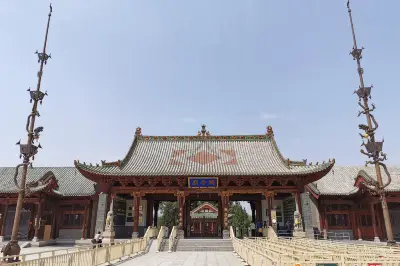
Haizhou Guandi Temple, Yuncheng, Shanxi
Haizhou Guandi Temple is situated in Haizhou Town, Yanhu District, Yuncheng City, Shanxi Province. It is the largest Guandi temple in China and ranks among the three major Guandi temples at home and abroad.
The temple was first built in the ninth year of the Kaihuang era of the Sui Dynasty (589 AD), rebuilt in the seventh year of the Dazhong Xiangfu era of the Song Dynasty (1014), and after repeated destruction and reconstruction, the current Haizhou Guandi Temple was rebuilt after the forty-first year of the Kangxi reign of the Qing Dynasty (1702), with its main structures dating from the Qing period.
The temple layout runs east-west and is divided into south and north sections. The southern part is the Brotherhood Garden (Jieyi Yuan), which includes, in order: Brotherhood Archway (Jieyi Fang), Pavilion of Gentlemen (Junzi Ting), Pavilion of Three Sworn Brothers (Sanyi Ge), Lotus Pond, and rockeries. The northern part is the main temple, further divided into a front courtyard and rear palace. From south to north, the front courtyard features: Screen Wall (Zhaobi), Duan Gate (Duan Men), Pheasant Gate (Zhi Men), Meridian Gate (Wu Men), Shanhai Zhongling Archway, Imperial Calligraphy Tower (Yushu Lou), and Chongning Hall (Chongning Dian). The rear palace is centered around the Qisu Qianqiu Archway and the Spring and Autumn Tower (Chunqiu Lou), flanked symmetrically by the Sword Tower (Dao Lou) and Seal Tower (Yin Lou). The east courtyard contains Chongsheng Shrine, Sanqing Hall, Zhu Gong Shrine, Baoyuan Palace, Xiangsheng Palace, and East Garden. The west courtyard includes Changshou Palace, Yongshou Palace, Yuqing Palace, Xinsheng Palace, Daozheng Office, Huishan Office, and West Garden. The entire temple complex comprises over a hundred halls and chambers, majestic in scale and revered as the 'Foremost of Martial Temples'. Hanging within are plaques with imperial inscriptions: 'Righteousness Illuminates Heaven and Earth' handwritten by the Kangxi Emperor, 'Divine Valor' endorsed by the Qianlong Emperor, 'Exemplar for All Ages' handwritten by the Xianfeng Emperor, and 'Majestic Power Reverberates' inscribed by Empress Dowager Cixi.
The Brotherhood Garden was first built in the 48th year of the Wanli reign of the Ming Dynasty (1620) under the supervision of Zhang Qilong, then Prefect of Haizhou. A major expansion took place in the 27th year of the Qianlong reign of the Qing Dynasty (1762), and it was named 'Brotherhood Garden'. The garden consists of an archway, Pavilion of Gentlemen, Brotherhood Pavilion, rockeries, and other features. The archway is tall and grand, a four-pillar, three-storey wooden structure, with a single-eave gabled roof; its carvings are exquisite, making it the most magnificent wooden archway in the Guandi ancestor temple. The Brotherhood Pavilion is the main structure in the garden. In front stand two ancient pine trees with gnarled, vigorous branches and lush green needles. The pavilion is five bays deep and five bays wide, with a single-eave rolled-shed gabled roof and a surrounding veranda. Inside is a stone tablet, 2 meters wide and 1 meter high, bearing a line-carved depiction of the story of Liu Bei, Guan Yu, and Zhang Fei pledging brotherhood in the peach orchard, with ancient trees twisting like dragons, slender bamboo, and peach blossoms in full bloom, evoking the original scene.
The Four-Dragon Wall stands directly south of the Duan Gate of the ancestor temple. It is a glazed screen wall fired during the Xuande period of the Ming Dynasty (1426–1435). The panel is divided into three realms from top to bottom: heaven, earth, and sea. It features four coiling dragons soaring and writhing, complemented by auspicious creatures such as phoenixes, qilin, and jade rabbits.
Chongning Hall is the main hall of the Guandi Temple, named after the title 'Chongning Zhenjun' (True Lord of Exalted Peace) bestowed on Guan Yu by Emperor Huizong of the Song Dynasty. On the moon terrace in front of the hall stand a bronze incense burner and a rectangular offering table, both cast in the Qing Dynasty imitating ancient styles. The stone steps leading up to the terrace are carved with scrolling grasses, flowing clouds, and a design of two dragons playing with a pearl, reminiscent of imperial palace norms. The hall is seven bays wide and six bays deep, with a double-eave hipped roof. Surrounding the hall are 26 massive stone columns carved with dragons. These pillars feature ascending dragons, descending dragons, and auspicious clouds, carved in a bold, powerful style that contrasts sharply with the delicate carvings on the architraves above, each enhancing the other's beauty. As an inscription in the temple declares: 'The stone pillars on the terrace, carved with soaring dragons, and the temple's magnificent appearance are the finest under heaven.'
In front of the Spring and Autumn Tower stands the 'Qisu Qiangqiu' ('Awe-Inspiring Spring and Autumn') archway, a four-pillar, three-bay, three-storey structure with ten supporting struts. At the center of the roof ridge is a glazed gourd symbolizing blessings and prosperity, flanked by a pair of glazed phoenix finials – the only ones of their kind in Shanxi. The tower's second storey features a suspended beam and hanging column structure, a rare gem in ancient Chinese architecture. Carved panels depict lotuses, chrysanthemums, and auspicious beasts. The lower architrave of the central bay is embossed with dragon heads and flowers, and drum-shaped bearing stones are placed in front and behind the pillars. On either side of the archway stand cast-iron lions and iron figures of foreign grooms (the archway, iron figures, and iron lions are all integral parts of the Spring and Autumn Tower). The lions hold their heads high, chests out, mighty and robust; the iron figures have high noses and deep-set eyes, representing foreign keepers of the lions.
Duan Gate is the first gate of the main temple, built in the Qing Dynasty. Constructed entirely of brick with a gabled roof, it features imitation wood brick corbel brackets under the eaves. The gate has three openings, and above the central entrance are plaques reading 'Guandi Temple' and 'Supporter of the Han Dynasty', among others. The brick relief carvings around the plaques are especially fine, depicting two flying dragons amid clustered floral motifs. Flanking the gate are two iron lions cast in the 48th year of the Wanli reign (1620), each nearly four meters tall, with finely wrought patterns, clear inscriptions, and excellent casting quality.
The Bell and Drum Towers are located on the east and west sides between Duan Gate and Pheasant Gate, connected to the front wall's eastern and western corners of the main temple. They were first built in the 37th year of the Wanli reign of the Ming Dynasty; the existing structures date to the Qianlong period of the Qing Dynasty. Both towers are square in plan and have two storeys. The lower section is a brick platform, and the upper storey is a wooden structure with a double-eave hipped roof. The roofs are entirely glazed, complete with ridge beasts, and the architecture is vividly crafted. Identical in form and appearance and symmetrically positioned, these pavilion-style towers were used to hang bells and mount drums, enhancing the temple's solemn dignity.
Pheasant Gate is the second gate on the central axis of the Guandi ancestor temple, north of Duan Gate, used exclusively by emperors. Its founding date is unknown; it was repaired in the Ming Dynasty, and the present structure is from the late Qing period. The gate is three bays wide and two bays deep, with a single-eave hipped roof. To the north is a music tower, integrated with the gate's platform and eaves, facing south and used as a stage for ritual performances honoring the deity and emperors. Thus, one gate serves two functions.
The Imperial Calligraphy Tower, originally called the 'Eight Trigrams Tower', stands at the center of the temple's central axis. The current building dates from the Kangxi and Qianlong periods. It has a front porch one bay wide with a single-eave hip roof, and a rear porch three bays wide with a single-eave rolled-shed roof. Inside, a wooden octagonal caisson ceiling is carved, topped with the Eight Trigrams pattern, hence the original name. In the 42nd year of the Kangxi reign (1703), Emperor Kangxi toured the west, paid homage to Guandi, and wrote the inscription 'Righteousness Illuminates Heaven and Earth'. In the 27th year of the Qianlong reign (1762), to commemorate Kangxi's calligraphy, Emperor Qianlong renamed it the 'Imperial Calligraphy Tower'.
The Bell Pavilion and Stele Pavilion stand on the east and west sides of Chongning Hall, both added during the Qing Dynasty. The Bell Pavilion, in the western corner in front of Chongning Hall, was reconstructed in the 14th year of the Jiaqing reign (1809); the iron bell inside was cast in the 17th year of the Shunzhi reign (1660). The Stele Pavilion, in the eastern corner, houses a poetry stele respectfully left by Prince Guo in the 12th year of the Yongzheng reign (1734). The two pavilions are opposite each other, similar in scale and form.
The Sword Tower and Seal Tower are located on the east and west sides in front of the Spring and Autumn Tower. The eastern tower is the Seal Tower and the western tower is the Sword Tower; both are identical in form. They are each three bays wide and deep, two-storey structures with three tiers of eaves and a cross-shaped hip roof. The Sword Tower houses a Green Dragon Crescent Blade, while the Seal Tower displays a square seal box of the Marquis of Hanshou Pavilion.
The Spring and Autumn Tower stands at the northernmost end of the temple's central axis, serving as Guandi's private quarters. Also known as the Lunjing Pavilion, it is named after Guan Yu reading the Spring and Autumn Annals by lamplight. Its exact founding date is unknown; it was rebuilt during the Wanli reign of the Ming Dynasty. The building is seven bays wide and six bays deep, a two-storey structure with three tiers of eaves and a hipped roof. On the first floor, a shrine enshrines a statue of Guan Yu in military attire; on the second floor, a shrine holds a true-to-life statue of Guan Yu reading the Spring and Autumn Annals at night. The inner walls of the warm pavilion are carved with the full text of the Spring and Autumn Annals. The ceiling features a suspended three-eye caisson, and around the tower are cantilevered beams and hanging columns – all masterpieces of ancient architectural art.