Southern Shanxi – A Gateway Through Time, an Ultimate Cultural Journey
Underground relics look to Shaanxi, above-ground heritage to Shanxi! Two trips to southern Shanxi over a decade ago gave me a first taste of the dazzling wealth of Shanxi’s above-ground antiquities. The Tang-era Tiantai Nunnery, standing solitary and peerless (later corrected to Five Dynasties after restoration); Qinglian Temple, cradled by mountains and streams, fusing ancient architecture, Tang sculptures, and Buddhist origins; Longmen Temple, nestled in the hills and encompassing buildings from the Five Dynasties, Song, Jin, Yuan, Ming and Qing; the magnificent and exquisite Yuan-dynasty murals of Yongle Palace; the rare surviving, brilliantly painted Five Dynasties murals at Dayun Monastery and the Song-dynasty Buddhist genre murals at Kaihua Temple; the ‘crown of Song sculpture’ – the Twelve Enlightened Beings at Faxing Temple and the Eighteen Arhats at Chongqing Temple; the twenty-eight constellations painted sculptures at Yuhuang Temple in Fucheng, whose artistic attainment rivals the European Renaissance; and the heavenly hanging sculptures of Guanyin Hall… each one a breathtaking masterpiece of ancient art! But time constraints and access policies back then left me locked out of many places, tinged with regret. Two years ago, an old college friend’s longing to visit Xiaoxitian in Xixian set this return journey in motion, a deep re-exploration of southern Shanxi.
Day 1 Zhengzhou > Anyang
Day 2 Anyang > Yecheng
Day 3 Yecheng > Pingshun > Changzhi
Day 4 Changzhi > Gaoping > Jincheng
Day 5 Jincheng > Xinjiang
Day 6 Xinjiang > Fencheng Town > Fenyang > Xixian
Day 7 Xixian > Jishan > Xiangning
Day 8 Xiangning, Yunqiu Mountain
Day 9 Yunqiu Mountain > Xia County > Ruicheng > Mianchi
Day 10 Mianchi > Longmen > Zhengzhou
Days 1 & 2: A Pilgrimage of Script and Buddhist Stone Art – Anyang Script / Yinxu Museum and Yecheng Archaeological Museum
On Day 1, after persistent efforts that saw flights swapped for high-speed rail, I reached that evening’s destination, Anyang. Day 2 formally launched our exploration of ancient writing and Shang dynasty ruins. First stop was a national first-class museum in Anyang’s urban district: the Chinese Character Museum.
— Chinese Character Museum —
Located at 656 East Renmin Avenue, Anyang, Henan Province, this state-approved museum integrates heritage conservation, exhibition, and scientific research. It is China’s first museum themed on writing. The complex blends modern architectural style with the elegance of a Shang palace: buildings include a character workshop, plaza, main hall, Cangjie Hall, science popularisation hall, research centre, and exchange centre, covering 143 mu (approx. 9.5 hectares) with a total floor area of 34,500 square metres. Its collection holds 4,123 artefacts, 305 of them grade-one, covering oracle bone inscriptions, bronze inscriptions, bamboo slips and silk manuscripts, the history of Chinese characters, calligraphy, minority scripts and world writing systems. – excerpted from Baidu
After exploring the museum, we drove a short distance north to the famed Yinxu Museum – the site where China’s verifiable written history begins. Yinxu spans both banks of the Huan River on Anyang’s northwest outskirts. Known in antiquity as ‘Beimeng’, ‘Yin Xu’, or ‘Yin Yi’, and in oracle bone inscriptions as ‘Da Yi Shang’ or ‘Shang Yi’, it was the late Shang capital, the first ancient capital in Chinese history with both documentary and archaeological proof, dating back 3,300 years. From 1300 BC, when Pan Geng moved the capital to Yin, until 1046 BC when King Di Xin perished, for 255 years this was the political, economic, military and cultural heart of the late Shang. – adapted from museum guide
— Yinxu Museum —
The Ya Zhang ox-zun, unearthed in 2001 from a tomb at Huayuanzhuang, Yinxu. Tomb intact, the ox’s face bears the inscription ‘Ya Zhang’, chief of the ‘Zhang’ state to the south of Shang, a military commander second only to Fu Hao and the tomb’s owner – a rare unlooted Shang tomb. This vessel is ox-shaped, 40 cm long, 22.5 cm high with lid, girth 52.5 cm, spout 12.9 x 9.1 cm, weight 7.1 kg. The ox is robust, head forward, mouth slightly open; its eyes, ears, nose, horns, belly, tail and features are vividly rendered. The body is richly decorated with dragon, bird, tiger, elephant and other animal motifs. Exquisite and unusual in form, intricately ornamented.
Oracle bone script is a mature square-character writing system, named after being incised on tortoise shells and animal bones. Yinxu has yielded about 150,000 inscribed shell and bone fragments, with over 5,000 individual characters and more than 100,000 divination inscriptions covering politics, economy, culture, astronomy, meteorology, and more. The museum’s oracle bone hall displays nearly 100 pieces, over 90% inscribed with divinations. The content is diverse, primarily sacrifice, warfare, hunting, and celestial events. In the script hall, ‘classified interpretation of oracle bone content’ provides the original characters, standard transcriptions, Chinese interpretations and English translations for pondering. One shell, once collected by Luo Zhenyu, records the Shang’s relations with powerful northwestern tribes: within less than 30 days, three individuals named Chang Youjiao, Qi Zhu, and Zhi Ga reported four invasions by Gong Fang and Tu Fang. The incursions also sparked local flight. – adapted from museum guide
Leaving Yinxu well past noon, we snacked in the car and rested briefly before driving 48 km to Yecheng Town (ancient Yecheng) in Linzhang County for the Yecheng Archaeological Museum, home to Northern Wei and Northern Qi Buddhist sculptures that shook the archaeological and art worlds.
Yecheng was the capital of six dynasties – Cao Wei, Later Zhao, Ran Wei, Former Yan, Eastern Wei, Northern Qi. In 2012, archaeologists carried a rescue excavation of the largest Buddhist sculpture burial pit found since the founding of the People’s Republic – the Bei Wuzhuang pit in the eastern suburbs of Yecheng. Most exhibits in the Yecheng Archaeological Museum come from that find. Pieces such as the Northern Wei statue of Sakyamuni commissioned by Tan Fu, the Northern Qi miniature pagoda, and painted standing Buddhas, as well as Sui-Tang sculptures, are breathtakingly beautiful, of immense artistic value. Notably, the ‘dragon-tree back screen’ Buddhist sculpture was the first discovery of its kind in the history of Chinese northern Buddhism. – excerpted from Baidu Baike
— Yecheng Archaeological Museum —
In the lobby’s prime spot stands the only Northern Qi white marble miniature pagoda found in the burial pit. The massive, fully polychrome and gilded body comprises a base, shaft, inverted bowl and spire. The four-sided niche-format shaft has two standing Buddhas in añjali mudra and one seated bodhisattva in each face. The crown is a fully inverted bowl in ancient Indian style – of immense historical and artistic value!
Before the 6th century, Buddhism in the Central Plains and north had gone through ‘Liangzhou mode’ and ‘Yungang mode’ stages. In Yecheng’s first phase, sculpture clearly bore Yungang traits. At the end of the 5th century, Emperor Xiaowen of Northern Wei’s sinification policies meant that the ‘loose robe, wide belt’ and ‘elegant bone, pure image’ style modelled on southern dynasties became mainstream. By the mid-6th century, under Wenxuan Emperor Gao Yang of Northern Qi, the ‘dragon-tree back-niche’ type became widely popular, a typical style of mid-to-late Northern Qi Buddhas centred on Yecheng. Yecheng’s Buddhist art shifted stylistically with politics, culture and social customs, mainly absorbing and learning from ancient Indian Buddhism – a crucial phase of Buddhist culture merging into native Chinese tradition. Influenced by Indian Gupta style, Yecheng produced a new kind of white marble sculpture with a double bodhi-tree back screen, a new-style Northern Qi Buddha as the main figure, and openwork carving. Exquisitely formed and distinctive, it was a radical departure from earlier pointed-arch back screen forms; scholars call it ‘dragon-tree back-niche sculpture’. It is said that both the widespread use of openwork and the entire bodhi tree backdrop are related to images of Prince Siddhartha (the future Sakyamuni) meditating beneath a tree. In 577 AD, with the fall of Northern Qi, Emperor Wu of Northern Zhou extended his persecution of Buddhism to Yecheng and the former Qi territory. Later, Yang Jian imposed a policy of city destruction and population relocation. Buddhism here was dealt a heavy blow: temples and pagodas were razed, monks scattered, and the ‘dragon-tree back-niche’ style, after flourishing for over 20 years, faded from history.
The Tan Fu statue of Sakyamuni is a national treasure. The face is damaged, but one can still see remnants of water-wave hair curls, the robe covering both shoulders, the right hand in abhaya mudra, the left holding the robe edge, standing barefoot on a lotus pedestal. On the back screen, symmetrical patterns of flying apsaras, flames, guardians, and donors can be seen. Interestingly, the apsaras here appear slightly stiff, lacking the fluidity of southern dynasty apsaras – perhaps an indication that the northern ethnic groups hadn’t yet fully adapted the Indian apsaras to Han aesthetics.
Almost all these sculptures are carved from white stone, distinct from the earlier bluish stone. ‘White stone’ is what we commonly call white marble. A belt of white marble runs along the eastern foot of the Taihang Mountains, stretching from Fangshan in Beijing southward through Quyang County to the Hebei-Henan border, right at Yecheng. We know the white marble sculptures from Xiude Temple in Quyang are famous, and quarrying white marble near Yecheng was easy. The fine-grained stone lends itself to openwork carving, yielding so many masterpieces.
‘White horse kisses foot’ is a key story from Buddha’s life, first appearing in the Wu-era translation of The Sutra of the Auspicious Beginnings of the Crown Prince by Zhi Qian. After Prince Siddhartha left the city and witnessed the sufferings of birth, old age, sickness and death, he vowed to find a way to free people from earthly pain. With the help of Indra, he broke free of palace restraints, mounted his beloved horse Kanthaka, left the city and entered the ascetic forest. In the quiet of nature, he felt sudden joy and clarity, dismounted to reflect, recalled endless worldly afflictions, and resolved to part with his servant and horse, sending them back so he could seek liberation alone. At that moment, the horse, “Kanthaka, hearing he was to be sent away, knelt and licked the feet, tears falling like rain.” The horse knelt and kissed Buddha’s feet, unwilling to leave. The prince saw this grief and shed a few tears too, then stroked the horse gently: “Kanthaka, do not grieve. I am deeply grateful to you. You have exhausted yourself serving me as a fine horse; your service is complete. Kanthaka, from now on you will be freed from evil rebirth, and you shall surely receive good karmic reward.”
The sculptures in this archaeological museum – their superb artistic expressiveness remains unforgettable long after! The craftsmen, names lost to history – what devotion they must have carried to create such masterpieces!
Anyang & Yecheng Tips:
A. External transport – Zhengzhou, a transport hub for North and Central China, has convenient flights and high-speed trains. Rental car services for self-drive tours are also well developed. The city is close to Anyang, Yecheng and southern Shanxi, making it a good transport node for this trip.
B. On-site transport – Both the Chinese Character Museum and Yinxu Museum are essentially within the greater urban area, reachable by car or taxi. For self-drivers, the Character Museum has a car park alongside. For Yinxu, navigate directly to the car park; walking in, you can easily detour onto the open archaeological area to see the Ya Zhang tomb site.
C. Food – For dinner in Anyang, find a local time-honoured restaurant to try the ‘three great treasures’: fenjiang fan (fermented rice porridge), pizha (starch cake), and blood cake. They’re reasonably tasty and distinctive. For breakfast, if not at the hotel, a neighbourhood shop serving bianfencai (flat noodle soup) is also distinctive. Dinner in Yecheng: try a donkey hotpot restaurant, rare in the south. Order two plates of donkey meat/offal with a mixed vegetable salad – the flavour is excellent!
D. Accommodation – Anyang has plenty of choice at all levels; book as needed. In Yecheng, options are limited. We stayed at a chain business hotel that was clean, tidy, well equipped and decent.
Day 3 will see us leave Henan and cross the Taihang Mountains into Shanxi. Before entering the mountains, our first stop en route is the Xiuding Temple Pagoda.
Leave Yecheng, head west towards Linzhou on Provincial Road 303 towards the Taihang Mountains. After Tongye Town, take a right turn onto County Road 006. Not far along, at the road’s end, a beautifully ornamented square pagoda stands on a small slope to the right.
— Xiuding Temple Pagoda —
Xiuding Temple Pagoda, commonly called ‘Tang Pagoda’, lies at the southern foot of Qingliang Mountain, over 30 km northwest of Anyang, inside the former Xiuding Temple (the temple is gone, the pagoda remains). Above its southern door lintel are carved the Buddhas of the Three Periods, hence also named ‘Three-Life Treasure Pagoda’. It is a single-storey square brick stupa with relief carvings. The pagoda comprises a spire, body and base, total height 20 m, body height 9.30 m, width 8.3 m. The body is hollow, with three solid walls and an arched door on the south. The base is Northern Qi (551–553), octagonal in plan; the body is square. Below is a waist-banded Sumeru pedestal, above a single layer of overlapping corbelled eaves. The spire has an elliptical vase atop an upturned lotus support. The interior chamber is built with small rectangular bricks. All four walls are covered with 3,775 moulded carved bricks in diamond, rectangular, triangular, parallelogram, pentagonal forms, and combinations of straight and curved lines, creating 76 patterns across 300 square metres – not a blank space remains. Patterns include Buddhas, disciples, bodhisattvas, guardians, warriors, heavenly kings, ladies, flying apsaras, musicians, blue dragons, white tigers, fierce lions, elephants, heavenly horses, giant pythons, assorted flowers and ribbons. The spire is of red, yellow and green glazed components. The entire pagoda, inlaid with high-relief bricks, resembles a splendid ornamental sedan chair from afar, evoking Li Bai’s verse: “Steadfast integrity pierces the clouds, a square vessel fit to carry far-reaching ambitions.”
In 1961, during a nationwide heritage survey, a team from the Henan Cultural Relics Bureau visited the pagoda, but with its top destroyed and most of the body plastered over, its value went unrecognised. In 1973, when the top was reconstructed, it was based on a Tang-period pagoda-shaped niche carved in the Wanfogou cliff of Lingquan Temple in Anyang.
Xiuding Temple was founded in the 18th year of the Taihe era (494 AD) during Emperor Xiaowen’s reign of Northern Wei – two years earlier than the Shaolin Temple in Dengfeng. The emperor allocated funds for the eminent monk Zhang Meng to build a monastery at Qingliang Mountain west of Ye. Because the surrounding mountains resembled battlements, it was named Tiancheng (Heavenly Wall) Temple. In the second year of Xinghe, Eastern Wei (541), Grand General Shangshu Ling Gao Cheng renamed it ‘Chengshan Temple’. In the first year of Tianbao, Northern Qi, Emperor Wenxuan Gao Yang visited the mountain, saw two streams joining before the temple, and renamed it ‘Heshui (Converging Waters) Temple’. In the Sui dynasty, Emperor Wen renamed it ‘Xiuding (Cultivation-Completion) Temple’ after a story of the monk Zhang Meng saving a tiger. Later, in the 10th year of Zhenguan, Tang (636), the pagoda was ‘restored by imperial decree’; in the third year of Qiande, Song (965), it received three imperial name tablets; in the first year of Xuande, Ming (1426), it served as an imperial prayer site. From its founding until the Ming, Xiuding Temple was a state-level monastery. The temple we see today has long disappeared, destroyed at the end of the Qing.
At least 24 carved bricks have found their way abroad, most now in European and American museums: 10 in the Asian Art Museum of San Francisco, 2 in the Metropolitan Museum of Art, New York, 6 in the Royal Ontario Museum, Canada, 1 in the British Museum, 2 in Cambridge University, and 1 in the Miho Museum, Japan.
After leaving the pagoda and returning to S303 westbound, soon the towering Taihang Mountains draw near, rushing to meet us.
Exiting the expressway rest area, a short drive from the exit brings us to the first destination in Shanxi: Nihong Village and its nationally protected Minghui Master’s Pagoda.
Nihong Village lies within the Hongtiguan Grand Canyon scenic area – an authentic ancient cliffside village. At the village entrance, the Nihong Waterfall cascades in spectacular fashion; beneath it, Nihong Gorge yawns, an abyss of unfathomable depth. All village buildings use locally quarried stone: roofs of slate, walls of piled rock. Within the village stands a pagoda called Minghui Master’s Pagoda. Originally in the Haihui Cloister (now gone), it is the funerary stupa of Master Minghui’s relics.
Park in the village, then walk a short distance up to the right. Soon the ancient pagoda appears, protected by walls and a steel-framed colour-steel roof.
— Minghui Master’s Pagoda —
Built in the fourth year of Qianfu, Tang (877), over a thousand years old. Among surviving Tang stone pagodas in China, this is the best-preserved. It is square in plan, 6.5 m high, side length 2.21 m, with a single layer of five-tiered stupa, pointed conical roof, all carved from stone. The overall form mimics timber construction, using pillar, architrave, rafter, and flying bracket elements along with mullioned windows. Like the Lamp-Lighting Pagoda at Faxing Temple in Zhangzi, it is an invaluable physical remnant for studying Tang architecture and carving. Graceful, elegant and exquisitely proportioned, richly carved, with sophisticated detail and mature artistry – though not grand in scale, its artistic value is immense, regarded by art authorities as a treasure and unique example among Tang stone pagoda architecture.
Leaving Nihong, we head to Longmen Temple in Pingshun via County Road 670 (Zhanghe Route) winding westwards. Soon we enter Tongtian Gorge; the Taihang peaks on both sides are sublimely majestic! Continuing, there is a tunnel under construction. After a detour, an unexpected cliff-hanging road appears, though the smooth tarmac turns into a gravel section still being repaired…
Passing through the cliff-hanging road, turn at Hongti Village onto Taihang Route 1. From then on, it’s well-paved tarmac and pleasant scenery. Drive to the end and you hit the northern bank of the Zhuozhang River on S324. Unfortunately, there was a traffic jam: an endless queue of trucks. Nearby Houbi Village has a Jin-dynasty Huilong Temple; let’s visit it first and wait for the jam to ease.
Huilong Temple preserves one Jin-dynasty Buddha hall, facing south, single-eave overhanging gable roof, three bays wide, four rafters deep, nearly square in plan. Bracket sets are fourth-rank, with level cantilevers. The roof frame is a three-rafter beam with an extension piece, through-eaves with three columns. The hall’s pillar tops lack pupai-fang blocks, directly supporting dou capitals; lan’e architraves do not protrude at corner pillars; the pillar-top bracket sets use chrysalis-shaped solid boards; the cantilevers are a distinctive hybrid between true and fake ang – a precious example for studying regional construction methods.
Inside the hall are over 50 square metres of Qing-dynasty light-colour gongbi murals. The front wall features Journey to the West scenes, showing Zhu Bajie carrying ‘Western scriptures’. The east wall, from south to north, shows: an elder with a dragon-headed cane in his left hand and a horsetail whisk in his right; Dhrtarastra (Heavenly King of the East); a pagoda-bearing Heavenly King; two young attendants with horsetail whisks driving a packhorse laden with books. Huilong Temple has many unique and even sole-surviving construction features, fully reflecting the diversity of local building and the creativity of folk craftsmen during the Song and Jin periods. Unfortunately, the gate was locked, and nowhere could I find the custodian’s contact info; I could only snap a few exterior shots from a high point.
After a brief look, we rested in the shady rear of the hall and ate snacks, but trucks were still at a standstill on S324. My quick-thinking companion spotted a small lane on the south bank of the Zhuozhang River on the map that might bypass the jam – and it did, perfectly. Turning north onto Township Road 012, it wasn’t long before we reached Longmen Temple, nestled in the hills with superb fengshui!
Longmen Temple (Five Dynasties to Qing) stands on the waist of Longmen Mountain, 65 km northwest of Pingshun town. Here peaks tower, cliffs rise, the shape resembles a dragon gate, hence the temple’s name. First built in the Tianbao era of Northern Qi, it was given its current name in the Qiande era of Northern Song, and extended and repaired over the centuries. The current layout comprises three courtyards on a central axis, with eastern meditation halls and sutra quarters forming distinct sections, rigorously arranged. Buildings include: the Shanmen (Mountain Gate) – a Jin-dynasty structure, three-bay overhanging gable, with a central row of columns dividing the roof frame into front and back segments, clear and concise. Surviving Jin-dynasty mountain gates in China are rare – apart from Longmen Temple, only four others exist: Kaihua Temple, Gaoping (1141); Shanhua Temple, Datong (1149); Guandi Temple, Jiyuan (1162); Chengtang Temple, Shexian (1164). The Main Hall, built in the 5th year of Shaosheng, Northern Song (1098), three bays square, nine-ridge roof, bracket sets fifth-rank, single tier single cantilever, cantilever tip formed like split bamboo, the tail pressed under the beam; a dated inscription is carved on a small octagonal stone pillar at the front eaves, corroborating the construction date. The hall’s glazed ridge beasts are ancient in form, fired in the Yuan dynasty. The West Side Hall, built in the 3rd year of Tongguang, Later Tang (925), three bays, four rafters, overhanging gable roof. The columns have gentle entasis, no pupai-fang above them; under the eaves only one step of bracket arm is set, with a small bracket head inside the cap block – simple and antique. Inside, on the four-rafter beam, camel’s-hump supports and large cap blocks carry the tie beam; tie beams have side struts, and on top sit short posts and a truss; the beams slightly resemble crescent beams, similar to Nanchan Temple on Wutaishan – simple yet elegant. This Five Dynasties wooden hall with an overhanging gable roof is the only extant example in the country. The Rear Hall is Yuan-dynasty, three bays both wide and deep, six rafters, overhanging gable roof, bracket sets fifth-rank, double cantilevers. Although the beams are Ming-dynasty, they continue the Song-Jin tradition of rough tie beams, with components of unconventional cross-sections. The eastern side hall, wing rooms, corridors, and meditation quarters are all Ming-Qing reconstructions – dignified in form, delicately carved, doors and windows more ornate than earlier. Bringing together structures of six dynasties – Five Dynasties, Song, Jin, Yuan, Ming, Qing – within a single temple is exceptionally rare among China’s surviving temple complexes.
In terms of ancient Chinese buildings, pre-Song structures are as rare as phoenix feathers, very few wooden remnants survive. The acknowledged complete ones are:
Tang (3): Main Hall of Nanchan Temple, Wutaishan, Shanxi – 3rd year of Jianzhong, Tang (782); Main Hall of Guangrenwang Temple, Ruicheng, Shanxi – 6th year of Taihe, Tang (832); East Hall of Foguang Temple, Wutaishan, Shanxi – 11th year of Dazhong, Tang (857).
Five Dynasties (6): West Side Hall, Longmen Temple, Pingshun, Shanxi – 3rd year of Tongguang, Later Tang (925); Main Hall of Tiantai Nunnery, Pingshun, Shanxi – 4th year of Tiancheng, Later Tang (929); Maitreya Hall, Dayun Monastery, Pingshun, Shanxi – 3rd year of Tianfu, Later Jin (938); Ten-Thousand Buddha Hall, Zhenguo Temple, Pingyao, Shanxi – 7th year of Tianhui, Northern Han (963); Main Hall of Hualin Temple, Fuzhou, Fujian – 2nd year of Qiande, Wuyue (964); Dacheng Hall, Confucian Temple, Zhengding County, Hebei – inferred Five Dynasties.
Of the six Five Dynasties buildings above, five have reign-year records, though only Tiantai Nunnery’s reign year appears on the building itself – a reliable date. The other four use the founding reign year of the monastery as the date of the oldest standing structure – reference dates. Yet even judging by structural style, these four are no later than Northern Song, so their Five Dynasties dates have high reference value. When Zhenguo Temple’s Ten-Thousand Buddha Hall and Fuzhou’s Hualin Temple Hall were built, the Northern Song had existed for several years but unification was incomplete; Northern Han and Wuyue were still independent kingdoms, so they are placed among Five Dynasties and Ten Kingdoms architecture.
After a hurried tour of the ancient temple, we returned to S324 and continued west. The next stop is Dayun Monastery, which houses the only surviving Five Dynasties temple murals known in China.
Drive west on S324 for under 30 km. Dayun Monastery lies on the mountainside to the north, reached via a branch road turning back at Shihui Village.
Dayun Monastery (Five Dynasties to Ming-Qing) was founded in the 3rd year of Tianfu, Later Jin (938). In the 8th year of Taiping Xingguo, Northern Song (983), it was renamed ‘Dayun Chan Monastery’ by imperial decree. The compound has two successive courtyards; apart from Maitreya Hall, which is a Five Dynasties original, all other buildings are Ming-Qing reconstructions. Maitreya Hall was built in the 5th year of Tianfu, Later Jin (940), one of only six known Five Dynasties buildings in China. Remnants of murals survive on its east wall and the fan-shaped wall behind the altar: the east wall depicts the ‘Vimalakirti Sutra Illustration’, the fan wall the ‘Illustration of the Western Pure Land’. Unfortunately, they are poorly preserved – colours and lines already blurred. Yet beyond Dunhuang, these are the only surviving Five Dynasties mural works in China. Pre-Jin temple murals in China are limited to just seven sites: Foguang Temple (Tang), Dayun Monastery (Five Dynasties), Kaihua Temple (Song), Zhatang Temple (Tibetan), Yingxian Wooden Pagoda (Liao), Chongfu Temple (Jin) and Yanshan Temple (Jin). This shows Dayun Monastery’s immense historical importance in the history of Chinese mural art. Outside the compound’s southwest corner stands an octagonal stone Seven-Treasure Pagoda, built in the 1st year of Xiande, Later Zhou (954) – a rare Five Dynasties stone pagoda. Tragically, in 2000 it was pulled down and destroyed by thieves, some carvings stolen; it was reconstructed from the remaining fragments in 2004.
The east wall’s Vimalakirti Sutra Illustration, though heavily aged and damaged, reveals from a distance an overall rigorous composition, fine brushwork, smooth line drawing, and coordinated colour contrast – truly a rare ancient art masterpiece. Personally, I feel its artistry surpasses even that of other ancient temple murals like Kaihua Temple, Qinglong Temple, Yongle Palace, and Jiyi Temple! After visiting these national treasures, it was already 5 p.m. without our noticing. Fortunately, the next must-see ancient building – Tiantai Nunnery in Wangqu Village – wasn’t far, less than 20 minutes by car, so there was still plenty of time.
Wangqu Village, where Tiantai Nunnery sits, is an ancient settlement on the old Jinyang official road connecting Henan and Shanxi. This road led from Linzhou, Henan into Pingshun, Lucheng and Licheng counties in Shanxi, on to Lu’an Prefecture and finally Jinyang. Wangqu was a large village stretching two or three li along the route; traces of shops by the roadside still remain.
Under the hall’s eaves, a bracket style known as ‘doukou tiao’ (direct jump on block) was used by the master architect Liang Sicheng as an example in his Annotations on the ‘Yingzao Fashi’, showing the nunnery’s architectural significance.
Beyond its architectural value, Tiantai Nunnery is a temple of the Tiantai School of Han Buddhism. The Tiantai School is China’s earliest Buddhist school, synthesizing southern doctrinal study and northern meditative practice, and had a profound influence on later schools founded after the Sui and Tang. Because its founder, the eminent monk Zhiyi, dwelled for long on Mount Tiantai in Zhejiang, the school took ‘Tiantai’ as its name. Yet here in Pingshun, far away in Shanxi, stands its subordinate nunnery – a history with its own stories.
As for why the tortoise bearing a stele is depicted with a tilted head? There’s a legend. A Tiantai master from Zhejiang once expounded the Dharma in this small temple. He spoke so vividly that the tortoise carrying the stele outside gradually gained spiritual awareness. One time, the Dharma talk was so captivating that the tortoise was moved, and unconsciously twisted its neck toward the hall to listen more carefully.
Compared to 12 years ago, the restored-in-original-condition hall retains its ancient, patinated charm. It feels more weighty and historically layered than the contemporaneous but well-renovated West Side Hall at Longmen Temple and Dayun Monastery. Before we knew it, dusk had fallen. As I left and looked back once more at the archaic hall and its upturned roof ridge, the excitement of that first encounter years ago surged anew!
Pingshun & Changzhi, Shanxi, Tips:
A. External transport – The road from Yecheng in Henan to Xiuding Temple Pagoda and Nihong Village in Pingshun is in good condition; just follow your navigation. Once into the Taihang Mountains, the scenery is splendid. From Nihong Village to Longmen Temple, choose the shorter provincial road route. Apart from a short gravel section where a tunnel is under construction at the start, the rest is fine tarmac, mostly along the scenic Shanxi Taihang No.1 Colour-coded Tourist Road – truly picturesque. Even that gravel section is the memorable cliff-hanging road. If S324, which you must take when nearing Longmen Temple, is jammed, a small lane along the south bank of the Zhuozhang River near Houbi Village can perfectly bypass the congestion. From Longmen Temple to other sites and Changzhi, just follow navigation. However, heading to Dayun Monastery will cut through a village where you might take a wrong turn; ask for directions.
B. On-site – All destinations that day had parking close to the entrance. Dayun Monastery charged an entry fee 12 years ago, and now Longmen Temple does too. Tiantai Nunnery doesn’t charge an entrance fee, but the gate is managed by a custodian. When you arrive, park at Wangqu Village and ask a local to contact the custodian; he will walk you over, and you just pay a visiting fee. At Dayun Monastery, which already charged 12 years ago, the custodian may offer you a guided explanation for an extra fee. In my experience, it’s well worth it: the murals from the Five Dynasties, by now faded and indistinct, suddenly become vivid and clear under his guidance. Moreover, despite his unassuming appearance, the custodian has professional knowledge of ancient architecture and answered my queries about pupai-fang construction, which was very rewarding. Finally, if time permits, on the way back to Changzhi not far from Wangqu Village, you can also visit Yuanqi Temple.
— Yuanqi Temple (photo from 12 years ago) —
A major national protected heritage site, it sits on Fenghuang Mountain in Xin’an Village, Xiahuang Township, 22 km northeast of Lucheng City. Commandingly positioned, it is imposing. Founded in the 6th year of Tianbao, Tang (747), the temple is enclosed by a brick flower railing wall. Within are three Buddha halls with glazed nine-ridge roofs, flying eaves and bracket sets, elegant and antique, displaying Song architectural style. In front of the hall, four square stone pillars support an incense pavilion; the front pillar couplet reads: ‘Mist veils the pagoda shadow and haze shrouds the temple, at dusk one hears the bell, at night the tide.’ The rear pillar couplet reads: ‘Flying pavilions drain red towards the uttermost earth, tier upon tier of green soar beyond high heavens.’ West of the hall stands the Great Sage Pagoda, commonly called the Green Dragon Pagoda, built in the 2nd year of Yuanyou, Northern Song (1087), over 900 years old. The pagoda is octagonal in plan, circumference 16 m, base built with sandstone. The south side has a door, the door opening is sealed at the top, so it cannot be climbed. Seven storeys, 17 m high, each storey diminishes, each tier featuring brick-carved bracket sets of five ranks with double-tier cantilever brackets; corners employ 45-degree oblique brackets and variant brackets, supporting carved eaves and flying rafters, the projecting eaves covered with flat tiles, each different in shape. Each corner hangs two iron bells, 56 in total. On the spire, eight iron figures are installed, and the finial is an upturned lotus jewel. Soaring and majestic, ancient yet beautiful – a rare example of a Northern Song closely-spaced eave brick pagoda. In front of the temple stands an octagonal bluish-stone pillar (jingchuang) from the Tang, carved with the Dharani Sutra and a record of the pagoda’s and temple’s construction. The pedestal’s eight faces are carved with eight musical entertainers, graceful and elegant.
Legend has it that during the Tang dynasty, a prophecy circulated that the Tang empire would fall into the hands of someone surnamed Wu. Emperor Taizong, with no choice, expelled Wu Meiniang from the palace. Later, after Crown Prince Li Zhi ascended the throne, he brought Wu Meiniang back, making his consort empress. Empress Wu eventually formally took the throne, changing the dynasty to Zhou. Twenty years later, when Li Zhi’s great-grandson Emperor Xuanzong came to power, fearing that the Li clan’s empire might again fall into another’s hands, he sought widely among the people. Thus he discovered Phoenix Mountain by the Zhang River. At that time, there was a legend of a fairy transforming into a phoenix; everyone believed that the land here was noble and would one day produce a notable woman. Upon hearing this, Emperor Xuanzong decreed the building of a temple on Phoenix Mountain to suppress the geomantic power, naming it Yuanqi Temple, meaning ‘to recommence the Tang empire’.
C. Food – The day’s schedule is fairly tight. Lunch can be dry snacks brought along and eaten during rest stops. If you want a proper meal, consider a farmhouse lunch at Nihong Village. After that, decent small restaurants don’t appear until you pass Longmen Temple and reach Provincial Road 324. For dinner in Changzhi, find a local restaurant near your hotel to sample regional specialities and Shanxi wheat-based noodles – plenty to choose from.
D. Accommodation – Changzhi has hotels at all levels, generally affordable. Book according to your needs and next day’s itinerary.
Day 4 was basically retracing the route from 12 years ago in reverse, full of anticipation for Kaihua Temple and Chongqing Temple, which I had been unable to enter back then!
Just like Xiaoxitian, the reason for this Shanxi trip, Guanyin Hall on the northern outskirts of Changzhi is another outstanding example of Ming-dynasty hanging sculpture. The three walls, roof beams and even above the doors and windows inside the Guanyin Hall are covered in gold-touched and painted clay sculptures and suspended figures. Within this tiny three-bay hall, there are about 500 statues, mixing clay sculpture with hanging sculpture, and intermingling Confucianism, Buddhism and Taoism – some seated on altars, some clinging to gables, some suspended from rafters. Twelve years ago, the entire hanging sculpture ensemble was completely open and could be viewed at close range. Now, a wire mesh barrier – even with fine anti-bird netting – is installed right inside the entrance, very unfriendly for viewing!
Leaving Guanyin Hall, Faxing Temple is less than an hour’s drive south from Changzhi, on Cuiyun Mountain in Zhangzi County.
Faxing Temple faces south, originally a three-courtyard layout, with the stupa, Enlightenment Hall and rear hall aligned on the central axis. The temple began in the 16 Kingdoms period, first year of Shengding, Later Liang (401), named Cilin Temple. It was renamed Guangde Temple in the first year of Shangyuan, Tang (674), and Faxing Temple in the Zhiping era of Song. The surviving Enlightenment Hall is the largest building – reconstructed in the 4th year of Yuanfeng, Northern Song (1081). The altar was rebuilt the following year, the statues sculpted in the 1st year of Zhenghe (1111). The hall is three bays wide and deep, with six rafters and an overhanging gable roof, three columns through-eaves, bracket sets six ranks with single tier and double cantilevers, the cantilevers in split-bamboo form. Doorframes are stone, doors wooden. Interior and exterior pillars are all blue-grey stone small octagonal columns carved with intertwined floral patterns. The front-eave blue-stone wall is carved with animal and lotus motifs, exquisitely detailed; the door lintel bears an inscription. The Thousand Buddha Hall at Chongqing Temple (Song) in Zhangzi and the Bodhisattva Hall at Faxing Temple have ingenious beam frames and graceful forms – true masterpieces. Their altar sculptures are delicate, elegantly shaped, with condensed sculptural language, relatively well-preserved Song polychrome, executed with superb skill, evidently the work of master hands, demonstrating remarkable Song craftsmanship and hailed as the ‘crown of Song sculpture’. Regrettably this time, the entire temple was undergoing major renovation and was locked… So here I revisit what I saw 12 years ago.
Faxing Temple was originally on Cilin Mountain, 17 km southeast of Zhangzi, in beautiful scenery. In the last century, due to coal-mining subsidence, with approval from the National Cultural Heritage Administration, it was relocated to Cuiyun Mountain opposite the original site, i.e. its present location on the north slope of Cuizhen Village in Cilin Town. The relocation started in 1984 and took 12 years to complete.
A blue-stone carved ancient lamp-lighting pagoda stands in front of the Enlightenment Hall. The lamp-lighting pagoda, also called an eternal lamp, is one of the six Buddhist offerings, also termed lamp pillar or lamp stand. It is not large but completely intact. Octagonal body, 2.04 m high; on an octagonal plinth rests a crabapple-shaped Sumeru pedestal supporting the body, topped with an eight-slope octagonal hip roof, finial in the form of a mountain-flower banana-leaf jewel. The body is carved with four doors and four windows in an open chamber; corner columns are shaped as bound-lotus pillar clusters, above which bracket sets support the eaves; columns are linked by architraves and flat-frame beams. Doors are rectangular openwork, windows sealed with mullion bars; the waist of the pedestal is carved with eight musicians. An inscription on a jianzhu column reads: ‘In the 8th year of Dali, Tang (773), faithful disciple Dong Xixuan… at this temple reverently constructed one perpetual lamp stand.’ The structure is intricate, carving meticulous, antique and elegant, showing the high standard of High Tang stone architectural art. It is a crucial physical relic for studying pre-Tang architecture and stone carving in China. Apart from this lamp pagoda, domestic examples of this format exist only at the Northern Qi stone lamp in Tongzi Temple, Longshan, Taiyuan, and the Balhae stone lamp in Longxing Temple, Ning’an County, Heilongjiang.
The temple also preserves six Tang stone pagodas. In addition to the lamp pagoda, the stupa built in the 4th year of Xianheng (673) is especially remarkable. Its plan is a square ‘回’ shape, side length 8.8 m, double-eave two-storey pavilion style. The whole is built of stone slabs and blocks, looking akin to a square hall, hence commonly called the Stone Hall or Stone Sutra Building. Inside, a perimeter panel wall supports the second-storey ceiling slab; at its centre is an eight-petal lotus caisson – simple and archaic, very close to Qi and Sui styles.
Next, Chongqing Temple is very close to Faxing Temple, less than 10 km away. Driving east shortly after, I reached the foot of Ziyun Mountain where the temple perches. Winding up the mountain road, the twisted, beautifully shaped lacebark pines impressed me deeply, though just like 12 years ago, some had already died for unknown reasons.
Midway up, I came to a temple I’d visited 12 years earlier (then thought to be Chongqing Temple), but a newly erected name stele (‘Lingkuangwang Temple’, a Ming hall dedicated to the archer Yi, also called the front temple) told me it wasn’t. So back then, with no sign, I’d mistaken it! This time I’d correct that. Continuing up led to a cluster with tourist facilities – the real Chongqing Temple at last.
Chongqing Temple: peaks shield it behind like screens, pines and cypresses crowd in front; on the summit stands a Ming-dynasty stele engraved with ‘Mount Ziyun’ in large cursive script by Fan Zhiwan of Zhongzhou. The temple was built in the 9th year of Dazhong Xiangfu, Northern Song (1016), with two courtyards front and back, facing south, rigorously structured and exquisitely laid out. Outside the mountain gate, not a soul; the gate was tightly shut. I knocked on a side door, and soon a man and a woman – the custodians – came out and opened it.
Inside the compound, due north is the Thousand Buddha Hall, its beam and bracket systems Song in structure. On the central altar, three figures: Sakyamuni, Manjusri and Samantabhadra. Behind, a thousand-armed, thousand-eyed Guanyin. The two side walls have hanging sculpture figures, partly damaged. East is the Reclining Buddha Hall (destroyed). West is the Mahasattva Hall (Hall of the Three Great Bodhisattvas and Eighteen Arhats), where in the 2nd year of Yuanfeng, Northern Song (1079), statues of the Three Great Bodhisattvas and Eighteen Arhats were sculpted, meticulously detailed, with drapery lines drawn with great precision – of superb artistic value. Northwest corner is the Ksitigarbha Hall, with early Ming statues of Ksitigarbha and the Ten Kings of Hell, also well executed. On the central axis, the Heavenly Kings Hall features four fiercely majestic guardians.
The Mahasattva Hall, commonly called the Arhat Hall, has a low altar bearing Guanyin, Manjusri and Samantabhadra – all female figures, crowned, with draped scarves, flowing robes, long skirts, serene faces, half-closed eyes, seated sideways on lotus pedestals borne by their respective mythical beasts. Here, the Bodhisattvas begin to shift from transcendent gods toward ordinary humans, a characteristic of Song Buddhist sculpture. Flanking them, the Eighteen Arhats, roughly life-size, are full-fleshed, strong-boned, with fluid drapery and vivid expressions, praised by Qian Shaowu of the Central Academy of Fine Arts as the ‘crown of Song sculpture’.
Sadly, in 1991, 13 Song and Ming painted sculpture heads from Chongqing Temple’s Mahasattva Hall, Thousand Buddha Hall and Yama Hall were stolen in successive thefts. The thieves, seeing that the Three Great Bodhisattvas were too damaged by age to be removed, pushed them over, smashing them to pieces. Soon, all 13 stolen heads were recovered and later restored. But the Three Great Bodhisattvas, shattered beyond repair, had to be remade – they are now contemporary works skillfully imitating Song style.
After seeing the sculptures in the temple’s three main halls, it was time for the day’s other highlight: Kaihua Temple, home to the Song murals I had missed 12 years ago.
Kaihua Temple is about 25 km from Chongqing Temple, about a 35-minute drive south. Twelve years ago, when I arrived, there was no one there.
This time, a few cars were parked at the mountain-foot square – a sign visitors had come. After parking, I climbed steep stone steps halfway up the hillside. A majestic, imposing Dabei Pavilion (Great Compassion Pavilion) mountain gate suddenly reared before me! Four visitors were already inside, so I said hello to the custodian and eagerly entered.
Kaihua Temple was founded in the Later Tang of the Five Dynasties. The Great Hero Hall was built in the 6th year of Xining, Northern Song (1073), with subsequent renovations over the centuries. The multi-storeyed mountain gate is called Dabei Pavilion. Behind it, the central courtyard holds the Song Great Hero Hall, with side halls east and west.
Passing through the solid arched gate, the first thing to catch my eye was the Great Hero Hall, built in the Song dynasty – simple, vigorous and ancient.
The Great Hero Hall is three bays wide and deep, with a single-eave hip-and-gable roof, structurally steady. Front and rear eaves have doors at the central bay; the front-eave secondary bays have large mullioned windows. Column inscriptions name donors and record dates. Inside, the beams and bracket sets bear China’s best-preserved Song painted patterns. On the west wall, Buddhist story murals are complete in plot and exquisite in execution; the surviving Buddhist mural area totals 88.2 square metres.
After negotiating with the custodian, I was allowed into the iron-barred interior. There, the Song murals finally unfolded before my eyes!
The hall faces south; murals are distributed on the east and west walls, the two secondary bays of the north wall, and on the gongbi panels, totalling 88.68 square metres. Following the ancient clockwise circumambulation practice, the first scene begins at the south end of the west wall and proceeds clockwise, ending at the south end of the east wall. The entire mural programme draws on three sutras: the Sutra of the Great Skillful Means of Repaying Kindness, the Sutra on the Contemplation of Maitreya Bodhisattva’s Ascent to Rebirth in Tusita Heaven (abbrev. Maitreya Ascension Sutra), and the Avatamsaka Sutra. Each is centred on a preaching scene, making nine tableaux in total. On the west wall and the north wall’s west side, four scenes come from the Sutra of Repaying Kindness; on the north wall’s east side, one scene from the Maitreya Ascension Sutra; on the east wall, four scenes from the Avatamsaka Sutra. The temple’s inscriptions tell us the murals began in the 3rd year of Shaosheng, Northern Song (1096), painted by a craftsman called Guo Fa. The content unfolds in a comic-strip manner to illustrate Buddhist doctrine. The most vivid is the ‘Execution Ground’ on the west wall – within a space of mere decimeters, it delineates a crowd of figures, reflecting the life and customs of the Northern Song period.
Sutra illustration stories are a common theme in Buddhist murals, but to have these three sutras painted together in one spot – only this single hall survives anywhere. The Sutra of Repaying Kindness has strong narrative appeal and appears often in Buddhist murals. Surviving murals of the Maitreya Ascension Sutra are relatively few; similar content can be found in sutra frontispieces and prints. The Avatamsaka Sutra is vast, complex and arcane, difficult to render visually. Typical illustrations often reduce it to ‘Seven Locations and Nine Assemblies’ preaching scenes. But Kaihua Temple’s murals clearly go beyond simply juxtaposing three sutra illustrations in one hall. Scholars have shown they are interconnected, not merely listed – especially how the Maitreya Ascension and Avatamsaka sutras are linked – revealing the designer’s profound mastery of sutras and doctrine. The Avatamsaka’s sheer size deters many; added to that, the murals here were unfinished (leaving blank inscribed panels), and the east wall is heavily blurred, so academic study has been limited. Yet the few findings are already astonishing, for its doctrinal ingenuity is peerless in comparable murals. – excerpted from JIN JIAN REN WEN
On the west wall, centred on a preaching scene, there are three tableaux. Continuing around to the north wall, there is one, making four in total – the illustration of the Sutra of the Great Skillful Means of Repaying Kindness. Around the four groupings of preaching scenes, nine stories from the sutra are interwoven, composed of 61 individual scenes. Nine have inscribed panels with text; the other 52 have only panel frames left blank. These four tableaux are like an illustrated companion to the Sutra. If we were to read the sutra alongside, it would seem as if the story had leaped from the pages onto the wall. – adapted from JIN JIAN REN WEN. The figures’ headgear and architecture make extensive use of raised gold-traced polychrome, lending the whole a brilliant, resplendent quality – a masterpiece among surviving Northern Song murals. The rear hall’s stone pillars bear inscriptions by Northern Song officials who visited Kaihua Temple. This time, as the custodian was in a hurry to go for his meal, I could not explore them.
The first tableau’s content comes from Chapters 1 (Xupin) and 2 (Xiaoyangpin) of the Sutra of Repaying Kindness, relating the sutra’s origin. It renders on the wall, exactly as the scripture describes, the place where Buddha preached (Gr?dhrakū?a Mountain, on a seven-jewelled lotus) and the assembly present (heavenly dragons and the eight kinds of beings, humans, non-humans, gods of the desire realm and their retinues, monks and nuns, lay donors, and four-direction Buddhas). Around the preaching scene, stories that the Buddha told are skilfully placed. The first preaching scene features the stories of ‘Ananda’s eulogy on filial piety’ and ‘Prince Sudhira’s Jataka’. – adapted from JIN JIAN REN WEN
The second tableau is based on Chapter 3 (Lunyipin), telling how the Buddha achieved Buddhahood through filial piety, and even after enlightenment never abandoned filial behaviour. Around it is the ‘Forbearance Prince Jataka’ story, which the Buddha told of his own past life. The tableau also depicts the Buddha going to Trāyastri??a Heaven to preach for 90 days to his mother, Queen Maya, and King Udayana’s commission of a sandalwood Buddha image out of longing for the Buddha. The third tableau, from Chapter 4 (Eyoupin), recounts the enmity between the Buddha’s past life as Prince Good Friend and his wicked younger brother Prince Evil Friend, portraying the Buddha’s act of not bearing grudges and benefiting all beings. To the left and right of the preaching scene, a large area is devoted to the story of Prince Good Friend – the ‘Prince Good Friend Jataka’. – adapted from JIN JIAN REN WEN
The Sutra of Repaying Kindness illustration is the representative work of Kaihua Temple’s murals, preserved basically intact, the essence of its kind. Especially the narrative scenes, though telling Buddhist stories, are at the same time a vivid representation of secular Song life. The Buddhist stories originate in ancient India, but these images contain almost no foreign elements – they are entirely Song secular life. Through these scenes, a Song society is reconstructed for us, like a series of photographs, allowing us a glimpse into the world of the ancients.
Approximately 37 works related to the Sutra of Repaying Kindness exist: 2 silk scrolls in the British Museum, 32 murals at Mogao Caves, Dunhuang, 3 murals at Yulin Caves, Anxi, 1 mural at Kaihua Temple in Gaoping, and 2 niches at Dazu Rock Carvings. Mogao Caves 148 and 4 are heavily damaged; Dazu Baodingshan Small Buddha Bend Niche 3 is a miniature of Large Buddha Bend Niche 17. – adapted from JIN JIAN REN WEN
After a hurried walkthrough of the hall and murals, I stepped outside the mountain gate to rest and chat with the other four visitors. They too were enthusiasts of ancient architecture and cultural sites, from Guangzhou and Beijing. Truly, fate brings people together though they be thousands of miles apart! From the two Beijing friends coming the opposite way, I learned that Yuhuang Temple was closed for renovation, so we probably couldn’t visit. We’d have to adjust our itinerary and go directly to Qinglian Temple – leaving some regrets!
Kaihua to Qinglian Temple is 60 km, about an hour’s drive south.
Now you must park at the foot of the mountain near the Danhe Bridge, then climb stone steps to the ancient Qinglian Temple.
Originally there was only the lower temple, also called the Ancient Temple. Later, as the temple flourished, a new upper temple was built higher on the slope. It is said that most of the scriptures left untranslated by Xuanzang were translated and annotated here, once housing over 5,000 scrolls of Buddhist scripture. Sadly, all have been lost through rise and fall. Moreover, the founders of major Buddhist schools such as Pure Land, Tiantai and Huayan almost all came from Qinglian Temple, earning it the title ‘Buddha Capital’. From the lower temple gate, Jueshan’s main peaks across the river are clearly visible. In the Tianbao era of Northern Qi (550–559), the monk Huiyuan founded a practice centre here, initiating the temple, named ‘Xiashi Temple’. Over 1,400 years, repeatedly damaged and rebuilt, the lower temple’s main buildings today are the Main Hall and South Hall. The Tang painted sculptures surviving on the Main Hall’s altar are one of only three extant groups of Tang temple sculptures in China (the other two are at Foguang Temple and Nanchan Temple). The statues have full, rounded bodies and serene, self-contained postures, conforming to the grandiose, peaceful Tang style. The South Hall has 12 painted sculptures. Inside the hall, a Tang stele, ‘Record of the Venerable Huiyuan of the Sui at Xiashi Temple’, bears on its upper part a diagram of Buddha’s hall (also called the Maitreya Preaching Diagram), outlining the temple’s complete Tang layout. Seventy metres west of the lower temple stands Master Huifeng’s Pagoda, an octagonal stone stupa dated by inscription to the 2nd year of Qianning, Tang (895).
Inside the compound there is also a Ming pagoda, visible from below. The upper temple has three courtyards. In the first courtyard stands the multi-storeyed Sutra Tower. In temple architecture, sutra repositories are usually placed at the rear; Qinglian’s upper temple places it in the first court – rather unusual. The second courtyard’s Sakyamuni Hall is a Northern Song building; its altar holds four Song painted sculptures. Behind the Arhat Hall, on the rear wall is embedded a Northern Song stele, ‘Record of Arhats’, from the 8th year of Zhenghe (1118), listing in detail the names of the sixteen Arhats dwelling in the world and the 500 ordinary Arhats. This is China’s earliest stele comprehensively recording the names of the 500 Arhats. In the rearmost courtyard, the millennium-old male-and-female ginkgo trees and the ‘child embracing mother’ ancient cypress are further marvels of the ancient temple.
The upper temple’s Sutra Tower is a two-storey structure. The ground floor, both in woodwork and brickwork, is Qing style, but under the upper-eaves there are genuine extending cantilever arms with a very ancient beam structure. No surviving Song or Jin structure is similar, yet parallels can be found in extant Tang buildings. Hence some believe this hall is another Tang construction. Among the handful of surviving Tang buildings, one can find a building with a beam-and-bracket structure identical to the Sutra Tower and a clearly recorded founding reign year, whereas none of the numerous Five Dynasties and Northern Song buildings apply it – fitting the structural dating principle of ‘present in the preceding era, absent in the following’. This suggests that this beam-and-bracket form had fallen out of use by the Song, a key argument for attributing the Sutra Tower to the Tang. Liang Sicheng and Lin Huiyin always wanted to investigate this site but, repeatedly prevented by warfare, never made it. After liberation, they had neither time nor energy for fieldwork, leaving the dating a great unfinished matter.
The painted sculptures in the rear hall of the ancient lower temple display both the ‘robes clinging as if drenched’ style and the mid-to-late Tang voluptuous ‘Zhou family style’. Compared to contemporaneous sculptures at Nanchan and Foguang temples, they are simpler and more archaic – masterpieces of Tang painted sculpture. The Maitreya Buddha here and the one in the East Hall at Foguang Temple represent Maitreya images in temple clay sculpture from the Sui and Tang. Moreover, Maitreya Pure Land belief is rarer and more precious than Amitabha Pure Land belief. Regarding the date of these sculptures, no exact period is yet ascertainable, but it is generally believed to be no later than the 8th year of Xiantong, Tang (867), when the temple received its imperially bestowed name. Mr. Chai Zejun, renowned Chinese ancient architecture expert, former chief engineer of Shanxi Provincial Cultural Heritage Bureau and former director of the Shanxi Ancient Architecture Protection Institute, opined that ‘the painted sculptures in the rear hall of this temple are late Sui or early Tang works, arguably the most ancient surviving temple painted sculptures in Shanxi’.
After seeing the upper temple, I discovered a newly built ancient architecture museum in the east wing, with documentary films on loop. I sat down, rested, and watched quietly. The film, together with the architecture, sculptures and surrounding mountains outside, transported me a thousand years back.
Lost in the documentary, I suddenly realised the sun was sinking behind the hills. Time to leave again. Yuhuang Temple, not far away – an absolute masterpiece of ancient sculpture – was closed for renovation, so we had to skip it this time. Below I share photos from my visit 12 years ago.
Yuhuang Temple is actually just 18 km northwest of Qinglian Temple, on the northern knoll of Fucheng Village, Jincheng Town.
— Xinjiang Great Hall —
— Xinjiang Catholic Church —
— Sima Guang’s Tomb —
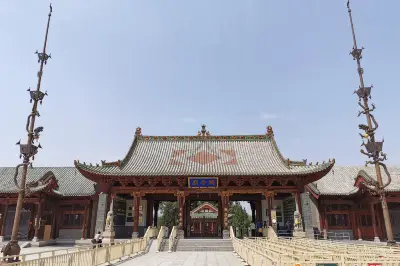
— Guangrenwang Temple —
— To be continued —
Travelogue Index
1. Itinerary Map Overview
2. Day 3: Crossing the Taihang – A Time-Spanning Journey – Dialogues with Millennia-Old Architecture and Murals
3. Day 4: Losses in the East – Faxing Temple and Yuhuang Temple; No Regrets with Kaihua Temple and Chongqing Temple
4. Day 5: Two Immortals Temple – Song Ambience in a Small Village, and the Uniquely Brilliant Ming Murals of Jiyi Temple
5. Day 6: Fencheng Town – An Unexpected Gateway to the Past, and the National Treasure Guangsheng Temple
6. Day 7: Xiaoxitian – Heavenly Hanging Sculptures and the Fine Water-and-Land Murals of Qinglong Temple
7. Day 8: Nature’s Marvel at a Cultural Holy Land – The Ten-Thousand-Year Ice Cave of Yunqiu Mountain
8. Day 9: Yongle Palace Murals, Once More Astounding, and the Pleasant Surprise of Guangrenwang Temple
9. Day 10: Longmen Grottoes – The Apex of Cave-Temple Art
Travel Information Hotel Index Guide Index Flight Index Website Navigation Travel Index Cruise Index Corporate Travel Index Join & Partner Distribution Alliance Friendly Links Corporate Gift Card Procurement Insurance Agent Agent Cooperation Hotel Onboarding Destination & Scenic Spot Cooperation and more Join & Partner
About Ctrip About Ctrip Ctrip Highlights Contact Us Talent Recruitment User Agreement Privacy Policy Business License Security Centre Ctrip Content Centre Intellectual Property Trip.com Group Algorithm Disclosure