Exploring Shanxi’s Ancient Architecture (Part 1)
In Chinese archaeological circles, there’s a saying: For underground relics, look to Shaanxi; for above-ground relics, look to Shanxi. Shanxi’s above-ground relics primarily consist of ancient buildings, mainly temples. The most valuable of these are from the Tang, Liao, Northern Wei, and Yuan dynasties. Years ago, the Japanese boasted that China no longer had any Tang dynasty buildings, and that to see Tang architecture one had to go to Kyoto or Nara in Japan. As it turned out, Liang Sicheng and Lin Huiyin discovered Foguang Temple on Mount Wutai in Shanxi. Its main hall, sculptures, murals, inscriptions – everything confirmed it was undeniably a Tang dynasty building, which was a huge slap in the face to the Japanese!
To be honest, I don’t know much about ancient architecture. Things like mortise-and-tenon brackets, hip-and-gable roofs, chiwen ridge ornaments, and guardian beasts are all rather confusing to me. Still, when heading to Shanxi, I was more than willing to see these ancient buildings, as they represent the very essence of Chinese culture.
I had been to Taiyuan, the capital of Shanxi, before. So in early August, I considered visiting two places: Yuncheng and Datong. Of course, another reason for flying to Yuncheng was the relatively cheap airfare – around 1,000 yuan for a round trip.
1. Yuncheng
Yuncheng is an important city in the south of Shanxi. The "yun" in Yuncheng has nothing to do with transportation; it’s related to salt. Thousands of years ago, the salt fields here were a vital resource. The salt produced was traded and transported elsewhere, and that’s how Yuncheng prospered.
Yuncheng is rich in ancient architecture, the most famous being the Haizhou Guandi Temple and the Yongle Palace in Ruicheng. Other places worth visiting include the Fanzhou Chan Master Pagoda, the brick tombs of Macun, the Jiwang Temple in Jishan, and Pujiu Temple. As for the Stork Tower, a rebuilt replica in an antique style much like the Yellow Crane Tower in Wuhan, it’s the kind of place you can skip if you like.
I flew from Chengdu and arrived in Yuncheng around 3 p.m. After checking into the hotel, we went for dinner in the evening at a nearby restaurant called Hedong Xiaoguan. Their specialty is "Yellow River Big Carp." The fish is deep-fried and then braised with seasonings for 25 minutes before being served, and the taste was quite good! However, we knew that the so-called Yellow River big carp was just a gimmick – at best, it was farmed in water diverted from the Yellow River.
After dinner, we strolled around Hedong Night Market and Yellow River Night Market. Hedong Night Market had roadworks and was practically dead. Yellow River Night Market was bustling with food stalls, but nothing seemed particularly distinctive. Apart from buying a cup of Li’s Snowflake Ice to try, we just walked around and looked.
The next day, we hired a car to visit Haizhou Guandi Temple and Yongle Palace in Ruicheng. Leaving the hotel, our first stop was Yuncheng Salt Lake. Historically, Yuncheng was a major salt-producing area in the north. The lake, the salt pans, and the Salt Pond Temple on the edge of the city silently tell the story of a past that thrived on salt. Today, Yuncheng no longer produces salt, and the salt lake and pans have become a tourist attraction, drawing visitors to snap photos.
In Yuncheng, the character “解” is pronounced “Hai” – I’d never have known that if I hadn’t come here. The Haizhou Guandi Temple scenic area consists of Guan Yu’s family temple, ancestral temple, and a bronze statue. Since Guan Yu was a native of Yuncheng, the Haizhou Guandi Temple is regarded as the ancestor of all temples dedicated to the God of War. Guan Yu’s bronze statue stands on a hill and is 80 meters tall. The base is 19 meters high, symbolizing the 19 years Guan Yu lived in Yuncheng, and the statue itself is 61 meters tall, representing the 61 years he lived. The statue was built with an investment of 200 million yuan from the local government. But impressive as it is, it’s best just viewed from a distance.
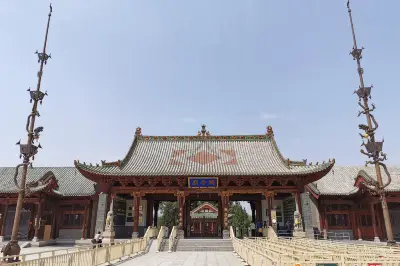
What’s really worth seeing is Guan Yu’s ancestral temple. Originally built in the Sui dynasty, the existing main structures mostly date from the Ming and Qing dynasties. The entire layout imitates an imperial palace (since Guan Yu was posthumously honored as an emperor), complete with a four-dragon screen, a spirit wall, a meridian gate, a sacrificial hall, the main hall, and a rear garden. The highlight is the chrysanthemum caisson ceiling on the second floor of the Spring and Autumn Tower. Caissons are decorative ceilings in traditional Chinese architecture, usually concave. But this one on the second floor is convex. In the center, a single thunder-god pillar hangs upside down like a flower stamen, and instead of bracket sets, more than 400 ang-beak brackets extend downwards layer by layer, radiating out in a structure that resembles an inverse blooming chrysanthemum. It’s a unique example in all of China. Even more astonishing, in the past, this caisson would rotate when the wind was strong enough. It was later fixed in place to protect the cultural relic.
The very first ancient building we saw in Shanxi already blew us away!
Leaving Haizhou Guandi Temple, we headed to Ruicheng. It was close to noon when we arrived, so we invited our driver to join us for lunch, and then went to see the Ruicheng City God Temple. According to old Chinese mythology, every city had a guardian deity – the City God – and a City God Temple was a standard feature of every city. With the passage of time, few cities in China still have their City God Temples today; most have been reduced to mere place names. The City God Temple in Ruicheng was first built in the Song dynasty and renovated in the Yuan, Ming, and Qing dynasties. It still retains the sacrificial pavilion, offering hall, main hall, and sleeping quarters. The sacrificial pavilion is a Yuan-dynasty structure, so overall the temple is relatively well-preserved. However, it’s obvious that the statues of the City God, the City God’s wife, and the judges, as well as the murals inside the halls, are all modern reproductions. Also, one of the temple’s stone lions, with its adorable expression, has become something of an online celebrity.
After seeing the City God Temple, we went to visit Ruicheng’s most important ancient building: Yongle Palace, one of China’s first batch of National Key Cultural Relics. Discovered during a cultural relics survey in 1952, its murals were immediately hailed as a treasure trove of ancient art. In 1956, when the state built the Sanmenxia Reservoir, Yongle Palace fell within the planned flooding area. Personally approved by Premier Zhou Enlai, the entire palace was relocated and preserved. It took ten years to complete. The murals in Yongle Palace’s three main halls – Wuji Hall, Chunyang Hall, and Chongyang Hall – mainly depict Daoist myths and figures, executed with extraordinary skill and considered an artistic treasure. If you look closely at the murals, you’ll notice they all have saw marks. That’s because back then, heritage workers cut the murals into pieces according to a grid, moved them to the current location, and reassembled and restored them.
Photography is not allowed inside, and since we’re not art experts, we could only listen to the guide’s explanations and try to understand as best we could.
After Yongle Palace, the driver took us to the nearby Guangrenwang Temple (also called Wulong Temple). As it was under renovation, we could only view it from the outside and take a few photos. This tiny temple, amazingly, turned out to be a Tang-dynasty structure! Once again, we were amazed.
Then it was an hour’s drive back to Yuncheng, ending our day’s sightseeing.
2. Hukou
On the third day, we decided to visit Hukou Waterfall. The easiest way is to take a high-speed train from Yuncheng to Linfen, then join a day tour.
We set off early from Yuncheng North Station and arrived at Linfen High-Speed Rail Station in an hour. As soon as we exited, the day tour guide called; we were the last passengers to be picked up that day. Another two-hour bus ride brought us to Ji County in Linfen, which borders Yichuan in Shaanxi along the Yellow River. This is where the famous Hukou Waterfall is located.
The Yellow River is the mother river of the Chinese nation, and the Hukou section truly embodies the unstoppable momentum of a river that rushes to the sea, never to return. It can’t help but remind you of the Yellow River Cantata and the indomitable spirit of the Chinese people.
The park entrance is several kilometers from the scenic spot, so you must take a shuttle bus – this has almost become standard practice for domestic scenic spots to make money. At Hukou Waterfall, you’ll find the area is actually quite small, and the midday sun is fierce. As a tourist, after taking your photos and ticking the box, how long can you really stay? We lingered for about 30 minutes, did our obligatory tourist routine, and hurriedly left.
At the park gate, we grabbed a casual bite for lunch, bought a few Ji County apples, and then sat in the air-conditioned visitor center.
The tour bus took us back to Linfen. In no rush to return to Yuncheng, we first relaxed in a large shopping mall, had dinner, and then took a leisurely walk around downtown Linfen. At just past 9 p.m., we caught the high-speed train back to Yuncheng.