Shanxi Self-Guided Tour (1)
I got up very early this morning and checked the time—it was only 3:30 a.m. Last night, I took my three feline kids to the cattery. Their terrified, desperate eyes were too painful to meet. I'm afraid they'll carry the trauma with them when I return.
The weather wasn't good, and the flight was delayed. By the time I arrived in Yuncheng, it was already 11 a.m. After talking with the driver who picked me up, I decided to rent his car in the afternoon and head straight to Ruicheng. But man proposes, God disposes: the heavy rain in Yuncheng today caused the expressway to close. My much-anticipated visit to Yongle Palace was impossible, so we had to adjust our plans on the fly and go to the Guandi Temple and the Yuncheng Museum instead.
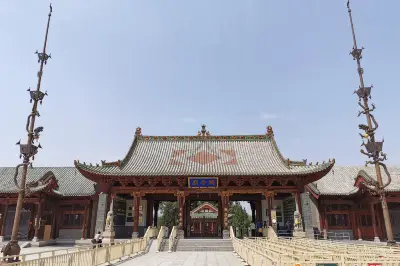
As the saying goes, all Guan Yu temples under heaven trace their roots to Yuncheng. Walking into the Guandi Temple, which has been honored by emperors of successive dynasties, I was struck by the beautiful Ming and Qing-era ancient architecture. Especially stunning were the wooden bracket arm carvings on the pheasant gate, the chiwen dragon ornaments on the roof ridges, and the decorative beasts on the eaves. The indoor murals and caisson ceilings were likewise nothing short of exquisite.
Even in the rain, people kept streaming in to pay respects to Lord Guan. At the tour guide booking point, I unexpectedly ran into a factory owner from Dongguan who runs a business in my hometown (I'm ashamed I didn't catch his name). Hearing Cantonese so far from home felt wonderfully familiar, so I ended up getting a free guided tour. He was so warm and welcoming that we felt a bit overwhelmed.
Since we had arranged with the driver to hurry back to the Yuncheng Museum (which stops admitting visitors at 4:30 p.m.), I said a rushed goodbye to the Dongguan gentleman and the car looped back through Changping and the Salt Lake to the city. The Guan Temple in Changping is Lord Guan's family temple, though it's smaller in scale than the one in Haizhou. We passed a memorial archway inscribed with "Blessings for Ten Thousand Generations." Different people might interpret that phrase in different ways, but the locals are surely grateful for the benefits he brought to their land. As we drove past the giant statue of Guan Gong, the heavy rain blurred the view, yet his spirit remains, watching over the nation, bringing us peace and something to hold on to.
Although I couldn't make it to Yongle Palace to see the original "Chaoyuan Tu" (Chart of the Heavenly Court), I was deeply awed by the replica on display at the museum. The mural of deities, over 4 meters tall, loomed before me—gods arrayed in orderly rows yet not feeling crowded, each immortal distinct in posture with flowing robes that blend seamlessly into the surroundings. The brushwork lines are fluid and confident, the composition rigorously planned, and the details arranged with impeccable rhythm. It's truly hard to imagine how the artists originally pulled this off.
Tomorrow I'll take the high-speed train north from Yuncheng to Datong. The main target on the itinerary is Huayan Temple—a masterpiece of Liao and Jin dynasty architecture.